
Articles liés à A Reading Diary
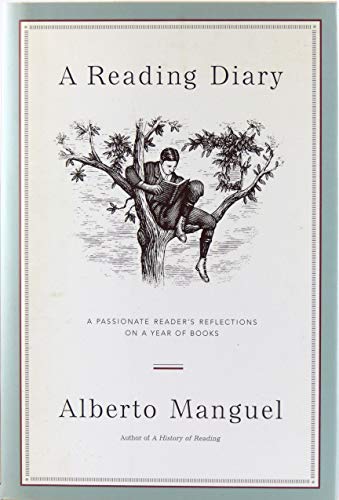
Synopsis
Book by Manguel Alberto
Les informations fournies dans la section « Synopsis » peuvent faire référence à une autre édition de ce titre.
Extrait
Foreword
“ . . . that we must laboriously seek the meaning of each word and line, conjecturing a larger sense than common use permits out of what wisdom and valour and generosity we have.”
—Thoreau, Walden
“Like every person of good taste, Menard abominated such worthless pantomimes, only apt — he would say — to provoke the plebeian pleasure of anachronism or (what is worse) to enthrall us with the rudimentary notion that all ages are the same or that they are different.”
—Jorge Luis Borges, Ficciones
There are books that we skim over happily, forgetting one page as we turn to the next; others that we read reverently, without daring to agree or disagree; others that offer mere information and preclude our commentary; others still that, because we have loved them so long and so dearly, we can repeat, word by word, since we know them, in the truest sense, by heart.
Reading is a conversation. Lunatics engage in imaginary dialogues which they hear echoing somewhere in their minds; readers engage in a similar dialogue provoked silently by words on a page. Usually the reader’s response is not recorded, but often a reader will feel the need to take up a pencil and answer back on the margins of a text. This comment, this gloss, this shadow that sometimes accompanies our favourite books extends and transports the text into another time and another experience; it lends reality to the illusion that a book speaks to us and wills us (its readers) into being.
A couple of years ago, after my fifty-third birthday, I decided to reread a few of my favourite old books, and I was struck, once again, by how their many-layered and complex worlds of the past seemed to reflect the dismal chaos of the world I was living in. A passage in a novel would suddenly illuminate an article in the daily paper; a half-forgotten episode would be recalled by a certain scene; a single word would prompt a long reflection. I decided to keep a record of these moments.
It occurred to me then that, rereading a book a month, I might complete, in a year, something between a personal diary and a commonplace book: a volume of notes, reflections, impressions of travel, sketches of friends, of events public and private, all elicited by my reading. I made a list of what the chosen books would be. It seemed important, for the sake of balance, that there should be a little of everything. (Since I’m nothing if not an eclectic reader, this wasn’t too difficult to accomplish.)
Reading is a comfortable, solitary, slow and sensuous task. Writing used to share some of these qualities. However, in recent times the profession of writer has acquired something of the ancient professions of travelling salesman and repertory actor, and writers are called upon to perform one-night stands in faraway places, extolling the virtues of their own books instead of toilet brushes or encyclopedia sets. Mainly because of these duties, throughout my reading year I found myself travelling to many different cities and yet wishing to be back home, in my house in a small village in France, where I keep my books and do my work.
Scientists have imagined that, before the universe came into being, it existed in a state of potentiality, time and space held in abeyance—“in a fog of possibility,” as one commentator put it, until the Big Bang. This latent existence should surprise no reader, for whom every book exists in a dreamlike condition until the hands that open it and the eyes that peruse it stir the words into awareness. The following pages are my attempt to record a few such awakenings.
Alberto Manguel
Part One — 2002
June — The Invention of Morel
Saturday
We have been in our house in France for just over a year, and already I have to leave, to visit my family in Buenos Aires. I don’t want to go. I want to enjoy the village in summer, the garden, the house kept cool by the thick, ancient walls. I want to start setting up the books on the shelves we have just had built. I want to sit in my room and work.
On the plane, I pull out a copy of Adolfo Bioy Casares’s The Invention of Morel, the tale of a man stranded on an island that is apparently inhabited by ghosts, a book I read for the first time thirty, thirty-five years ago.
This is my first visit to Buenos Aires after the December crisis of 2001, which unhitched the peso from the dollar, saw the economy crash and left thousands of people ruined. Downtown, there are no visible signs of the disaster except that, just before nightfall, the streets fill with hordes of cartoneros, men, women and children who scrape a living by collecting recyclable rubbish off the sidewalks. Perhaps most crises are invisible: there are no attendant pathetic fallacies to help us see the devastation. Shops close, people look haggard, prices jump, but overall life carries on: the restaurants are full, the shops still stock expensive imports (though I overhear one woman complaining, “I can’t find aceto balsámico anywhere!”), the city bustles noisily long past midnight. A tourist in a city that was once my own, I don’t see the growing slums, the hospitals lacking supplies, the bankruptcies, the middle class joining soup-kitchen queues.
My brother wants to buy me a new recording of Bach’s Magnificat. He stops at five bank machines before one agrees to release a few bills. I ask, what will he do when he can’t find an obliging machine? There will always be at least one, he says, with magical confidence.
The Invention of Morel begins with a phrase now famous in Argentine literature: “Today, on this island, a miracle happened.” Miracles in Argentina appear to be quotidian. Bioy’s narrator: “Here are neither hallucinations nor images: merely real men, at least as real as myself.”
Picasso used to say that everything was a miracle, and that it was a miracle one didn’t dissolve in one’s bath.
Revue de presse
"Reading the Diary is a perfect tonic for our hurried, over-stressed lives. And once you have closed the covers on Manguel’s 12 literary months, you’ll wish you could return for 12 more."
—Toronto Star
"A celebration of the joys to be garnered between the covers of books, and a candid commentary on the countless surprises of daily life. A Reading Diary is a book lover’s delight. It demands a sequel."
—The London Free Press
"Manguel . . . is an amiable, warm-hearted companion, sharing views of literature, words sketches of friends, list of likes and dislikes, all spiced up with unexpected insights into books and life."
—The Edmonton Journal
"Alberto Manguel has probably read more widely than almost anyone else now alive. Among English speakers, perhaps only Harold Bloom, George Steiner and Guy Davenport may outclass him — and they are all 20 years his senior, and long-time university teachers, to boot: In short, Manguel’s approach to books remains resolutely that of an amateur, one who loves with the pure joy sometimes denied the more scholarly."
—The Globe and Mail
"The chance to eavesdrop on his raw reflections on some of his favourite books is a rare treat."
—The Telegram
"One of the wonderful things about A Reading Diary is that it urges, even demands, that the reader make up his own list of 10 or 12 books worthy of rereading."
—The Telegram
"Manguel makes wonderful connections between his chosen texts and a host of others. He’s also a playful reader, enjoying the ways different writers use words to explore a host of different ideas, emotions, and passions, while trying to help his own readers find their own special and unique connections to books."
—Quill & Quire
"A Reading Diary is an utterly seductive book, the kind of book that lovers will want to read aloud to one another, that friends will quote back and forth."
—The Calgary Herald
"Elegantly elliptical and wryly contemporary...thoughtful and joyfully postmodern... Manguel’s exquisitely distilled style and gentle humility are pure pleasure. His diary is a gold mine of the unexpected, and his companionable, deeply cultivated persona will entrance all those who love to read and to ponder."
—Publishers Weekly, starred review
Praise for Alberto Manguel:
"Manguel is not only a gentleman and a scholar but a gentleman as a scholar, offering constellations of connected readings and insights with grace, humour and tact."
—The New Yorker
"It is almost startling, on the brink of the millennium, to discover a writer who believes in literature so thoroughly."
—The Times Literary Supplement
Les informations fournies dans la section « A propos du livre » peuvent faire référence à une autre édition de ce titre.
Résultats de recherche pour A Reading Diary

Image fournie par le vendeur
A Reading Diary: A Passionate Reader's Reflections on a Year of Books
Edité par
Farrar, Straus and Giroux, 2004
ISBN 10 : 0374247420
ISBN 13 : 9780374247423
Ancien ou d'occasion
Couverture rigide
Vendeur : Bay State Book Company, North Smithfield, RI, Etats-Unis
Évaluation du vendeur 5 sur 5 étoiles

Etat : good. The book is in good condition with all pages and cover intact, including the dust jacket if originally issued. The spine may show light wear. Pages may contain some notes or highlighting, and there might be a "From the library of" label. Boxed set packaging, shrink wrap, or included media like CDs may be missing. N° de réf. du vendeur BSM.1D9BN
Acheter D'occasion
EUR 5,60
Livraison gratuite
Expédition nationale : Etats-Unis
Expédition nationale : Etats-Unis
Quantité disponible : 1 disponible(s)
Image d'archives
A Reading Diary : A Passionate Reader's Reflections on a Year of Books
Edité par
Farrar, Straus & Giroux, 2004
ISBN 10 : 0374247420
ISBN 13 : 9780374247423
Ancien ou d'occasion
Couverture rigide
Vendeur : Better World Books, Mishawaka, IN, Etats-Unis
Évaluation du vendeur 5 sur 5 étoiles
Etat : Good. Pages intact with minimal writing/highlighting. The binding may be loose and creased. Dust jackets/supplements are not included. Stock photo provided. Product includes identifying sticker. Better World Books: Buy Books. Do Good. N° de réf. du vendeur 5581019-6
Acheter D'occasion
EUR 6,86
Livraison gratuite
Expédition nationale : Etats-Unis
Expédition nationale : Etats-Unis
Quantité disponible : 1 disponible(s)
Image d'archives
A Reading Diary : A Passionate Reader's Reflections on a Year of Books
Edité par
Farrar, Straus & Giroux, 2004
ISBN 10 : 0374247420
ISBN 13 : 9780374247423
Ancien ou d'occasion
Couverture rigide
Vendeur : Better World Books, Mishawaka, IN, Etats-Unis
Évaluation du vendeur 5 sur 5 étoiles
Etat : Very Good. Former library copy. Pages intact with possible writing/highlighting. Binding strong with minor wear. Dust jackets/supplements may not be included. Includes library markings. Stock photo provided. Product includes identifying sticker. Better World Books: Buy Books. Do Good. N° de réf. du vendeur 7846395-6
Acheter D'occasion
EUR 6,86
Livraison gratuite
Expédition nationale : Etats-Unis
Expédition nationale : Etats-Unis
Quantité disponible : 1 disponible(s)
Image d'archives
A Reading Diary : A Passionate Reader's Reflections on a Year of Books
Edité par
Farrar, Straus & Giroux, 2004
ISBN 10 : 0374247420
ISBN 13 : 9780374247423
Ancien ou d'occasion
Couverture rigide
Vendeur : Better World Books: West, Reno, NV, Etats-Unis
Évaluation du vendeur 5 sur 5 étoiles
Etat : Very Good. Former library copy. Pages intact with possible writing/highlighting. Binding strong with minor wear. Dust jackets/supplements may not be included. Includes library markings. Stock photo provided. Product includes identifying sticker. Better World Books: Buy Books. Do Good. N° de réf. du vendeur 7846395-6
Acheter D'occasion
EUR 6,86
Livraison gratuite
Expédition nationale : Etats-Unis
Expédition nationale : Etats-Unis
Quantité disponible : 1 disponible(s)
Image d'archives
A Reading Diary: A Passionate Reader's Reflections on a Year of Books
Edité par
Farrar, Straus and Giroux, 2004
ISBN 10 : 0374247420
ISBN 13 : 9780374247423
Ancien ou d'occasion
Couverture rigide
Vendeur : Open Books, Chicago, IL, Etats-Unis
Évaluation du vendeur 5 sur 5 étoiles
hardcover. Etat : Good. Open Books is a nonprofit social venture that provides literacy experiences for thousands of readers each year through inspiring programs and creative capitalization of books. N° de réf. du vendeur mon0000800032
Acheter D'occasion
EUR 3,57
Expédition à EUR 3,48
Expédition nationale : Etats-Unis
Expédition nationale : Etats-Unis
Quantité disponible : 1 disponible(s)
Image d'archives
A Reading Diary: A Passionate Reader's Reflections on a Year of Books
Edité par
Farrar, Straus and Giroux, 2004
ISBN 10 : 0374247420
ISBN 13 : 9780374247423
Ancien ou d'occasion
Couverture rigide
Vendeur : St Vincent de Paul of Lane County, Eugene, OR, Etats-Unis
Évaluation du vendeur 5 sur 5 étoiles
Etat : Acceptable. FORMER LIBRARY COPY,MAY HAVE INDENTIFYING STAMPS AND/OR STICKERS BUT REMAINS IN FINE READABLE CONDITION. Former Library book. hardcover 100% of proceeds go to charity! Acceptable reading copy with obvious signs of use, wear, and/or cosmetic issues. Item is complete and remains readable despite notable condition issues. N° de réf. du vendeur 2AA-01-3188
Acheter D'occasion
EUR 3,59
Expédition à EUR 3,48
Expédition nationale : Etats-Unis
Expédition nationale : Etats-Unis
Quantité disponible : 1 disponible(s)
Image d'archives
A Reading Diary: A Passionate Reader's Reflections on a Year of Books
Edité par
Farrar, Straus and Giroux, 2004
ISBN 10 : 0374247420
ISBN 13 : 9780374247423
Ancien ou d'occasion
Couverture rigide
Vendeur : ThriftBooks-Dallas, Dallas, TX, Etats-Unis
Évaluation du vendeur 5 sur 5 étoiles
Hardcover. Etat : Good. No Jacket. Missing dust jacket; Pages can have notes/highlighting. Spine may show signs of wear. ~ ThriftBooks: Read More, Spend Less. N° de réf. du vendeur G0374247420I3N01
Acheter D'occasion
EUR 7,18
Livraison gratuite
Expédition nationale : Etats-Unis
Expédition nationale : Etats-Unis
Quantité disponible : 1 disponible(s)
Image d'archives
A Reading Diary: A Passionate Reader's Reflections on a Year of Books
Edité par
Farrar, Straus and Giroux, 2004
ISBN 10 : 0374247420
ISBN 13 : 9780374247423
Ancien ou d'occasion
Couverture rigide
Vendeur : Half Price Books Inc., Dallas, TX, Etats-Unis
Évaluation du vendeur 5 sur 5 étoiles
hardcover. Etat : Very Good. Connecting readers with great books since 1972! Used books may not include companion materials, and may have some shelf wear or limited writing. We ship orders daily and Customer Service is our top priority! N° de réf. du vendeur S_483942248
Acheter D'occasion
EUR 5,38
Expédition à EUR 3,27
Expédition nationale : Etats-Unis
Expédition nationale : Etats-Unis
Quantité disponible : 1 disponible(s)
Image d'archives
A Reading Diary: A Passionate Reader's Reflections on a Year of Books
Edité par
Farrar, Straus and Giroux, 2004
ISBN 10 : 0374247420
ISBN 13 : 9780374247423
Ancien ou d'occasion
Couverture rigide
Vendeur : Books From California, Simi Valley, CA, Etats-Unis
Évaluation du vendeur 4 sur 5 étoiles

hardcover. Etat : Good. minor wear and creasing. N° de réf. du vendeur mon0003763212
Acheter D'occasion
EUR 6,46
Expédition à EUR 4,35
Expédition nationale : Etats-Unis
Expédition nationale : Etats-Unis
Quantité disponible : 1 disponible(s)
Image d'archives
A Reading Diary: A Passionate Reader's Reflections on a Year of Books
Edité par
Farrar, Straus and Giroux October 2004, 2004
ISBN 10 : 0374247420
ISBN 13 : 9780374247423
Ancien ou d'occasion
Couverture rigide
Vendeur : Organic Books, Albuquerque, NM, Etats-Unis
Évaluation du vendeur 5 sur 5 étoiles
Hardcover. Etat : Used - Very Good. N° de réf. du vendeur 33795
Acheter D'occasion
EUR 11,36
Expédition à EUR 6,10
Expédition nationale : Etats-Unis
Expédition nationale : Etats-Unis
Quantité disponible : 1 disponible(s)