
Articles liés à Bech at Bay
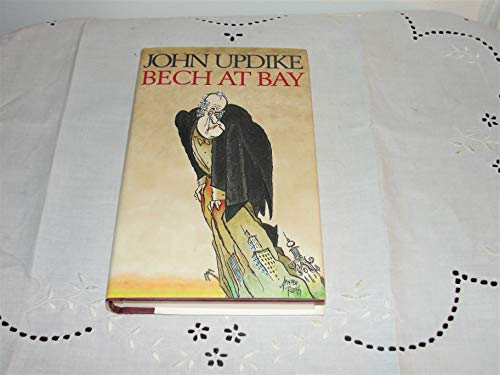
Synopsis
Book by Updike John
Les informations fournies dans la section « Synopsis » peuvent faire référence à une autre édition de ce titre.
Extrait
BECH HAD A NEW SIDEKICK. Her monicker was Robin. Rachel
"Robin" Teagarten. Twenty-six, post-Jewish, frizzy big hair, figure on the
short and solid side. She interfaced for him with an IBM PS/1 his
publisher had talked him into buying. She set up the defaults, rearranged
the icons, programmed the style formats, accessed the ANSI character
sets--Bech was a stickler for foreign accents. When he answered a letter,
she typed it for him from dictation. When he took a creative leap, she
deciphered his handwriting and turned it into digitized code. Neither
happened very often. Bech was of the Ernest Hemingway
save-your-juices school. To fill the time, he and Robin slept together. He
was seventy-four, but they worked with that. Seventy-four plus
twenty-six was one hundred; divided by two, that was fifty, the prime of
life. The energy of youth plus the wisdom of age. A team. A duo.
They were in his snug aerie on Crosby Street. He was reading the
Times at breakfast: caffeineless Folgers, calcium-reinforced D'Agostino
orange juice, poppy-seed bagel lightly toasted. The crumbs and poppy
seeds had scattered over the newspaper and into his lap but you don't
get something for nothing, not on this hard planer. Bech announced to
Robin, "Hey, Lucas Mishner is dead."
A creamy satisfaction--the finest quality, made extra easy to spread by
the toasty warmth--thickly covered his heart.
"Who's Lucas Mishner?" Robin asked. She was deep in the D
section--Business Day. She was a practical-minded broad with no
experience of culture prior to 1975.
"Once-powerful critic," Bech told her, biting off his phrases. "Late
Partisan Review school. Used to condescend to appear in the Trib
Book Review, when the Trib was still alive on this side of the Atlantic.
Despised my stuff. Called it `superficially energetic but lacking in the true
American fiber, the grit, the wrestle.' That's him talking, not me. The grit,
the wrestle. Sanctimonious bastard. When The Chosen came out in '63,
he wrote, `Strive and squirm as he will, Bech will never, never be
touched by the American sublime.' The simple, smug, know-it-all son of
a bitch. You know what his idea of the real stuff was? James Jones.
James Jones and James Gould Cozzens."
There Mishner's face was, in the Times, twenty years younger, with a
fuzzy little rosebud smirk and a pathetic slicked-down comb-over like
limp Venetian blinds throwing a shadow across the dome of his head.
The thought of him dead filled Bech with creamy ease. He told Robin,
"Lived way the hell up in Connecticut. Three wives, no flowers. Hadn't
published for years. The rumor in the industry was he was gaga with
alcoholic dementia."
"You seem happy."
"Very."
"Why? You say he had stopped being a critic anyway."
"Not in my head. He tried to hurt me. He did hurt me. Vengeance is
mine."
"Who said that?"
"The Lord. In the Bible. Wake up, Robin."
"I thought it didn't sound like you," she admitted. "Stop hogging the
Arts section. Let's see what's playing in the Village. I feel like a movie
tonight."
"I'm not reading the Arts section."
"But it's under what you are reading."
"I was going to get to it."
"That's what I call hogging. Pass it over."
He passed it over, with a pattering of poppy seeds on the
polyurethaned teak dining table Robin had installed. For years he and his
female guests had eaten at a low glass coffee table farther forward in the
loft. The sun slanting in had been pretty, but eating all doubled up had
been bad for their internal organs. Robin had got him to take vitamins,
too, and the calcium-reinforced o.j. She thought it would straighten his
spine. He was in his best shape in years. She had got him doing sit-ups
and push-ups. He was hard and quick, for a man who'd had his Biblical
three score and ten. He was ready for action. He liked the tone of his
own body. He liked the cut of Robin's smooth broad jaw across the teak
table. Her healthy big hair, her pushy plump lips, her little flattened nose.
"One down," he told her, mysteriously.
But she was reading the Arts section, the B section, and didn't hear.
"Con Air, Face/Off," she read. This was the summer of 1997. "Air
Force One, Men in Black. They're all violent. Disgusting."
"Why are you afraid of a little violence?" he asked her. "Violence is
our poetry now, now that sex has become fatally tainted."
"Or Contact," Robin said. "From the reviews it's all about how the
universe secretly loves us."
"That'll be the day," snarled Bech. Though in fact the juices surging
inside him bore a passing resemblance to those of love. Mishner dead put
...
Présentation de l'éditeur
Henry Bech, the moderately well known Jewish-American writer who served as the hero of John Updike's previous Bech: A Book (1970) and Bech Is Back (1982), has become older but scarcely wiser. In these five new chapters from his life, he is still at bay, pursued by the hounds of desire and anxiety, of unbridled criticism and publicity in a literary world ever more cheerfully crass. He fights intimations of annihilation in still-Communist Czechoslovakia, while promiscuously consorting with dissidents, apparatchiks, and Midwestern Republicans. Next, he succumbs to the temptations of power by accepting the presidency of a quaint and cosseted honorary body patterned on the Académie Française. Then, the reader finds him on trial in California and on a criminal rampage in a gothic Gotham, abetted by a nubile sidekick called Robin. Lastly, our septuagenarian veteran of the literary wars is rewarded with a coveted medal, stunning him into a well-deserved silence. It's not easy being Henry Bech in the post-Gutenbergian world, but somebody has to do it, and he brings to the task an indomitable mixture of grit and ennui.
Les informations fournies dans la section « A propos du livre » peuvent faire référence à une autre édition de ce titre.
Résultats de recherche pour Bech at Bay

Image d'archives
Bech at Bay
Edité par
Alfred A. Knopf, 1998
ISBN 10 : 037540368X
ISBN 13 : 9780375403682
Ancien ou d'occasion
Couverture rigide
Vendeur : World of Books (was SecondSale), Montgomery, IL, Etats-Unis
Évaluation du vendeur 5 sur 5 étoiles

Etat : Good. Item in good condition. Textbooks may not include supplemental items i.e. CDs, access codes etc. N° de réf. du vendeur 00085402500
Acheter D'occasion
EUR 3,59
Livraison gratuite
Expédition nationale : Etats-Unis
Expédition nationale : Etats-Unis
Quantité disponible : 3 disponible(s)
Image d'archives
Bech at Bay
Edité par
Alfred A. Knopf, 1998
ISBN 10 : 037540368X
ISBN 13 : 9780375403682
Ancien ou d'occasion
Couverture rigide
Vendeur : World of Books (was SecondSale), Montgomery, IL, Etats-Unis
Évaluation du vendeur 5 sur 5 étoiles
Etat : Acceptable. Item in acceptable condition! Textbooks may not include supplemental items i.e. CDs, access codes etc. N° de réf. du vendeur 00087143340
Acheter D'occasion
EUR 3,59
Livraison gratuite
Expédition nationale : Etats-Unis
Expédition nationale : Etats-Unis
Quantité disponible : 2 disponible(s)
Image d'archives
Bech at Bay
Edité par
Alfred A. Knopf, 1998
ISBN 10 : 037540368X
ISBN 13 : 9780375403682
Ancien ou d'occasion
Couverture rigide
Vendeur : World of Books (was SecondSale), Montgomery, IL, Etats-Unis
Évaluation du vendeur 5 sur 5 étoiles
Etat : Very Good. Item in very good condition! Textbooks may not include supplemental items i.e. CDs, access codes etc. N° de réf. du vendeur 00087066670
Acheter D'occasion
EUR 3,59
Livraison gratuite
Expédition nationale : Etats-Unis
Expédition nationale : Etats-Unis
Quantité disponible : 1 disponible(s)
Image d'archives
Bech at Bay: A Quasi-Novel (Quasi-Novels)
Edité par
Alfred A. Knopf, 1998
ISBN 10 : 037540368X
ISBN 13 : 9780375403682
Ancien ou d'occasion
Couverture rigide
Vendeur : Your Online Bookstore, Houston, TX, Etats-Unis
Évaluation du vendeur 5 sur 5 étoiles
Hardcover. Etat : Good. N° de réf. du vendeur 037540368X-3-18643545
Acheter D'occasion
EUR 3,60
Livraison gratuite
Expédition nationale : Etats-Unis
Expédition nationale : Etats-Unis
Quantité disponible : 1 disponible(s)
Image d'archives
Bech at Bay: A Quasi-Novel
Edité par
Alfred A. Knopf, 1998
ISBN 10 : 037540368X
ISBN 13 : 9780375403682
Ancien ou d'occasion
Couverture rigide
Vendeur : BookHolders, Towson, MD, Etats-Unis
Évaluation du vendeur 5 sur 5 étoiles
Etat : Good. [ No Hassle 30 Day Returns ][ Ships Daily ] [ Underlining/Highlighting: NONE ] [ Writing: NONE ] [ Edition: first ] Publisher: Knopf Pub Date: 10/13/1998 Binding: Hardcover Pages: 240 first edition. N° de réf. du vendeur 2372876
Acheter D'occasion
EUR 3,98
Livraison gratuite
Expédition nationale : Etats-Unis
Expédition nationale : Etats-Unis
Quantité disponible : 1 disponible(s)
Image d'archives
Bech at Bay: A Quasi-Novel (Quasi-Novels)
Edité par
Alfred A. Knopf, 1998
ISBN 10 : 037540368X
ISBN 13 : 9780375403682
Ancien ou d'occasion
Couverture rigide
Vendeur : More Than Words, Waltham, MA, Etats-Unis
Évaluation du vendeur 5 sur 5 étoiles
Etat : Good. A sound copy with only light wear. Overall a solid copy at a great price! N° de réf. du vendeur BOS-I-05b-01921
Acheter D'occasion
EUR 0,89
Expédition à EUR 3,44
Expédition nationale : Etats-Unis
Expédition nationale : Etats-Unis
Quantité disponible : 1 disponible(s)
Image d'archives
Bech At Bay
Edité par
Alfred A. Knopf, New York, 1998
ISBN 10 : 037540368X
ISBN 13 : 9780375403682
Ancien ou d'occasion
Couverture rigide
Vendeur : Foxtrot Books, Yankton, SD, Etats-Unis
Évaluation du vendeur 5 sur 5 étoiles
Hardcover. Etat : Good. Etat de la jaquette : Good. Good Condition hard cover 241 pages former library book. N° de réf. du vendeur 028423
Acheter D'occasion
EUR 1,67
Expédition à EUR 3,67
Expédition nationale : Etats-Unis
Expédition nationale : Etats-Unis
Quantité disponible : 1 disponible(s)
Image d'archives
Bech at Bay: A Quasi-Novel (Quasi-Novels)
Edité par
Alfred A. Knopf, 1998
ISBN 10 : 037540368X
ISBN 13 : 9780375403682
Ancien ou d'occasion
Couverture rigide
Edition originale
Vendeur : The Maryland Book Bank, Baltimore, MD, Etats-Unis
Évaluation du vendeur 5 sur 5 étoiles
hardcover. Etat : Very Good. First Edition. Used - Very Good. N° de réf. du vendeur 12-D-2-0206
Acheter D'occasion
EUR 1,65
Expédition à EUR 4,05
Expédition nationale : Etats-Unis
Expédition nationale : Etats-Unis
Quantité disponible : 1 disponible(s)
Image d'archives
Bech at Bay: A Quasi-Novel
Edité par
Alfred A. Knopf, 1998
ISBN 10 : 037540368X
ISBN 13 : 9780375403682
Ancien ou d'occasion
Couverture rigide
Vendeur : ThriftBooks-Atlanta, AUSTELL, GA, Etats-Unis
Évaluation du vendeur 5 sur 5 étoiles
Hardcover. Etat : As New. No Jacket. Pages are clean and are not marred by notes or folds of any kind. ~ ThriftBooks: Read More, Spend Less. N° de réf. du vendeur G037540368XI2N00
Acheter D'occasion
EUR 6,20
Livraison gratuite
Expédition nationale : Etats-Unis
Expédition nationale : Etats-Unis
Quantité disponible : 1 disponible(s)
Image d'archives
Bech at Bay: A Quasi-Novel
Edité par
Alfred A. Knopf, 1998
ISBN 10 : 037540368X
ISBN 13 : 9780375403682
Ancien ou d'occasion
Couverture rigide
Vendeur : ThriftBooks-Dallas, Dallas, TX, Etats-Unis
Évaluation du vendeur 5 sur 5 étoiles
Hardcover. Etat : Very Good. No Jacket. Former library book; May have limited writing in cover pages. Pages are unmarked. ~ ThriftBooks: Read More, Spend Less. N° de réf. du vendeur G037540368XI4N10
Acheter D'occasion
EUR 6,20
Livraison gratuite
Expédition nationale : Etats-Unis
Expédition nationale : Etats-Unis
Quantité disponible : 1 disponible(s)