
Articles liés à Fierce Pajamas: An Anthology of Humor Writing from...
Synopsis
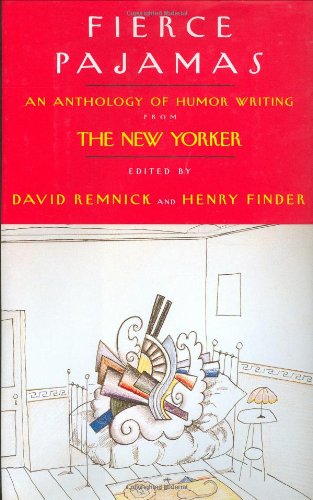
Remnick, David and Finder, Henry ed. Fierce Pajamas: An Anthology of Humor Writing from The New Yorker. New York, Random House, 2001. Octavo. XXI, 492 pages. Original Hardcover with dustjacket in protective Mylar. Excellent condition with only minor signs of external wear. David Remnick (born October 29, 1958) is an American journalist, writer, and magazine editor. He won a Pulitzer Prize in 1994 for his book Lenin's Tomb: The Last Days of the Soviet Empire. Remnick has been editor of The New Yorker magazine since 1998. He was named Editor of the Year by Advertising Age in 2000. Before joining The New Yorker, Remnick was a reporter and the Moscow correspondent for The Washington Post. He has also served on the New York Public Library's board of trustees. In 2010 he published his sixth book, The Bridge: The Life and Rise of Barack Obama. Remnick's 1997 New Yorker article Kid Dynamite Blows Up, about boxer Mike Tyson, was nominated for a National Magazine Award. In 1998, he became editor, succeeding Tina Brown. Remnick promoted Hendrik Hertzberg, a former Jimmy Carter speechwriter and former editor of The New Republic, to write the lead pieces in Talk of the Town, the magazine's opening section. In 2005, Remnick earned $1 million for his work as the magazine's editor. (Wikipedia).
Les informations fournies dans la section « Synopsis » peuvent faire référence à une autre édition de ce titre.
Extrait
SPOOFS
WOLCOTT GIBBS
DEATH IN THE RUMBLE SEAT WITH THE USUAL APOLOGIES TO ERNEST HEMINGWAY,
WHO MUST BE PRETTY SICK OF THIS SORT OF THING
Most people don’t like the pedestrian part, and it is best not to look at that if you can help it. But if you can’t help seeing them, long-legged and their faces white, and then the shock and the car lifting up a little on one side, then it is best to think of it as something very unimportant but beautiful and necessary artistically. It is unimportant because the people who are pedestrians are not very important, and if they were not being cogido by automobiles it would just be something else. And it is beautiful and necessary because, without the possibility of somebody getting cogido, driving a car would be just like anything else. It would be like reading “Thanatopsis,” which is neither beautiful nor necessary, but hogwash. If you drive a car, and don’t like the pedestrian part, then you are one of two kinds of people. Either you haven’t very much vitality and you ought to do something about it, or else you are yellow and there is nothing to be done about it at all.
If you don’t know anything about driving cars you are apt to think a driver is good just because he goes fast. This may be very exciting at first, but afterwards there is a bad taste in the mouth and the feeling of dishonesty. Ann Bender, the American, drove as fast on the Merrick Road as anybody I have ever seen, but when cars came the other way she always worked out of their terrain and over in the ditch so that you never had the hard, clean feeling of danger, but only bumping up and down in the ditch, and sometimes hitting your head on the top of the car. Good drivers go fast too, but it is always down the middle of the road, so that cars coming the other way are dominated, and have to go in the ditch themselves. There are a great many ways of getting the effect of danger, such as staying in the middle of the road till the last minute and then swerving out of the pure line, but they are all tricks, and afterwards you know they were tricks, and there is nothing left but disgust.
The cook: I am a little tired of cars, sir. Do you know any stories?
I know a great many stories, but I’m not sure that they’re suitable.
The cook: The hell with that.
Then I will tell you the story about God and Adam and naming the animals. You see, God was very tired after he got through making the world. He felt good about it, but he was tired so he asked Adam if he’d mind thinking up names for the animals.
“What animals?” Adam said.
“Those,” God said.
“Do they have to have names?” Adam said.
“You’ve got a name, haven’t you?” God said.
I could see–
The cook: How do you get into this?
Some people always write in the first person, and if you do it’s very hard to write any other way, even when it doesn’t altogether fit into the context. If you want to hear this story, don’t keep interrupting.
The cook: O.K.
I could see that Adam thought God was crazy, but he didn’t say anything. He went over to where the animals were, and after a while he came back with the list of names.
“Here you are,” he said.
God read the list, and nodded.
“They’re pretty good,” he said. “They’re all pretty good except that last one.”
“That’s a good name,” Adam said. “What’s the matter with it?”
“What do you want to call it an elephant for?,” God said.
Adam looked at God.
“It looks like an elephant to me,” he said.
The cook: Well?
That’s all.
The cook: It is a very strange story, sir.
It is a strange world, and if a man and a woman love each other, that is strange too, and what is more, it always turns out badly.
In the golden age of car-driving, which was about 1910, the sense of impending disaster, which is a very lovely thing and almost nonexistent, was kept alive in a number of ways. For one thing, there was always real glass in the windshield so that if a driver hit anything, he was very definitely and beautifully cogido. The tires weren’t much good either, and often they’d blow out before you’d gone ten miles. Really, the whole car was built that way. It was made not only so that it would precipitate accidents but so that when the accidents came it was honestly vulnerable, and it would fall apart, killing all the people with a passion that was very fine to watch. Then they began building the cars so that they would go much faster, but the glass and the tires were all made so that if anything happened it wasn’t real danger, but only the false sense of it. You could do all kinds of things with the new cars, but it was no good because it was all planned in advance. Mickey Finn, the German, always worked very far into the other car’s terrain so that the two cars always seemed to be one. Driving that way he often got the faender, or the clicking when two cars touch each other in passing, but because you knew that nothing was really at stake it was just an empty classicism, without any value because the insecurity was all gone and there was nothing left but a kind of mechanical agility. It is the same way when any art gets into its decadence. It is the same way about s-x–
The cook: I like it very much better when you talk about s-x, sir, and I wish you would do it more often.
I have talked a lot about s-x before, and now I thought I would talk about something else.
The cook: I think that is very unfortunate, sir, because you are at your best with s-x, but when you talk about automobiles you are just a nuisance.
From the Hardcover edition.
Revue de presse
“A complete delight from beginning to end.” —The New York Times
“Classic humor writing from a fantasy slumber party of writers.” —Vanity Fair
“Quite simply among the greatest stuff like this ever written . . . There is comic brilliance in these pages. . . . [Fierce Pajamas] is more than worth your time, your money and the potential damage to your funny bone.” —The Atlanta Journal-Constitution
“The New Yorker’s fine anthology of humor writing can inspire us to collectively bemoan the scarcity of a certain kind of printed comedy: the subtle and sophisticated type." —Newsday
Les informations fournies dans la section « A propos du livre » peuvent faire référence à une autre édition de ce titre.
Résultats de recherche pour Fierce Pajamas: An Anthology of Humor Writing from...

Image fournie par le vendeur
Fierce Pajamas: An Anthology of Humor Writing from The New Yorker
Edité par
Random House, 2001
ISBN 10 : 0375504753
ISBN 13 : 9780375504754
Ancien ou d'occasion
Couverture rigide
Vendeur : Greenworld Books, Arlington, TX, Etats-Unis
Évaluation du vendeur 5 sur 5 étoiles

Etat : very_good. Fast Free Shipping â" Very Good condition book with a firm cover and clean pages. Shows normal use and some light wear or limited notes markings. A solid, nice copy to enjoy. N° de réf. du vendeur GWV.0375504753.VG
Acheter D'occasion
EUR 5,11
Livraison gratuite
Expédition nationale : Etats-Unis
Expédition nationale : Etats-Unis
Quantité disponible : 1 disponible(s)
Image d'archives
Fierce Pajamas
Edité par
Random House USA Inc, 2001
ISBN 10 : 0375504753
ISBN 13 : 9780375504754
Ancien ou d'occasion
Couverture rigide
Vendeur : World of Books (was SecondSale), Montgomery, IL, Etats-Unis
Évaluation du vendeur 5 sur 5 étoiles
Hardback. Etat : Fair. When Harold Ross founded The New Yorker in 1925, he called it a comic weekly. And although it has become much more than that, it has remained true in its irreverent heart to the founder's description, publishing the most illustrious literary humorists in the modern era--among them Robert Benchley, Dorothy Parker, Groucho Marx, James Thurber, S. J. Perelman, Mike Nichols, Woody Allen, Calvin Trillin, Garrison Keillor, Ian Frazier, Roy Blount, Jr., Steve Martin, and Christopher Buckley. Fierce Pajamas is a treasury of laughter from the magazine W. H. Auden called the best comic magazine in existence. N° de réf. du vendeur 00085950041
Acheter D'occasion
EUR 5,24
Livraison gratuite
Expédition nationale : Etats-Unis
Expédition nationale : Etats-Unis
Quantité disponible : 2 disponible(s)
Image d'archives
Fierce Pajamas
Edité par
Random House USA Inc, 2001
ISBN 10 : 0375504753
ISBN 13 : 9780375504754
Ancien ou d'occasion
Couverture rigide
Vendeur : World of Books (was SecondSale), Montgomery, IL, Etats-Unis
Évaluation du vendeur 5 sur 5 étoiles
Hardback. Etat : Good. When Harold Ross founded The New Yorker in 1925, he called it a comic weekly. And although it has become much more than that, it has remained true in its irreverent heart to the founder's description, publishing the most illustrious literary humorists in the modern era--among them Robert Benchley, Dorothy Parker, Groucho Marx, James Thurber, S. J. Perelman, Mike Nichols, Woody Allen, Calvin Trillin, Garrison Keillor, Ian Frazier, Roy Blount, Jr., Steve Martin, and Christopher Buckley. Fierce Pajamas is a treasury of laughter from the magazine W. H. Auden called the best comic magazine in existence. N° de réf. du vendeur 00093132050
Acheter D'occasion
EUR 5,24
Livraison gratuite
Expédition nationale : Etats-Unis
Expédition nationale : Etats-Unis
Quantité disponible : 5 disponible(s)
Image d'archives
Fierce Pajamas: An Anthology of Humor Writing from The New Yorker
Edité par
Random House (edition 1), 2001
ISBN 10 : 0375504753
ISBN 13 : 9780375504754
Ancien ou d'occasion
Couverture rigide
Vendeur : BooksRun, Philadelphia, PA, Etats-Unis
Évaluation du vendeur 5 sur 5 étoiles
Hardcover. Etat : Very Good. 1. It's a well-cared-for item that has seen limited use. The item may show minor signs of wear. All the text is legible, with all pages included. It may have slight markings and/or highlighting. N° de réf. du vendeur 0375504753-11-1
Acheter D'occasion
EUR 5,48
Livraison gratuite
Expédition nationale : Etats-Unis
Expédition nationale : Etats-Unis
Quantité disponible : 1 disponible(s)
Image d'archives
Fierce Pajamas: An Anthology of Humor Writing from The New Yorker
Edité par
Random House, 2001
ISBN 10 : 0375504753
ISBN 13 : 9780375504754
Ancien ou d'occasion
Couverture rigide
Vendeur : HPB Inc., Dallas, TX, Etats-Unis
Évaluation du vendeur 5 sur 5 étoiles
hardcover. Etat : Very Good. Connecting readers with great books since 1972! Used books may not include companion materials, and may have some shelf wear or limited writing. We ship orders daily and Customer Service is our top priority! N° de réf. du vendeur S_471253373
Acheter D'occasion
EUR 2,51
Expédition à EUR 3,34
Expédition nationale : Etats-Unis
Expédition nationale : Etats-Unis
Quantité disponible : 1 disponible(s)
Image d'archives
Fierce Pajamas: An Anthology of Humor Writing from The New Yorker
Edité par
Random House, 2001
ISBN 10 : 0375504753
ISBN 13 : 9780375504754
Ancien ou d'occasion
Couverture rigide
Vendeur : HPB-Ruby, Dallas, TX, Etats-Unis
Évaluation du vendeur 5 sur 5 étoiles
Hardcover. Etat : Very Good. Connecting readers with great books since 1972! Used books may not include companion materials, and may have some shelf wear or limited writing. We ship orders daily and Customer Service is our top priority! N° de réf. du vendeur S_452629312
Acheter D'occasion
EUR 2,51
Expédition à EUR 3,34
Expédition nationale : Etats-Unis
Expédition nationale : Etats-Unis
Quantité disponible : 1 disponible(s)
Image d'archives
Fierce Pajamas: An Anthology of Humor Writing from The New Yorker
Edité par
Random House, 2001
ISBN 10 : 0375504753
ISBN 13 : 9780375504754
Ancien ou d'occasion
Couverture rigide
Vendeur : HPB-Emerald, Dallas, TX, Etats-Unis
Évaluation du vendeur 5 sur 5 étoiles
hardcover. Etat : Very Good. Connecting readers with great books since 1972! Used books may not include companion materials, and may have some shelf wear or limited writing. We ship orders daily and Customer Service is our top priority! N° de réf. du vendeur S_456167622
Acheter D'occasion
EUR 2,51
Expédition à EUR 3,34
Expédition nationale : Etats-Unis
Expédition nationale : Etats-Unis
Quantité disponible : 1 disponible(s)
Image d'archives
Fierce Pajamas: An Anthology of Humor Writing from The New Yorker
Edité par
Random House, 2001
ISBN 10 : 0375504753
ISBN 13 : 9780375504754
Ancien ou d'occasion
Couverture rigide
Vendeur : HPB-Diamond, Dallas, TX, Etats-Unis
Évaluation du vendeur 5 sur 5 étoiles
hardcover. Etat : Very Good. Connecting readers with great books since 1972! Used books may not include companion materials, and may have some shelf wear or limited writing. We ship orders daily and Customer Service is our top priority! N° de réf. du vendeur S_448316049
Acheter D'occasion
EUR 2,52
Expédition à EUR 3,34
Expédition nationale : Etats-Unis
Expédition nationale : Etats-Unis
Quantité disponible : 1 disponible(s)
Image d'archives
Fierce Pajamas: An Anthology of Humor Writing from The New Yorker
Edité par
Random House (edition 1), 2001
ISBN 10 : 0375504753
ISBN 13 : 9780375504754
Ancien ou d'occasion
Couverture rigide
Vendeur : BooksRun, Philadelphia, PA, Etats-Unis
Évaluation du vendeur 5 sur 5 étoiles
Hardcover. Etat : Fair. 1. With dust jacket. The item might be beaten up but readable. May contain markings or highlighting, as well as stains, bent corners, or any other major defect, but the text is not obscured in any way. N° de réf. du vendeur 0375504753-7-1-29
Acheter D'occasion
EUR 6,36
Livraison gratuite
Expédition nationale : Etats-Unis
Expédition nationale : Etats-Unis
Quantité disponible : 1 disponible(s)
Image d'archives
Fierce Pajamas: An Anthology of Humor Writing from The New Yorker
Edité par
Random House, 2001
ISBN 10 : 0375504753
ISBN 13 : 9780375504754
Ancien ou d'occasion
Couverture rigide
Vendeur : Wonder Book, Frederick, MD, Etats-Unis
Évaluation du vendeur 5 sur 5 étoiles
Etat : Good. Good condition. Good dust jacket. A copy that has been read but remains intact. May contain markings such as bookplates, stamps, limited notes and highlighting, or a few light stains. N° de réf. du vendeur L13B-03857
Acheter D'occasion
EUR 6,47
Livraison gratuite
Expédition nationale : Etats-Unis
Expédition nationale : Etats-Unis
Quantité disponible : 2 disponible(s)