
Articles liés à Multichain Immune Recognition Receptor Signaling: From...
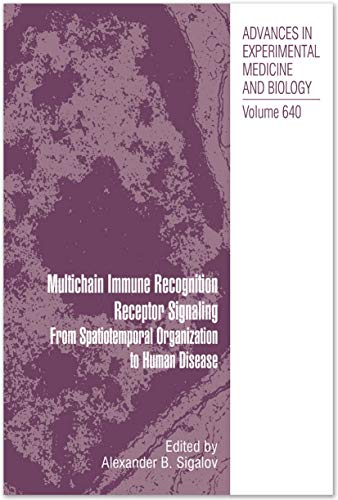
Multichain Immune Recognition Receptor Signaling: From Spatiotemporal Organization to Human Disease - Couverture rigide
Synopsis
Multichain Immune Recognition Receptors (MIRRs) represent a family of surface receptors expressed on different cells of the hematopoetic system and function to transduce signals leading to a variety of biologic responses. This text describes the molecular basis of MIRR-mediated transmembrane signaling.
Les informations fournies dans la section « Synopsis » peuvent faire référence à une autre édition de ce titre.
À propos de l'auteur
ALEXANDER SIGALOV, PhD, is a Research Assistant Professor in the Department of Pathology at the University of Massachusetts Medical School in Worcester, Massachusetts, USA. His main research interests include protein intrinsic disorder and oligomericity in the context of transmembrane signal transduction, the molecular mechanisms underlying immune receptor-mediated signaling and ways to control these processes and thus to modulate the immune response, as well as the development and applications of novel targets and strategies for innovative immune therapy. He discovered and investigated a very unusual and unique biophysical phenomenon, the homooligomerization of intrinsically disordered proteins, thus providing the first evidence for the existence of specific interactions between unfolded protein molecules. In the field of immunology, he unraveled a long-standing mystery of transmembrane signaling and immune cell activation triggered by multichain immune recognition receptors. Later, he developed a novel concept of platelet inhibition and invented a novel class of platelet inhibitors. In the field of immune therapy, he proposed new therapeutic strategies for a variety of malignancies and immune disorders, including immunodeficiencies, inflammatory and autoimmune diseases, allergy and HIV. He is a member of the American Association for the Advancement of Science and the Biophysical Society, USA. Alexander Sigalov received his academic degrees (MSc in Chemistry and a PhD in Organic Chemistry) from Moscow State University, Russia.
Les informations fournies dans la section « A propos du livre » peuvent faire référence à une autre édition de ce titre.
Résultats de recherche pour Multichain Immune Recognition Receptor Signaling: From...

Image d'archives
Multichain Immune Recognition Receptor Signaling: From Spatiotemporal Organization To Human Disease
Vendeur : Basi6 International, Irving, TX, Etats-Unis
Évaluation du vendeur 5 sur 5 étoiles

Etat : Brand New. New. US edition. Expediting shipping for all USA and Europe orders excluding PO Box. Excellent Customer Service. N° de réf. du vendeur ABEOCT25-80300
Acheter neuf
EUR 101,11
Livraison gratuite
Expédition nationale : Etats-Unis
Expédition nationale : Etats-Unis
Quantité disponible : 1 disponible(s)
Image d'archives
Multichain Immune Recognition Receptor Signaling: From Spatiotemporal Organization To Human Disease
Vendeur : Romtrade Corp., STERLING HEIGHTS, MI, Etats-Unis
Évaluation du vendeur 5 sur 5 étoiles
Etat : New. This is a Brand-new US Edition. This Item may be shipped from US or any other country as we have multiple locations worldwide. N° de réf. du vendeur ABBB-158436
Acheter neuf
EUR 101,11
Livraison gratuite
Expédition nationale : Etats-Unis
Expédition nationale : Etats-Unis
Quantité disponible : 1 disponible(s)
Image d'archives
Multichain Immune Recognition Receptor Signaling
Edité par
Springer, 2008
ISBN 10 : 0387097880
ISBN 13 : 9780387097886
Ancien ou d'occasion
Couverture rigide
Vendeur : Books Puddle, New York, NY, Etats-Unis
Évaluation du vendeur 4 sur 5 étoiles

Etat : Used. pp. xxxvii + 169 1st Edition. N° de réf. du vendeur 26480992
Acheter D'occasion
EUR 140,97
Expédition à EUR 3,47
Expédition nationale : Etats-Unis
Expédition nationale : Etats-Unis
Quantité disponible : 1 disponible(s)
Image d'archives
Multichain Immune Recognition Receptor Signaling
Edité par
Springer, 2008
ISBN 10 : 0387097880
ISBN 13 : 9780387097886
Ancien ou d'occasion
Couverture rigide
Vendeur : Majestic Books, Hounslow, Royaume-Uni
Évaluation du vendeur 4 sur 5 étoiles
Etat : Used. pp. xxxvii + 169 Illus. N° de réf. du vendeur 7399743
Acheter D'occasion
EUR 142,96
Expédition à EUR 7,58
Expédition depuis Royaume-Uni vers Etats-Unis
Expédition depuis Royaume-Uni vers Etats-Unis
Quantité disponible : 1 disponible(s)
Image d'archives
Multichain Immune Recognition Receptor Signaling
Edité par
Springer, 2008
ISBN 10 : 0387097880
ISBN 13 : 9780387097886
Ancien ou d'occasion
Couverture rigide
Vendeur : Biblios, Frankfurt am main, HESSE, Allemagne
Évaluation du vendeur 4 sur 5 étoiles
Etat : Used. pp. xxxvii + 169. N° de réf. du vendeur 18481002
Acheter D'occasion
EUR 143,45
Expédition à EUR 9,95
Expédition depuis Allemagne vers Etats-Unis
Expédition depuis Allemagne vers Etats-Unis
Quantité disponible : 1 disponible(s)
Image fournie par le vendeur
Multichain Immune Recognition Receptor Signaling
Edité par
Springer New York Okt 2008, 2008
ISBN 10 : 0387097880
ISBN 13 : 9780387097886
Neuf
Couverture rigide
Vendeur : BuchWeltWeit Ludwig Meier e.K., Bergisch Gladbach, Allemagne
Évaluation du vendeur 5 sur 5 étoiles
Buch. Etat : Neu. This item is printed on demand - it takes 3-4 days longer - Neuware -Immunological recognition is a central feature of the adaptive immunity of vertebrates. With the exception of agnathans, which developed an entirely distinct set of immunologically-specific molecules, all vertebrates use a recognition system based on what Achsah Keegan and I suggested in 1992 be termed multichain immune recognition receptors (MIRRs). MIRRs consist of ligand-binding molecules that are immunoglobulin supergene family members associated with signal transducers and enhancers in such a way as both insure precise ligand recognition, discrimination and ampHfication of the signal. Two of the prototypic sets of MIRRs, the T-cell and B-cell receptors, are among the most remarkable recognition molecules known. These are extraordinarily diverse molecules in which the range of ligands that can be potentially recognized prob ably exceeds the actual numbers of lymphocytes in the body. The discovery of the genetic basis of assembling these receptors and understanding how they bind to their cognate antigens are among the most stunning of scientific achievements. Yet these immensely specific binding chains (the heavy/light chain pair for immunoglobulin and the a/p chain pair for most T cells), when expressed as membrane molecules, have no obvious mechanism of signaling. For example, the iH chain cytosolic do main consists of three amino acids (lysine-valine-lysine) and the L chain is not even embedded in the membrane. Furthermore, there is no known direct mechanism to propagate information from the binding domain of the B-cell or T-cell receptors to the membrane-proximal domains of the same chains. 388 pp. Englisch. N° de réf. du vendeur 9780387097886
Acheter neuf
EUR 160,49
Expédition à EUR 23
Expédition depuis Allemagne vers Etats-Unis
Expédition depuis Allemagne vers Etats-Unis
Quantité disponible : 2 disponible(s)
Image fournie par le vendeur
Multichain Immune Recognition Receptor Signaling
Edité par
Springer New York, 2008
ISBN 10 : 0387097880
ISBN 13 : 9780387097886
Neuf
Couverture rigide
Vendeur : moluna, Greven, Allemagne
Évaluation du vendeur 5 sur 5 étoiles
Gebunden. Etat : New. Dieser Artikel ist ein Print on Demand Artikel und wird nach Ihrer Bestellung fuer Sie gedruckt. ALEXANDER SIGALOV, PhD, is a Research Assistant Professor in the Department of Pathology at the University of Massachusetts Medical School in Worcester, Massachusetts, USA. His main research interests include protein intrinsic disorder and oligomericity . N° de réf. du vendeur 5909010
Acheter neuf
EUR 136,16
Expédition à EUR 48,99
Expédition depuis Allemagne vers Etats-Unis
Expédition depuis Allemagne vers Etats-Unis
Quantité disponible : Plus de 20 disponibles
Image fournie par le vendeur
Multichain Immune Recognition Receptor Signaling
Edité par
Springer New York, Springer New York Okt 2008, 2008
ISBN 10 : 0387097880
ISBN 13 : 9780387097886
Neuf
Couverture rigide
Vendeur : buchversandmimpf2000, Emtmannsberg, BAYE, Allemagne
Évaluation du vendeur 5 sur 5 étoiles
Buch. Etat : Neu. This item is printed on demand - Print on Demand Titel. Neuware -Immunological recognition is a central feature of the adaptive immunity of vertebrates. With the exception of agnathans, which developed an entirely distinct set of immunologically-specific molecules, all vertebrates use a recognition system based on what Achsah Keegan and I suggested in 1992 be termed multichain immune recognition receptors (MIRRs). MIRRs consist of ligand-binding molecules that are immunoglobulin supergene family members associated with signal transducers and enhancers in such a way as both insure precise ligand recognition, discrimination and ampHfication of the signal. Two of the prototypic sets of MIRRs, the T-cell and B-cell receptors, are among the most remarkable recognition molecules known. These are extraordinarily diverse molecules in which the range of ligands that can be potentially recognized prob ably exceeds the actual numbers of lymphocytes in the body. The discovery of the genetic basis of assembling these receptors and understanding how they bind to their cognate antigens are among the most stunning of scientific achievements. Yet these immensely specific binding chains (the heavy/light chain pair for immunoglobulin and the a/p chain pair for most T cells), when expressed as membrane molecules, have no obvious mechanism of signaling. For example, the |iH chain cytosolic do main consists of three amino acids (lysine-valine-lysine) and the L chain is not even embedded in the membrane. Furthermore, there is no known direct mechanism to propagate information from the binding domain of the B-cell or T-cell receptors to the membrane-proximal domains of the same chains.Springer-Verlag GmbH, Tiergartenstr. 17, 69121 Heidelberg 388 pp. Englisch. N° de réf. du vendeur 9780387097886
Acheter neuf
EUR 160,49
Expédition à EUR 60
Expédition depuis Allemagne vers Etats-Unis
Expédition depuis Allemagne vers Etats-Unis
Quantité disponible : 1 disponible(s)
Image d'archives
Multichain Immune Recognition Receptor Signaling : From Spatiotemporal Organization to Human Disease
Edité par
Springer New York, 2008
ISBN 10 : 0387097880
ISBN 13 : 9780387097886
Ancien ou d'occasion
Couverture rigide
Vendeur : Buchpark, Trebbin, Allemagne
Évaluation du vendeur 5 sur 5 étoiles
Etat : Sehr gut. Zustand: Sehr gut | Seiten: 388 | Sprache: Englisch | Produktart: Bücher | Immunological recognition is a central feature of the adaptive immunity of vertebrates. With the exception of agnathans, which developed an entirely distinct set of immunologically-specific molecules, all vertebrates use a recognition system based on what Achsah Keegan and I suggested in 1992 be termed multichain immune recognition receptors (MIRRs). MIRRs consist of ligand-binding molecules that are immunoglobulin supergene family members associated with signal transducers and enhancers in such a way as both insure precise ligand recognition, discrimination and ampHfication of the signal. Two of the prototypic sets of MIRRs, the T-cell and B-cell receptors, are among the most remarkable recognition molecules known. These are extraordinarily diverse molecules in which the range of ligands that can be potentially recognized prob ably exceeds the actual numbers of lymphocytes in the body. The discovery of the genetic basis of assembling these receptors and understanding how they bind to their cognate antigens are among the most stunning of scientific achievements. Yet these immensely specific binding chains (the heavy/light chain pair for immunoglobulin and the a/p chain pair for most T cells), when expressed as membrane molecules, have no obvious mechanism of signaling. For example, the |iH chain cytosolic do main consists of three amino acids (lysine-valine-lysine) and the L chain is not even embedded in the membrane. Furthermore, there is no known direct mechanism to propagate information from the binding domain of the B-cell or T-cell receptors to the membrane-proximal domains of the same chains. N° de réf. du vendeur 4643450/12
Acheter D'occasion
EUR 119,30
Expédition à EUR 105
Expédition depuis Allemagne vers Etats-Unis
Expédition depuis Allemagne vers Etats-Unis
Quantité disponible : 1 disponible(s)
Image fournie par le vendeur
Multichain Immune Recognition Receptor Signaling : From Spatiotemporal Organization to Human Disease
Vendeur : AHA-BUCH GmbH, Einbeck, Allemagne
Évaluation du vendeur 5 sur 5 étoiles
Buch. Etat : Neu. Druck auf Anfrage Neuware - Printed after ordering - Immunological recognition is a central feature of the adaptive immunity of vertebrates. With the exception of agnathans, which developed an entirely distinct set of immunologically-specific molecules, all vertebrates use a recognition system based on what Achsah Keegan and I suggested in 1992 be termed multichain immune recognition receptors (MIRRs). MIRRs consist of ligand-binding molecules that are immunoglobulin supergene family members associated with signal transducers and enhancers in such a way as both insure precise ligand recognition, discrimination and ampHfication of the signal. Two of the prototypic sets of MIRRs, the T-cell and B-cell receptors, are among the most remarkable recognition molecules known. These are extraordinarily diverse molecules in which the range of ligands that can be potentially recognized prob ably exceeds the actual numbers of lymphocytes in the body. The discovery of the genetic basis of assembling these receptors and understanding how they bind to their cognate antigens are among the most stunning of scientific achievements. Yet these immensely specific binding chains (the heavy/light chain pair for immunoglobulin and the a/p chain pair for most T cells), when expressed as membrane molecules, have no obvious mechanism of signaling. For example, the iH chain cytosolic do main consists of three amino acids (lysine-valine-lysine) and the L chain is not even embedded in the membrane. Furthermore, there is no known direct mechanism to propagate information from the binding domain of the B-cell or T-cell receptors to the membrane-proximal domains of the same chains. N° de réf. du vendeur 9780387097886
Acheter neuf
EUR 224,71
Expédition à EUR 30,50
Expédition depuis Allemagne vers Etats-Unis
Expédition depuis Allemagne vers Etats-Unis
Quantité disponible : 1 disponible(s)