
Articles liés à Genetics And Genomic Of Cotton
Genetics And Genomic Of Cotton - Couverture rigide
Livre 2 sur 16: Plant Genetics and Genomics: Crops and Models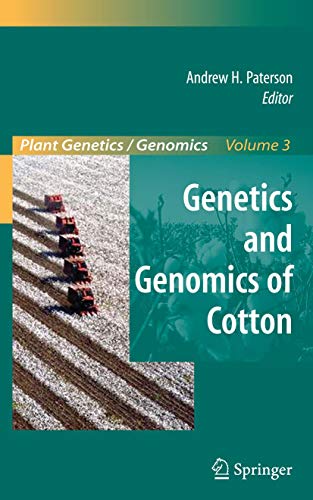
Synopsis
A few members of the Gossypium (cotton) genus are cultivated for the production of elongated single-celled fibers valued worldwide at about $20 billion annually at the farm gate, and which sustain one of the world's largest industries (textiles) with an annual worldwide economic impact of about $500 billion. In a number of ways, cotton production and the textile industry are closely tied to petrochemical usage. At a practical level, cotton genomics offers both bio-based carbon sequestration alternatives to petrochemical use, and improved sustainability of crop production.
The Gossypium (cotton) also genus presents novel opportunities to advance our understanding of the natural world and its organic evolution. In particular, the evolution of cultivated cottons from their wild ancestors has involved a fascinating series of events that offer scientists the opportunity to dissect the evolution of a novel organ, the 'lint fiber', and also to unravel the consequences of polyploidy, both for the generation of biodiversity and for crop productivity.
In this book, advances of the past decade will be summarized and synthesized to elucidate the current state of knowledge of the structure, function, and evolution of the Gossypium genome, and progress in the application of this knowledge to cotton improvement. This book will address five broad topics. First, as a backdrop for all studies of the genus, it is important to understand the naturally-occurring diversity in the genus, its organization and distribution, and its evolutionary history. Of special importance is the formation of a single polyploid from two (among 8) diploid genome types, the radiation of this polyploid, and the domestication and improvement of two (among 5 extant) polyploid species.
Les informations fournies dans la section « Synopsis » peuvent faire référence à une autre édition de ce titre.
Résultats de recherche pour Genetics And Genomic Of Cotton

Image d'archives
Genetics and Genomics of Cotton (Plant Genetics and Genomics: Crops and Models)
Edité par
Springer, 2009
ISBN 10 : 038770809X
ISBN 13 : 9780387708096
Ancien ou d'occasion
Couverture rigide
Vendeur : Bookmans, Tucson, AZ, Etats-Unis
Évaluation du vendeur 5 sur 5 étoiles

Hardcover. Etat : Good. Satisfaction 100% guaranteed. N° de réf. du vendeur mon0001902273
Acheter D'occasion
EUR 89,18
Expédition à EUR 3,51
Expédition nationale : Etats-Unis
Expédition nationale : Etats-Unis
Quantité disponible : 1 disponible(s)
Image fournie par le vendeur
Genetics and Genomics of Cotton (Plant Genetics and Genomics: Crops and Models (3))
Edité par
Springer-Verlag Publishing, 2009
ISBN 10 : 038770809X
ISBN 13 : 9780387708096
Ancien ou d'occasion
Couverture rigide
Vendeur : Salish Sea Books, Bellingham, WA, Etats-Unis
Évaluation du vendeur 5 sur 5 étoiles
Etat : Very Good. Very Good; Hardcover; Light wear to the covers; Unblemished textblock edges; The endpapers and all text pages are clean and unmarked; The binding is excellent with a straight spine; This book will be shipped in a sturdy cardboard box with foam padding; Medium Format (8.5" - 9.75" tall); Dark green and orange covers with title in white lettering; 2009, Springer-Verlag Publishing; 532 pages; "Genetics and Genomics of Cotton (Plant Genetics and Genomics: Crops and Models (3))," by Andrew H. Paterson. N° de réf. du vendeur SKU-822AC00511150
Acheter D'occasion
EUR 88,32
Expédition à EUR 4,39
Expédition nationale : Etats-Unis
Expédition nationale : Etats-Unis
Quantité disponible : 1 disponible(s)
Image fournie par le vendeur
Genetics and Genomics of Cotton (Plant Genetics and Genomics: Crops and Models)
Edité par
Springer, 2009
ISBN 10 : 038770809X
ISBN 13 : 9780387708096
Ancien ou d'occasion
Couverture rigide
Vendeur : Salish Sea Books, Bellingham, WA, Etats-Unis
Évaluation du vendeur 5 sur 5 étoiles
Hardcover. Etat : Very Good. 038770809X Very Good+; Hardcover; Very light wear to the covers; Unblemished textblock edges; The endpapers and all text pages are bright and unmarked; The binding is excellent with a straight spine; This book will be stored and delivered in a sturdy cardboard box with foam padding; Medium Format (8.5" - 9.75" tall); Green and orange covers with title in white lettering; 2009, Springer-Verlag Publishing; 518 pages; "Genetics and Genomics of Cotton (Plant Genetics and Genomics: Crops and Models)," by Andrew H. Paterson. N° de réf. du vendeur SKU-U28JA13602247
Acheter D'occasion
EUR 104,13
Expédition à EUR 4,39
Expédition nationale : Etats-Unis
Expédition nationale : Etats-Unis
Quantité disponible : 1 disponible(s)
Image d'archives
Genetics And Genomics Of Cotton
Vendeur : Basi6 International, Irving, TX, Etats-Unis
Évaluation du vendeur 5 sur 5 étoiles
Etat : Brand New. New. US edition. Expediting shipping for all USA and Europe orders excluding PO Box. Excellent Customer Service. N° de réf. du vendeur ABEOCT25-84137
Acheter neuf
EUR 112,32
Livraison gratuite
Expédition nationale : Etats-Unis
Expédition nationale : Etats-Unis
Quantité disponible : 1 disponible(s)
Image d'archives
Genetics And Genomics Of Cotton
Vendeur : SMASS Sellers, IRVING, TX, Etats-Unis
Évaluation du vendeur 4 sur 5 étoiles

Etat : New. Brand New Original US Edition. Customer service! Satisfaction Guaranteed. N° de réf. du vendeur SNTA-40231
Acheter neuf
EUR 152,32
Livraison gratuite
Expédition nationale : Etats-Unis
Expédition nationale : Etats-Unis
Quantité disponible : 2 disponible(s)
Image d'archives
Genetics And Genomics Of Cotton
Vendeur : Romtrade Corp., STERLING HEIGHTS, MI, Etats-Unis
Évaluation du vendeur 5 sur 5 étoiles
Etat : New. This is a Brand-new US Edition. This Item may be shipped from US or any other country as we have multiple locations worldwide. N° de réf. du vendeur ABBB-40231
Acheter neuf
EUR 164,49
Livraison gratuite
Expédition nationale : Etats-Unis
Expédition nationale : Etats-Unis
Quantité disponible : 2 disponible(s)
Image d'archives
Genetics And Genomics Of Cotton
Vendeur : Basi6 International, Irving, TX, Etats-Unis
Évaluation du vendeur 5 sur 5 étoiles
Etat : Brand New. New. US edition. Expediting shipping for all USA and Europe orders excluding PO Box. Excellent Customer Service. N° de réf. du vendeur ABEOCT25-84138
Acheter neuf
EUR 164,49
Livraison gratuite
Expédition nationale : Etats-Unis
Expédition nationale : Etats-Unis
Quantité disponible : 5 disponible(s)
Image d'archives
Genetics and Genomics of Cotton
Vendeur : Books Puddle, Woodside, NY, Etats-Unis
Évaluation du vendeur 4 sur 5 étoiles
Etat : New. pp. 509. N° de réf. du vendeur 26746262
Acheter neuf
EUR 180,23
Expédition à EUR 3,51
Expédition nationale : Etats-Unis
Expédition nationale : Etats-Unis
Quantité disponible : 4 disponible(s)
Image d'archives
Genetics and Genomics of Cotton
Edité par
Springer New York, 2009
ISBN 10 : 038770809X
ISBN 13 : 9780387708096
Ancien ou d'occasion
Couverture rigide
Vendeur : Buchpark, Trebbin, Allemagne
Évaluation du vendeur 5 sur 5 étoiles
Etat : Sehr gut. Zustand: Sehr gut | Seiten: 518 | Sprache: Englisch | Produktart: Bücher | A few members of the Gossypium (cotton) genus are cultivated for the production of elongated single-celled fibers valued worldwide at about $20 billion annually at the farm gate, and which sustain one of the world's largest industries (textiles) with an annual worldwide economic impact of about $500 billion. In a number of ways, cotton production and the textile industry are closely tied to petrochemical usage. At a practical level, cotton genomics offers both bio-based carbon sequestration alternatives to petrochemical use, and improved sustainability of crop production. The Gossypium (cotton) also genus presents novel opportunities to advance our understanding of the natural world and its organic evolution. In particular, the evolution of cultivated cottons from their wild ancestors has involved a fascinating series of events that offer scientists the opportunity to dissect the evolution of a novel organ, the 'lint fiber', and also to unravel the consequences of polyploidy, both for the generation of biodiversity and for crop productivity. In this book, advances of the past decade will be summarized and synthesized to elucidate the current state of knowledge of the structure, function, and evolution of the Gossypium genome, and progress in the application of this knowledge to cotton improvement. This book will address five broad topics. First, as a backdrop for all studies of the genus, it is important to understand the naturally-occurring diversity in the genus, its organization and distribution, and its evolutionary history. Of special importance is the formation of a single polyploid from two (among 8) diploid genome types, the radiation of this polyploid, and the domestication and improvement of two (among 5 extant) polyploid species. N° de réf. du vendeur 3968017/12
Acheter D'occasion
EUR 83,03
Expédition à EUR 105
Expédition depuis Allemagne vers Etats-Unis
Expédition depuis Allemagne vers Etats-Unis
Quantité disponible : 1 disponible(s)
Image d'archives
Genetics and Genomics of Cotton
Vendeur : Majestic Books, Hounslow, Royaume-Uni
Évaluation du vendeur 4 sur 5 étoiles
Etat : New. pp. 509. N° de réf. du vendeur 8182985
Acheter neuf
EUR 185,58
Expédition à EUR 7,58
Expédition depuis Royaume-Uni vers Etats-Unis
Expédition depuis Royaume-Uni vers Etats-Unis
Quantité disponible : 4 disponible(s)