
Articles liés à How Nature Works: The Science of Self-Organized Criticality
Synopsis
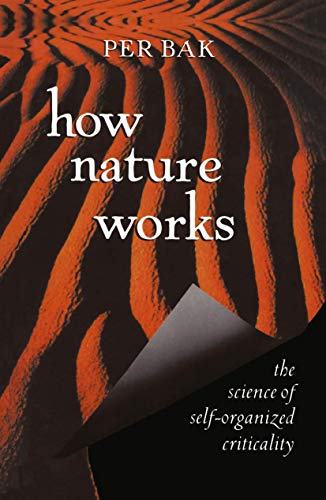
and acknowledgments Self-organized criticality is a new way of viewing nature. The basic picture is one where nature is perpetually out of balance, but organized in a poised state-the critical state-where anything can happen within well-defined statistical laws. The aim of the science of self-organized criticality is to yield insight into the fundamental question of why nature is complex, not simple, as the laws of physics imply. Self-organized criticality explains some ubiquitous patterns existing in nature that we view as complex. Fractal structure and catastrophic events are among those regularities. Applications range from the study of pulsars and black holes to earthquakes and the evolution of life. One intriguing conse- quence of the theory is that catastrophes can occur for no reason whatsoever. Mass extinctions may take place without any external triggering mechanism such as a volcanic eruption or a meteorite hitting the earth (although the the- ory of course cannot rule out that this has in fact occurred). xu How Nature Works Since we first proposed the idea in 1987, more than 2, ooo papers have been written on self-organized criticality, making ours the most cited paper in physics during that period. How Nature Works is the first book to deal with the subject. The basic idea is simple, and most of the mathematical models that have been used in the implementation of the theory are not complicated.
Les informations fournies dans la section « Synopsis » peuvent faire référence à une autre édition de ce titre.
Présentation de l'éditeur
Self-organized criticality, the spontaneous development of systems to a critical state, is the first general theory of complex systems with a firm mathematical basis. This theory describes how many seemingly desperate aspects of the world, from stock market crashes to mass extinctions, avalanches to solar flares, all share a set of simple, easily described properties. " . . . a 'must read' . . . Bak writes with such ease and lucidity, and his ideas are so intriguing . . . essential reading for those interested in complex systems . . . it will reward a sufficiently skeptical reader" -NATURE " . . . presents the theory (self-organized criticality) in a form easily absorbed by the non-mathematically inclined reader" -BOSTON BOOK REVIEW "I picture Bak as a kind of scientific musketeer; flamboyant, touchy, full of swagger and ready to join every fray . . . His book is written with panache. The style is brisk, the content stimulating. I recommend it as a bracing experience" -NEW SCIENTIST
Biographie de l'auteur
Per Bak is a professor in the Physics Department of Brookhaven National Laboratory. He has published over 150 papers, including articles in Scientific American and New Scientist.
Les informations fournies dans la section « A propos du livre » peuvent faire référence à une autre édition de ce titre.
Résultats de recherche pour How Nature Works: The Science of Self-Organized Criticality

Image d'archives
How Nature Works: The Science of Self-organized Criticality
Edité par
Copernicus (Springer) (edition First Edition), 1996
ISBN 10 : 0387947914
ISBN 13 : 9780387947914
Ancien ou d'occasion
Couverture rigide
Edition originale
Vendeur : BooksRun, Philadelphia, PA, Etats-Unis
Évaluation du vendeur 5 sur 5 étoiles

Hardcover. Etat : Very Good. First Edition. With dust jacket. It's a well-cared-for item that has seen limited use. The item may show minor signs of wear. All the text is legible, with all pages included. It may have slight markings and/or highlighting. N° de réf. du vendeur 0387947914-11-1-29
Acheter D'occasion
EUR 14,42
Livraison gratuite
Expédition nationale : Etats-Unis
Expédition nationale : Etats-Unis
Quantité disponible : 2 disponible(s)
Image fournie par le vendeur
How Nature Works: The Science of Self-organized Criticality
Edité par
Copernicus (Springer), 1996
ISBN 10 : 0387947914
ISBN 13 : 9780387947914
Ancien ou d'occasion
Couverture rigide
Vendeur : Dream Books Co., Denver, CO, Etats-Unis
Évaluation du vendeur 5 sur 5 étoiles
Etat : good. Gently used with minimal wear on the corners and cover. A few pages may contain light highlighting or writing, but the text remains fully legible. Dust jacket may be missing, and supplemental materials like CDs or codes may not be included. May be ex-library with library markings. Ships promptly! N° de réf. du vendeur DBV.0387947914.G
Acheter D'occasion
EUR 14,48
Livraison gratuite
Expédition nationale : Etats-Unis
Expédition nationale : Etats-Unis
Quantité disponible : 1 disponible(s)
Image d'archives
How Nature Works: The Science of Self-organized Criticality
Edité par
Copernicus (Springer), 1996
ISBN 10 : 0387947914
ISBN 13 : 9780387947914
Ancien ou d'occasion
Couverture rigide
Vendeur : HPB-Red, Dallas, TX, Etats-Unis
Évaluation du vendeur 5 sur 5 étoiles
Hardcover. Etat : Good. Connecting readers with great books since 1972! Used textbooks may not include companion materials such as access codes, etc. May have some wear or writing/highlighting. We ship orders daily and Customer Service is our top priority! N° de réf. du vendeur S_482028622
Acheter D'occasion
EUR 12,94
Expédition à EUR 3,34
Expédition nationale : Etats-Unis
Expédition nationale : Etats-Unis
Quantité disponible : 1 disponible(s)
Image d'archives
How Nature Works: The Science of Self-organized Criticality
Edité par
Copernicus (Springer), 1996
ISBN 10 : 0387947914
ISBN 13 : 9780387947914
Ancien ou d'occasion
Couverture rigide
Vendeur : HPB Inc., Dallas, TX, Etats-Unis
Évaluation du vendeur 5 sur 5 étoiles
Hardcover. Etat : Very Good. Connecting readers with great books since 1972! Used books may not include companion materials, and may have some shelf wear or limited writing. We ship orders daily and Customer Service is our top priority! N° de réf. du vendeur S_485786838
Acheter D'occasion
EUR 13,74
Expédition à EUR 3,34
Expédition nationale : Etats-Unis
Expédition nationale : Etats-Unis
Quantité disponible : 1 disponible(s)
Image d'archives
How Nature Works : The Science of Self-Organized Criticality
Edité par
Springer New York, 1996
ISBN 10 : 0387947914
ISBN 13 : 9780387947914
Ancien ou d'occasion
Couverture rigide
Vendeur : Better World Books, Mishawaka, IN, Etats-Unis
Évaluation du vendeur 5 sur 5 étoiles
Etat : Good. Former library copy. Pages intact with minimal writing/highlighting. The binding may be loose and creased. Dust jackets/supplements are not included. Includes library markings. Stock photo provided. Product includes identifying sticker. Better World Books: Buy Books. Do Good. N° de réf. du vendeur 10198194-75
Acheter D'occasion
EUR 17,11
Livraison gratuite
Expédition nationale : Etats-Unis
Expédition nationale : Etats-Unis
Quantité disponible : 2 disponible(s)
Image d'archives
How Nature Works : The Science of Self-Organized Criticality
Edité par
Springer New York, 1996
ISBN 10 : 0387947914
ISBN 13 : 9780387947914
Ancien ou d'occasion
Couverture rigide
Vendeur : Better World Books, Mishawaka, IN, Etats-Unis
Évaluation du vendeur 5 sur 5 étoiles
Etat : Very Good. Former library copy. Pages intact with possible writing/highlighting. Binding strong with minor wear. Dust jackets/supplements may not be included. Includes library markings. Stock photo provided. Product includes identifying sticker. Better World Books: Buy Books. Do Good. N° de réf. du vendeur 4070126-6
Acheter D'occasion
EUR 17,11
Livraison gratuite
Expédition nationale : Etats-Unis
Expédition nationale : Etats-Unis
Quantité disponible : 1 disponible(s)
Image fournie par le vendeur
How Nature Works: The Science of Self-Organized Criticality
Edité par
Copernicus, an imprint of Springer-Verlag New York, 1996
ISBN 10 : 0387947914
ISBN 13 : 9780387947914
Ancien ou d'occasion
Couverture rigide
Edition originale
Vendeur : Southampton Books, Sag Harbor, NY, Etats-Unis
Évaluation du vendeur 5 sur 5 étoiles
Hardcover. Etat : Like New. First Edition. First Edition, Later Printing. Published by Copernicus, an imprint of Springer-Verlag New York, 1996. Octavo. Hardcover. Book is like new. Dust jacket is like new. Previous owner inscription on pastedown. Spotting along page ends. Has sticker on back cover. N° de réf. du vendeur 545971
Acheter D'occasion
EUR 18,33
Expédition à EUR 4,44
Expédition nationale : Etats-Unis
Expédition nationale : Etats-Unis
Quantité disponible : 1 disponible(s)
Image d'archives
How Nature Works: The Science of Self-organized Criticality
Edité par
Copernicus (Springer), 1996
ISBN 10 : 0387947914
ISBN 13 : 9780387947914
Ancien ou d'occasion
Couverture rigide
Vendeur : Books From California, Simi Valley, CA, Etats-Unis
Évaluation du vendeur 4 sur 5 étoiles

Hardcover. Etat : Good. Ex-library copy with usual markings. N° de réf. du vendeur mon0004245881
Acheter D'occasion
EUR 19,16
Expédition à EUR 4,44
Expédition nationale : Etats-Unis
Expédition nationale : Etats-Unis
Quantité disponible : 1 disponible(s)
Image d'archives
How Nature Works: The Science of Self-organized Criticality
Edité par
Copernicus (Springer), 1996
ISBN 10 : 0387947914
ISBN 13 : 9780387947914
Ancien ou d'occasion
Couverture rigide
Vendeur : Books From California, Simi Valley, CA, Etats-Unis
Évaluation du vendeur 4 sur 5 étoiles
Hardcover. Etat : Fine. N° de réf. du vendeur mon0004074318
Acheter D'occasion
EUR 21,12
Expédition à EUR 4,44
Expédition nationale : Etats-Unis
Expédition nationale : Etats-Unis
Quantité disponible : 1 disponible(s)
Image d'archives
How Nature Works: The Science of Self-organized Criticality
Edité par
Copernicus (Springer), 1996
ISBN 10 : 0387947914
ISBN 13 : 9780387947914
Neuf
Couverture rigide
Vendeur : Lakeside Books, Benton Harbor, MI, Etats-Unis
Évaluation du vendeur 5 sur 5 étoiles
Etat : New. Brand New! Not Overstocks or Low Quality Book Club Editions! Direct From the Publisher! We're not a giant, faceless warehouse organization! We're a small town bookstore that loves books and loves it's customers! Buy from Lakeside Books! N° de réf. du vendeur OTF-S-9780387947914
Acheter neuf
EUR 37,51
Expédition à EUR 3,55
Expédition nationale : Etats-Unis
Expédition nationale : Etats-Unis
Quantité disponible : Plus de 20 disponibles