
Articles liés à River Ecology and Management: Lessons From The Pacific...
Synopsis
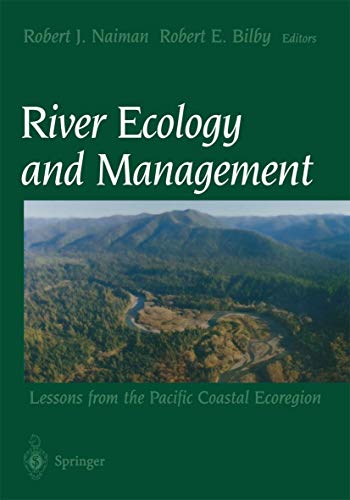
Today, with unprecedented demands on streams and rivers by an exponentially increasing human population, a basic ecological understanding of the structure and dynamics of running waters is essential for formulating sound management and policy decisions. The interface between the science and policy of natural resource management is illustrated by examples from the Pacific coastal ecoregion, including the protection of riparian forest, the marbled murrelet, salmon, and amphibians.
Les informations fournies dans la section « Synopsis » peuvent faire référence à une autre édition de ce titre.
À propos de la quatrième de couverture
As the vast expanses of natural forests and the great populations of salmonids are harvested to support a rapidly expanding human population, the need to understand streams as ecological systems and to manage them effectively becomes increasingly urgent. The unfortunate legacy of such natural resource exploitation is well documented. For several decades the Pacific coastal ecoregion of North America has served as a natural laboratory for scientific and managerial advancements in stream ecology, and much has been learned about how to better integrate ecological processes and characteristics with a human-dominated environment. These in sightful but hard-learned ecological and social lessons are the subject of this book. Integrating land and rivers as interactive components of ecosystems and watersheds has provided the ecological sciences with impor tant theoretical foundations. Even though scientific disciplines have begun to integrate land-based processes with streams and rivers, the institutions and processes charged with managing these systems have not done so successfully. As a result, many of the watersheds of the Pacific coastal ecoregion no longer support natural settings for environmental processes or the valuable natural resources those processes create. An important role for scientists, educators, and decision makers is to make the integration between ecology and con sumptive uses more widely understood, as well as useful for effective management.
Les informations fournies dans la section « A propos du livre » peuvent faire référence à une autre édition de ce titre.
Résultats de recherche pour River Ecology and Management: Lessons From The Pacific...

Image d'archives
River Ecology and Management: Lessons from the Pacific Coastal Ecoregion
Edité par
Springer, 1998
ISBN 10 : 0387952462
ISBN 13 : 9780387952468
Ancien ou d'occasion
paperback
Edition originale
Vendeur : Textbooks_Source, Columbia, MO, Etats-Unis
Évaluation du vendeur 5 sur 5 étoiles

paperback. Etat : Good. First Edition. Ships in a BOX from Central Missouri! May not include working access code. Will not include dust jacket. Has used sticker(s) and some writing or highlighting. UPS shipping for most packages, (Priority Mail for AK/HI/APO/PO Boxes). N° de réf. du vendeur 000583108U
Acheter D'occasion
EUR 85,67
Expédition à EUR 3,57
Expédition nationale : Etats-Unis
Expédition nationale : Etats-Unis
Quantité disponible : 1 disponible(s)
Image fournie par le vendeur
River Ecology and Management : Lessons from the Pacific Coastal Ecoregion
Edité par
Springer, 1998
ISBN 10 : 0387952462
ISBN 13 : 9780387952468
Ancien ou d'occasion
Couverture souple
Vendeur : GreatBookPrices, Columbia, MD, Etats-Unis
Évaluation du vendeur 5 sur 5 étoiles
Etat : good. May show signs of wear, highlighting, writing, and previous use. This item may be a former library book with typical markings. No guarantee on products that contain supplements Your satisfaction is 100% guaranteed. Twenty-five year bookseller with shipments to over fifty million happy customers. N° de réf. du vendeur 672068-5
Acheter D'occasion
EUR 86,90
Expédition à EUR 2,36
Expédition nationale : Etats-Unis
Expédition nationale : Etats-Unis
Quantité disponible : 1 disponible(s)
Image fournie par le vendeur
River Ecology and Management : Lessons from the Pacific Coastal Ecoregion
Edité par
Springer, 1998
ISBN 10 : 0387952462
ISBN 13 : 9780387952468
Ancien ou d'occasion
Couverture souple
Vendeur : GreatBookPrices, Columbia, MD, Etats-Unis
Évaluation du vendeur 5 sur 5 étoiles
Etat : As New. Unread book in perfect condition. N° de réf. du vendeur 672068
Acheter D'occasion
EUR 95,73
Expédition à EUR 2,36
Expédition nationale : Etats-Unis
Expédition nationale : Etats-Unis
Quantité disponible : 2 disponible(s)
Image fournie par le vendeur
River Ecology and Management
Edité par
Springer New York Feb 2001, 2001
ISBN 10 : 0387952462
ISBN 13 : 9780387952468
Neuf
Taschenbuch
Vendeur : BuchWeltWeit Ludwig Meier e.K., Bergisch Gladbach, Allemagne
Évaluation du vendeur 5 sur 5 étoiles
Taschenbuch. Etat : Neu. This item is printed on demand - it takes 3-4 days longer - Neuware -As the vast expanses of natural forests and the great populations of salmonids are harvested to support a rapidly expanding human population, the need to understand streams as ecological systems and to manage them effectively becomes increasingly urgent. The unfortunate legacy of such natural resource exploitation is well documented. For several decades the Pacific coastal ecoregion of North America has served as a natural laboratory for scientific and managerial advancements in stream ecology, and much has been learned about how to better integrate ecological processes and characteristics with a human-dominated environment. These in sightful but hard-learned ecological and social lessons are the subject of this book. Integrating land and rivers as interactive components of ecosystems and watersheds has provided the ecological sciences with impor tant theoretical foundations. Even though scientific disciplines have begun to integrate land-based processes with streams and rivers, the institutions and processes charged with managing these systems have not done so successfully. As a result, many of the watersheds of the Pacific coastal ecoregion no longer support natural settings for environmental processes or the valuable natural resources those processes create. An important role for scientists, educators, and decision makers is to make the integration between ecology and con sumptive uses more widely understood, as well as useful for effective management. 732 pp. Englisch. N° de réf. du vendeur 9780387952468
Acheter neuf
EUR 117,69
Expédition à EUR 23
Expédition depuis Allemagne vers Etats-Unis
Expédition depuis Allemagne vers Etats-Unis
Quantité disponible : 2 disponible(s)
Image d'archives
River Ecology and Management: Lessons from the Pacific Coastal Ecoregion
Vendeur : BennettBooksLtd, Los Angeles, CA, Etats-Unis
Évaluation du vendeur 5 sur 5 étoiles
paperback. Etat : New. In shrink wrap. Looks like an interesting title! N° de réf. du vendeur Q-0387952462
Acheter neuf
EUR 140,73
Expédition à EUR 6,22
Expédition nationale : Etats-Unis
Expédition nationale : Etats-Unis
Quantité disponible : 1 disponible(s)
Image fournie par le vendeur
River Ecology and Management : Lessons from the Pacific Coastal Ecoregion
Vendeur : GreatBookPrices, Columbia, MD, Etats-Unis
Évaluation du vendeur 5 sur 5 étoiles
Etat : New. N° de réf. du vendeur 672068-n
Acheter neuf
EUR 144,69
Expédition à EUR 2,36
Expédition nationale : Etats-Unis
Expédition nationale : Etats-Unis
Quantité disponible : 2 disponible(s)
Image fournie par le vendeur
River Ecology and Management
Edité par
Springer New York, 2001
ISBN 10 : 0387952462
ISBN 13 : 9780387952468
Neuf
Kartoniert / Broschiert
Vendeur : moluna, Greven, Allemagne
Évaluation du vendeur 5 sur 5 étoiles
Kartoniert / Broschiert. Etat : New. Dieser Artikel ist ein Print on Demand Artikel und wird nach Ihrer Bestellung fuer Sie gedruckt. As the vast expanses of natural forests and the great populations of salmonids are harvested to support a rapidly expanding human population, the need to understand streams as ecological systems and to manage them effectively becomes increasingly urgent. Th. N° de réf. du vendeur 5912418
Acheter neuf
EUR 101,04
Expédition à EUR 48,99
Expédition depuis Allemagne vers Etats-Unis
Expédition depuis Allemagne vers Etats-Unis
Quantité disponible : Plus de 20 disponibles
Image fournie par le vendeur
River Ecology and Management : Lessons from the Pacific Coastal Ecoregion
Vendeur : GreatBookPricesUK, Woodford Green, Royaume-Uni
Évaluation du vendeur 5 sur 5 étoiles
Etat : New. N° de réf. du vendeur 672068-n
Acheter neuf
EUR 132,95
Expédition à EUR 17,91
Expédition depuis Royaume-Uni vers Etats-Unis
Expédition depuis Royaume-Uni vers Etats-Unis
Quantité disponible : 2 disponible(s)
Image d'archives
River Ecology and Management: Lessons from the Pacific Coastal Ecoregion
Vendeur : Ria Christie Collections, Uxbridge, Royaume-Uni
Évaluation du vendeur 5 sur 5 étoiles
Etat : New. In English. N° de réf. du vendeur ria9780387952468_new
Acheter neuf
EUR 145,08
Expédition à EUR 17,84
Expédition depuis Royaume-Uni vers Etats-Unis
Expédition depuis Royaume-Uni vers Etats-Unis
Quantité disponible : Plus de 20 disponibles
Image fournie par le vendeur
River Ecology and Management : Lessons from the Pacific Coastal Ecoregion
Edité par
Springer, 1998
ISBN 10 : 0387952462
ISBN 13 : 9780387952468
Ancien ou d'occasion
Couverture souple
Vendeur : GreatBookPricesUK, Woodford Green, Royaume-Uni
Évaluation du vendeur 5 sur 5 étoiles
Etat : As New. Unread book in perfect condition. N° de réf. du vendeur 672068
Acheter D'occasion
EUR 146,42
Expédition à EUR 17,91
Expédition depuis Royaume-Uni vers Etats-Unis
Expédition depuis Royaume-Uni vers Etats-Unis
Quantité disponible : 2 disponible(s)