
Articles liés à Principles of Mathematics
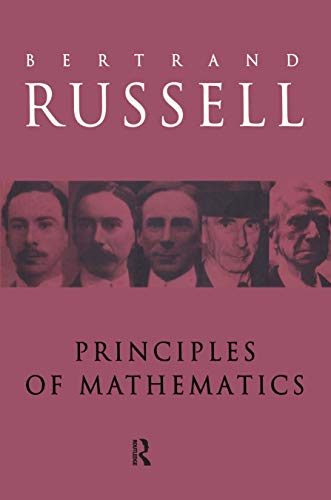
Synopsis
Published in 1903, this book was the first comprehensive treatise on the logical foundations of mathematics written in English. It sets forth, as far as possible without mathematical and logical symbolism, the grounds in favour of the view that mathematics and logic are identical. It proposes simply that what is commonly called mathematics are merely later deductions from logical premises. It provided the thesis for which Principia Mathematica provided the detailed proof, and introduced the work of Frege to a wider audience.
In addition to the new introduction by John Slater, this edition contains Russell's introduction to the 1937 edition in which he defends his position against his formalist and intuitionist critics.
Les informations fournies dans la section « Synopsis » peuvent faire référence à une autre édition de ce titre.
À propos de l'auteur
Bertrand Russell
Les informations fournies dans la section « A propos du livre » peuvent faire référence à une autre édition de ce titre.
Résultats de recherche pour Principles of Mathematics

Image d'archives
The principles of mathematics
Edité par
Routledge, 1992
ISBN 10 : 0415082994
ISBN 13 : 9780415082990
Ancien ou d'occasion
Paperback
Vendeur : Powell's Bookstores Chicago, ABAA, Chicago, IL, Etats-Unis
Évaluation du vendeur 5 sur 5 étoiles

Paperback. Etat : Very Good. 2. Pap. Minor shelf wear; bottom corner of front wrap creased. Else a nice, clean copy. N° de réf. du vendeur 2053515
Acheter D'occasion
EUR 30,24
Expédition à EUR 4,45
Expédition nationale : Etats-Unis
Expédition nationale : Etats-Unis
Quantité disponible : 1 disponible(s)
Image d'archives
The Principles of Mathematics
Edité par
Cambridge University Press, 1993
ISBN 10 : 0415082994
ISBN 13 : 9780415082990
Ancien ou d'occasion
Paperback
Vendeur : Goulds Book Arcade, Sydney, Newtown, Sydney, NSW, Australie
Évaluation du vendeur 5 sur 5 étoiles
Paperback. Etat : Very Good. 534 pages. The cover has a little wear. The page edges are lightly foxed. Books listed here are not stored at the shop. Please contact us if you want to pick up a book from Newtown. N° de réf. du vendeur 183853
Acheter D'occasion
EUR 19,10
Expédition à EUR 22,24
Expédition depuis Australie vers Etats-Unis
Expédition depuis Australie vers Etats-Unis
Quantité disponible : 1 disponible(s)
Image d'archives
Principles of Mathematics
Edité par
Routledge, 1992
ISBN 10 : 0415082994
ISBN 13 : 9780415082990
Ancien ou d'occasion
Soft cover
Vendeur : FITZ BOOKS AND WAFFLES, Buffalo, NY, Etats-Unis
Évaluation du vendeur 5 sur 5 étoiles
Soft cover. Etat : Near Fine. 3rd Edition. This copy is signed by the previous owner but otherwise unmarked. Light outer wear. N° de réf. du vendeur ABE-1792347059659
Acheter D'occasion
EUR 41,24
Expédition à EUR 3,56
Expédition nationale : Etats-Unis
Expédition nationale : Etats-Unis
Quantité disponible : 1 disponible(s)
Image d'archives
Principles of Mathematics
Edité par
Routledge, 1992
ISBN 10 : 0415082994
ISBN 13 : 9780415082990
Ancien ou d'occasion
Paperback
Vendeur : WorldofBooks, Goring-By-Sea, WS, Royaume-Uni
Évaluation du vendeur 5 sur 5 étoiles
Paperback. Etat : Very Good. The book has been read, but is in excellent condition. Pages are intact and not marred by notes or highlighting. The spine remains undamaged. N° de réf. du vendeur GOR002316560
Acheter D'occasion
EUR 41,81
Expédition à EUR 6,64
Expédition depuis Royaume-Uni vers Etats-Unis
Expédition depuis Royaume-Uni vers Etats-Unis
Quantité disponible : 1 disponible(s)
Image d'archives
Principles of Mathematics
Edité par
Routledge, 1992
ISBN 10 : 0415082994
ISBN 13 : 9780415082990
Ancien ou d'occasion
Couverture souple
Vendeur : Phatpocket Limited, Waltham Abbey, HERTS, Royaume-Uni
Évaluation du vendeur 5 sur 5 étoiles
Etat : Good. Your purchase helps support Sri Lankan Children's Charity 'The Rainbow Centre'. Ex-library, so some stamps and wear, but in good overall condition. Our donations to The Rainbow Centre have helped provide an education and a safe haven to hundreds of children who live in appalling conditions. N° de réf. du vendeur Z1-W-002-01724
Acheter D'occasion
EUR 40,29
Expédition à EUR 12,62
Expédition depuis Royaume-Uni vers Etats-Unis
Expédition depuis Royaume-Uni vers Etats-Unis
Quantité disponible : 1 disponible(s)
Image fournie par le vendeur
Principles of Mathematics
Edité par
Routledge, 1992
ISBN 10 : 0415082994
ISBN 13 : 9780415082990
Ancien ou d'occasion
paperback
Vendeur : M Godding Books Ltd, Devizes, WILTS, Royaume-Uni
Évaluation du vendeur 5 sur 5 étoiles
paperback. Etat : Good. . Posted within 1 working day. Royal Mail Tracked 24 to UK. Tracked Airmail worldwide. Robust recyclable packaging. Picture is the actual item. N° de réf. du vendeur 311822
Acheter D'occasion
EUR 42,45
Expédition à EUR 14,80
Expédition depuis Royaume-Uni vers Etats-Unis
Expédition depuis Royaume-Uni vers Etats-Unis
Quantité disponible : 1 disponible(s)
Image fournie par le vendeur
Principles of Mathematics
Edité par
Routledge, 1992
ISBN 10 : 0415082994
ISBN 13 : 9780415082990
Ancien ou d'occasion
Paperback
Vendeur : Optimon Books, Gravesend, KENT, Royaume-Uni
Évaluation du vendeur 5 sur 5 étoiles
Paperback. Etat : Good. Published in 1903, this book was the first comprehensive treatise on the logical foundations of mathematics written in English. It sets forth, as far as possible without mathematical and logical symbolism, the grounds in favour of the view that mathematics and logic are identical. It proposes simply that what is commonly called mathematics are merely later deductions from logical premises. It provided the thesis for which Principia Mathematica provided the detailed proof, and introduced the work of Frege to a wider audience. Copyright © Taylor & Francis. N° de réf. du vendeur 475097
Acheter D'occasion
EUR 45,19
Expédition à EUR 21,35
Expédition depuis Royaume-Uni vers Etats-Unis
Expédition depuis Royaume-Uni vers Etats-Unis
Quantité disponible : 1 disponible(s)
Image fournie par le vendeur
Principles of Mathematics Book by Bertrand Russell
Edité par
Routledge, 2004
ISBN 10 : 0415082994
ISBN 13 : 9780415082990
Ancien ou d'occasion
Softcover
Vendeur : West Cove UK, Wellington, Royaume-Uni
Évaluation du vendeur 5 sur 5 étoiles
Softcover. Etat : Very Good. Immediate dispatch from Somerset. Nice book in great condition. Pages in excellent condition. Pages in unused condition. Softcover. English. Pub Year 2004, See images for condition. About the book >.>.> Principles of Mathematics Book by Bertrand RussellThe Principles of Mathematics is a treatise on the logical foundations of mathematics. First published in 1903, it presents the position that mathematics and logic are identical. The work is described as the first comprehensive English-language treatise devoted to this subject, and as an account of Bertrand Russell?s view of the world. The book is also characterised as an original and important contribution to the philosophy of mathematics and as a precursor to the Principia Mathematica. This edition includes Russell?s introduction to the 1937 edition, in which he responds to his earlier work. (MP). N° de réf. du vendeur Batch-FM799-VG-15748
Acheter D'occasion
EUR 42,02
Expédition à EUR 30,78
Expédition depuis Royaume-Uni vers Etats-Unis
Expédition depuis Royaume-Uni vers Etats-Unis
Quantité disponible : 1 disponible(s)
Image fournie par le vendeur
Principles of Mathematics
Edité par
Taylor & Francis, 1992
ISBN 10 : 0415082994
ISBN 13 : 9780415082990
Ancien ou d'occasion
Paperback
Vendeur : Optimon Books, Gravesend, KENT, Royaume-Uni
Évaluation du vendeur 5 sur 5 étoiles
Paperback. Etat : Very Good. Published in 1903, this book was the first comprehensive treatise on the logical foundations of mathematics written in English. It sets forth, as far as possible without mathematical and logical symbolism, the grounds in favour of the view that mathematics and logic are identical. It proposes simply that what is commonly called mathematics are merely later deductions from logical premises. It provided the thesis for which Principia Mathematica provided the detailed proof, and introduced the work of Frege to a wider audience. Copyright © Taylor & Francis. N° de réf. du vendeur 478786
Acheter D'occasion
EUR 57,40
Expédition à EUR 21,35
Expédition depuis Royaume-Uni vers Etats-Unis
Expédition depuis Royaume-Uni vers Etats-Unis
Quantité disponible : 1 disponible(s)
Image fournie par le vendeur
The Principles of Mathematics
Edité par
Routledge, 1992
ISBN 10 : 0415082994
ISBN 13 : 9780415082990
Ancien ou d'occasion
paperback edition
Vendeur : Borkert, Schwarz und Zerfaß GbR, Berlin, Allemagne
Évaluation du vendeur 5 sur 5 étoiles
paperback edition. Etat : Sehr gut. 534 pgs. Very good and clean copy. - Published in 1903, this book was the first comprehensive treatise on the logical foundations of mathematics to be written in English. It set forth, as far as possible without mathematical and logical symbolism, the grounds in favour of the view that mathematics and logic are identical. Russell proposed simply that what is commonly called mathematics is merely later deductions from logical premisses. He outlined the thesis for which Principia Mathematica provided the detailed proof, and introduced the work of Frege to a wider audience. In addition to the new introduction by John G. Slater of the University of Toronto, this edition contains Russell's introduction to the 1937 edition in which he defends his position against his formalist and intuitionist critics. / TABLE OF CONTENTS -- INTRODUCTION TO THE SECOND EDITION -- PREFACE -- PAGE -- V -- XV -- PART I -- THE INDEFINABLES OF MATHEMATICS -- CHAPTER I -- DEFINITION OF PURE MATHEMATICS -- Definition of pure mathematics -- The principles of mathematics are no longer controversial -- Pure mathematics uses only a few notions, and these are logical constants -- -- All pure mathematics follows formally from twenty premisses -- Asserts formal implications -- And employs variables -- Which may have any value without exception -- Mathematics deals with types of relations -- Applied mathematics is defined by the occurrence of constants which are not logical -- Relation of mathematics to logic -- CHAPTER II -- SYMBOLIC LOGIC -- Definition and scope of symbolic logic -- The indefinables of symbolic logic -- -- Symbolic logic consists of three parts -- A The Propositional Calculus -- Definition -- -- Distinction between implication and formal implication -- Implication indefinable -- Two indefinables and ten primitive propositions in this calculus -- PAGE -- The ten primitive propositions -- Disjunction and negation defined -- B The Calculus of Classes -- Three new indefinables -- The relation of an individual to its class -- Propositional functions -- The notion of such that -- Two new primitive propositions -- Relation to propositional calculus -- Identity -- C The Calculus of Relations -- The logic of relations essential to mathematics -- New primitive propositions -- Relative products -- Relations with assigned domains -- D Peano's Symbolic Logic -- Mathematical and philosophical definitions -- Peano's indefinables -- -- Elementary definitions -- Peano's primitive propositions -- Negation and disjunction -- Existence and the null-class -- CHAPTER III -- IMPLICATION AND FORMAL IMPLICATION -- Meaning of implication -- Asserted and unasserted propositions -- Inference does not require two premisses -- Formal implication is to be interpreted extensionally -- The variable in a formal implication has an unrestricted field -- A formal implication is a single propositional function, not a relation of two -- Assertions -- Formal implication involved in rules of inference -- Conditions that a term in an implication may be varied -- CHAPTER IV -- PROPER NAMES, ADJECTIVES AND VERBS -- Proper names, adjectives and verbs distinguished -- Terms -- Things and concepts -- Concepts as such and as terms -- Conceptual diversity -- Meaning and the subject-predicate logic -- Table of Contents -- xxvii -- Verbs and truth -- All verbs, except perhaps is, express relations -- Relations per se and relating relations -- Relations are not particularized by their terms -- Definition of denoting -- CHAPTER V -- DENOTING -- Connection with subject-predicate propositions -- Denoting concepts obtained from predicates -- Extensional account of all, every, any, a and some -- PAGE -- Intensional account of the same -- Illustrations -- The difference between all, every, etc lies in the objects denoted, not in the -- way of denoting them -- The notion of the and definition -- The notion of the and identity -- Summary -- CHAPTER VI -- CLASSES -- Combination of intensional and extensional standpoints required -- Meaning of class -- Intensional and extensional genesis of class -- Distinctions overlooked by Peano -- The class as one and as many -- The notion of and -- All men is not analyzable into all and men -- There are null class-concepts, but there is no null class -- The class as one, except when it has one term, is distinct from the class as many -- Every, any, a and some each denote one object, but an ambiguous one -- The relation of a term to its class -- The relation of inclusion between classes -- The contradiction -- Summary -- CHAPTER VII -- PROPOSITIONAL FUNCTIONS -- Indefinability of such that -- Where a fixed relation to a fixed term is asserted, a propositional function can be analyzed into a variable subject and a constant assertion -- But this analysis is impossible in other cases -- Variation of the concept in a proposition -- Relation of propositional functions to classes -- A propositional function is in general not analyzable into a constant and a variable element -- CHAPTER VIII -- THE VARIABLE -- Nature of the variable -- Relation of the variable to any -- Formal and restricted variables -- Formal implication presupposes any -- Duality of any and some -- The class-concept propositional function is indefinable -- Other classes can be defined by means of such that -- Analysis of the variable -- CHAPTER IX -- RELATIONS -- PAC -- Characteristics of relations -- Relations of terms to themselves -- The domain and the converse domain of a relation -- Logical sum, logical product and relative product of relations -- A relation is not a class of couples -- Relations of a relation to its terms -- CHAPTER X -- THE CONTRADICTION -- Consequences of the contradiction -- Various statements of the contradiction -- An analogous generalized argument -- Variable propositional functions are in general inadmissible -- The contradiction arises from treating as one a class which is only many -- Other primâ facie possible solutions appear inadequat. N° de réf. du vendeur 1253810
Acheter D'occasion
EUR 39
Expédition à EUR 40
Expédition depuis Allemagne vers Etats-Unis
Expédition depuis Allemagne vers Etats-Unis
Quantité disponible : 1 disponible(s)