
Articles liés à Random Processes in Physical Systems: An Introduction...
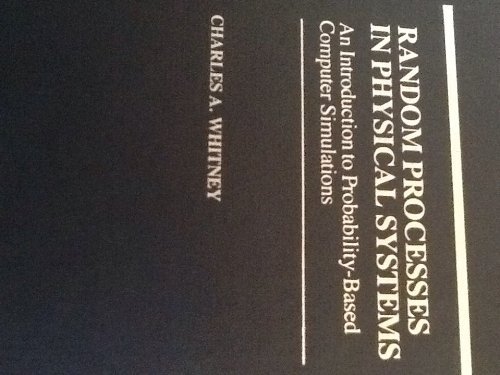
Random Processes in Physical Systems: An Introduction to Probability-Based Computer Simulations - Couverture rigide
Synopsis
The advent of powerful desktop computers promises to open a new door to the natural sciences and mathematics. It is often called "numerical experimentation" and consists of computer programs that permit the manipulation of simulated physical systems. This book introduces the reader to computer methods that are modelled on the rules of gambling. They can be done on a personal computer, and aim to provide physical and mathematical insights to the expert and novice alike. The aim is to encourage a more pragmatic and critical attitude toward the application of physical concepts than is implied by the immediate assumption of classical methods.
Les informations fournies dans la section « Synopsis » peuvent faire référence à une autre édition de ce titre.
Présentation de l'éditeur
Introduces the reader to applications of computer programs that permit the manipulation of simulated physical systems, unlocking the potential for dramatic insights in the fields of physics, chemistry and statistics. Divided into four sections, it opens with an introduction to pseudo–random numbers and discusses the concept of the ``random walk′′ as well as the excitation of atoms whose energy arrives in discrete quanta. Sample listings of computer programs for some of the key calculations are included. Section 2 describes a few of the most important processes that take place in the continuum of time, especially the scattering of photons in a gas and the ``Brownian motion′′ of small particles. The third section applies these modeling techniques to the behavior of more complex systems and points the way to what promises to be a major use of computers in the future. Section 4 introduces the application of randomizing methods to the solution of statistical problems such as curve–fitting and error analysis. Using computer methods modeled on the rules of gambling, it promises to be a milestone in the field of physics education.
Les informations fournies dans la section « A propos du livre » peuvent faire référence à une autre édition de ce titre.
Résultats de recherche pour Random Processes in Physical Systems: An Introduction...

Image fournie par le vendeur
Random Processes in Physical Systems: An Itroduction to Probability-Based Computer Simulations [= A Wiley-Interscience Publication]
ISBN 10 : 0471517925
ISBN 13 : 9780471517924
Ancien ou d'occasion
Couverture souple
Vendeur : Antikvariat Valentinska, Praha, Rébublique tchèque
Évaluation du vendeur 5 sur 5 étoiles

OKart. mit silbergeprägten Titeln, OUmschlag, XV+320 Seiten mit zahlr. Abb. u. Tabellen, 4° (16 x 24 cm), Umschlag ganz leicht angekratzt u. hinten vergilbt, Deckel unbeschädigt, Stempel auf Titelseite, innen tadellos, insgesamt sehr schöner Zustand. Book Language/s: English. N° de réf. du vendeur A43831
Acheter D'occasion
EUR 45
Expédition à EUR 26,50
Expédition depuis Rébublique tchèque vers Etats-Unis
Expédition depuis Rébublique tchèque vers Etats-Unis
Quantité disponible : 1 disponible(s)
Image d'archives
Random Processes in Physical Systems
Vendeur : Mispah books, Redhill, SURRE, Royaume-Uni
Évaluation du vendeur 4 sur 5 étoiles

Hardcover. Etat : New. NEW. SHIPS FROM MULTIPLE LOCATIONS. book. N° de réf. du vendeur ERICA82904715179256
Acheter neuf
EUR 153,74
Expédition à EUR 29,15
Expédition depuis Royaume-Uni vers Etats-Unis
Expédition depuis Royaume-Uni vers Etats-Unis
Quantité disponible : 1 disponible(s)