
Articles liés à The Marrow of Tradition
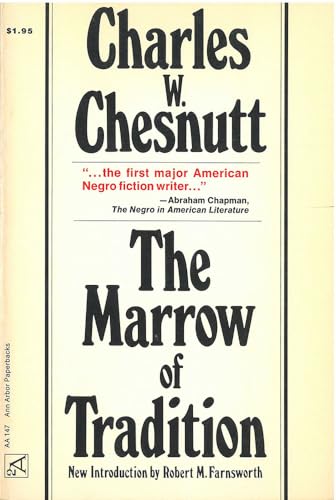
Synopsis
A stirring tale of racial confrontation in a reconstructionist Southern town, first published in 1901
Les informations fournies dans la section « Synopsis » peuvent faire référence à une autre édition de ce titre.
Présentation de l'éditeur
This book was originally published prior to 1923, and represents a reproduction of an important historical work, maintaining the same format as the original work. While some publishers have opted to apply OCR (optical character recognition) technology to the process, we believe this leads to sub-optimal results (frequent typographical errors, strange characters and confusing formatting) and does not adequately preserve the historical character of the original artifact. We believe this work is culturally important in its original archival form. While we strive to adequately clean and digitally enhance the original work, there are occasionally instances where imperfections such as blurred or missing pages, poor pictures or errant marks may have been introduced due to either the quality of the original work or the scanning process itself. Despite these occasional imperfections, we have brought it back into print as part of our ongoing global book preservation commitment, providing customers with access to the best possible historical reprints. We appreciate your understanding of these occasional imperfections, and sincerely hope you enjoy seeing the book in a format as close as possible to that intended by the original publisher.
Biographie de l'auteur
Charles W. Chesnutt (1858–1932) was an American author, essayist, political activist and lawyer, best known for his novels and short stories exploring complex issues of racial and social identity in the post-Civil War South. The legacy of slavery and interracial relations had resulted in many free people of color who had attained education before the war, as well as slaves and freedmen of mixed race. Two of his books were adapted as silent films in 1926 and 1927 by the director and producer Oscar Micheaux. Chesnutt also established what became a highly successful legal stenography business, which provided his main income.
Les informations fournies dans la section « A propos du livre » peuvent faire référence à une autre édition de ce titre.
Résultats de recherche pour The Marrow of Tradition

Image fournie par le vendeur
The Marrow of Tradition (Ann Arbor Paperbacks)
Edité par
Ann Arbor Paperbacks, 1969
ISBN 10 : 047206147X
ISBN 13 : 9780472061471
Ancien ou d'occasion
Couverture souple
Vendeur : ZBK Books, Carlstadt, NJ, Etats-Unis
Évaluation du vendeur 5 sur 5 étoiles

Etat : good. Fast & Free Shipping â" Good condition. It may show normal signs of use, such as light writing, highlighting, or library markings, but all pages are intact and the book is fully readable. A solid, complete copy that's ready to enjoy. N° de réf. du vendeur ZWV.047206147X.G
Acheter D'occasion
EUR 5,36
Livraison gratuite
Expédition nationale : Etats-Unis
Expédition nationale : Etats-Unis
Quantité disponible : 1 disponible(s)
Image d'archives
The Marrow of Tradition (Ann Arbor Paperbacks)
Edité par
Ann Arbor Paperbacks, 1969
ISBN 10 : 047206147X
ISBN 13 : 9780472061471
Ancien ou d'occasion
Couverture souple
Vendeur : World of Books (was SecondSale), Montgomery, IL, Etats-Unis
Évaluation du vendeur 5 sur 5 étoiles
Etat : Good. Item in good condition. Textbooks may not include supplemental items i.e. CDs, access codes etc. N° de réf. du vendeur 00108718453
Acheter D'occasion
EUR 5,50
Livraison gratuite
Expédition nationale : Etats-Unis
Expédition nationale : Etats-Unis
Quantité disponible : 1 disponible(s)
Image d'archives
The Marrow of Tradition
Edité par
University of Michigan Press, 1969
ISBN 10 : 047206147X
ISBN 13 : 9780472061471
Ancien ou d'occasion
Paperback
Vendeur : ThriftBooks-Atlanta, AUSTELL, GA, Etats-Unis
Évaluation du vendeur 5 sur 5 étoiles
Paperback. Etat : Good. No Jacket. Pages can have notes/highlighting. Spine may show signs of wear. ~ ThriftBooks: Read More, Spend Less. N° de réf. du vendeur G047206147XI3N00
Acheter D'occasion
EUR 6,05
Livraison gratuite
Expédition nationale : Etats-Unis
Expédition nationale : Etats-Unis
Quantité disponible : 1 disponible(s)
Image d'archives
The Marrow of Tradition
Edité par
University of Michigan Press, 1969
ISBN 10 : 047206147X
ISBN 13 : 9780472061471
Ancien ou d'occasion
Paperback
Vendeur : ThriftBooks-Atlanta, AUSTELL, GA, Etats-Unis
Évaluation du vendeur 5 sur 5 étoiles
Paperback. Etat : Very Good. No Jacket. May have limited writing in cover pages. Pages are unmarked. ~ ThriftBooks: Read More, Spend Less. N° de réf. du vendeur G047206147XI4N00
Acheter D'occasion
EUR 6,05
Livraison gratuite
Expédition nationale : Etats-Unis
Expédition nationale : Etats-Unis
Quantité disponible : 1 disponible(s)
Image d'archives
The Marrow of Tradition
Edité par
University of Michigan Press, 1969
ISBN 10 : 047206147X
ISBN 13 : 9780472061471
Ancien ou d'occasion
Couverture souple
Vendeur : Better World Books, Mishawaka, IN, Etats-Unis
Évaluation du vendeur 5 sur 5 étoiles
Etat : Very Good. Pages intact with possible writing/highlighting. Binding strong with minor wear. Dust jackets/supplements may not be included. Stock photo provided. Product includes identifying sticker. Better World Books: Buy Books. Do Good. N° de réf. du vendeur 38452240-6
Acheter D'occasion
EUR 6,56
Livraison gratuite
Expédition nationale : Etats-Unis
Expédition nationale : Etats-Unis
Quantité disponible : 1 disponible(s)
Image d'archives
The Marrow of Tradition
Edité par
University of Michigan Press, 1969
ISBN 10 : 047206147X
ISBN 13 : 9780472061471
Ancien ou d'occasion
Couverture souple
Vendeur : Better World Books: West, Reno, NV, Etats-Unis
Évaluation du vendeur 5 sur 5 étoiles
Etat : Very Good. Pages intact with possible writing/highlighting. Binding strong with minor wear. Dust jackets/supplements may not be included. Stock photo provided. Product includes identifying sticker. Better World Books: Buy Books. Do Good. N° de réf. du vendeur 38452240-6
Acheter D'occasion
EUR 6,56
Livraison gratuite
Expédition nationale : Etats-Unis
Expédition nationale : Etats-Unis
Quantité disponible : 1 disponible(s)
Image d'archives
The Marrow of Tradition
Edité par
University of Michigan Press, 1969
ISBN 10 : 047206147X
ISBN 13 : 9780472061471
Ancien ou d'occasion
Couverture souple
Vendeur : Better World Books, Mishawaka, IN, Etats-Unis
Évaluation du vendeur 5 sur 5 étoiles
Etat : Good. Pages intact with minimal writing/highlighting. The binding may be loose and creased. Dust jackets/supplements are not included. Stock photo provided. Product includes identifying sticker. Better World Books: Buy Books. Do Good. N° de réf. du vendeur 19143259-75
Acheter D'occasion
EUR 6,56
Livraison gratuite
Expédition nationale : Etats-Unis
Expédition nationale : Etats-Unis
Quantité disponible : 1 disponible(s)
Image d'archives
The Marrow of Tradition (Ann Arbor Paperbacks)
Edité par
Ann Arbor Paperbacks, 1969
ISBN 10 : 047206147X
ISBN 13 : 9780472061471
Ancien ou d'occasion
Paperback
Vendeur : Midtown Scholar Bookstore, Harrisburg, PA, Etats-Unis
Évaluation du vendeur 5 sur 5 étoiles
Paperback. Etat : Good. Good - Bumped and creased book with tears to the extremities, but not affecting the text block, may have remainder mark or previous owner's name - GOOD Standard-sized. N° de réf. du vendeur M047206147XZ3
Acheter D'occasion
EUR 2,41
Expédition à EUR 5,34
Expédition nationale : Etats-Unis
Expédition nationale : Etats-Unis
Quantité disponible : 1 disponible(s)
Image d'archives
The Marrow of TYradition
Edité par
Univ of Michigan Press, Ann Arbor, 1969
ISBN 10 : 047206147X
ISBN 13 : 9780472061471
Ancien ou d'occasion
Soft cover
Vendeur : Works on Paper, DeKalb, IL, Etats-Unis
Évaluation du vendeur 4 sur 5 étoiles

Soft cover. Etat : Very Good. A very good copy of the softcover edition. The text is wholly unmarked, pristine, and the binding is bright and fresh in appearance, with minor wear at the extremities of the cover. A lovely copy. N° de réf. du vendeur 011593
Acheter D'occasion
EUR 3,14
Expédition à EUR 5,79
Expédition nationale : Etats-Unis
Expédition nationale : Etats-Unis
Quantité disponible : 1 disponible(s)
Image d'archives
The Marrow of Tradition
Edité par
Univ of Michigan Press, Jackson, Tennessee, U.S.A., 1969
ISBN 10 : 047206147X
ISBN 13 : 9780472061471
Ancien ou d'occasion
Paperback
Vendeur : Lowry's Books, Three Rivers, MI, Etats-Unis
Évaluation du vendeur 4 sur 5 étoiles
Paperback. Etat : Good. No Jacket. This copy has clean text and minimal wear. The spine is slightly cocked forward. There is a stamp in the upper right corner of the first page. Overall, this copy is in good condition. Size: 8vo - over 7¾" - 9¾" tall. N° de réf. du vendeur 041558
Acheter D'occasion
EUR 3,67
Expédition à EUR 5,30
Expédition nationale : Etats-Unis
Expédition nationale : Etats-Unis
Quantité disponible : 1 disponible(s)