
Articles liés à Regime and Discipline: Democracy and the Development...
Synopsis
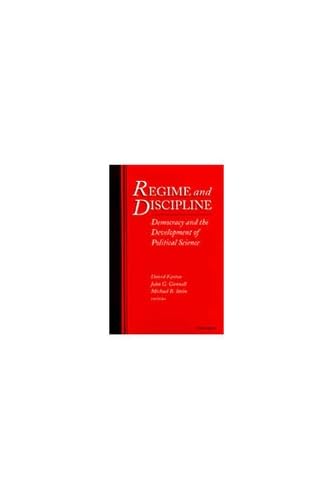
Is the discipline of political science a specific by-product of democratic regimes? Can it develop and have an impact only where democracy itself is flourishing? Or is it possible to forge such a discipline in authoritarian and transitional regimes? Can political science shape the democratic process in established democracies? Can it foster liberalization in countries attempting to rid themselves of authoritarian regimes? The contributors to this volume seek answers to these questions from methodological and substantive perspectives. The methodological debate is presented in terms of whether the goal of objectivity and neutrality in disciplinary history is desirable and attainable, or whether all such histories are inherently "whiggish" or "pessimistic," and mere ex-post facto justifications of a particular disciplinary perspective. The volume then explores the relationship between democracy and the development of political science in a variety of national settings and political regimes, including older Western democracies, newer democracies, and current transitional regimes. The contributions reflect both consensus and disagreement about the nature of the interactive relationship between political science and democracy. Indeed, a fundamental debate centers on the very terms democracy and political science. Nevertheless, with one or two exceptions, the participants do acknowledge that some kind of relationship does in fact exist between democracy and political science, be it interactive and correlational or causal.
Les informations fournies dans la section « Synopsis » peuvent faire référence à une autre édition de ce titre.
À propos de l'auteur
David Easton is Andrew Macleish Distinguished Service Professor Emeritus, University of Chicago, and distinguished Professor of Political Science, University of California at Irvine.
John G. Gunnell is Professor of Political Science, Rockefeller College of Public Affairs and Policy, State University of New York at Albany.
Michael B. Stein is Professor of Political Science, McMaster University.
Les informations fournies dans la section « A propos du livre » peuvent faire référence à une autre édition de ce titre.
Résultats de recherche pour Regime and Discipline: Democracy and the Development...

Image fournie par le vendeur
Regime and Discipline: Democracy and the Development of Political Science
Edité par
University of Michigan Press, 1995
ISBN 10 : 0472104446
ISBN 13 : 9780472104444
Ancien ou d'occasion
Couverture rigide
Vendeur : -OnTimeBooks-, Phoenix, AZ, Etats-Unis
Évaluation du vendeur 5 sur 5 étoiles

Etat : good. A copy that has been read, remains in good condition. All pages are intact, and the cover is intact. The spine and cover show signs of wear. Pages can include notes and highlighting and show signs of wear, and the copy can include "From the library of" labels or previous owner inscriptions. 100% GUARANTEE! Shipped with delivery confirmation, if you're not satisfied with purchase please return item! Ships via media mail. N° de réf. du vendeur OTV.0472104446.G
Acheter D'occasion
EUR 18,81
Livraison gratuite
Expédition nationale : Etats-Unis
Expédition nationale : Etats-Unis
Quantité disponible : 1 disponible(s)
Image d'archives
Regime and Discipline: Democracy and the Development of Political Science
Edité par
University of Michigan Press, 1995
ISBN 10 : 0472104446
ISBN 13 : 9780472104444
Ancien ou d'occasion
Couverture rigide
Vendeur : Ammareal, Morangis, France
Évaluation du vendeur 5 sur 5 étoiles
No jacket. Etat : Bon. Ancien livre de bibliothèque avec équipements. Sans jaquette. Edition 1995. Ammareal reverse jusqu'à 15% du prix net de cet article à des organisations caritatives. ENGLISH DESCRIPTION Book Condition: Used, Good. Former library book. No dust jacket. Edition 1995. Ammareal gives back up to 15% of this item's net price to charity organizations. N° de réf. du vendeur G-968-162
Acheter D'occasion
EUR 6,49
Expédition à EUR 16,50
Expédition depuis France vers Etats-Unis
Expédition depuis France vers Etats-Unis
Quantité disponible : 1 disponible(s)
Image d'archives
Regime and Discipline: Democracy and the Development of Political Science
Edité par
The University of Michigan Press, Michigan, 1995
ISBN 10 : 0472104446
ISBN 13 : 9780472104444
Ancien ou d'occasion
Couverture rigide
Edition originale
Vendeur : Edinburgh Books, Edinburgh, Royaume-Uni
Évaluation du vendeur 5 sur 5 étoiles
Hardcover. Etat : Very Good Plus. Etat de la jaquette : Very Good Plus. First Edition. 1995. 296pp. 'Is the discipline of political science a specific product of democratic regimes? Can it develop and have an impact only where democracy itself is flourishing? Or is it possible to forge such a discipline in authoritarian and transitional regimes? These are the central questions of the book.' The book has been bumped to the top right corner. O/w it is in excellent condition. N° de réf. du vendeur Politics053
Acheter D'occasion
EUR 36,57
Expédition à EUR 23,67
Expédition depuis Royaume-Uni vers Etats-Unis
Expédition depuis Royaume-Uni vers Etats-Unis
Quantité disponible : 1 disponible(s)
Image d'archives
Regime and discipline : democracy and the development of political science. Ex-Library.
Edité par
University of Michigan Press, Ann Arbor, 1998
ISBN 10 : 0472104446
ISBN 13 : 9780472104444
Ancien ou d'occasion
Couverture rigide
Vendeur : Yushodo Co., Ltd., Fuefuki-shi, Yamanashi Pref., Japon
Évaluation du vendeur 5 sur 5 étoiles
Hardcover. Etat : Good. x, 296 p. N° de réf. du vendeur GU2091
Acheter D'occasion
EUR 36,78
Expédition à EUR 31,25
Expédition depuis Japon vers Etats-Unis
Expédition depuis Japon vers Etats-Unis
Quantité disponible : 1 disponible(s)
Image d'archives
Regime and Discipline: Democracy and the Development of Political Science
Edité par
University of Michigan Press, Ann Arbor, 1998
ISBN 10 : 0472104446
ISBN 13 : 9780472104444
Ancien ou d'occasion
Couverture rigide
Edition originale
Vendeur : killarneybooks, Inagh, CLARE, Irlande
Évaluation du vendeur 5 sur 5 étoiles
Hardcover. Etat : Fine. Etat de la jaquette : Near Fine. 1st Edition. Hardcover, x + 296 page, NOT ex-library. Fine in a gently shelfworn, untorn dust jacket. Clean and bright throughout, with unmarked text and firm binding, free of inscriptions and stamps. -- An investigation into the historical and epistemological relationship between political regimes and the emergence of political science as an academic discipline. The volume brings together an international cohort of scholars to address a foundational question: is political science inherently a product of liberal democratic regimes, or can it emerge independently in non-democratic or transitional contexts? More than a retrospective of disciplinary development, the volume foregrounds the complex interplay between institutional context and disciplinary practice, arguing that political science cannot be meaningfully understood apart from the regimes within which it develops. The book is divided into two sections. The first, methodological in orientation, features reflective essays on the philosophy of disciplinary history. These chapters challenge readers to consider whether histories of political science can ever be truly neutral, or whether they inevitably serve particular ideological functions - whether Whiggish or pessimistic. Contributors such as John Dryzek, John Gunnell, J.A.W. Gunn, and Malcolm Vout scrutinize how political science narrates its own origins, institutional commitments, and normative assumptions. These discussions, though abstract, raise enduring questions about the character of social scientific inquiry, the meaning of objectivity, and the relationship between disciplinary identity and political values. The second section offers substantive national case studies that track the institutionalization of political science across a spectrum of political systems - from established Western democracies to post-authoritarian transitions and non-liberal regimes. James Farr provides a nuanced account of 19th-century American political thought, showing how political science emerged as both a scholarly and civic enterprise, initially outside of universities. Michael Stein compares the trajectories of the discipline in the US, Britain, France, and Germany, analyzing how differing educational systems and political cultures shaped disciplinary consolidation. Other chapters explore how political science in Hungary and Poland evolved in tension with state Marxism, how democratization opened new possibilities for autonomous scholarship, and how political science developed in regions like Argentina, Japan, and broader Asia. These chapters demonstrate that the discipline's institutional and epistemic forms are deeply shaped by local political and ideological constraints. The overarching argument is not that political science requires liberal democracy to exist, but that its development and form are profoundly influenced by the nature of the surrounding political regime. Indeed, one of the most compelling themes of the volume is that in authoritarian or transitional regimes, political science often arises not as a tool of governance but as a form of intellectual resistance or democratizing critique. Yet the book also asks a reciprocal question often left unexamined: what impact, if any, does political science have on democratic regimes themselves? In today's global context - marked by democratic erosion, authoritarian resurgence, and the politicization of knowledge - Regime and Discipline is more relevant than ever. It provides a necessary framework for reflecting on how political science is produced, institutionalized, and practiced in divergent contexts, and how it might reclaim a more self-conscious role in shaping democratic futures. As higher education faces renewed scrutiny and scholars confront pressures to demonstrate social relevance, this book offers a potent reminder that disciplines are not politically neutral vessels of knowledge, but are historically situated, ideologically embedded, and normatively consequential. N° de réf. du vendeur 011366
Acheter D'occasion
EUR 42,20
Expédition à EUR 33,70
Expédition depuis Irlande vers Etats-Unis
Expédition depuis Irlande vers Etats-Unis
Quantité disponible : 1 disponible(s)
Image fournie par le vendeur
Regime and Discipline: Democracy and the Development of Political Science
Edité par
University of Michigan Press, 1995
ISBN 10 : 0472104446
ISBN 13 : 9780472104444
Neuf
Couverture rigide
Vendeur : Solr Books, Lincolnwood, IL, Etats-Unis
Évaluation du vendeur 5 sur 5 étoiles
Etat : new. N° de réf. du vendeur BCV.0472104446.N
Acheter neuf
EUR 70,30
Expédition à EUR 7,12
Expédition nationale : Etats-Unis
Expédition nationale : Etats-Unis
Quantité disponible : 1 disponible(s)
Image d'archives
Regime and Discipline: Democracy and the Development of Political Science
Edité par
University of Michigan Press, 1995
ISBN 10 : 0472104446
ISBN 13 : 9780472104444
Ancien ou d'occasion
Couverture rigide
Vendeur : BUCHSERVICE / ANTIQUARIAT Lars Lutzer, Wahlstedt, Allemagne
Évaluation du vendeur 5 sur 5 étoiles
Etat : gut. Regime and Discipline: Democracy and the Development of Political Science In englischer Sprache. pages. N° de réf. du vendeur BN325636
Acheter D'occasion
EUR 179,95
Expédition à EUR 39,95
Expédition depuis Allemagne vers Etats-Unis
Expédition depuis Allemagne vers Etats-Unis
Quantité disponible : 1 disponible(s)