
Articles liés à Thinking Big How the Evolution of Social Life Shaped...
Thinking Big How the Evolution of Social Life Shaped the Human Mind (Hardback) /anglais - Couverture rigide
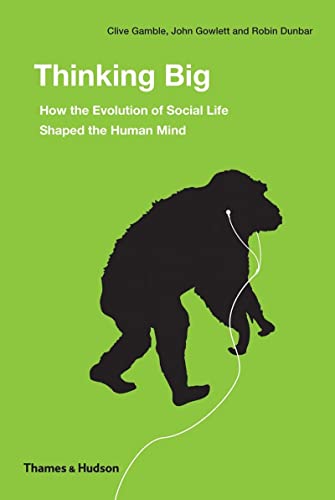
Synopsis
When and how did the brains of our hominin ancestors become human minds? When and why did our capacity for language or art, music and dance evolve? It is the contention of this pathbreaking and provocative book that it was the need for early humans to live in ever-larger social groups, and to maintain social relations over ever-greater distances the ability to think big that drove the enlargement of the human brain and the development of the human mind. This social brain hypothesis, put forward by evolutionary psychologists such as Robin Dunbar, one of the authors of this book, can be tested against archaeological and fossil evidence, as archaeologists Clive Gamble and John Gowlett show in the second part of Thinking Big. Along the way, the three authors touch on subjects as diverse and diverting as the switch from finger-tip grooming to vocal grooming or the crucial importance of making fire for the lengthening of the social day. Ultimately, the social worlds we inhabit today can be traced back to our Stone Age ancestors.
Les informations fournies dans la section « Synopsis » peuvent faire référence à une autre édition de ce titre.
À propos des auteurs
Clive Gamble is a British archaeologist and anthropologist, and Professor of Archaeology at Southampton University. He has been described as the 'UK’s foremost archaeologist investigating our earliest ancestors'.
John Gowlett is Professor of Archaeology, Classics and Egyptology at Liverpool University. He is involved in fieldwork in eastern and southern Africa.
Robin Dunbar is a British anthropologist and evolutionary psychologist specialised in primate behaviour. He is currently head of the Social and Evolutionary Neuroscience Research Group in the Department of Experimental Psychology at the University of Oxford. He is best known for formulating Dunbar's number, a measurement of the 'cognitive limit to the number of individuals with whom any one person can maintain stable relationships'.
À propos de la quatrième de couverture
When and how did the brains of our hominin ancestors become human minds? When and why did our capacity for language or art, music and dance evolve? It is the contention of this pathbreaking and provocative book that it was the need for early humans to live in ever-larger social groups, and to maintain social relations over ever-greater distances the ability to think big that drove the enlargement of the human brain and the development of the human mind. This social brain hypothesis, put forward by evolutionary psychologists such as Robin Dunbar, one of the authors of this book, can be tested against archaeological and fossil evidence, as archaeologists Clive Gamble and John Gowlett show in the second part of Thinking Big. Along the way, the three authors touch on subjects as diverse and diverting as the switch from finger-tip grooming to vocal grooming or the crucial importance of making fire for the lengthening of the social day. Ultimately, the social worlds we inhabit today can be traced back to our Stone Age ancestors.
Les informations fournies dans la section « A propos du livre » peuvent faire référence à une autre édition de ce titre.
Résultats de recherche pour Thinking Big How the Evolution of Social Life Shaped...

Image d'archives
Thinking Big: How the Evolution of Social Life Shaped the Human Mind
Edité par
Thames & Hudson, 2014
ISBN 10 : 0500051801
ISBN 13 : 9780500051801
Ancien ou d'occasion
Paperback
Vendeur : WorldofBooks, Goring-By-Sea, WS, Royaume-Uni
Évaluation du vendeur 5 sur 5 étoiles

Paperback. Etat : Very Good. The book has been read, but is in excellent condition. Pages are intact and not marred by notes or highlighting. The spine remains undamaged. N° de réf. du vendeur GOR006321396
Acheter D'occasion
EUR 15,39
Expédition à EUR 6,53
Expédition depuis Royaume-Uni vers Etats-Unis
Expédition depuis Royaume-Uni vers Etats-Unis
Quantité disponible : 5 disponible(s)
Image d'archives
Thinking Big: How the Evolution of Social Life Shaped the Human Mind
Edité par
Thames & Hudson, 2014
ISBN 10 : 0500051801
ISBN 13 : 9780500051801
Ancien ou d'occasion
Paperback
Vendeur : WorldofBooks, Goring-By-Sea, WS, Royaume-Uni
Évaluation du vendeur 5 sur 5 étoiles
Paperback. Etat : Fair. A readable copy of the book which may include some defects such as highlighting and notes. Cover and pages may be creased and show discolouration. N° de réf. du vendeur GOR015000818
Acheter D'occasion
EUR 15,39
Expédition à EUR 6,53
Expédition depuis Royaume-Uni vers Etats-Unis
Expédition depuis Royaume-Uni vers Etats-Unis
Quantité disponible : 1 disponible(s)
Image d'archives
Thinking Big: How the Evolution of Social Life Shaped the Human Mind
Edité par
Thames & Hudson, 2014
ISBN 10 : 0500051801
ISBN 13 : 9780500051801
Ancien ou d'occasion
Paperback
Vendeur : WorldofBooks, Goring-By-Sea, WS, Royaume-Uni
Évaluation du vendeur 5 sur 5 étoiles
Paperback. Etat : Fine. N° de réf. du vendeur GOR011137561
Acheter D'occasion
EUR 15,39
Expédition à EUR 6,53
Expédition depuis Royaume-Uni vers Etats-Unis
Expédition depuis Royaume-Uni vers Etats-Unis
Quantité disponible : 2 disponible(s)
Image d'archives
Thinking Big : How the Evolution of Social Life Shaped the Human Mind
Edité par
Thames & Hudson, 2014
ISBN 10 : 0500051801
ISBN 13 : 9780500051801
Ancien ou d'occasion
Couverture rigide
Edition originale
Vendeur : Better World Books: West, Reno, NV, Etats-Unis
Évaluation du vendeur 5 sur 5 étoiles
Etat : Good. 1st Edition. Pages intact with minimal writing/highlighting. The binding may be loose and creased. Dust jackets/supplements are not included. Stock photo provided. Product includes identifying sticker. Better World Books: Buy Books. Do Good. N° de réf. du vendeur 7890475-20
Acheter D'occasion
EUR 22,65
Livraison gratuite
Expédition nationale : Etats-Unis
Expédition nationale : Etats-Unis
Quantité disponible : 1 disponible(s)
Image d'archives
Thinking Big: How the Evolution of Social Life Shaped the Human Mind
Vendeur : GoldBooks, Denver, CO, Etats-Unis
Évaluation du vendeur 5 sur 5 étoiles
Hardcover. Etat : new. New Copy. Customer Service Guaranteed. N° de réf. du vendeur 17A95_52_0500051801
Acheter neuf
EUR 42,52
Expédition à EUR 4,84
Expédition nationale : Etats-Unis
Expédition nationale : Etats-Unis
Quantité disponible : 1 disponible(s)
Image d'archives
Thinking Big
Edité par
Thames Hudson, 2014
ISBN 10 : 0500051801
ISBN 13 : 9780500051801
Ancien ou d'occasion
Couverture rigide
Vendeur : Mooney's bookstore, Den Helder, Pays-Bas
Évaluation du vendeur 4 sur 5 étoiles

Etat : Very Good. N° de réf. du vendeur 05602F7B6E3183A
Acheter D'occasion
EUR 35,68
Expédition à EUR 14,95
Expédition depuis Pays-Bas vers Etats-Unis
Expédition depuis Pays-Bas vers Etats-Unis
Quantité disponible : 1 disponible(s)