
Articles liés à Women of the Klan: Racism and Gender in the 1920s
Synopsis
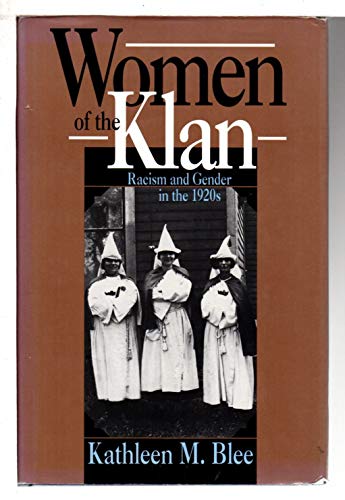
Ignorant. Brutal. Male. One of these stereotypes of the Ku Klux Klan offer a misleading picture. In "Women of the Klan", sociologist Kathleen Blee unveils an accurate portrait of a racist movement that appealed to ordinary people throughout the country. In so doing, she dismantles the popular notion that politically involved women are always inspired by pacifism, equality, and justice. "All the better people," a former Klanswoman assures us, were in the Klan.During the 1920s, perhaps half a million white native-born Protestant women joined the Women's Ku Klux Klan (WKKK). Like their male counterparts, Klanswomen held reactionary views on race, nationality, and religion. But their perspectives on gender roles were often progressive. The Klan publicly asserted that a women's order could safeguard women's suffrage and expand their other legal rights. Privately the WKKK was working to preserve white Protestant supremacy. Blee draws from extensive archival research and interviews with former Klan members and victims to underscore the complexity of extremist right-wing political movements. Issues of women's rights, she argues, do not fit comfortably into the standard dichotomies of "progressive" and "reactionary." These need to be replaced by a more complete understanding of how gender politics are related to the politics of race, religion, and class.
Les informations fournies dans la section « Synopsis » peuvent faire référence à une autre édition de ce titre.
À propos de l'auteur
Kathleen M. Blee is Professor of Sociology at the University of Pittsburgh.
Les informations fournies dans la section « A propos du livre » peuvent faire référence à une autre édition de ce titre.
Résultats de recherche pour Women of the Klan: Racism and Gender in the 1920s

Image fournie par le vendeur
Women of the Klan: Racism and Gender in the 1920s
Edité par
University of California Press, 1992
ISBN 10 : 0520072634
ISBN 13 : 9780520072633
Ancien ou d'occasion
Couverture rigide
Vendeur : Upward Bound Books, VALRICO, FL, Etats-Unis
Évaluation du vendeur 5 sur 5 étoiles

Etat : acceptable. Fully readable with visible signs of use. Cover may have creases, dents, or edge wear. Pages may include writing, highlighting, or folded corners. Binding remains intact. Dust jacket included if originally issued with hardcover. Supplemental items e.g., CDs, codes, or inserts are not guaranteed. We ship daily, Monday through Friday excluding weekends and holidays , in a protective poly mailer for secure delivery. N° de réf. du vendeur UBV.0520072634.A
Acheter D'occasion
EUR 13,69
Expédition à EUR 3,82
Expédition nationale : Etats-Unis
Expédition nationale : Etats-Unis
Quantité disponible : 1 disponible(s)
Image d'archives
Women of the Klan: Racism and Gender in the 1920s
Edité par
University of California Press, 1992
ISBN 10 : 0520072634
ISBN 13 : 9780520072633
Ancien ou d'occasion
Couverture rigide
Vendeur : HPB-Red, Dallas, TX, Etats-Unis
Évaluation du vendeur 5 sur 5 étoiles
hardcover. Etat : Acceptable. Connecting readers with great books since 1972. Used textbooks may not include companion materials such as access codes, etc. May have condition issues including wear and notes/highlighting. We ship orders daily and Customer Service is our top priority! N° de réf. du vendeur S_483293705
Acheter D'occasion
EUR 14,59
Expédition à EUR 3,34
Expédition nationale : Etats-Unis
Expédition nationale : Etats-Unis
Quantité disponible : 1 disponible(s)
Image d'archives
Women of the Klan : Racism and Gender in the 1920s
Edité par
University of California Press, 1992
ISBN 10 : 0520072634
ISBN 13 : 9780520072633
Ancien ou d'occasion
Couverture rigide
Vendeur : Better World Books, Mishawaka, IN, Etats-Unis
Évaluation du vendeur 5 sur 5 étoiles
Etat : Good. Former library copy. Pages intact with minimal writing/highlighting. The binding may be loose and creased. Dust jackets/supplements are not included. Includes library markings. Stock photo provided. Product includes identifying sticker. Better World Books: Buy Books. Do Good. N° de réf. du vendeur GRP15162965
Acheter D'occasion
EUR 18,98
Livraison gratuite
Expédition nationale : Etats-Unis
Expédition nationale : Etats-Unis
Quantité disponible : 1 disponible(s)
Image d'archives
Women of the Klan : Racism and Gender in the 1920s
Edité par
University of California Press, 1992
ISBN 10 : 0520072634
ISBN 13 : 9780520072633
Ancien ou d'occasion
Couverture rigide
Vendeur : Better World Books, Mishawaka, IN, Etats-Unis
Évaluation du vendeur 5 sur 5 étoiles
Etat : Good. Pages intact with minimal writing/highlighting. The binding may be loose and creased. Dust jackets/supplements are not included. Stock photo provided. Product includes identifying sticker. Better World Books: Buy Books. Do Good. N° de réf. du vendeur 5254287-6
Acheter D'occasion
EUR 18,98
Livraison gratuite
Expédition nationale : Etats-Unis
Expédition nationale : Etats-Unis
Quantité disponible : 1 disponible(s)
Image d'archives
Women of the Klan: Racism and Gender in the 1920s
Edité par
University of California Press (edition First Edition), 1992
ISBN 10 : 0520072634
ISBN 13 : 9780520072633
Ancien ou d'occasion
Couverture rigide
Edition originale
Vendeur : BooksRun, Philadelphia, PA, Etats-Unis
Évaluation du vendeur 5 sur 5 étoiles
Hardcover. Etat : Very Good. First Edition. With dust jacket. It's a well-cared-for item that has seen limited use. The item may show minor signs of wear. All the text is legible, with all pages included. It may have slight markings and/or highlighting. N° de réf. du vendeur 0520072634-11-1-29
Acheter D'occasion
EUR 20,69
Livraison gratuite
Expédition nationale : Etats-Unis
Expédition nationale : Etats-Unis
Quantité disponible : 1 disponible(s)
Image d'archives
Women of the Klan: Racism and Gender in the 1920s
Edité par
? University of California Press, 1992
ISBN 10 : 0520072634
ISBN 13 : 9780520072633
Ancien ou d'occasion
Couverture rigide
Vendeur : Recycle Bookstore, San Jose, CA, Etats-Unis
Évaluation du vendeur 4 sur 5 étoiles

Hardcover. N° de réf. du vendeur 1011740
Acheter D'occasion
EUR 18,31
Expédition à EUR 5,12
Expédition nationale : Etats-Unis
Expédition nationale : Etats-Unis
Quantité disponible : 1 disponible(s)
Image d'archives
WOMEN OF THE KLAN: RACISM AND GENDER IN THE 1920'S
Edité par
Berkeley University Of California Press c1991., 1992
ISBN 10 : 0520072634
ISBN 13 : 9780520072633
Ancien ou d'occasion
Couverture rigide
Edition originale
Vendeur : Black Swan Books, Inc., Lexington, KY, Etats-Unis
Évaluation du vendeur 4 sur 5 étoiles
F/F. The dust jacket is protected by a Brodart mylar cover. ; B&W Photographs and illustrations; 8vo.; 228 pages. First Edition. Binding is Hardcover. N° de réf. du vendeur 19740
Acheter D'occasion
EUR 18,35
Expédition à EUR 5,12
Expédition nationale : Etats-Unis
Expédition nationale : Etats-Unis
Quantité disponible : 1 disponible(s)
Image d'archives
Women of the Klan: Racism and Gender in the 1920s
Edité par
University of California Press, 1992
ISBN 10 : 0520072634
ISBN 13 : 9780520072633
Ancien ou d'occasion
Couverture rigide
Edition originale
Vendeur : Jay W. Nelson, Bookseller, IOBA, Austin, MN, Etats-Unis
Évaluation du vendeur 5 sur 5 étoiles
Hardcover. Etat : Near Fine. Etat de la jaquette : Near Fine. 1st Edition. Near fine book and jacket. Name in ink. N° de réf. du vendeur 129062
Acheter D'occasion
EUR 22,02
Expédition à EUR 2,45
Expédition nationale : Etats-Unis
Expédition nationale : Etats-Unis
Quantité disponible : 1 disponible(s)
Image d'archives
Women of the Klan : Racism & Gender in the 1920s
ISBN 10 : 0520072634
ISBN 13 : 9780520072633
Ancien ou d'occasion
Couverture rigide
Edition originale
Vendeur : DBookmahn's Used and Rare Military Books, Burke, VA, Etats-Unis
Évaluation du vendeur 4 sur 5 étoiles
Cloth. Etat : Very Good+. Etat de la jaquette : Very Good+. First Edition. Cloth. Very Good+/Very Good+. First Edition. 8vo - over 7¾" - 9¾" Tall. Book has 229 pages. During the 1920s, as many as half a million white native-born Protestant women joined the Women of the Ku Klux Klan (WKKK). Like their male counterparts, Klanswomen held reactionary views on race, nationality, and religion. But their perspectives on gender roles were often progressive. The WKKK asserted that it cound safeguard white women's suffrage and expand their other legal rights while working to preserve white Protestand supremacy. N° de réf. du vendeur 000352
Acheter D'occasion
EUR 29,82
Expédition à EUR 4,68
Expédition nationale : Etats-Unis
Expédition nationale : Etats-Unis
Quantité disponible : 1 disponible(s)
Image d'archives
Women of the Klan: Racism and Gender in the 1920s
Edité par
University of California Press, 1992
ISBN 10 : 0520072634
ISBN 13 : 9780520072633
Neuf
Couverture rigide
Vendeur : DeckleEdge LLC, Albuquerque, NM, Etats-Unis
Évaluation du vendeur 5 sur 5 étoiles
hardcover. Etat : new. N° de réf. du vendeur Shelfdream0520072634
Acheter neuf
EUR 100,22
Livraison gratuite
Expédition nationale : Etats-Unis
Expédition nationale : Etats-Unis
Quantité disponible : 1 disponible(s)