
Articles liés à MYTH AND REALITY IN THE RAIN FOREST.: How Conservation...
MYTH AND REALITY IN THE RAIN FOREST.: How Conservation Strategies Are Failing in West Africa - Couverture souple
Synopsis
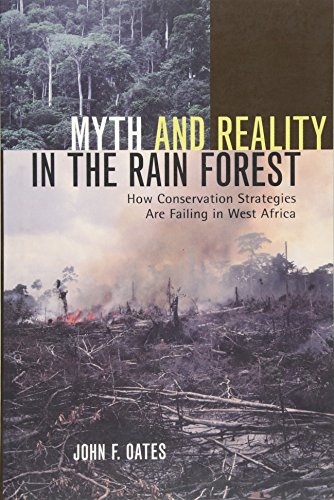
n Myth and Reality in the Rain Forest, John Oates tackles one of the most serious challenges facing the world's conservation leaders today: How can the needs of wildlands and wildlife bc reconciled with the needs of people? Current conservation theory holds that wildlife can best be conserved through promoting human economic development. Oates disagrees. Drawing on more than thirty years' experience as a primate ecologist in West Africa and India, Oates argues that the linking of conservation to economic development has had disastrous consequences for many wildlife populations in the rain forest zone of West Africa. Oates contends that conservation agencies must recognize that economic development is intrinsically incompatible with conservation goals. He urges that conservation planners return to the principle on which many conservation organizations were founded: that nature is worthy of protection for its intrinsic value, as a precious heritage for all of us.
Les informations fournies dans la section « Synopsis » peuvent faire référence à une autre édition de ce titre.
À propos de l'auteur
John F. Oates is Professor of Anthropology at Hunter College and The Graduate School, City University of New York. His most recent books include African Primates: Status Survey and Conservation Action Plan (1996) and Colobine Monkeys: Their Ecology, Behaviour, and Evolution (with A. G. Davies, 1994). He has over thirty years of field experience in biological research and conservation in West Africa, East Africa, and India.
Les informations fournies dans la section « A propos du livre » peuvent faire référence à une autre édition de ce titre.
Résultats de recherche pour MYTH AND REALITY IN THE RAIN FOREST.: How Conservation...

Image d'archives
Myth and Reality in the Rain Forest: How Conservation Strategies are Failing in West Africa
Edité par
University of California Press, 1999
ISBN 10 : 0520222520
ISBN 13 : 9780520222526
Ancien ou d'occasion
Soft cover
Vendeur : N. Fagin Books, Chicago, IL, Etats-Unis
Évaluation du vendeur 5 sur 5 étoiles

Soft cover. Etat : Near Fine. 1999. Natural History, Conservation, Africa. University of California Press. near fine paperback 310p. 1/26. N° de réf. du vendeur -684334598
Acheter D'occasion
EUR 13,73
Expédition à EUR 5,33
Expédition nationale : Etats-Unis
Expédition nationale : Etats-Unis
Quantité disponible : 2 disponible(s)
Image d'archives
Myth and Reality in the Rain Forest: How Conservation Strategies Are Failing in West Africa
Edité par
University of California Press, 1999
ISBN 10 : 0520222520
ISBN 13 : 9780520222526
Ancien ou d'occasion
Couverture souple
Vendeur : World of Books (was SecondSale), Montgomery, IL, Etats-Unis
Évaluation du vendeur 5 sur 5 étoiles
Etat : Good. Good condition ex-library book with usual library markings and stickers. N° de réf. du vendeur 00104406803
Acheter D'occasion
EUR 19,21
Livraison gratuite
Expédition nationale : Etats-Unis
Expédition nationale : Etats-Unis
Quantité disponible : 1 disponible(s)
Image d'archives
Myth and Reality in the Rain Forest: How Conservation Strategies Are Failing in West Africa
Edité par
University of California Press, 1999
ISBN 10 : 0520222520
ISBN 13 : 9780520222526
Ancien ou d'occasion
Couverture souple
Vendeur : World of Books (was SecondSale), Montgomery, IL, Etats-Unis
Évaluation du vendeur 5 sur 5 étoiles
Etat : Very Good. Item in very good condition! Textbooks may not include supplemental items i.e. CDs, access codes etc. N° de réf. du vendeur 00104406796
Acheter D'occasion
EUR 19,21
Livraison gratuite
Expédition nationale : Etats-Unis
Expédition nationale : Etats-Unis
Quantité disponible : 1 disponible(s)
Image d'archives
Myth and Reality in the Rain Forest: How Conservation Strategies Are Failing in West Africa
Edité par
University of California Press, 1999
ISBN 10 : 0520222520
ISBN 13 : 9780520222526
Ancien ou d'occasion
Paperback
Vendeur : ThriftBooks-Dallas, Dallas, TX, Etats-Unis
Évaluation du vendeur 5 sur 5 étoiles
Paperback. Etat : Very Good. No Jacket. Former library book; May have limited writing in cover pages. Pages are unmarked. ~ ThriftBooks: Read More, Spend Less. N° de réf. du vendeur G0520222520I4N10
Acheter D'occasion
EUR 19,87
Livraison gratuite
Expédition nationale : Etats-Unis
Expédition nationale : Etats-Unis
Quantité disponible : 1 disponible(s)
Image d'archives
Myth and Reality in the Rain Forest: How Conservation Strategies Are Failing in West Africa
Edité par
University of California Press (edition First Edition), 1999
ISBN 10 : 0520222520
ISBN 13 : 9780520222526
Ancien ou d'occasion
Paperback
Edition originale
Vendeur : BooksRun, Philadelphia, PA, Etats-Unis
Évaluation du vendeur 5 sur 5 étoiles
Paperback. Etat : Very Good. First Edition. It's a well-cared-for item that has seen limited use. The item may show minor signs of wear. All the text is legible, with all pages included. It may have slight markings and/or highlighting. N° de réf. du vendeur 0520222520-8-1
Acheter D'occasion
EUR 20,05
Livraison gratuite
Expédition nationale : Etats-Unis
Expédition nationale : Etats-Unis
Quantité disponible : 1 disponible(s)
Image d'archives
Myth and Reality in the Rain Forest: How Conservation Strategies Are Failing in West Africa
Edité par
University of California Press October 1999, 1999
ISBN 10 : 0520222520
ISBN 13 : 9780520222526
Ancien ou d'occasion
Paper Back
Vendeur : Isle of Books, Bozeman, MT, Etats-Unis
Évaluation du vendeur 4 sur 5 étoiles

Paper Back. Etat : Good. N° de réf. du vendeur 630270
Acheter D'occasion
EUR 20,13
Livraison gratuite
Expédition nationale : Etats-Unis
Expédition nationale : Etats-Unis
Quantité disponible : 1 disponible(s)
Image d'archives
Myth and Reality in the Rain Forest: How Conservation Strategies Are Failing in West Africa
Edité par
University of California Press, 1999
ISBN 10 : 0520222520
ISBN 13 : 9780520222526
Ancien ou d'occasion
Paperback
Vendeur : World of Books Inc, Montgomery, IL, Etats-Unis
Évaluation du vendeur 4 sur 5 étoiles
Paperback. Etat : Very Good. John Oates tackles one of the most serious challenges facing the world's conservation leaders today: How can the needs of wildlands and wildlife be reconciled with the needs of people? Current conservation theory holds that wildlife can best be protected through the promotion of human economic development. Oates disagrees. Drawing on his extensive experience as a primate ecologist who has worked on rainforest conservation projects in Africa and India, he argues that the linking of conservation to economic development has had disastrous consequences for many wildlife populations, especially in West Africa. He maintains that in those parts of the world where people are very poor, human well-being is more likely to be promoted by large-scale political, social, and economic reforms than by community development schemes associated with conservation projects. N° de réf. du vendeur CIN0520222520VG
Acheter D'occasion
EUR 21,04
Livraison gratuite
Expédition nationale : Etats-Unis
Expédition nationale : Etats-Unis
Quantité disponible : 1 disponible(s)
Image d'archives
Myth and Reality in the Rain Forest: How Conservation Strategies Are Failing in West Africa
Edité par
University of California Press, 1999
ISBN 10 : 0520222520
ISBN 13 : 9780520222526
Ancien ou d'occasion
Paperback
Vendeur : World of Books Inc, Montgomery, IL, Etats-Unis
Évaluation du vendeur 4 sur 5 étoiles
Paperback. Etat : Good. John Oates tackles one of the most serious challenges facing the world's conservation leaders today: How can the needs of wildlands and wildlife be reconciled with the needs of people? Current conservation theory holds that wildlife can best be protected through the promotion of human economic development. Oates disagrees. Drawing on his extensive experience as a primate ecologist who has worked on rainforest conservation projects in Africa and India, he argues that the linking of conservation to economic development has had disastrous consequences for many wildlife populations, especially in West Africa. He maintains that in those parts of the world where people are very poor, human well-being is more likely to be promoted by large-scale political, social, and economic reforms than by community development schemes associated with conservation projects. N° de réf. du vendeur CIN0520222520G
Acheter D'occasion
EUR 21,04
Livraison gratuite
Expédition nationale : Etats-Unis
Expédition nationale : Etats-Unis
Quantité disponible : 1 disponible(s)
Image d'archives
Myth and Reality in the Rain Forest: How Conservation Strategies Are Failing in West Africa
Edité par
University of California Press, 1999
ISBN 10 : 0520222520
ISBN 13 : 9780520222526
Ancien ou d'occasion
Paperback
Vendeur : WorldofBooks, Goring-By-Sea, WS, Royaume-Uni
Évaluation du vendeur 5 sur 5 étoiles
Paperback. Etat : Very Good. The book has been read, but is in excellent condition. Pages are intact and not marred by notes or highlighting. The spine remains undamaged. N° de réf. du vendeur GOR004504212
Acheter D'occasion
EUR 25,50
Expédition à EUR 6,59
Expédition depuis Royaume-Uni vers Etats-Unis
Expédition depuis Royaume-Uni vers Etats-Unis
Quantité disponible : 1 disponible(s)
Image fournie par le vendeur
Myth and Reality in the Rain Forest: How Conservation Strategies Are Failing in West Africa
Edité par
University of California Press, 1999
ISBN 10 : 0520222520
ISBN 13 : 9780520222526
Ancien ou d'occasion
paperback
Vendeur : WeBuyBooks, Rossendale, LANCS, Royaume-Uni
Évaluation du vendeur 5 sur 5 étoiles
paperback. Etat : Very Good. Most items will be dispatched the same or the next working day. A copy that has been read, but is in excellent condition. Pages are intact and not marred by notes or highlighting. The spine remains undamaged. N° de réf. du vendeur rev3577093162
Acheter D'occasion
EUR 28,75
Expédition à EUR 7,94
Expédition depuis Royaume-Uni vers Etats-Unis
Expédition depuis Royaume-Uni vers Etats-Unis
Quantité disponible : 1 disponible(s)