
Articles liés à Origins of Democracy in Ancient Greece
Synopsis
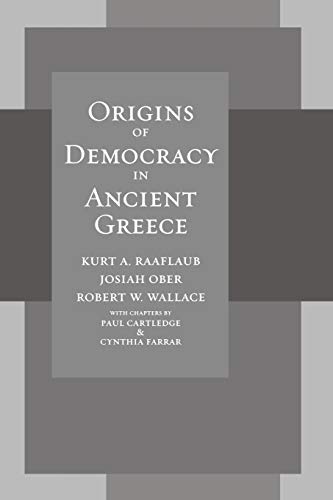
This book presents a state-of-the-art debate about the origins of Athenian democracy by five eminent scholars. The result is a stimulating, critical exploration and interpretation of the extant evidence on this intriguing and important topic. The authors address such questions as: Why was democracy first realized in ancient Greece? Was democracy "invented" or did it evolve over a long period of time? What were the conditions for democracy, the social and political foundations that made this development possible? And what factors turned the possibility of democracy into necessity and reality? The authors first examine the conditions in early Greek society that encouraged equality and "people's power." They then scrutinize, in their social and political contexts, three crucial points in the evolution of democracy: the reforms connected with the names of Solon, Cleisthenes, and Ephialtes in the early and late sixth and mid-fifth century. Finally, an ancient historian and a political scientist review the arguments presented in the previous chapters and add their own perspectives, asking what lessons we can draw today from the ancient democratic experience. Designed for a general readership as well as students and scholars, the book intends to provoke discussion by presenting side by side the evidence and arguments that support various explanations of the origins of democracy, thus enabling readers to join in the debate and draw their own conclusions.
Les informations fournies dans la section « Synopsis » peuvent faire référence à une autre édition de ce titre.
À propos de l'auteur
Kurt Raaflaub is David Herlihy University Professor and Professor of Classics and History at Brown University. His most recent book is The Discovery of Freedom in Ancient Greece. Josiah Ober is Constantine Mitsotakis Professor of Political Science and Classics at Stanford University. His books include Athenian Legacies: Essays on the Politics of Going on Together. Robert Wallace is Professor of Ancient History at Northwestern University and author of The Areopagus Council to 307 BC, among other books. Paul Cartledge is currently Professor of Greek History in the Faculty of Classics and Professorial Fellow of Clare College, University of Cambridge, and author of several volumes including Spartan Reflections (UC Press). Cynthia Farrar directs a project on deliberation and local governance at Yale's Institution for Social and Policy Studies (ISPS) and teaches in the Political Science Department. She is the author of The Origins of Democratic Thinking: The Invention of Politics in Classical Athens.
Les informations fournies dans la section « A propos du livre » peuvent faire référence à une autre édition de ce titre.
Résultats de recherche pour Origins of Democracy in Ancient Greece

Image d'archives
Origins of Democracy in Ancient Greece
Edité par
University of California Press, 2008
ISBN 10 : 0520258096
ISBN 13 : 9780520258099
Ancien ou d'occasion
Paperback
Vendeur : World of Books (was SecondSale), Montgomery, IL, Etats-Unis
Évaluation du vendeur 5 sur 5 étoiles

Paperback. Etat : Fair. This book presents a state-of-the-art debate about the origins of Athenian democracy by five eminent scholars. The result is a stimulating, critical exploration and interpretation of the extant evidence on this intriguing and important topic. The authors address such questions as: Why was democracy first realized in ancient Greece? Was democracy invented or did it evolve over a long period of time? What were the conditions for democracy, the social and political foundations that made this development possible? And what factors turned the possibility of democracy into necessity and reality? The authors first examine the conditions in early Greek society that encouraged equality and people's power. They then scrutinize, in their social and political contexts, three crucial points in the evolution of democracy: the reforms connected with the names of Solon, Cleisthenes, and Ephialtes in the early and late sixth and mid-fifth century. Finally, an ancient historian and a political scientist review the arguments presented in the previous chapters and add their own perspectives, asking what lessons we can draw today from the ancient democratic experience. Designed for a general readership as well as students and scholars, the book intends to provoke discussion by presenting side by side the evidence and arguments that support various explanations of the origins of democracy, thus enabling readers to join in the debate and draw their own conclusions. N° de réf. du vendeur 00108373038
Acheter D'occasion
EUR 10,35
Livraison gratuite
Expédition nationale : Etats-Unis
Expédition nationale : Etats-Unis
Quantité disponible : 1 disponible(s)
Image d'archives
Origins of Democracy in Ancient Greece
Edité par
University of California Press, 2008
ISBN 10 : 0520258096
ISBN 13 : 9780520258099
Ancien ou d'occasion
Paperback
Vendeur : World of Books (was SecondSale), Montgomery, IL, Etats-Unis
Évaluation du vendeur 5 sur 5 étoiles
Paperback. Etat : Good. This book presents a state-of-the-art debate about the origins of Athenian democracy by five eminent scholars. The result is a stimulating, critical exploration and interpretation of the extant evidence on this intriguing and important topic. The authors address such questions as: Why was democracy first realized in ancient Greece? Was democracy invented or did it evolve over a long period of time? What were the conditions for democracy, the social and political foundations that made this development possible? And what factors turned the possibility of democracy into necessity and reality? The authors first examine the conditions in early Greek society that encouraged equality and people's power. They then scrutinize, in their social and political contexts, three crucial points in the evolution of democracy: the reforms connected with the names of Solon, Cleisthenes, and Ephialtes in the early and late sixth and mid-fifth century. Finally, an ancient historian and a political scientist review the arguments presented in the previous chapters and add their own perspectives, asking what lessons we can draw today from the ancient democratic experience. Designed for a general readership as well as students and scholars, the book intends to provoke discussion by presenting side by side the evidence and arguments that support various explanations of the origins of democracy, thus enabling readers to join in the debate and draw their own conclusions. N° de réf. du vendeur CIN0520258096G
Acheter D'occasion
EUR 10,35
Livraison gratuite
Expédition nationale : Etats-Unis
Expédition nationale : Etats-Unis
Quantité disponible : 1 disponible(s)
Image d'archives
Origins of Democracy in Ancient Greece
Edité par
University of California Press, 2007
ISBN 10 : 0520258096
ISBN 13 : 9780520258099
Ancien ou d'occasion
Paperback
Vendeur : Fox and Tome Books, Frederick, MD, Etats-Unis
Évaluation du vendeur 4 sur 5 étoiles

Paperback. Etat : Very Good. A nice copy. No writing or highlighting. Clean pages, shows very minimal signs of wear from use. Shipped with care. Feel free to inquire for photos or more details. N° de réf. du vendeur 260828-shelf-76-027
Acheter D'occasion
EUR 11,01
Livraison gratuite
Expédition nationale : Etats-Unis
Expédition nationale : Etats-Unis
Quantité disponible : 1 disponible(s)
Image d'archives
Origins of Democracy in Ancient Greece
Edité par
University of California Press, 2008
ISBN 10 : 0520258096
ISBN 13 : 9780520258099
Ancien ou d'occasion
Paperback
Vendeur : World of Books Inc, Montgomery, IL, Etats-Unis
Évaluation du vendeur 4 sur 5 étoiles
Paperback. Etat : Fair. This book presents a state-of-the-art debate about the origins of Athenian democracy by five eminent scholars. The result is a stimulating, critical exploration and interpretation of the extant evidence on this intriguing and important topic. The authors address such questions as: Why was democracy first realized in ancient Greece? Was democracy invented or did it evolve over a long period of time? What were the conditions for democracy, the social and political foundations that made this development possible? And what factors turned the possibility of democracy into necessity and reality? The authors first examine the conditions in early Greek society that encouraged equality and people's power. They then scrutinize, in their social and political contexts, three crucial points in the evolution of democracy: the reforms connected with the names of Solon, Cleisthenes, and Ephialtes in the early and late sixth and mid-fifth century. Finally, an ancient historian and a political scientist review the arguments presented in the previous chapters and add their own perspectives, asking what lessons we can draw today from the ancient democratic experience. Designed for a general readership as well as students and scholars, the book intends to provoke discussion by presenting side by side the evidence and arguments that support various explanations of the origins of democracy, thus enabling readers to join in the debate and draw their own conclusions. N° de réf. du vendeur CIN0520258096A
Acheter D'occasion
EUR 12,18
Livraison gratuite
Expédition nationale : Etats-Unis
Expédition nationale : Etats-Unis
Quantité disponible : 1 disponible(s)
Image d'archives
Origins of Democracy in Ancient Greece
Edité par
University of California Press, 2008
ISBN 10 : 0520258096
ISBN 13 : 9780520258099
Ancien ou d'occasion
Paperback
Vendeur : World of Books Inc, Montgomery, IL, Etats-Unis
Évaluation du vendeur 4 sur 5 étoiles
Paperback. Etat : Good. This book presents a state-of-the-art debate about the origins of Athenian democracy by five eminent scholars. The result is a stimulating, critical exploration and interpretation of the extant evidence on this intriguing and important topic. The authors address such questions as: Why was democracy first realized in ancient Greece? Was democracy invented or did it evolve over a long period of time? What were the conditions for democracy, the social and political foundations that made this development possible? And what factors turned the possibility of democracy into necessity and reality? The authors first examine the conditions in early Greek society that encouraged equality and people's power. They then scrutinize, in their social and political contexts, three crucial points in the evolution of democracy: the reforms connected with the names of Solon, Cleisthenes, and Ephialtes in the early and late sixth and mid-fifth century. Finally, an ancient historian and a political scientist review the arguments presented in the previous chapters and add their own perspectives, asking what lessons we can draw today from the ancient democratic experience. Designed for a general readership as well as students and scholars, the book intends to provoke discussion by presenting side by side the evidence and arguments that support various explanations of the origins of democracy, thus enabling readers to join in the debate and draw their own conclusions. N° de réf. du vendeur CIN0520258096G
Acheter D'occasion
EUR 12,18
Livraison gratuite
Expédition nationale : Etats-Unis
Expédition nationale : Etats-Unis
Quantité disponible : 1 disponible(s)
Image d'archives
Origins of Democracy in Ancient Greece
Edité par
University of California Press, 2008
ISBN 10 : 0520258096
ISBN 13 : 9780520258099
Ancien ou d'occasion
paperback
Vendeur : HPB-Diamond, Dallas, TX, Etats-Unis
Évaluation du vendeur 5 sur 5 étoiles
paperback. Etat : Very Good. Connecting readers with great books since 1972! Used books may not include companion materials, and may have some shelf wear or limited writing. We ship orders daily and Customer Service is our top priority! N° de réf. du vendeur S_485227732
Acheter D'occasion
EUR 14,68
Expédition à EUR 3,34
Expédition nationale : Etats-Unis
Expédition nationale : Etats-Unis
Quantité disponible : 1 disponible(s)
Image d'archives
Origins of Democracy in Ancient Greece
Edité par
University of California Press, 2008
ISBN 10 : 0520258096
ISBN 13 : 9780520258099
Ancien ou d'occasion
Paperback
Vendeur : Sequitur Books, Boonsboro, MD, Etats-Unis
Évaluation du vendeur 5 sur 5 étoiles
Paperback. Etat : As New. Softcover. Good binding and cover. Light edge wear. Faint stain to cover. Clean, unmarked pages. N° de réf. du vendeur 2608110054
Acheter D'occasion
EUR 21,02
Expédition à EUR 5,32
Expédition nationale : Etats-Unis
Expédition nationale : Etats-Unis
Quantité disponible : 1 disponible(s)
Image d'archives
ORIGINS OF DEMOCRACY IN ANCIENT GREECE
Edité par
University of California Press, 2008
ISBN 10 : 0520258096
ISBN 13 : 9780520258099
Ancien ou d'occasion
Softcover
Vendeur : Ancient World Books, Toronto, ON, Canada
Évaluation du vendeur 5 sur 5 étoiles
Softcover. Etat : Very Good. Underlining in pencil to a few pages. Remainder mark to base of textblock (small black felt marker line).; Joan Palevsky Imprint in Classical Literature; 5.5 X 0.65 X 9 inches; 258 pages. N° de réf. du vendeur 42388
Acheter D'occasion
EUR 21,11
Expédition à EUR 6,68
Expédition depuis Canada vers Etats-Unis
Expédition depuis Canada vers Etats-Unis
Quantité disponible : 1 disponible(s)
Image fournie par le vendeur
Origins of Democracy in Ancient Greece
Edité par
University of California Press, 2008
ISBN 10 : 0520258096
ISBN 13 : 9780520258099
Neuf
Couverture souple
Vendeur : GreatBookPrices, Columbia, MD, Etats-Unis
Évaluation du vendeur 5 sur 5 étoiles
Etat : New. N° de réf. du vendeur 5630638-n
Acheter neuf
EUR 28,46
Expédition à EUR 2,35
Expédition nationale : Etats-Unis
Expédition nationale : Etats-Unis
Quantité disponible : 11 disponible(s)
Image d'archives
Origins of Democracy in Ancient Greece (Paperback)
Edité par
University of California Press, Berkerley, 2008
ISBN 10 : 0520258096
ISBN 13 : 9780520258099
Neuf
Paperback
Vendeur : Grand Eagle Retail, Bensenville, IL, Etats-Unis
Évaluation du vendeur 5 sur 5 étoiles
Paperback. Etat : new. Paperback. This book presents a state-of-the-art debate about the origins of Athenian democracy by five eminent scholars. The result is a stimulating, critical exploration and interpretation of the extant evidence on this intriguing and important topic. The authors address such questions as: Why was democracy first realized in ancient Greece? Was democracy "invented" or did it evolve over a long period of time? What were the conditions for democracy, the social and political foundations that made this development possible? And what factors turned the possibility of democracy into necessity and reality? The authors first examine the conditions in early Greek society that encouraged equality and "people's power." They then scrutinize, in their social and political contexts, three crucial points in the evolution of democracy: the reforms connected with the names of Solon, Cleisthenes, and Ephialtes in the early and late sixth and mid-fifth century. Finally, an ancient historian and a political scientist review the arguments presented in the previous chapters and add their own perspectives, asking what lessons we can draw today from the ancient democratic experience. Designed for a general readership as well as students and scholars, the book intends to provoke discussion by presenting side by side the evidence and arguments that support various explanations of the origins of democracy, thus enabling readers to join in the debate and draw their own conclusions. Presents a debate about the origins of Athenian democracy. This book addresses such questions as: Why was democracy first realized in ancient Greece? Was democracy 'invented' or did it evolve over a long period of time? And what were the conditions for democracy, the social and political foundations that made this development possible? Shipping may be from multiple locations in the US or from the UK, depending on stock availability. N° de réf. du vendeur 9780520258099
Acheter neuf
EUR 30,88
Livraison gratuite
Expédition nationale : Etats-Unis
Expédition nationale : Etats-Unis
Quantité disponible : 1 disponible(s)