
Articles liés à Killing Consensus: Police, Organized Crime, and the...
Killing Consensus: Police, Organized Crime, and the Regulation of Life and Death in Urban Brazil - Couverture souple
Synopsis
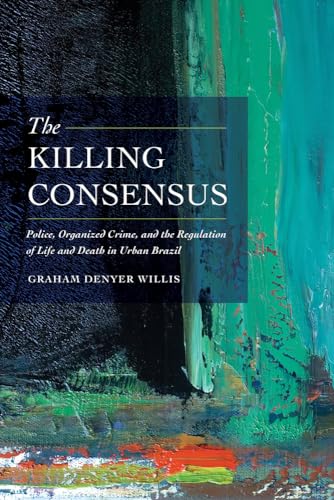
We hold many assumptions about police work-that it is the responsibility of the state, or that police officers are given the right to kill in the name of public safety or self-defense. But in The Killing Consensus, Graham Denyer Willis shows how in São Paulo, Brazil, killing and the arbitration of "normal" killing in the name of social order are actually conducted by two groups-the police and organized crime-both operating according to parallel logics of murder. Based on three years of ethnographic fieldwork, Willis's book traces how homicide detectives categorize two types of killing: the first resulting from "resistance" to police arrest (which is often broadly defined) and the second at the hands of a crime "family' known as the Primeiro Comando da Capital (PCC). Death at the hands of police happens regularly, while the PCC's centralized control and strict moral code among criminals has also routinized killing, ironically making the city feel safer for most residents. In a fractured urban security environment, where killing mirrors patterns of inequitable urbanization and historical exclusion along class, gender, and racial lines, Denyer Willis's research finds that the city's cyclical periods of peace and violence can best be understood through an unspoken but mutually observed consensus on the right to kill. This consensus hinges on common notions and street-level practices of who can die, where, how, and by whom, revealing an empirically distinct configuration of authority that Denyer Willis calls sovereignty by consensus.
Les informations fournies dans la section « Synopsis » peuvent faire référence à une autre édition de ce titre.
À propos de l'auteur
Graham Denyer Willis is a University Lecturer at the Centres of Development and Latin American Studies and a Fellow at Queens' College, University of Cambridge.
Les informations fournies dans la section « A propos du livre » peuvent faire référence à une autre édition de ce titre.
Résultats de recherche pour Killing Consensus: Police, Organized Crime, and the...

Image fournie par le vendeur
Killing Consensus: Police, Organized Crime, and the Regulation of Life and Death in Urban Brazil
Edité par
University of California Press, 2015
ISBN 10 : 0520285719
ISBN 13 : 9780520285712
Ancien ou d'occasion
Couverture souple
Vendeur : Bay State Book Company, North Smithfield, RI, Etats-Unis
Évaluation du vendeur 5 sur 5 étoiles

Etat : very_good. N° de réf. du vendeur BSM.1BVEN
Acheter D'occasion
EUR 4,62
Livraison gratuite
Expédition nationale : Etats-Unis
Expédition nationale : Etats-Unis
Quantité disponible : 1 disponible(s)
Image d'archives
The Killing Consensus: Police, Organized Crime, and the Regulation of Life and Death in Urban Brazil
Edité par
University of California Press, 2015
ISBN 10 : 0520285719
ISBN 13 : 9780520285712
Ancien ou d'occasion
Paperback
Vendeur : World of Books (was SecondSale), Montgomery, IL, Etats-Unis
Évaluation du vendeur 5 sur 5 étoiles
Paperback. Etat : Very Good. Shows how in Sao Paulo, Brazil, killing and the arbitration of normal killing in the name of social order are actually conducted by two groups the police and organized crime both operating according to parallel logics of murder. N° de réf. du vendeur 00109619347
Acheter D'occasion
EUR 5,51
Livraison gratuite
Expédition nationale : Etats-Unis
Expédition nationale : Etats-Unis
Quantité disponible : 1 disponible(s)
Image d'archives
The Killing Consensus: Police, Organized Crime, and the Regulation of Life and Death in Urban Brazil
Edité par
University of California Press, 2015
ISBN 10 : 0520285719
ISBN 13 : 9780520285712
Ancien ou d'occasion
Paperback
Vendeur : World of Books Inc, Montgomery, IL, Etats-Unis
Évaluation du vendeur 4 sur 5 étoiles

Paperback. Etat : Very Good. Shows how in Sao Paulo, Brazil, killing and the arbitration of normal killing in the name of social order are actually conducted by two groups the police and organized crime both operating according to parallel logics of murder. N° de réf. du vendeur CIN0520285719VG
Acheter D'occasion
EUR 7,35
Livraison gratuite
Expédition nationale : Etats-Unis
Expédition nationale : Etats-Unis
Quantité disponible : 1 disponible(s)
Image d'archives
The Killing Consensus : Police, Organized Crime, and the Regulation of Life and Death in Urban Brazil
Edité par
University of California Press, 2015
ISBN 10 : 0520285719
ISBN 13 : 9780520285712
Ancien ou d'occasion
Couverture souple
Vendeur : Better World Books: West, Reno, NV, Etats-Unis
Évaluation du vendeur 5 sur 5 étoiles
Etat : Very Good. Former library copy. Pages intact with possible writing/highlighting. Binding strong with minor wear. Dust jackets/supplements may not be included. Includes library markings. Stock photo provided. Product includes identifying sticker. Better World Books: Buy Books. Do Good. N° de réf. du vendeur 15065735-75
Acheter D'occasion
EUR 8,35
Livraison gratuite
Expédition nationale : Etats-Unis
Expédition nationale : Etats-Unis
Quantité disponible : 1 disponible(s)
Image fournie par le vendeur
Killing Consensus: Police, Organized Crime, and the Regulation of Life and Death in Urban Brazil
Edité par
University of California Press, 2015
ISBN 10 : 0520285719
ISBN 13 : 9780520285712
Ancien ou d'occasion
Couverture souple
Vendeur : Goodwill San Antonio, San Antonio, TX, Etats-Unis
Évaluation du vendeur 5 sur 5 étoiles
Etat : good. N° de réf. du vendeur SANV.0520285719.G
Acheter D'occasion
EUR 5,51
Expédition à EUR 3,56
Expédition nationale : Etats-Unis
Expédition nationale : Etats-Unis
Quantité disponible : 1 disponible(s)
Image d'archives
The Killing Consensus
Edité par
University of California Press, 2015
ISBN 10 : 0520285719
ISBN 13 : 9780520285712
Ancien ou d'occasion
Paperback
Vendeur : Textbook Bookie, Little Rock, AR, Etats-Unis
Évaluation du vendeur 4 sur 5 étoiles
Paperback. Etat : Good. Book in Good condition. N° de réf. du vendeur 9780520285712-good
Acheter D'occasion
EUR 9,19
Expédition à EUR 3,79
Expédition nationale : Etats-Unis
Expédition nationale : Etats-Unis
Quantité disponible : 4 disponible(s)
Image d'archives
Killing Consensus: Police, Organized Crime, and the Regulation of Life and Death in Urban Brazil
Vendeur : Goodmediandmore, Asheville, NC, Etats-Unis
Évaluation du vendeur 5 sur 5 étoiles
paperback. Etat : Good. Light wear to edges. Overall good condition. Ships next business day from NC. N° de réf. du vendeur S159-TS26-19.95-040726-G-2.9M-008
Acheter D'occasion
EUR 14,49
Expédition à EUR 4,02
Expédition nationale : Etats-Unis
Expédition nationale : Etats-Unis
Quantité disponible : 1 disponible(s)
Image d'archives
Killing Consensus: Police, Organized Crime, and the Regulation of Life and Death in Urban Brazil
Vendeur : AwesomeBooks, Wallingford, Royaume-Uni
Évaluation du vendeur 5 sur 5 étoiles
Paperback. Etat : Very Good. Killing Consensus: Police, Organized Crime, and the Regulation of Life and Death in Urban Brazil This book is in very good condition and will be shipped within 24 hours of ordering. The cover may have some limited signs of wear but the pages are clean, intact and the spine remains undamaged. This book has clearly been well maintained and looked after thus far. Money back guarantee if you are not satisfied. See all our books here, order more than 1 book and get discounted shipping. N° de réf. du vendeur 7719-9780520285712
Acheter D'occasion
EUR 22,16
Expédition à EUR 4,88
Expédition depuis Royaume-Uni vers Etats-Unis
Expédition depuis Royaume-Uni vers Etats-Unis
Quantité disponible : 2 disponible(s)
Image fournie par le vendeur
Killing Consensus : Police, Organized Crime, and the Regulation of Life and Death in Urban Brazil
Edité par
University of California Press, 2015
ISBN 10 : 0520285719
ISBN 13 : 9780520285712
Ancien ou d'occasion
Couverture souple
Vendeur : GreatBookPrices, Columbia, MD, Etats-Unis
Évaluation du vendeur 5 sur 5 étoiles
Etat : As New. Unread book in perfect condition. N° de réf. du vendeur 22183176
Acheter D'occasion
EUR 27,18
Expédition à EUR 2,36
Expédition nationale : Etats-Unis
Expédition nationale : Etats-Unis
Quantité disponible : 3 disponible(s)
Image d'archives
Killing Consensus Police, Organized Crime, and the Regulation of Life and Death in Urban Brazil
Edité par
University of California Press, 2015
ISBN 10 : 0520285719
ISBN 13 : 9780520285712
Ancien ou d'occasion
Paperback
Vendeur : Skoob-ebooks, Pontiac, QC, Canada
Évaluation du vendeur 5 sur 5 étoiles
Paperback. Etat : Good. A clean copy containing no highlighting, underlining or margin notes but with some wear and other blemishes. The binding is tight and all of the pages are clean and intact. The book cover is intact with some wear and other blemishes including some corners that are scuffed, frayed and/or curled. We are 100% Canadian proud and we provide free shipping, a stellar return policy and outstanding customer service. ; 6 X 0.8 X 9 inches; 216 pages. N° de réf. du vendeur SH-QWQB-WFLU
Acheter D'occasion
EUR 18,51
Expédition à EUR 11,60
Expédition depuis Canada vers Etats-Unis
Expédition depuis Canada vers Etats-Unis
Quantité disponible : 1 disponible(s)