
Articles liés à The Cambridge Ancient History
Synopsis
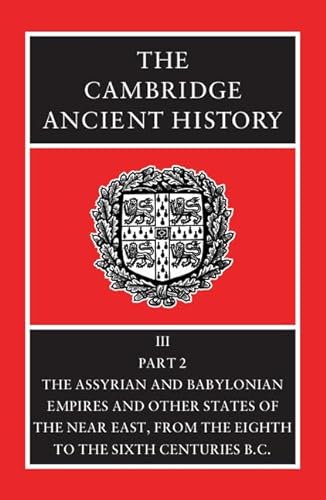
Volume III Part II carries on the history of the Near East from the close of Volume III Part I and covers roughly the same chronological period as Volume III Part III. During this period the dominant powers in the East were Assyria and then Babylonia. Each established an extensive empire which was based on Mesopotamia, and each in turn fell largely through internal strife. Assyrian might was reflected in the imposing palaces, libraries and sculptures of the Assyrian kings. Babylonian culture was outstanding in literature, mathematics and astronomy, and the great buildings of Nebuchadnezzar II surpassed even those of the Assyrian kings. Israel and Judah suffered at the hands of both imperial powers, Jerusalem being destroyed and part of the population deported to Babylon; and Egypt was weakened by an Assyrian invasion. The Phoenicians found a new outlet in colonising and founded Carthage. A number of small, vigorous kingdoms developed in Asia Minor, while from the north and north east the Scythian nomadic tribes pressed down upon Turkey and the Danube valley, but found their match in the Thracian tribes which held south-eastern Europe and parts of western Turkey. The burials of the chieftains of both peoples were remarkable for the great wealth of offerings.
Les informations fournies dans la section « Synopsis » peuvent faire référence à une autre édition de ce titre.
Présentation de l'éditeur
Volume III Part II carries on the history of the Near East from the close of Volume III Part I and covers roughly the same chronological period as Volume III Part III. During this period the dominant powers in the East were Assyria and then Babylonia. Each established an extensive empire which was based on Mesopotamia, and each in turn fell largely through internal strife. Assyrian might was reflected in the imposing palaces, libraries and sculptures of the Assyrian kings. Babylonian culture was outstanding in literature, mathematics and astronomy, and the great buildings of Nebuchadnezzar II surpassed even those of the Assyrian kings. Israel and Judah suffered at the hands of both imperial powers, Jerusalem being destroyed and part of the population deported to Babylon; and Egypt was weakened by an Assyrian invasion. The Phoenicians found a new outlet in colonising and founded Carthage. A number of small, vigorous kingdoms developed in Asia Minor, while from the north and north east the Scythian nomadic tribes pressed down upon Turkey and the Danube valley, but found their match in the Thracian tribes which held south-eastern Europe and parts of western Turkey. The burials of the chieftains of both peoples were remarkable for the great wealth of offerings.
Revue de presse
"The answer to the question whether the ancient world is worth studying is 'yes', and the Cambridge Ancient History proves it....CAH III/2 is an impressive achievement." John Ray, Times Literary Supplement
Les informations fournies dans la section « A propos du livre » peuvent faire référence à une autre édition de ce titre.
Résultats de recherche pour The Cambridge Ancient History

Image d'archives
The Cambridge Ancient History
Edité par
Cambridge University Press, 1992
ISBN 10 : 0521227178
ISBN 13 : 9780521227179
Ancien ou d'occasion
Couverture rigide
Vendeur : ThriftBooks-Atlanta, AUSTELL, GA, Etats-Unis
Évaluation du vendeur 5 sur 5 étoiles

Hardcover. Etat : Good. No Jacket. Former library book; Missing dust jacket; Pages can have notes/highlighting. Spine may show signs of wear. ~ ThriftBooks: Read More, Spend Less. N° de réf. du vendeur G0521227178I3N11
Acheter D'occasion
EUR 91,37
Livraison gratuite
Expédition nationale : Etats-Unis
Expédition nationale : Etats-Unis
Quantité disponible : 1 disponible(s)
Image d'archives
The Cambridge Ancient History
Edité par
Cambridge University Press, 1992
ISBN 10 : 0521227178
ISBN 13 : 9780521227179
Ancien ou d'occasion
Couverture rigide
Vendeur : Better World Books, Mishawaka, IN, Etats-Unis
Évaluation du vendeur 5 sur 5 étoiles
Etat : Good. Former library copy. Pages intact with minimal writing/highlighting. The binding may be loose and creased. Dust jackets/supplements are not included. Includes library markings. Stock photo provided. Product includes identifying sticker. Better World Books: Buy Books. Do Good. N° de réf. du vendeur GRP16500515
Acheter D'occasion
EUR 96,17
Livraison gratuite
Expédition nationale : Etats-Unis
Expédition nationale : Etats-Unis
Quantité disponible : 1 disponible(s)
Image d'archives
Cambridge Ancient History Volume III, Part 2; The Assyrian and Babylonian Empires and Other States of the Near East, from the Eighth to the Sixth Centuries BC
Edité par
Cambridge University Press, Cambridge, 1991
ISBN 10 : 0521227178
ISBN 13 : 9780521227179
Ancien ou d'occasion
Couverture rigide
Vendeur : 4 THE WORLD RESOURCE DISTRIBUTORS, Springfield, MO, Etats-Unis
Évaluation du vendeur 5 sur 5 étoiles
Hardcover. Etat : Good. Second Edition. Volume 3 Part 2 only. Second edition, 1991. 906 pages.; Ex-Library; 8vo 8" - 9" tall; 906 pages. N° de réf. du vendeur 090587
Acheter D'occasion
EUR 138,46
Expédition à EUR 4,47
Expédition nationale : Etats-Unis
Expédition nationale : Etats-Unis
Quantité disponible : 1 disponible(s)
Image fournie par le vendeur
THE CAMBRIDGE ANCIENT HISTORY VOLUME III PART 2 The Assyrian and Babylonian Empires and Other States of the Near East, from the Eighth to the Sixth Centuries B. C.
Edité par
Cambridge University Press, 1993
ISBN 10 : 0521227178
ISBN 13 : 9780521227179
Ancien ou d'occasion
Couverture rigide
Vendeur : Easton's Books, Inc., Mount Vernon, WA, Etats-Unis
Évaluation du vendeur 5 sur 5 étoiles
Hardcover. Etat : VG+. Reprint. Hardback in Very Good+ condition with Very Good+ dust jacket. 6.4 X 2 X 9.2 inches. 926 pages. Clean, unmarked interior. Tight binding, sharp corners, and only mild shelf wear. Minimal dust jacket wear. Quick shipping, excellent customer service. All books carefully packaged in boxes and ship with tracking information. N° de réf. du vendeur 73960
Acheter D'occasion
EUR 138,46
Expédition à EUR 5,37
Expédition nationale : Etats-Unis
Expédition nationale : Etats-Unis
Quantité disponible : 1 disponible(s)
Image fournie par le vendeur
THE CAMBRIDGE ANCIENT HISTORY Volume III Part 2. The Assyrian and Babylonian Empires and Other States of the Near East, from the Eighth to the Sixth Centuries B.C.
Edité par
Cambridge University Press, 1996
ISBN 10 : 0521227178
ISBN 13 : 9780521227179
Ancien ou d'occasion
Couverture rigide
Vendeur : GfB, the Colchester Bookshop, Colchester, Royaume-Uni
Évaluation du vendeur 5 sur 5 étoiles
Hardcover. Etat : Good. Etat de la jaquette : Good. Cambridge University Press, 1996, 2nd edition reprint. Hardback, d/j, 8vo, xix,906pp, illust. A good copy. 0521227178/1.3uk. N° de réf. du vendeur 378718
Acheter D'occasion
EUR 123,60
Expédition à EUR 25,80
Expédition depuis Royaume-Uni vers Etats-Unis
Expédition depuis Royaume-Uni vers Etats-Unis
Quantité disponible : 1 disponible(s)
Image d'archives
The Cambridge Ancient History, Volume 3, Part 2: The Assyrian and Babylonian Empires and Other States of the Near East, from the Eighth to the Sixth Centuries BC
Edité par
Cambridge University Press, 1992
ISBN 10 : 0521227178
ISBN 13 : 9780521227179
Ancien ou d'occasion
Couverture rigide
Vendeur : Salish Sea Books, Bellingham, WA, Etats-Unis
Évaluation du vendeur 5 sur 5 étoiles
Etat : Good. Good+; Hardcover, Missing Jacket; Withdrawn library copy with the standard library markings; Light wear to the covers; Library stamps to the endpapers; Text pages are clean & unmarked; Binding is excellent with a straight spine; This book will be shipped in a sturdy cardboard box with foam padding; Medium Format (8.5" - 9.75" tall); 3.0 lbs; Dark orange cloth-covered boards with title printed in gold lettering along the spine; 1992, Cambridge University Press; 962 pages; "The Cambridge Ancient History, Volume 3, Part 2: The Assyrian and Babylonian Empires and Other States of the Near East, from the Eighth to the Sixth Centuries BC," by John Boardman, et al. N° de réf. du vendeur SKU-1600AJ07104255
Acheter D'occasion
EUR 182,31
Expédition à EUR 4,47
Expédition nationale : Etats-Unis
Expédition nationale : Etats-Unis
Quantité disponible : 1 disponible(s)
Image d'archives
The Cambridge Ancient History, Volume 3, Part 2: The Assyrian and Babylonian Empires and Other States of the Near East, from the Eighth to the Sixth Centuries BC
Edité par
Cambridge University Press, Cambridge, 1992
ISBN 10 : 0521227178
ISBN 13 : 9780521227179
Ancien ou d'occasion
Couverture rigide
Vendeur : Lost Books, AUSTIN, TX, Etats-Unis
Évaluation du vendeur 5 sur 5 étoiles
Hard cover. Contains: Line drawings, Maps, Tables. Very good in very good dust jacket. N° de réf. du vendeur Alibris.0017352
Acheter D'occasion
EUR 231,69
Expédition à EUR 4,47
Expédition nationale : Etats-Unis
Expédition nationale : Etats-Unis
Quantité disponible : 1 disponible(s)
Image d'archives
The Cambridge Ancient History, Volume 3, Part 2: The Assyrian and Babylonian Empires and Other States of the Near East, from the Eighth to the Sixth Centuries BC
Edité par
Cambridge University Press, 1992
ISBN 10 : 0521227178
ISBN 13 : 9780521227179
Neuf
Couverture rigide
Vendeur : BennettBooksLtd, Los Angeles, CA, Etats-Unis
Évaluation du vendeur 5 sur 5 étoiles
hardcover. Etat : New. In shrink wrap. Looks like an interesting title! N° de réf. du vendeur Q-0521227178
Acheter neuf
EUR 319,55
Expédition à EUR 6,23
Expédition nationale : Etats-Unis
Expédition nationale : Etats-Unis
Quantité disponible : 1 disponible(s)
Image d'archives
The Cambridge Ancient History, Volume 3, Part 2: The Assyrian and Babylonian Empires and Other States of the Near East, from the Eighth to the Sixth Centuries BC
Edité par
Cambridge University Press, 1992
ISBN 10 : 0521227178
ISBN 13 : 9780521227179
Neuf
Couverture rigide
Vendeur : GoldBooks, Denver, CO, Etats-Unis
Évaluation du vendeur 5 sur 5 étoiles
Hardcover. Etat : new. New Copy. Customer Service Guaranteed. N° de réf. du vendeur 17N56_70_0521227178
Acheter neuf
EUR 324,42
Expédition à EUR 4,93
Expédition nationale : Etats-Unis
Expédition nationale : Etats-Unis
Quantité disponible : 1 disponible(s)
Image d'archives
The Cambridge Ancient History: Volume 3: Part 2 The Assyrian and Babylonian Empires and Other States of the Near East, from the Eighth to the Sixth Centuries BC
Edité par
Cambridge Univ Pr, 1992
ISBN 10 : 0521227178
ISBN 13 : 9780521227179
Neuf
Couverture rigide
Vendeur : Revaluation Books, Exeter, Royaume-Uni
Évaluation du vendeur 5 sur 5 étoiles
Hardcover. Etat : Brand New. 2nd sub edition. 962 pages. 9.50x6.50x2.50 inches. In Stock. N° de réf. du vendeur 0521227178
Acheter neuf
EUR 486,67
Expédition à EUR 24
Expédition depuis Royaume-Uni vers Etats-Unis
Expédition depuis Royaume-Uni vers Etats-Unis
Quantité disponible : 1 disponible(s)