
Articles liés à The Physics of Information Technology
Synopsis
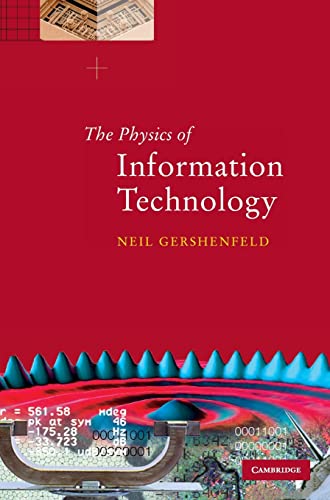
The Physics of Information Technology explores the familiar devices that we use to collect, transform, transmit, and interact with electronic information. Many such devices operate surprisingly close to very many fundamental physical limits. Understanding how such devices work, and how they can (and cannot) be improved, requires deep insight into the character of physical law as well as engineering practice. The book starts with an introduction to units, forces, and the probabilistic foundations of noise and signalling, then progresses through the electromagnetics of wired and wireless communications, and the quantum mechanics of electronic, optical, and magnetic materials, to discussions of mechanisms for computation, storage, sensing, and display. This self-contained volume will help both physical scientists and computer scientists see beyond the conventional division between hardware and software to understand the implications of physical theory for information manipulation.
Les informations fournies dans la section « Synopsis » peuvent faire référence à une autre édition de ce titre.
Présentation de l'éditeur
The Physics of Information Technology, first published in 2000, explores the familiar devices that we use to collect, transform, transmit, and interact with electronic information. Many such devices operate surprisingly close to very many fundamental physical limits. Understanding how such devices work, and how they can (and cannot) be improved, requires deep insight into the character of physical law as well as engineering practice. The book starts with an introduction to units, forces, and the probabilistic foundations of noise and signalling, then progresses through the electromagnetics of wired and wireless communications, and the quantum mechanics of electronic, optical, and magnetic materials, to discussions of mechanisms for computation, storage, sensing, and display. This self-contained volume will help both physical scientists and computer scientists see beyond the conventional division between hardware and software to understand the implications of physical theory for information manipulation.
Présentation de l'éditeur
The Physics of Information Technology explores the familiar devices that we use to collect, transform, transmit, and interact with electronic information. Many such devices operate surprisingly close to very many fundamental physical limits. Understanding how such devices work, and how they can (and cannot) be improved, requires deep insight into the character of physical law as well as engineering practice. The book starts with an introduction to units, forces, and the probabilistic foundations of noise and signalling, then progresses through the electromagnetics of wired and wireless communications, and the quantum mechanics of electronic, optical, and magnetic materials, to discussions of mechanisms for computation, storage, sensing, and display. This self-contained volume will help both physical scientists and computer scientists see beyond the conventional division between hardware and software to understand the implications of physical theory for information manipulation.
Les informations fournies dans la section « A propos du livre » peuvent faire référence à une autre édition de ce titre.
Résultats de recherche pour The Physics of Information Technology

Image d'archives
The Physics of Information Technology (Cambridge Series on Information and the Natural Sciences)
Edité par
Cambridge University Press (edition 1), 2000
ISBN 10 : 0521580447
ISBN 13 : 9780521580441
Ancien ou d'occasion
Couverture rigide
Vendeur : BooksRun, Philadelphia, PA, Etats-Unis
Évaluation du vendeur 5 sur 5 étoiles

Hardcover. Etat : Very Good. 1. With dust jacket. It's a well-cared-for item that has seen limited use. The item may show minor signs of wear. All the text is legible, with all pages included. It may have slight markings and/or highlighting. N° de réf. du vendeur 0521580447-11-1-29
Acheter D'occasion
EUR 7,69
Livraison gratuite
Expédition nationale : Etats-Unis
Expédition nationale : Etats-Unis
Quantité disponible : 2 disponible(s)
Image d'archives
The Physics of Information Technology
Edité par
Cambridge University Press, 2000
ISBN 10 : 0521580447
ISBN 13 : 9780521580441
Ancien ou d'occasion
Couverture rigide
Vendeur : Better World Books, Mishawaka, IN, Etats-Unis
Évaluation du vendeur 5 sur 5 étoiles
Etat : Very Good. Former library copy. Pages intact with possible writing/highlighting. Binding strong with minor wear. Dust jackets/supplements may not be included. Includes library markings. Stock photo provided. Product includes identifying sticker. Better World Books: Buy Books. Do Good. N° de réf. du vendeur 620939-6
Acheter D'occasion
EUR 7,78
Livraison gratuite
Expédition nationale : Etats-Unis
Expédition nationale : Etats-Unis
Quantité disponible : 1 disponible(s)
Image d'archives
The Physics of Information Technology
Edité par
Cambridge University Press, 2000
ISBN 10 : 0521580447
ISBN 13 : 9780521580441
Ancien ou d'occasion
Couverture rigide
Vendeur : Better World Books, Mishawaka, IN, Etats-Unis
Évaluation du vendeur 5 sur 5 étoiles
Etat : Good. Pages intact with minimal writing/highlighting. The binding may be loose and creased. Dust jackets/supplements are not included. Stock photo provided. Product includes identifying sticker. Better World Books: Buy Books. Do Good. N° de réf. du vendeur 5407671-6
Acheter D'occasion
EUR 7,78
Livraison gratuite
Expédition nationale : Etats-Unis
Expédition nationale : Etats-Unis
Quantité disponible : 1 disponible(s)
Image fournie par le vendeur
The Physics of Information Technology (Cambridge Series on Information and the Natural Sciences)
Edité par
Cambridge University Press, 2000
ISBN 10 : 0521580447
ISBN 13 : 9780521580441
Ancien ou d'occasion
Couverture rigide
Vendeur : -OnTimeBooks-, Phoenix, AZ, Etats-Unis
Évaluation du vendeur 5 sur 5 étoiles
Etat : good. A copy that has been read, remains in good condition. All pages are intact, and the cover is intact. The spine and cover show signs of wear. Pages can include notes and highlighting and show signs of wear, and the copy can include "From the library of" labels or previous owner inscriptions. 100% GUARANTEE! Shipped with delivery confirmation, if you're not satisfied with purchase please return item! Ships via media mail. N° de réf. du vendeur OTV.0521580447.G
Acheter D'occasion
EUR 9,11
Livraison gratuite
Expédition nationale : Etats-Unis
Expédition nationale : Etats-Unis
Quantité disponible : 1 disponible(s)
Image d'archives
The Physics of Information Technology (Cambridge Series on Information and the Natural Sciences)
Edité par
Cambridge University Press, 2000
ISBN 10 : 0521580447
ISBN 13 : 9780521580441
Ancien ou d'occasion
Couverture rigide
Vendeur : WorldofBooks, Goring-By-Sea, WS, Royaume-Uni
Évaluation du vendeur 5 sur 5 étoiles
Hardback. Etat : Very Good. The book has been read, but is in excellent condition. Pages are intact and not marred by notes or highlighting. The spine remains undamaged. N° de réf. du vendeur GOR007151667
Acheter D'occasion
EUR 6,06
Expédition à EUR 6,52
Expédition depuis Royaume-Uni vers Etats-Unis
Expédition depuis Royaume-Uni vers Etats-Unis
Quantité disponible : 1 disponible(s)
Image fournie par le vendeur
The Physics of Information Technology (Cambridge Series on Information and the Natural Sciences)
Edité par
Cambridge University Press, 2000
ISBN 10 : 0521580447
ISBN 13 : 9780521580441
Ancien ou d'occasion
Couverture rigide
Vendeur : WeBuyBooks, Rossendale, LANCS, Royaume-Uni
Évaluation du vendeur 5 sur 5 étoiles
hardcover. Etat : Good. Most items will be dispatched the same or the next working day. A copy that has been read but remains in clean condition. All of the pages are intact and the cover is intact and the spine may show signs of wear. The book may have minor markings which are not specifically mentioned. Ex library copy with usual stamps & stickers. N° de réf. du vendeur rev8936363963
Acheter D'occasion
EUR 4,27
Expédition à EUR 11,15
Expédition depuis Royaume-Uni vers Etats-Unis
Expédition depuis Royaume-Uni vers Etats-Unis
Quantité disponible : 1 disponible(s)
Image d'archives
The Physics of Information Technology (Cambridge Series on Information and the Natural Sciences)
Edité par
Cambridge University Press, 2000
ISBN 10 : 0521580447
ISBN 13 : 9780521580441
Ancien ou d'occasion
Couverture rigide
Vendeur : Phatpocket Limited, Waltham Abbey, HERTS, Royaume-Uni
Évaluation du vendeur 5 sur 5 étoiles
Etat : Good. Your purchase helps support Sri Lankan Children's Charity 'The Rainbow Centre'. Ex-library, so some stamps and wear, but in good overall condition. Our donations to The Rainbow Centre have helped provide an education and a safe haven to hundreds of children who live in appalling conditions. N° de réf. du vendeur Z1-X-017-03065
Acheter D'occasion
EUR 3,90
Expédition à EUR 12,38
Expédition depuis Royaume-Uni vers Etats-Unis
Expédition depuis Royaume-Uni vers Etats-Unis
Quantité disponible : 1 disponible(s)
Image fournie par le vendeur
The Physics of INFORMATION TECHNOLOGY
Edité par
Cambridge University Press, 2000
ISBN 10 : 0521580447
ISBN 13 : 9780521580441
Ancien ou d'occasion
Couverture rigide
Edition originale
Vendeur : Frey Fine Books, Rougemont, NC, Etats-Unis
Évaluation du vendeur 5 sur 5 étoiles
hardcover. Etat : Fine. Etat de la jaquette : Near Fine. 1st edition. 1st edition.A Fine copy in Near Fine dust jacket. 4to., xiv, 370 pp., illustrated with charts, diagrams, and chemical formulae. Red paper boards, in similar red dust jacket. The dj is now protected in a mylar sleeve. N° de réf. du vendeur 32296
Acheter D'occasion
EUR 31,12
Expédition à EUR 6
Expédition nationale : Etats-Unis
Expédition nationale : Etats-Unis
Quantité disponible : 1 disponible(s)
Image fournie par le vendeur
The Physics of Information Technology
Edité par
Cambridge University Press, 2000
ISBN 10 : 0521580447
ISBN 13 : 9780521580441
Ancien ou d'occasion
Couverture rigide
Edition originale
Vendeur : Midway Book Store (ABAA), St. Paul, MN, Etats-Unis
Évaluation du vendeur 5 sur 5 étoiles
Hardcover. Etat : fine/fine. First edition. octavo. 10' x 7". 370pp. A fine copy in dust jacket. N° de réf. du vendeur 80398
Acheter D'occasion
EUR 31,12
Expédition à EUR 6,91
Expédition nationale : Etats-Unis
Expédition nationale : Etats-Unis
Quantité disponible : 1 disponible(s)
Image d'archives
The Physics of Information Technology (Cambridge Series on Information and the Natural Sciences)
Edité par
Cambridge University Press, 2000
ISBN 10 : 0521580447
ISBN 13 : 9780521580441
Ancien ou d'occasion
Couverture rigide
Vendeur : Half Price Books Inc., Dallas, TX, Etats-Unis
Évaluation du vendeur 5 sur 5 étoiles
hardcover. Etat : Very Good. Connecting readers with great books since 1972! Used books may not include companion materials, and may have some shelf wear or limited writing. We ship orders daily and Customer Service is our top priority! N° de réf. du vendeur S_469417520
Acheter D'occasion
EUR 39,01
Expédition à EUR 3,24
Expédition nationale : Etats-Unis
Expédition nationale : Etats-Unis
Quantité disponible : 1 disponible(s)