
Articles liés à Inconsistency in Roman Epic: Studies In Catullus, Lucretius,...
Inconsistency in Roman Epic: Studies In Catullus, Lucretius, Vergil, Ovid And Lucan - Couverture souple
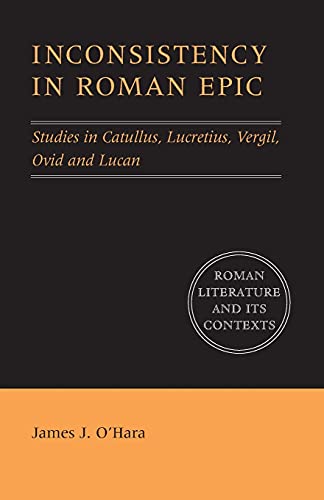
Synopsis
Explores the possibility of providing literary interpretations of inconsistencies in five Roman epics.
Les informations fournies dans la section « Synopsis » peuvent faire référence à une autre édition de ce titre.
À propos de l'auteur
James J. O'Hara is George L. Paddison Professor of Latin at the University of North Carolina, Chapel Hill. He is the author of Death and the Optimistic Prophecy in Vergil's Aeneid (1990) and True Names: Vergil and the Alexandrian Tradition of Etymological Wordplay (1996), as well as numerous articles and reviews on Latin literature.
Les informations fournies dans la section « A propos du livre » peuvent faire référence à une autre édition de ce titre.
Résultats de recherche pour Inconsistency in Roman Epic: Studies In Catullus, Lucretius,...

Image d'archives
Inconsistency in Roman Epic: Studies in Catullus, Lucretius, Vergil, Ovid and Lucan (Roman Literature and its Contexts)
Edité par
Cambridge University Press, 2007
ISBN 10 : 0521646421
ISBN 13 : 9780521646420
Ancien ou d'occasion
Paperback
Vendeur : Powell's Bookstores Chicago, ABAA, Chicago, IL, Etats-Unis
Évaluation du vendeur 5 sur 5 étoiles

Paperback. Etat : Used-Very Good. Pap. Slight shelf-wear, clean internals. N° de réf. du vendeur 1995589
Acheter D'occasion
EUR 19,25
Expédition à EUR 4,45
Expédition nationale : Etats-Unis
Expédition nationale : Etats-Unis
Quantité disponible : 1 disponible(s)
Image d'archives
Inconsistency in Roman Epic: Studies In Catullus, Lucretius, Vergil, Ovid And Lucan (Roman Literature and its Contexts)
Edité par
Cambridge University Press, 2007
ISBN 10 : 0521646421
ISBN 13 : 9780521646420
Ancien ou d'occasion
paperback
Vendeur : Black Gull Books (P.B.F.A.), St Leonard's on Sea, Royaume-Uni
Évaluation du vendeur 4 sur 5 étoiles

paperback. Etat : Very Good. N° de réf. du vendeur 06993
Acheter D'occasion
EUR 13,44
Expédition à EUR 15,42
Expédition depuis Royaume-Uni vers Etats-Unis
Expédition depuis Royaume-Uni vers Etats-Unis
Quantité disponible : 1 disponible(s)
Image d'archives
Inconsistency in Roman Epic
Edité par
Cambridge University Press CUP, 2007
ISBN 10 : 0521646421
ISBN 13 : 9780521646420
Neuf
Couverture souple
Vendeur : Books Puddle, Woodside, NY, Etats-Unis
Évaluation du vendeur 4 sur 5 étoiles
Etat : New. pp. 180. N° de réf. du vendeur 26550141
Acheter neuf
EUR 33,35
Expédition à EUR 3,55
Expédition nationale : Etats-Unis
Expédition nationale : Etats-Unis
Quantité disponible : 1 disponible(s)
Image d'archives
Inconsistency in Roman Epic
Edité par
Cambridge University Press, 2007
ISBN 10 : 0521646421
ISBN 13 : 9780521646420
Neuf
Couverture souple
Vendeur : Majestic Books, Hounslow, Royaume-Uni
Évaluation du vendeur 4 sur 5 étoiles
Etat : New. pp. 180. N° de réf. du vendeur 8379170
Acheter neuf
EUR 29,65
Expédition à EUR 7,71
Expédition depuis Royaume-Uni vers Etats-Unis
Expédition depuis Royaume-Uni vers Etats-Unis
Quantité disponible : 1 disponible(s)
Image d'archives
Inconsistency in Roman Epic
Edité par
Cambridge University Press, 2007
ISBN 10 : 0521646421
ISBN 13 : 9780521646420
Neuf
Couverture souple
Vendeur : Biblios, Frankfurt am main, HESSE, Allemagne
Évaluation du vendeur 4 sur 5 étoiles
Etat : New. pp. 180. N° de réf. du vendeur 18550135
Acheter neuf
EUR 30,15
Expédition à EUR 9,95
Expédition depuis Allemagne vers Etats-Unis
Expédition depuis Allemagne vers Etats-Unis
Quantité disponible : 1 disponible(s)
Image d'archives
Inconsistency in Roman Epic
Edité par
Cambridge University Press 2007-04, 2007
ISBN 10 : 0521646421
ISBN 13 : 9780521646420
Neuf
PF
Vendeur : Chiron Media, Wallingford, Royaume-Uni
Évaluation du vendeur 5 sur 5 étoiles
PF. Etat : New. This item is printed on demand. Brand new book, sourced directly from publisher. Dispatch time is 6-7 days from our warehouse. Book will be sent in robust, secure packaging to ensure it reaches you securely. N° de réf. du vendeur 6666-IUK-9780521646420
Acheter neuf
EUR 34,92
Expédition à EUR 5,33
Expédition depuis Royaume-Uni vers Etats-Unis
Expédition depuis Royaume-Uni vers Etats-Unis
Quantité disponible : 20 disponible(s)
Image d'archives
Inconsistency in Roman Epic: Studies in Catullus, Lucretius, Vergil, Ovid and Lucan (Roman Literature and its Contexts)
Edité par
Cambridge University Press, Cambridge, 2007
ISBN 10 : 0521646421
ISBN 13 : 9780521646420
Ancien ou d'occasion
Soft cover
Edition originale
Vendeur : Edinburgh Books, Edinburgh, Royaume-Uni
Évaluation du vendeur 5 sur 5 étoiles
Soft cover. Etat : Near Fine. First Edition. 2007. xiv, 165pp. "How should we react as readers and as critics when two passages in a literary work contradict one another? Classicists once assumed that all inconsistencies in ancient texts needed to be amended, explained away, or lamented. Building on recent work on both Greek and Roman authors, this book explores the possibility of interpreting inconsistencies in Roman epic. After a chapter surveying Greek background material including Homer, tragedy, Plato and the Alexandrians, five chapters argue that comparative study of the literary use of inconsistencies can shed light on major problems in Catullus' Peleus and Thetis, Lucretius' De Rerum Natura, Vergil's Aeneid, Ovid's Metamorphoses, and Lucan's Bellum Civile. Not all inconsistencies can or should be interpreted thematically, but numerous details in these poems, and some ancient and modern theorists, suggest that we can be better readers if we consider how inconsistencies may be functioning in Greek and Roman texts." Softcover in excellent condition, no inscriptions. N° de réf. du vendeur ClassGen047
Acheter D'occasion
EUR 18,32
Expédition à EUR 23,72
Expédition depuis Royaume-Uni vers Etats-Unis
Expédition depuis Royaume-Uni vers Etats-Unis
Quantité disponible : 1 disponible(s)
Image d'archives
Inconsistency in Roman Epic: Studies in Catullus, Lucretius, Vergil, Ovid and Lucan (Roman Literature and its Contexts)
Edité par
Cambridge University Press, 2007
ISBN 10 : 0521646421
ISBN 13 : 9780521646420
Neuf
Couverture souple
Vendeur : California Books, Miami, FL, Etats-Unis
Évaluation du vendeur 5 sur 5 étoiles
Etat : New. N° de réf. du vendeur I-9780521646420
Acheter neuf
EUR 46,74
Livraison gratuite
Expédition nationale : Etats-Unis
Expédition nationale : Etats-Unis
Quantité disponible : Plus de 20 disponibles
Image d'archives
Inconsistency in Roman Epic: Studies in Catullus, Lucretius, Vergil, Ovid and Lucan (Roman Literature and its Contexts)
Edité par
Cambridge University Press, 2007
ISBN 10 : 0521646421
ISBN 13 : 9780521646420
Neuf
Couverture souple
Vendeur : Ria Christie Collections, Uxbridge, Royaume-Uni
Évaluation du vendeur 5 sur 5 étoiles
Etat : New. In English. N° de réf. du vendeur ria9780521646420_new
Acheter neuf
EUR 41,60
Expédition à EUR 11,11
Expédition depuis Royaume-Uni vers Etats-Unis
Expédition depuis Royaume-Uni vers Etats-Unis
Quantité disponible : Plus de 20 disponibles
Image d'archives
Inconsistency in Roman Epic.
Edité par
Cambridge University Press, 2007
ISBN 10 : 0521646421
ISBN 13 : 9780521646420
Ancien ou d'occasion
Couverture souple
Vendeur : Scrinium Classical Antiquity, Aalten, Pays-Bas
Évaluation du vendeur 5 sur 5 étoiles
Cambridge University Press, 2007. 180p. Paperback. Series: Roman Literature and its Contexts. 'O'Hara argues that inconsistencies in Roman epic are often, but not always, thematic devices that demand interpretation. He begins with an expansive survey of the device in 'Greek Versions' (chapter 1) that introduces inconsistency as an established hermeneutic, especially in Hellenistic literature. He proceeds to focus on Roman epic alone in the following five chapters, which are on Catullus 64 (chapter 2), Lucretius' 'De Rerum Natura' (chapter 3), Vergil's 'Aeneid' (chapter 4), Ovid's 'Metamorphoses' (chapter 5), and Lucan's 'De Bello Civili' (chapter 6). In a compelling study, O'Hara argues that many thematic inconsistencies are related to the experience of reading these texts. O'Hara supports his argument by focusing specifically on the proems of the epics he covers. One of the greatest strengths of his argument is to link thematic inconsistencies with the formal construction of epic. His command of the secondary literature is formidable, as the sixteen pages of bibliography and over 300 footnotes attest. O'Hara attends constantly to the place of his argument in the history of scholarship and guides the reader through a variety of interpretive approaches to the inconsistencies that he analyzes without claiming to offer a 'key' to them all.' (JOSIAH EDWARDS DAVIS in Bryn Mawr Classical Review 2007.10.22). N° de réf. du vendeur 32547
Acheter D'occasion
EUR 26,50
Expédition à EUR 27,50
Expédition depuis Pays-Bas vers Etats-Unis
Expédition depuis Pays-Bas vers Etats-Unis
Quantité disponible : 1 disponible(s)