
Articles liés à The Man in the Ceiling
Biographie de l'auteur
Jules Feiffer has won a number of prizes for his cartoons, plays, and screenplays, including the Pulitzer Prize for editorial cartooning. His books for children include The Man in the Ceiling, A Barrel of Laughs, A Vale of Tears, I Lost My Bear, Bark, George, and Meanwhile... He lives in New York City. In His Own Words...
"I have been writing and drawing comic strips all illy life, first as a six-year-old, when I'd try to draw like my heroes: Alex Raymond, who did Flash Gordon, E. C. Segar, who did Popeye, Milton Caniff, who did Terry and the Pirates. The newspaper strip back in the I 1940s was a glorious thing to behold. Sunday pages were full-sized and Colored broadsheets that created a universe that could swallow a boy whole.
"I was desperate to be a cartoonist. One of my heroes was Will Eisner, who did a weekly comic book supplement to the Sunday comics. One day I walked into his office and showed him my samples. He said they were lousy, but lie hired me anyway. And I began my apprenticeship.
"Later I was drafted Out of Eisner's office into tile Korean War. Militarism, regimentation, and mindless authority combined to squeeze the boy cartoonist Out Of me and bring out the rebel. There was no format at the time to fit [he work I raged and screamed to do, so I had to invent one. Cartoon satire that commented on the Lin military the Bomb, the Cold War, the hypocrisy of grownLIPS, the mating habits of urban Young men and women, these were my subjects. After four years of trying to break into print and getting nowhere, the Village Voice, the first alternative newspaper, offered to publish me. Only one catch: They couldn't Pay me. What (lid I care?
"My weekly satirical strip, Sick Sick Sick, later renamed Feiffer started appearing in late 1956. Two years later, Sick Sick Sick came out in book form and became a bestseller. The following years saw a string of cartoon collections, syndication, stage and screen adaptations of the cartoon. One, Munro, won an Academy Award.
"This was heady stuff, taking me miles beyond my boyhood dreams. The only thing that got in the way of my enjoying it was the real world. The Cuban missile crisis, the assassination of President Kennedy, the Vietnam War, the Civil Rights revolution. The country was coining unglued and my weekly cartoons didn't seem to be an adequate way of handling it. So I started writing plays: Little Murders, The White House Murder Case, Carnal Knowledge, Grownups. All the themes of my comic strips expanded theatrically and later, cinematically to give me the time and space I needed to explain the times to myself and to my audience.
"I grew older. I had a family, and late in life, a very young family. I started thinking, as old guys will, about what I wanted these children to read, to learn. I read them E.B. White and Beverly Cleary and Roald Dahl, and, one day, I thought, I ley, I can do this."
"Writing for young readers connects me profess sionally to) a part of myself that I didn't know how to let out until I was sixty: that kid who lived a life of innocence, mixed with confusion and consternation, disappointment and dopey humor. And who drew comic strips and needed friends--and found them--in cartoons and children's books that told him what the grown-ups in his life had left out. That's what reading (lid for me when I was a kid. Now, I try to return the favor."
Jules Feiffer has won a number of prizes for his cartoons, plays, and screenplays, including the Pulitzer Prize for editorial cartooning. His books for children include The Man in the Ceiling, A Barrel of Laughs, A Vale of Tears, I Lost My Bear, Bark, George, and Meanwhile... He lives in New York City. In His Own Words...
"I have been writing and drawing comic strips all illy life, first as a six-year-old, when I'd try to draw like my heroes: Alex Raymond, who did Flash Gordon, E. C. Segar, who did Popeye, Milton Caniff, who did Terry and the Pirates. The newspaper strip back in the I 1940s was a glorious thing to behold. Sunday pages were full-sized and Colored broadsheets that created a universe that could swallow a boy whole.
"I was desperate to be a cartoonist. One of my heroes was Will Eisner, who did a weekly comic book supplement to the Sunday comics. One day I walked into his office and showed him my samples. He said they were lousy, but lie hired me anyway. And I began my apprenticeship.
"Later I was drafted Out of Eisner's office into tile Korean War. Militarism, regimentation, and mindless authority combined to squeeze the boy cartoonist Out Of me and bring out the rebel. There was no format at the time to fit [he work I raged and screamed to do, so I had to invent one. Cartoon satire that commented on the Lin military the Bomb, the Cold War, the hypocrisy of grownLIPS, the mating habits of urban Young men and women, these were my subjects. After four years of trying to break into print and getting nowhere, the Village Voice, the first alternative newspaper, offered to publish me. Only one catch: They couldn't Pay me. What (lid I care?
"My weekly satirical strip, Sick Sick Sick, later renamed Feiffer started appearing in late 1956. Two years later, Sick Sick Sick came out in book form and became a bestseller. The following years saw a string of cartoon collections, syndication, stage and screen adaptations of the cartoon. One, Munro, won an Academy Award.
"This was heady stuff, taking me miles beyond my boyhood dreams. The only thing that got in the way of my enjoying it was the real world. The Cuban missile crisis, the assassination of President Kennedy, the Vietnam War, the Civil Rights revolution. The country was coining unglued and my weekly cartoons didn't seem to be an adequate way of handling it. So I started writing plays: Little Murders, The White House Murder Case, Carnal Knowledge, Grownups. All the themes of my comic strips expanded theatrically and later, cinematically to give me the time and space I needed to explain the times to myself and to my audience.
"I grew older. I had a family, and late in life, a very young family. I started thinking, as old guys will, about what I wanted these children to read, to learn. I read them E.B. White and Beverly Cleary and Roald Dahl, and, one day, I thought, I ley, I can do this."
"Writing for young readers connects me profess sionally to) a part of myself that I didn't know how to let out until I was sixty: that kid who lived a life of innocence, mixed with confusion and consternation, disappointment and dopey humor. And who drew comic strips and needed friends--and found them--in cartoons and children's books that told him what the grown-ups in his life had left out. That's what reading (lid for me when I was a kid. Now, I try to return the favor."
Présentation de l'éditeur
Now planned as a Broadway musical from the Tony Award-winning producer of “Hamilton” and “Rent”!
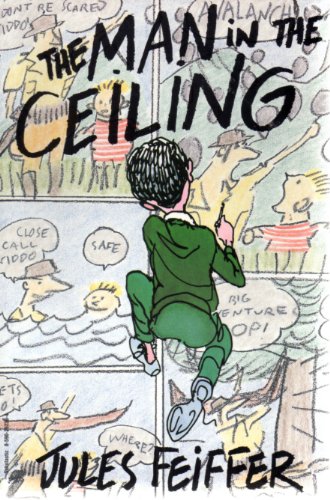
From the Pulitzer Prize-winning cartoonist, playwright, screenwriter, and illustrator of The Phantom Tollbooth, Jules Feiffer, comes a witty story about following your dreams.
Jimmy is bad at sports and not much better at school, but he sure can draw terrific cartoons. And his dream, like that of his Uncle Lester who writes flop Broadway musicals, is to be recognized for what he loves doing most.
“Wickedly funny... reminiscent of Roald Dahl's edgy lampoons." —ALA Booklist (starred review)
“A witty story that combines a comfortably oldfangled tone with up-to-the-minute characterizations and a playful use of graphics.” —Publishers Weekly (starred review)
Les informations fournies dans la section « A propos du livre » peuvent faire référence à une autre édition de ce titre.
Résultats de recherche pour The Man in the Ceiling

Image d'archives
The Man in the Ceiling
Edité par
Scholastic, 1993
ISBN 10 : 0590262394
ISBN 13 : 9780590262392
Ancien ou d'occasion
Soft cover
Vendeur : Books for a Cause, Rochester, NY, Etats-Unis
Évaluation du vendeur 5 sur 5 étoiles

Soft cover. Etat : Very Good. This book is in very nice shape. However, it does have small bits of wear in both the upper and lower corners of its front cover. N° de réf. du vendeur CPB8902
Acheter D'occasion
EUR 5,84
Livraison gratuite
Expédition nationale : Etats-Unis
Expédition nationale : Etats-Unis
Quantité disponible : 1 disponible(s)
Image d'archives
The Man in the Ceiling
Vendeur : ThriftBooks-Dallas, Dallas, TX, Etats-Unis
Évaluation du vendeur 5 sur 5 étoiles
Paperback. Etat : Fair. No Jacket. Readable copy. Pages may have considerable notes/highlighting. ~ ThriftBooks: Read More, Spend Less. N° de réf. du vendeur G0590262394I5N00
Acheter D'occasion
EUR 7,15
Livraison gratuite
Expédition nationale : Etats-Unis
Expédition nationale : Etats-Unis
Quantité disponible : 1 disponible(s)
Image d'archives
The Man in the Ceiling
Edité par
Harper, 1995
ISBN 10 : 0590262394
ISBN 13 : 9780590262392
Ancien ou d'occasion
paperback
Edition originale
Vendeur : Books From California, Simi Valley, CA, Etats-Unis
Évaluation du vendeur 4 sur 5 étoiles

paperback. Etat : Good. First Edition. 1st edition. N° de réf. du vendeur mon0003243001
Acheter D'occasion
EUR 4,78
Expédition à EUR 4,35
Expédition nationale : Etats-Unis
Expédition nationale : Etats-Unis
Quantité disponible : 1 disponible(s)
Image d'archives
The Man in the Ceiling
Edité par
Scholastic, 1995
ISBN 10 : 0590262394
ISBN 13 : 9780590262392
Ancien ou d'occasion
Couverture souple
Vendeur : Better World Books, Mishawaka, IN, Etats-Unis
Évaluation du vendeur 5 sur 5 étoiles
Etat : Good. Pages intact with minimal writing/highlighting. The binding may be loose and creased. Dust jackets/supplements are not included. Stock photo provided. Product includes identifying sticker. Better World Books: Buy Books. Do Good. N° de réf. du vendeur 58172075-6
Acheter D'occasion
EUR 10,13
Livraison gratuite
Expédition nationale : Etats-Unis
Expédition nationale : Etats-Unis
Quantité disponible : 1 disponible(s)
Image fournie par le vendeur
The Man in the Ceiling
Edité par
Scholastic Inc, 1995
ISBN 10 : 0590262394
ISBN 13 : 9780590262392
Ancien ou d'occasion
Trade Paperback
Edition originale
Vendeur : Inga's Original Choices, Piggott, AR, Etats-Unis
Évaluation du vendeur 5 sur 5 étoiles
Trade Paperback. Etat : Near Fine-. by Author (illustrateur). 1st Edition, 1st Printing. First Scholastic edition with complete number line at copyright page [1-12]. Illustrated throughout with B&W drawings. Pages clean, unmarked, binding tight and square. Covers clean, colors bright, minimal edge wear. Jimmy Jibbett's dream is to be a great cartoonist someday. His hero, Charley Beemer suggests that they create comics together. But he soon realizes he's made a big mistake. Media Mail, Priority & most international shipping include free tracking information. Every book listed is located in my smoke free and climate controlled shop. All are inspected by me and will have qualities and/or flaws described. Size: 8vo - over 7¾" - 9¾" tall. N° de réf. du vendeur 003185
Acheter D'occasion
EUR 5,39
Expédition à EUR 5,23
Expédition nationale : Etats-Unis
Expédition nationale : Etats-Unis
Quantité disponible : 1 disponible(s)
Image fournie par le vendeur
The Man in the Ceiling
Vendeur : A Cappella Books, Inc., Atlanta, GA, Etats-Unis
Évaluation du vendeur 5 sur 5 étoiles
Paper Back. Etat : Good. N° de réf. du vendeur 347626
Acheter D'occasion
EUR 13,46
Livraison gratuite
Expédition nationale : Etats-Unis
Expédition nationale : Etats-Unis
Quantité disponible : 1 disponible(s)
Image d'archives
The Man in the Ceiling by Jules Feiffer 1995 Paperback Book
Vendeur : Crown City Books, Cortland, NY, Etats-Unis
Évaluation du vendeur 2 sur 5 étoiles

paperback. Etat : Very Good. N° de réf. du vendeur BT-120825-334555
Acheter D'occasion
EUR 9,16
Expédition à EUR 5,45
Expédition nationale : Etats-Unis
Expédition nationale : Etats-Unis
Quantité disponible : 1 disponible(s)
Image fournie par le vendeur
The Man In The Ceiling
Edité par
Scholastic, Usa, 1995
ISBN 10 : 0590262394
ISBN 13 : 9780590262392
Ancien ou d'occasion
Soft cover
Edition originale
Vendeur : Sparkle Books, Calgary, AB, Canada
Évaluation du vendeur 4 sur 5 étoiles
Soft cover. Etat : As New. 1st Edition. As New, First Thus Scholastic Edition With Full Number-Line. Appears Unread. No Writing Or Marks. N° de réf. du vendeur 002618
Acheter D'occasion
EUR 12,83
Expédition à EUR 9,02
Expédition depuis Canada vers Etats-Unis
Expédition depuis Canada vers Etats-Unis
Quantité disponible : 1 disponible(s)