
Articles liés à The Emergence of Cinematic Time: Modernity, Contingency,...
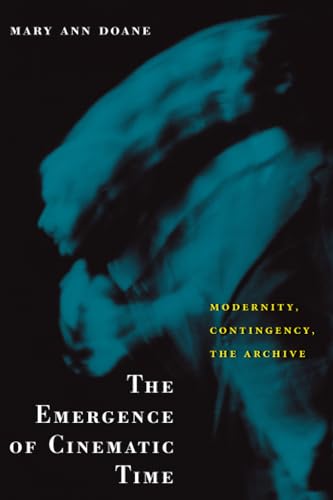
Synopsis
Hailed as the permanent record of fleeting moments, the cinema emerged at the turn of the nineteenth century as an unprecedented means of capturing time--and this at a moment when disciplines from physics to philosophy, and historical trends from industrialization to the expansion of capitalism, were transforming the very idea of time. In a work that itself captures and reconfigures the passing moments of art, history, and philosophy, Mary Ann Doane shows how the cinema, representing the singular instant of chance and ephemerality in the face of the increasing rationalization and standardization of the day, participated in the structuring of time and contingency in capitalist modernity.
At this book's heart is the cinema's essential paradox: temporal continuity conveyed through "stopped time," the rapid succession of still frames or frozen images. Doane explores the role of this paradox, and of notions of the temporal indeterminacy and instability of an image, in shaping not just cinematic time but also modern ideas about continuity and discontinuity, archivability, contingency and determinism, and temporal irreversibility. A compelling meditation on the status of cinematic knowledge, her book is also an inquiry into the very heart and soul of modernity.Les informations fournies dans la section « Synopsis » peuvent faire référence à une autre édition de ce titre.
À propos de l'auteur
Mary Ann Doane is George Hazard Crooker University Professor of Modern Culture and Media and of English at Brown University.
Les informations fournies dans la section « A propos du livre » peuvent faire référence à une autre édition de ce titre.
Résultats de recherche pour The Emergence of Cinematic Time: Modernity, Contingency,...

Image d'archives
The Emergence of Cinematic Time: Modernity, Contingency, the Archive
Edité par
Harvard University Press, 2002
ISBN 10 : 0674007840
ISBN 13 : 9780674007840
Ancien ou d'occasion
Paperback
Vendeur : ThriftBooks-Dallas, Dallas, TX, Etats-Unis
Évaluation du vendeur 5 sur 5 étoiles

Paperback. Etat : Fair. No Jacket. Readable copy. Pages may have considerable notes/highlighting. ~ ThriftBooks: Read More, Spend Less. N° de réf. du vendeur G0674007840I5N00
Acheter D'occasion
EUR 33,08
Livraison gratuite
Expédition nationale : Etats-Unis
Expédition nationale : Etats-Unis
Quantité disponible : 1 disponible(s)
Image d'archives
The Emergence of Cinematic Time: Modernity, Contingency, the Archive
Edité par
Harvard University Press, 2002
ISBN 10 : 0674007840
ISBN 13 : 9780674007840
Ancien ou d'occasion
Paperback
Vendeur : ThriftBooks-Atlanta, AUSTELL, GA, Etats-Unis
Évaluation du vendeur 5 sur 5 étoiles
Paperback. Etat : Fair. No Jacket. Readable copy. Pages may have considerable notes/highlighting. ~ ThriftBooks: Read More, Spend Less. N° de réf. du vendeur G0674007840I5N00
Acheter D'occasion
EUR 33,08
Livraison gratuite
Expédition nationale : Etats-Unis
Expédition nationale : Etats-Unis
Quantité disponible : 1 disponible(s)
Image d'archives
The Emergence of Cinematic Time: Modernity, Contingency, the Archive
Edité par
Harvard University Press, United States, Cambridge, Mass, 2002
ISBN 10 : 0674007840
ISBN 13 : 9780674007840
Ancien ou d'occasion
Paperback
Vendeur : WorldofBooks, Goring-By-Sea, WS, Royaume-Uni
Évaluation du vendeur 5 sur 5 étoiles
Paperback. Etat : Very Good. Hailed as the permanent record of fleeting moments, the cinema emerged at the turn of the nineteenth century as an unprecedented means of capturing time--and this at a moment when disciplines from physics to philosophy, and historical trends from industrialization to the expansion of capitalism, were transforming the very idea of time. In a work that itself captures and reconfigures the passing moments of art, history, and philosophy, Mary Ann Doane shows how the cinema, representing the singular instant of chance and ephemerality in the face of the increasing rationalization and standardization of the day, participated in the structuring of time and contingency in capitalist modernity.At this book's heart is the cinema's essential paradox: temporal continuity conveyed through "stopped time," the rapid succession of still frames or frozen images. Doane explores the role of this paradox, and of notions of the temporal indeterminacy and instability of an image, in shaping not just cinematic time but also modern ideas about continuity and discontinuity, archivability, contingency and determinism, and temporal irreversibility. A compelling meditation on the status of cinematic knowledge, her book is also an inquiry into the very heart and soul of modernity. The book has been read, but is in excellent condition. Pages are intact and not marred by notes or highlighting. The spine remains undamaged. N° de réf. du vendeur GOR006118976
Acheter D'occasion
EUR 27,18
Expédition à EUR 6,69
Expédition depuis Royaume-Uni vers Etats-Unis
Expédition depuis Royaume-Uni vers Etats-Unis
Quantité disponible : 3 disponible(s)
Image d'archives
The Emergence of Cinematic Time: Modernity, Contingency, the Archive
Edité par
Harvard University Press, 2002
ISBN 10 : 0674007840
ISBN 13 : 9780674007840
Ancien ou d'occasion
Couverture souple
Vendeur : medimops, Berlin, Allemagne
Évaluation du vendeur 5 sur 5 étoiles
Etat : good. Befriedigend/Good: Durchschnittlich erhaltenes Buch bzw. Schutzumschlag mit Gebrauchsspuren, aber vollständigen Seiten. / Describes the average WORN book or dust jacket that has all the pages present. N° de réf. du vendeur M00674007840-G
Acheter D'occasion
EUR 37,67
Expédition à EUR 10
Expédition depuis Allemagne vers Etats-Unis
Expédition depuis Allemagne vers Etats-Unis
Quantité disponible : 1 disponible(s)
Image d'archives
The Emergence of Cinematic Time: Modernity, Contingency, the Archive (eng)
Edité par
Harvard University Press, 2002
ISBN 10 : 0674007840
ISBN 13 : 9780674007840
Neuf
Couverture souple
Vendeur : Brook Bookstore On Demand, Napoli, NA, Italie
Évaluation du vendeur 5 sur 5 étoiles
Etat : new. N° de réf. du vendeur b0395fe4b5069d1a43c6f3ed15777ea3
Acheter neuf
EUR 43,86
Expédition à EUR 5,50
Expédition depuis Italie vers Etats-Unis
Expédition depuis Italie vers Etats-Unis
Quantité disponible : Plus de 20 disponibles
Image fournie par le vendeur
Emergence of Cinematic Time : Modernity, Contingency, the Archive
Edité par
Harvard University Press, 2002
ISBN 10 : 0674007840
ISBN 13 : 9780674007840
Ancien ou d'occasion
Couverture souple
Vendeur : GreatBookPrices, Columbia, MD, Etats-Unis
Évaluation du vendeur 5 sur 5 étoiles
Etat : As New. Unread book in perfect condition. N° de réf. du vendeur 734564
Acheter D'occasion
EUR 47,57
Expédition à EUR 2,36
Expédition nationale : Etats-Unis
Expédition nationale : Etats-Unis
Quantité disponible : Plus de 20 disponibles
Image fournie par le vendeur
Emergence of Cinematic Time : Modernity, Contingency, the Archive
Edité par
Harvard University Press, 2002
ISBN 10 : 0674007840
ISBN 13 : 9780674007840
Neuf
Couverture souple
Vendeur : GreatBookPrices, Columbia, MD, Etats-Unis
Évaluation du vendeur 5 sur 5 étoiles
Etat : New. N° de réf. du vendeur 734564-n
Acheter neuf
EUR 49,73
Expédition à EUR 2,36
Expédition nationale : Etats-Unis
Expédition nationale : Etats-Unis
Quantité disponible : Plus de 20 disponibles
Image d'archives
The Emergence of Cinematic Time
Vendeur : PBShop.store US, Wood Dale, IL, Etats-Unis
Évaluation du vendeur 5 sur 5 étoiles
PAP. Etat : New. New Book. Shipped from UK. Established seller since 2000. N° de réf. du vendeur WH-9780674007840
Acheter neuf
EUR 52,16
Livraison gratuite
Expédition nationale : Etats-Unis
Expédition nationale : Etats-Unis
Quantité disponible : 15 disponible(s)
Image d'archives
The Emergence of Cinematic Time
Vendeur : PBShop.store UK, Fairford, GLOS, Royaume-Uni
Évaluation du vendeur 5 sur 5 étoiles
PAP. Etat : New. New Book. Shipped from UK. Established seller since 2000. N° de réf. du vendeur WH-9780674007840
Acheter neuf
EUR 48,30
Expédition à EUR 5,99
Expédition depuis Royaume-Uni vers Etats-Unis
Expédition depuis Royaume-Uni vers Etats-Unis
Quantité disponible : 15 disponible(s)
Image fournie par le vendeur
Emergence of Cinematic Time: Modernity, Contingency, the Archive (Paperback or Softback)
Edité par
Harvard University Press 12/27/2002, 2002
ISBN 10 : 0674007840
ISBN 13 : 9780674007840
Neuf
Paperback or Softback
Vendeur : BargainBookStores, Grand Rapids, MI, Etats-Unis
Évaluation du vendeur 5 sur 5 étoiles
Paperback or Softback. Etat : New. Emergence of Cinematic Time: Modernity, Contingency, the Archive. Book. N° de réf. du vendeur BBS-9780674007840
Acheter neuf
EUR 56,12
Livraison gratuite
Expédition nationale : Etats-Unis
Expédition nationale : Etats-Unis
Quantité disponible : 5 disponible(s)