
Articles liés à Kin: How We Came to Know Our Microbe Relatives
Synopsis
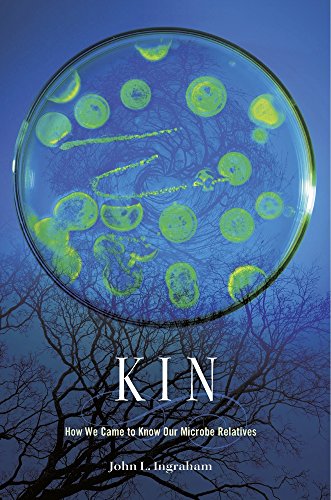
Since Darwin, people have speculated about the evolutionary relationships among dissimilar species, including our connections to the diverse life forms known as microbes. In the 1970s biologists discovered a way to establish these kinships. This new era of exploration began with Linus Pauling s finding that every protein in every cell contains a huge reservoir of evolutionary history. His discovery opened a research path that has changed the way biologists and others think about the living world. In Kin John L. Ingraham tells the story of these remarkable breakthroughs. His original, accessible history explains how we came to understand our microbe inheritance and the relatedness of all organisms on Earth.
Among the most revolutionary scientific achievements was Carl Woese s discovery that a large group of organisms previously lumped together with bacteria were in fact a totally distinct form of life, now called the archaea. But the crowning accomplishment has been to construct the Tree of Life an evolutionary project Darwin dreamed about over a century ago. Today, we know that the Tree s three main stems are dominated by microbes. The nonmicrobes plants and animals, including humans constitute only a small upper branch in one stem.
Knowing the Tree s structure has given biologists the ability to characterize the complex array of microbial populations that live in us and on us, and investigate how they contribute to health and disease. This knowledge also moves us closer to answering the tantalizing question of how the Tree of Life began, over 3.5 billion years ago.
"Les informations fournies dans la section « Synopsis » peuvent faire référence à une autre édition de ce titre.
À propos de l'auteur
John L. Ingraham is Professor of Microbiology, Emeritus, at the University of California, Davis.
Les informations fournies dans la section « A propos du livre » peuvent faire référence à une autre édition de ce titre.
Résultats de recherche pour Kin: How We Came to Know Our Microbe Relatives

Image d'archives
Kin: How We Came to Know Our Microbe Relatives
Edité par
Harvard University Press, 2017
ISBN 10 : 0674660404
ISBN 13 : 9780674660403
Ancien ou d'occasion
Couverture rigide
Vendeur : ThriftBooks-Atlanta, AUSTELL, GA, Etats-Unis
Évaluation du vendeur 5 sur 5 étoiles

Hardcover. Etat : Very Good. No Jacket. May have limited writing in cover pages. Pages are unmarked. ~ ThriftBooks: Read More, Spend Less. N° de réf. du vendeur G0674660404I4N00
Acheter D'occasion
EUR 9,22
Livraison gratuite
Expédition nationale : Etats-Unis
Expédition nationale : Etats-Unis
Quantité disponible : 1 disponible(s)
Image d'archives
Kin: How We Came to Know Our Microbe Relatives
Edité par
Harvard University Press, 2017
ISBN 10 : 0674660404
ISBN 13 : 9780674660403
Ancien ou d'occasion
Couverture rigide
Vendeur : Midtown Scholar Bookstore, Harrisburg, PA, Etats-Unis
Évaluation du vendeur 5 sur 5 étoiles
Hardcover. Etat : Good. HARDCOVER Good - Bumped and creased book with tears to the extremities, but not affecting the text block, may have remainder mark or previous owner's name - GOOD Standard-sized. N° de réf. du vendeur M0674660404Z3
Acheter D'occasion
EUR 4,75
Expédition à EUR 5,27
Expédition nationale : Etats-Unis
Expédition nationale : Etats-Unis
Quantité disponible : 1 disponible(s)
Image d'archives
Kin: How We Came to Know Our Microbe Relatives
Edité par
Harvard University Press, 2017
ISBN 10 : 0674660404
ISBN 13 : 9780674660403
Ancien ou d'occasion
Couverture rigide
Vendeur : HPB-Ruby, Dallas, TX, Etats-Unis
Évaluation du vendeur 5 sur 5 étoiles
hardcover. Etat : Very Good. Connecting readers with great books since 1972! Used books may not include companion materials, and may have some shelf wear or limited writing. We ship orders daily and Customer Service is our top priority! N° de réf. du vendeur S_441710712
Acheter D'occasion
EUR 9,50
Expédition à EUR 3,29
Expédition nationale : Etats-Unis
Expédition nationale : Etats-Unis
Quantité disponible : 1 disponible(s)
Image d'archives
Kin: How We Came to Know Our Microbe Relatives
Edité par
Harvard University Press, 2017
ISBN 10 : 0674660404
ISBN 13 : 9780674660403
Neuf
Couverture rigide
Vendeur : GoldBooks, Denver, CO, Etats-Unis
Évaluation du vendeur 5 sur 5 étoiles
Hardcover. Etat : new. New Copy. Customer Service Guaranteed. N° de réf. du vendeur 57L96_48_0674660404
Acheter neuf
EUR 25,63
Expédition à EUR 4,83
Expédition nationale : Etats-Unis
Expédition nationale : Etats-Unis
Quantité disponible : 1 disponible(s)
Image fournie par le vendeur
Kin : How We Came to Know Our Microbe Relatives
Edité par
Harvard University Press, 2017
ISBN 10 : 0674660404
ISBN 13 : 9780674660403
Neuf
Couverture rigide
Vendeur : GreatBookPrices, Columbia, MD, Etats-Unis
Évaluation du vendeur 5 sur 5 étoiles
Etat : New. N° de réf. du vendeur 28064319-n
Acheter neuf
EUR 34,33
Expédition à EUR 2,32
Expédition nationale : Etats-Unis
Expédition nationale : Etats-Unis
Quantité disponible : Plus de 20 disponibles
Image fournie par le vendeur
Kin: How We Came to Know Our Microbe Relatives (Hardback or Cased Book)
Edité par
Harvard 5/8/2017, 2017
ISBN 10 : 0674660404
ISBN 13 : 9780674660403
Neuf
Couverture rigide
Vendeur : BargainBookStores, Grand Rapids, MI, Etats-Unis
Évaluation du vendeur 5 sur 5 étoiles
Hardback or Cased Book. Etat : New. Kin: How We Came to Know Our Microbe Relatives. Book. N° de réf. du vendeur BBS-9780674660403
Acheter neuf
EUR 36,73
Livraison gratuite
Expédition nationale : Etats-Unis
Expédition nationale : Etats-Unis
Quantité disponible : 5 disponible(s)
Image d'archives
Kin
Edité par
Harvard University Press, 2017
ISBN 10 : 0674660404
ISBN 13 : 9780674660403
Neuf
Couverture rigide
Vendeur : Majestic Books, Hounslow, Royaume-Uni
Évaluation du vendeur 4 sur 5 étoiles

Etat : New. N° de réf. du vendeur 370425696
Acheter neuf
EUR 29,75
Expédition à EUR 7,56
Expédition depuis Royaume-Uni vers Etats-Unis
Expédition depuis Royaume-Uni vers Etats-Unis
Quantité disponible : 1 disponible(s)
Image d'archives
Kin
Edité par
Harvard University Press, 2017
ISBN 10 : 0674660404
ISBN 13 : 9780674660403
Neuf
Couverture rigide
Vendeur : Books Puddle, Woodside, NY, Etats-Unis
Évaluation du vendeur 4 sur 5 étoiles
Etat : New. N° de réf. du vendeur 26375619775
Acheter neuf
EUR 34,42
Expédition à EUR 3,50
Expédition nationale : Etats-Unis
Expédition nationale : Etats-Unis
Quantité disponible : 1 disponible(s)
Image d'archives
Kin: How We Came to Know Our Microbe Relatives
Edité par
Harvard University Press, 2017
ISBN 10 : 0674660404
ISBN 13 : 9780674660403
Neuf
Couverture rigide
Vendeur : California Books, Miami, FL, Etats-Unis
Évaluation du vendeur 5 sur 5 étoiles
Etat : New. N° de réf. du vendeur I-9780674660403
Acheter neuf
EUR 37,98
Livraison gratuite
Expédition nationale : Etats-Unis
Expédition nationale : Etats-Unis
Quantité disponible : Plus de 20 disponibles
Image fournie par le vendeur
Kin : How We Came to Know Our Microbe Relatives
Edité par
Harvard University Press, 2017
ISBN 10 : 0674660404
ISBN 13 : 9780674660403
Ancien ou d'occasion
Couverture rigide
Vendeur : GreatBookPrices, Columbia, MD, Etats-Unis
Évaluation du vendeur 5 sur 5 étoiles
Etat : As New. Unread book in perfect condition. N° de réf. du vendeur 28064319
Acheter D'occasion
EUR 36,03
Expédition à EUR 2,32
Expédition nationale : Etats-Unis
Expédition nationale : Etats-Unis
Quantité disponible : Plus de 20 disponibles