
Articles liés à Lucretius: De Rerum Natura
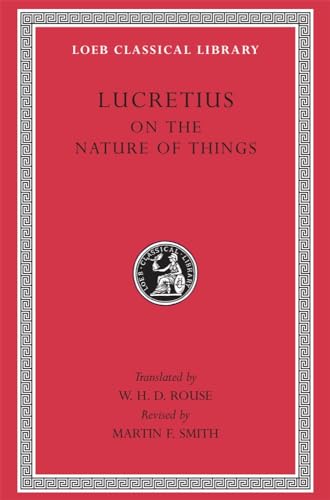
Synopsis
Atomic atheism in verse.
Lucretius (Titus Lucretius Carus) lived ca. 99–ca. 55 BC, but the details of his career are unknown. He is the author of the great didactic poem in hexameters, De Rerum Natura (On the Nature of Things). In six books compounded of solid reasoning, brilliant imagination, and noble poetry, he expounds the scientific theories of the Greek philosopher Epicurus, with the aim of dispelling fear of the gods and fear of death and so enabling man to attain peace of mind and happiness.
In Book 1 he establishes the general principles of the atomic system, refutes the views of rival physicists, and proves the infinity of the universe and of its two ultimate constituents, matter and void. In Book 2 he explains atomic movement, the variety of atomic shapes, and argues that the atoms lack color, sensation, and other secondary qualities. In Book 3 he expounds the nature and composition of mind and spirit, proves their mortality, and argues that there is nothing to fear in death. Book 4 explains the nature of sensation and thought, and ends with an impressive account of sexual love. Book 5 describes the nature and formation of our world, astronomical phenomena, the beginnings of life on earth, and the development of civilization. In Book 6 the poet explains various atmospheric and terrestrial phenomena, including thunder, lightning, earthquakes, volcanoes, the magnet, and plagues.
The work is distinguished by the fervor and poetry of the author.
Les informations fournies dans la section « Synopsis » peuvent faire référence à une autre édition de ce titre.
À propos des auteurs
William Henry Denham Rouse (1863-1950) was Headmaster of the Perse School and a founding editor of the Loeb Classical Library.
Martin Ferguson Smith is Emeritus Professor of Classics, Durham University, UK.
Les informations fournies dans la section « A propos du livre » peuvent faire référence à une autre édition de ce titre.
Résultats de recherche pour Lucretius: De Rerum Natura

Image d'archives
Lucretius: On the Nature of Things (Loeb Classical Library No. 181)
Edité par
Harvard University Press January 1924, 1924
ISBN 10 : 0674992008
ISBN 13 : 9780674992009
Ancien ou d'occasion
Couverture rigide
Vendeur : A Cappella Books, Inc., Atlanta, GA, Etats-Unis
Évaluation du vendeur 5 sur 5 étoiles

Hardcover. Etat : Very Good. Etat de la jaquette : Very Good. N° de réf. du vendeur 383034
Acheter D'occasion
EUR 28,39
Livraison gratuite
Expédition nationale : Etats-Unis
Expédition nationale : Etats-Unis
Quantité disponible : 1 disponible(s)
Image fournie par le vendeur
De Rerum Natura
Edité par
Harvard University Press, Cambrige, MA, 1975
ISBN 10 : 0674992008
ISBN 13 : 9780674992009
Ancien ou d'occasion
Couverture rigide
Vendeur : Pistil Books Online, IOBA, Seattle, WA, Etats-Unis
Évaluation du vendeur 5 sur 5 étoiles
Hard Cover. Etat : Near Fine. No Jacket. A clean, unmarked book with a tight binding. 600 pages. Lucretius's first-century BC didactic epic presenting Epicurean philosophy and atomic theory in Latin verse, arguing that all things are composed of atoms in void and that understanding nature frees humans from fear of death and divine punishment, with facing Latin text translated by W.H.D. Rouse and revised by Martin Ferguson Smith. Keywords: Epicurean Philosophy, Atomic Theory, Nature of Universe, W H D Rouse, Red Loeb, Bilingual Edition, Latin Text, Roman Poetry, Fear of Death, Epicurus Follower, Martin Ferguson Smith, Didactic Epic. N° de réf. du vendeur 180537
Acheter D'occasion
EUR 26,32
Expédition à EUR 5,33
Expédition nationale : Etats-Unis
Expédition nationale : Etats-Unis
Quantité disponible : 1 disponible(s)
Image d'archives
Lucretius De Rerum Natura
Edité par
Loeb Classical Library, 1982
ISBN 10 : 0674992008
ISBN 13 : 9780674992009
Ancien ou d'occasion
Couverture rigide
Vendeur : M & M Books, ATHENS, GA, Etats-Unis
Évaluation du vendeur 3 sur 5 étoiles

Hardcover. Etat : As New. Etat de la jaquette : As New. 2nd Edition. tiny sig. of prev. owner on f.e.p. N° de réf. du vendeur 151310
Acheter D'occasion
EUR 27,47
Expédition à EUR 6
Expédition nationale : Etats-Unis
Expédition nationale : Etats-Unis
Quantité disponible : 1 disponible(s)
Image fournie par le vendeur
Lucretius : De Rerum Natura
Edité par
Harvard University Press / Loeb Classical Library, 1975
ISBN 10 : 0674992008
ISBN 13 : 9780674992009
Ancien ou d'occasion
Couverture rigide
Vendeur : GreatBookPrices, Columbia, MD, Etats-Unis
Évaluation du vendeur 5 sur 5 étoiles
Etat : As New. Unread book in perfect condition. N° de réf. du vendeur 598637
Acheter D'occasion
EUR 31,22
Expédition à EUR 2,35
Expédition nationale : Etats-Unis
Expédition nationale : Etats-Unis
Quantité disponible : Plus de 20 disponibles
Image fournie par le vendeur
Lucretius : De Rerum Natura
Edité par
Harvard University Press / Loeb Classical Library, 1975
ISBN 10 : 0674992008
ISBN 13 : 9780674992009
Neuf
Couverture rigide
Vendeur : GreatBookPrices, Columbia, MD, Etats-Unis
Évaluation du vendeur 5 sur 5 étoiles
Etat : New. N° de réf. du vendeur 598637-n
Acheter neuf
EUR 31,22
Expédition à EUR 2,35
Expédition nationale : Etats-Unis
Expédition nationale : Etats-Unis
Quantité disponible : Plus de 20 disponibles
Image fournie par le vendeur
On the Nature of Things
Edité par
Harvard University Press, US, 1924
ISBN 10 : 0674992008
ISBN 13 : 9780674992009
Neuf
Couverture rigide
Vendeur : Rarewaves.com USA, London, LONDO, Royaume-Uni
Évaluation du vendeur 5 sur 5 étoiles
Hardback. Etat : New. Atomic atheism in verse. Lucretius (Titus Lucretius Carus) lived ca. 99-ca. 55 BC, but the details of his career are unknown. He is the author of the great didactic poem in hexameters, De Rerum Natura (On the Nature of Things). In six books compounded of solid reasoning, brilliant imagination, and noble poetry, he expounds the scientific theories of the Greek philosopher Epicurus, with the aim of dispelling fear of the gods and fear of death and so enabling man to attain peace of mind and happiness. In Book 1 he establishes the general principles of the atomic system, refutes the views of rival physicists, and proves the infinity of the universe and of its two ultimate constituents, matter and void. In Book 2 he explains atomic movement, the variety of atomic shapes, and argues that the atoms lack color, sensation, and other secondary qualities. In Book 3 he expounds the nature and composition of mind and spirit, proves their mortality, and argues that there is nothing to fear in death. Book 4 explains the nature of sensation and thought, and ends with an impressive account of sexual love. Book 5 describes the nature and formation of our world, astronomical phenomena, the beginnings of life on earth, and the development of civilization. In Book 6 the poet explains various atmospheric and terrestrial phenomena, including thunder, lightning, earthquakes, volcanoes, the magnet, and plagues. The work is distinguished by the fervor and poetry of the author. N° de réf. du vendeur LU-9780674992009
Acheter neuf
EUR 33,65
Livraison gratuite
Expédition depuis Royaume-Uni vers Etats-Unis
Expédition depuis Royaume-Uni vers Etats-Unis
Quantité disponible : Plus de 20 disponibles
Image fournie par le vendeur
De rerum natura
Edité par
Cambridge, MA/London : Harvard University Press, 1992
ISBN 10 : 0674992008
ISBN 13 : 9780674992009
Ancien ou d'occasion
Couverture rigide
Vendeur : Klondyke, Almere, Pays-Bas
Évaluation du vendeur 5 sur 5 étoiles
Hardcover. Etat : Good. Original gilt lettered red cloth, dust jacket, translated by W.H.D. Rouse, revised by Martin F. Smith, LXVI,601,(1) pages, reprinted, text in Latin and English, 8vo. Loeb Classical Library 181. On front dust jacket: Lucretius on The Nature of Things; Edges and corners dust jacket occasionaly worn. N° de réf. du vendeur 422081-YF13
Acheter D'occasion
EUR 16,50
Expédition à EUR 20
Expédition depuis Pays-Bas vers Etats-Unis
Expédition depuis Pays-Bas vers Etats-Unis
Quantité disponible : 1 disponible(s)
Image d'archives
On the Nature of Things (eng)
Edité par
Harvard University Press, 1924
ISBN 10 : 0674992008
ISBN 13 : 9780674992009
Neuf
Couverture rigide
Vendeur : Brook Bookstore On Demand, Napoli, NA, Italie
Évaluation du vendeur 5 sur 5 étoiles
Etat : new. N° de réf. du vendeur b3475cb1b8295a09da71a894816e458a
Acheter neuf
EUR 32,14
Expédition à EUR 5,50
Expédition depuis Italie vers Etats-Unis
Expédition depuis Italie vers Etats-Unis
Quantité disponible : Plus de 20 disponibles
Image fournie par le vendeur
On the Nature of Things (Hardcover)
Edité par
Harvard University Press, Cambridge, Mass, 1924
ISBN 10 : 0674992008
ISBN 13 : 9780674992009
Neuf
Couverture rigide
Vendeur : Grand Eagle Retail, Bensenville, IL, Etats-Unis
Évaluation du vendeur 5 sur 5 étoiles
Hardcover. Etat : new. Hardcover. Lucretius (Titus Lucretius Carus) lived ca. 99ca. 55 BCE, but the details of his career are unknown. He is the author of the great didactic poem in hexameters, De Rerum Natura (On the Nature of Things). In six books compounded of solid reasoning, brilliant imagination, and noble poetry, he expounds the scientific theories of the Greek philosopher Epicurus, with the aim of dispelling fear of the gods and fear of death and so enabling man to attain peace of mind and happiness.In Book 1 he establishes the general principles of the atomic system, refutes the views of rival physicists, and proves the infinity of the universe and of its two ultimate constituents, matter and void. In Book 2 he explains atomic movement, the variety of atomic shapes, and argues that the atoms lack colour, sensation, and other secondary qualities. In Book 3 he expounds the nature and composition of mind and spirit, proves their mortality, and argues that there is nothing to fear in death. Book 4 explains the nature of sensation and thought, and ends with an impressive account of sexual love. Book 5 describes the nature and formation of our world, astronomical phenomena, the beginnings of life on earth, and the development of civilization. In Book 6 the poet explains various atmospheric and terrestrial phenomena, including thunder, lightning, earthquakes, volcanoes, the magnet, and plagues.The work is distinguished by the fervour and poetry of the author. Lucretius lived ca. 99 ca. 55 BCE, but the details of his career are unknown. In his didactic poem De Rerum Natura (On the Nature of Things) he expounds Epicurean philosophy so as to dispel fear of the gods and death, and promote spiritual tranquility. Shipping may be from multiple locations in the US or from the UK, depending on stock availability. N° de réf. du vendeur 9780674992009
Acheter neuf
EUR 37,77
Livraison gratuite
Expédition nationale : Etats-Unis
Expédition nationale : Etats-Unis
Quantité disponible : 1 disponible(s)
Image fournie par le vendeur
On the Nature of Things
Edité par
Harvard University Press, 1924
ISBN 10 : 0674992008
ISBN 13 : 9780674992009
Ancien ou d'occasion
Couverture souple
Vendeur : Hamelyn, Madrid, M, Espagne
Évaluation du vendeur 5 sur 5 étoiles
Etat : Fair. : Sumérgete en 'Sobre la naturaleza de las cosas' de Lucrecio, una obra maestra de la poesía didáctica que explora la filosofía epicúrea y la naturaleza del universo. Este libro, traducido por W.H.D. Rouse y revisado por Martin F. Smith, ofrece una visión profunda de la física atómica, la mortalidad del alma y la búsqueda de la felicidad. Publicado por Harvard University Press como parte de la prestigiosa Loeb Classical Library, esta edición en tapa dura presenta el texto original en latín junto con una traducción al inglés, lo que lo convierte en una valiosa herramienta tanto para estudiantes como para eruditos. Descubre la sabiduría de Lucrecio y su impacto duradero en el pensamiento occidental. EAN: 9780674992009 Tipo: Libros Categoría: Filosofía|Literatura y Ficción Título: On the Nature of Things Autor: Titus Lucretius Carus| W.H.D. Rouse| Martin F. Smith Editorial: Harvard University Press Idioma: en, la Páginas: 672 Formato: tapa dura Año de publicación: 1924. N° de réf. du vendeur Happ-2026-06-24-5cca9793
Acheter D'occasion
EUR 26,38
Expédition à EUR 11,99
Expédition depuis Espagne vers Etats-Unis
Expédition depuis Espagne vers Etats-Unis
Quantité disponible : 1 disponible(s)