Plotinus, With an English Translation: Enneads, Books 1-5 (6) - Couverture rigide
Livre 6 sur 7: Loeb Classical Library: Plotinus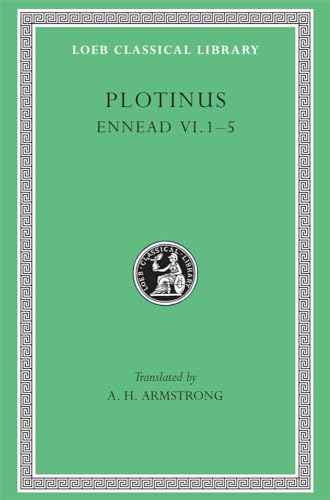
Synopsis
Plato's most influential disciple and proponent.
Plotinus (AD 204/5-270), possibly of Roman descent, but certainly a Greek in education and environment, was the first and greatest of Neoplatonic philosophers. Practically nothing is known of his early life, but at the age of 28 he went to Alexandria, and studied philosophy with Ammonius "Saccas" for eleven years. Wishing to learn the philosophy of the Persians and Indians, he joined the expedition of Gordian III against the Persians in 243, not without subsequent danger. Aged 40 he settled in Rome and taught philosophy there till shortly before his death. In 253 he began to write, and continued to do so till the last year of his life. His writings were edited by his disciple Porphyry, who published them many years after his master's death in six sets of nine treatises each (the Enneads). Plotinus regarded Plato as his master, and his own philosophy is a profoundly original development of the Platonism of the first two centuries of the Christian era and the closely related thought of the Neopythagoreans, with some influences from Aristotle and his followers and the Stoics, whose writings he knew well but used critically. There is no real trace of Oriental influence on his thought, and he was passionately opposed to Gnosticism. He is a unique combination of mystic and Hellenic rationalist. His thought dominated later Greek philosophy and influenced both Christians and Muslims, and is still alive today because of its union of rationality and intense religious experience. The Loeb Classical Library edition of Plotinus is in seven volumes.Les informations fournies dans la section « Synopsis » peuvent faire référence à une autre édition de ce titre.
À propos de l?auteur
Arthur Hilary Armstrong (1909-1997) was the Gladstone Professor of Greek at the University of Liverpool.
Les informations fournies dans la section « A propos du livre » peuvent faire référence à une autre édition de ce titre.
Résultats de recherche pour Plotinus, With an English Translation: Enneads, Books...

Image fournie par le vendeur
Ennead VI.1â"5
Edité par
Harvard University Press, 1988
ISBN 10 : 0674994906
ISBN 13 : 9780674994904
Ancien ou d'occasion
Couverture rigide
Vendeur : Zoom Books Company, Lynden, WA, Etats-Unis
Évaluation du vendeur 5 sur 5 étoiles

Etat : very_good. Book is in very good condition and may include minimal underlining highlighting. The book can also include "From the library of" labels. May not contain miscellaneous items toys, dvds, etc. . We offer 100% money back guarantee and 24 7 customer service. N° de réf. du vendeur ZBV.0674994906.VG
Acheter D'occasion
EUR 23,08
Frais de port :
Gratuit
Vers Etats-Unis
Quantité disponible : 1 disponible(s)
Image d'archives
Plotinus: Volume VI, Ennead VI.1-5 (Loeb Classical Library No. 445)
Edité par
Harvard University Press, 1988
ISBN 10 : 0674994906
ISBN 13 : 9780674994904
Ancien ou d'occasion
Couverture rigide
Vendeur : Avol's Books LLC, Madison, WI, Etats-Unis
Évaluation du vendeur 5 sur 5 étoiles
Hardcover. Etat : Very Good. Etat de la jaquette : Good. Dust jacket spine darkened, spotted. From the library of Prof. John Scarborough, School of Pharmacy and Department of Classics, University of Wisconsin-Madison, with his name and date on front flyleaf. N° de réf. du vendeur 222651
Acheter D'occasion
EUR 18,60
Frais de port :
EUR 5,16
Vers Etats-Unis
Quantité disponible : 1 disponible(s)
Image d'archives
Ennead VI.1â"5
Edité par
Harvard University Press, 1988
ISBN 10 : 0674994906
ISBN 13 : 9780674994904
Ancien ou d'occasion
Couverture rigide
Vendeur : Evergreen Goodwill, Seattle, WA, Etats-Unis
Évaluation du vendeur 5 sur 5 étoiles
hardcover. Etat : Acceptable. N° de réf. du vendeur mon0000237225
Acheter D'occasion
EUR 20,34
Frais de port :
EUR 3,43
Vers Etats-Unis
Quantité disponible : 1 disponible(s)
Image fournie par le vendeur
Plotinus, With an English Translation : Enneads, Books 1-5
Vendeur : GreatBookPrices, Columbia, MD, Etats-Unis
Évaluation du vendeur 5 sur 5 étoiles
Etat : New. N° de réf. du vendeur 623779-n
Acheter neuf
EUR 28,54
Frais de port :
EUR 2,27
Vers Etats-Unis
Quantité disponible : Plus de 20 disponibles
Image d'archives
Ennead VI.15
Vendeur : PBShop.store US, Wood Dale, IL, Etats-Unis
Évaluation du vendeur 5 sur 5 étoiles
HRD. Etat : New. New Book. Shipped from UK. Established seller since 2000. N° de réf. du vendeur WL-9780674994904
Acheter neuf
EUR 30,89
Frais de port :
Gratuit
Vers Etats-Unis
Quantité disponible : 15 disponible(s)
Image fournie par le vendeur
Ennead VI.1-5
Edité par
Harvard University Press, US, 1988
ISBN 10 : 0674994906
ISBN 13 : 9780674994904
Neuf
Couverture rigide
Vendeur : Rarewaves.com USA, London, LONDO, Royaume-Uni
Évaluation du vendeur 5 sur 5 étoiles
Hardback. Etat : New. Plato's most influential disciple and proponent.Plotinus (AD 204/5-270), possibly of Roman descent, but certainly a Greek in education and environment, was the first and greatest of Neoplatonic philosophers. Practically nothing is known of his early life, but at the age of 28 he went to Alexandria, and studied philosophy with Ammonius "Saccas" for eleven years. Wishing to learn the philosophy of the Persians and Indians, he joined the expedition of Gordian III against the Persians in 243, not without subsequent danger. Aged 40 he settled in Rome and taught philosophy there till shortly before his death. In 253 he began to write, and continued to do so till the last year of his life. His writings were edited by his disciple Porphyry, who published them many years after his master's death in six sets of nine treatises each (the Enneads).Plotinus regarded Plato as his master, and his own philosophy is a profoundly original development of the Platonism of the first two centuries of the Christian era and the closely related thought of the Neopythagoreans, with some influences from Aristotle and his followers and the Stoics, whose writings he knew well but used critically. There is no real trace of Oriental influence on his thought, and he was passionately opposed to Gnosticism. He is a unique combination of mystic and Hellenic rationalist. His thought dominated later Greek philosophy and influenced both Christians and Muslims, and is still alive today because of its union of rationality and intense religious experience.The Loeb Classical Library edition of Plotinus is in seven volumes. N° de réf. du vendeur LU-9780674994904
Acheter neuf
EUR 33,14
Frais de port :
Gratuit
De Royaume-Uni vers Etats-Unis
Quantité disponible : 8 disponible(s)
Image fournie par le vendeur
Plotinus, With an English Translation : Enneads, Books 1-5
Edité par
LOEB, 1988
ISBN 10 : 0674994906
ISBN 13 : 9780674994904
Ancien ou d'occasion
Couverture rigide
Vendeur : GreatBookPrices, Columbia, MD, Etats-Unis
Évaluation du vendeur 5 sur 5 étoiles
Etat : As New. Unread book in perfect condition. N° de réf. du vendeur 623779
Acheter D'occasion
EUR 30,99
Frais de port :
EUR 2,27
Vers Etats-Unis
Quantité disponible : Plus de 20 disponibles
Image d'archives
Ennead VI.15
Vendeur : PBShop.store UK, Fairford, GLOS, Royaume-Uni
Évaluation du vendeur 5 sur 5 étoiles
HRD. Etat : New. New Book. Shipped from UK. Established seller since 2000. N° de réf. du vendeur WL-9780674994904
Acheter neuf
EUR 28,72
Frais de port :
EUR 4,73
De Royaume-Uni vers Etats-Unis
Quantité disponible : 15 disponible(s)
Image d'archives
Plotinus VI: Ennead VI.1-5. Loeb Classical Library No. 445
Edité par
Harvard University Press, 1988
ISBN 10 : 0674994906
ISBN 13 : 9780674994904
Ancien ou d'occasion
Couverture rigide
Vendeur : The Bookseller, Edmonton, AB, Canada
Évaluation du vendeur 5 sur 5 étoiles
Hardcover. Etat : Near Fine. Etat de la jaquette : Near Fine. Near fine unmarked book in dust jacket. N° de réf. du vendeur 067001
Acheter D'occasion
EUR 22,83
Frais de port :
EUR 13,76
De Canada vers Etats-Unis
Quantité disponible : 1 disponible(s)
Image fournie par le vendeur
Ennead VI.15 (Hardcover)
Edité par
Harvard University Press, Cambridge, Mass, 1988
ISBN 10 : 0674994906
ISBN 13 : 9780674994904
Neuf
Couverture rigide
Vendeur : Grand Eagle Retail, Bensenville, IL, Etats-Unis
Évaluation du vendeur 5 sur 5 étoiles
Hardcover. Etat : new. Hardcover. Plotinus (204/5-270 CE) was the first and greatest of Neoplatonic philosophers. His writings were edited by his disciple Porphyry, who published them many years after his master's death in six sets of nine treatises each (the Enneads).Plotinus regarded Plato as his master, and his own philosophy is a profoundly original development of the Platonism of the first two centuries of the Christian era and the closely related thought of the Neopythagoreans, with some influences from Aristotle and his followers and the Stoics, whose writings he knew well but used critically. He is a unique combination of mystic and Hellenic rationalist. His thought dominated later Greek philosophy and influenced both Christians and Moslems, and is still alive today because of its union of rationality and intense religious experience.In his acclaimed edition of Plotinus, Armstrong provides excellent introductions to each treatise. His invaluable notes explain obscure passages and give reference to parallels in Plotinus and others. Plotinus was the first and greatest of Neoplatonic philosophers. His writings were edited by his disciple Porphyry, who published them sometime between AD 301 and 305 in six sets of nine treatises each (Enneads), with a biography of his master in which he also explains his editorial principles. Shipping may be from multiple locations in the US or from the UK, depending on stock availability. N° de réf. du vendeur 9780674994904
Acheter neuf
EUR 38,73
Frais de port :
Gratuit
Vers Etats-Unis
Quantité disponible : 1 disponible(s)