
Articles liés à The Hand: How Its Use Shapes the Brain, Language, and...
Synopsis
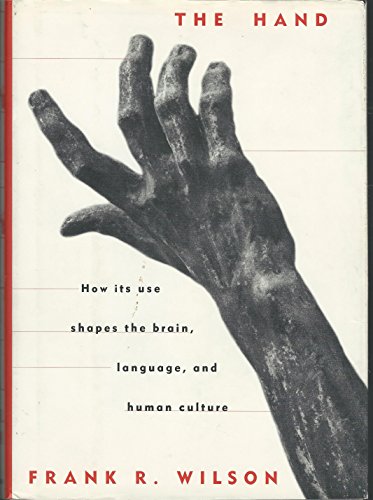
Drawing from anthropology, physiology, and neurology, and using the examples of jugglers, surgeons, musicians, and puppetmakers, the author explores the role of the hand in how humans learn and form their identities. 20,000 first printing.
Les informations fournies dans la section « Synopsis » peuvent faire référence à une autre édition de ce titre.
Extrait
Prologue
Early this morning, even before you were out of bed, your hands and arms came to life, goading your weak and helpless body into the new day. Perhaps your day began with a lunge at the snooze bar on the bedside radio, or a roundhouse swing at the alarm clock. As the shock of coming awake subsided, you probably flapped the numb, tingling arm you had been sleeping on, scratched yourself, and maybe even rubbed or hugged someone next to you.
After tugging at the covers and sheets and rolling yourself into a more comfortable position, you realized that you really did have to get out of bed. Next came the whole circus routine of noisy bathroom antics: the twisting of faucet handles, opening and closing of cabinet and shower doors, putting the toilet seat back where it belongs. There were slippery things to play with: soap, brushes, tubes, and little jars with caps and lids to twist or flip open. If you shaved, there was a razor to steer around the nose and over the chin; if you put on makeup, there were pencils, brushes, and tubes to bring color to eyelids, cheeks, and lips.
Each morning begins with a ritual dash through our own private obstacle course--objects to be opened or closed, lifted or pushed, twisted or turned, pulled, twiddled, or tied, and some sort of breakfast to be peeled or unwrapped, toasted, brewed, boiled, or fried. The hands move so ably over this terrain that we think nothing of the accomplishment. Whatever your own particular early-morning routine happens to be, it is nothing short of a virtuoso display of highly choreographed manual skill.
Where would we be without our hands? Our lives are so full of commonplace experience in which the hands are so skillfully and silently involved that we rarely consider how dependent upon them we actually are. We notice our hands when we are washing them, when our fingernails need to be trimmed, or when little brown spots and wrinkles crop up and begin to annoy us. We also pay attention to a hand that hurts or has been injured.
The book you are holding is a meditation on the human hand, born of nearly two decades of personal and professional experiences that caused me to want to know more about the hand. Among these, two had the greatest impact: first, as an adult musical novice, I tried to learn how to play the piano; second, as an experienced neurologist, I began to see patients who were having difficulty using their hands. Each experience afforded its own indelible lessons; each spawned its own progeny of questions.
Like most people, I have spent the better part of my life oblivious to the workings of my own hands. My first extended attempt to master a specific manual skill for its own sake took place at the piano. I was in my early forties at the time and in my dual role as parent and neurologist had become enchanted by the pianistic flights of my twelve-year-old daughter, Suzanna. "How does she make her fingers go so fast?" was the question that occurred to me when I interrupted my listening long enough to watch her play. I read everything I could about the subject and finally realized I would never find the answer until I took myself to the piano to find out.
As a beginning student I imagined that music learning would go just as it is depicted by music teachers: begin with simple pieces, learn the names of the notes, practice scales and exercises, memorize, play in student recitals, then move on (shakily or steadily) to more and more difficult music. But over the course of five years of study my personal experience deviated further and further from this itinerary. It was not that I was fast or slow, musical or unmusical; at various times I was each of those. Despite the guidance of a seasoned teacher armed with the highly polished canons of music pedagogy, the whole enterprise was rife with unexpected turns, detours, and diversions. Inside me, it seems, there was already a plan for being a musician--a modest one, but a plan nonetheless: the protocols of music had simply set the specific cognitive, motor, emotional, and social terms according to which hand and finger movements that were initially unsure and clumsy would gradually become more accurate and fluent. As I hope to demonstrate--even to the satisfaction of music teachers--I might as easily have been in a woodcarving class, or learning how to arrange flowers or build racing-car engines.
After several years of piano study I began to see musicians as patients. Most came expecting that a doctor with musical training would better understand their physical problems than one without such experience. Later, the "hand cases" also came from restaurants, banks, police stations, dental offices, machine shops, beauty parlors, hospitals, ranches. All came for the same simple reason: they could not do their jobs without a working pair of hands.
A major turning point in my thinking about the hand came as the result of a presentation I made to a group of musicians about a particularly difficult and puzzling problem called musician's cramp. I had brought along a video clip to show during the talk. It was a brief clinical-musical medley of hands that had either been injured or had mysteriously lost their former skill; formerly graceful, lithe, dazzlingly fast hands could barely limp through the notes they sought to draw out of pianos, guitars, flutes, and violins. Just a few minutes after the film began, a guitarist in the audience fainted. I was amazed. This was not the sort of grotesque display one sometimes sees in medical movies; these were just musicians unable to play their instruments. When the same thing happened at subsequent presentations--a second and then a third time--I was genuinely puzzled. I decided I must have missed subtleties or hidden meaning in these films apparent only to very few viewers. It was not until much later that I came to understand the real message these fainting musicians were expressing.
I now understand that I had failed to appreciate how the commitment to a career in music differs from even the most serious amateur interest. Although I had worked very hard as a beginning piano student, took the work seriously and spent a great deal of time at it, it was not my life. Consequently I did not anticipate the profound empathy for the injured musicians that would be felt by some viewers of these films. Moreover--and this is a lesson I learned, one person at a time, as I conducted interviews with nonmusicians for this book--when personal desire prompts anyone to learn to do something well with the hands, an extremely complicated process is initiated that endows the work with a powerful emotional charge. People are changed, significantly and irreversibly it seems, when movement, thought, and feeling fuse during the active, long-term pursuit of personal goals.
Serious musicians are emotional about their work not simply because they are committed to it, nor because their work demands the public expression of emotion. The musicians' concern for their hands is a by-product of the intense striving through which they turn them into the essential physical instrument for realization of their own ideas or the communication of closely held feelings. The same is true of sculptors, woodcarvers, jewelers, jugglers, and surgeons when they are fully immersed in their work. It is more than simple satisfaction or contentedness: musicians, for example, love to work and are miserable when they cannot; they rarely welcome an unscheduled vacation unless it is very brief. How peculiar it is that people who normally permit themselves so little rest from an extreme and, by some standards, unrewarding discipline cannot bear to be disengaged from it. The musician in full flight is an ecstatic creature, and the same person with wings clipped is unexploded dynamite with the fuse lit. The word "passion" describes attachments that are this strong. As I came to learn how such attachments are generated, it became the mission of this book to expose the hidden physical roots of the unique human capacity for passionate and creative work. It is now abundantly clear to me that these roots are more than deep and more than merely ancient. They reach down, and backward in time, past the dawn of human history to the beginning of primate life on this planet.
Paleoanthropology--the study of ancient human origins--has until recently been better known to the public through cartoon images than through its serious work. But this seemingly dry as dust discipline is now followed by an enthralled public because of the stunning discoveries and brilliant reporting of its most prominent modern pioneers, including the Leakey family in Kenya, Donald Johanson, and, of course, Stephen Jay Gould. New information harvested from fossilized skeletal fragments millions of years old has both enlivened evolutionary theory and joined it to the developmental and behavioral sciences, linguistics, and even the neurosciences. Charles Darwin's name and his ideas are again as widely discussed and debated as they were in the middle of the last century. Indeed, the explosion of recent publications about Darwin, neo-Darwinism, universal Darwinism, and even neural Darwinism certify his genius; with the passage of time the impact of his insights and his work simply grows and grows.
Reawakened interest in Darwin finds a quiet but highly significant counterpart in a recent growing awareness of the remarkable life and work of Sir Charles Bell, a Scottish surgeon who was not only a contemporary of Darwin but one of the most respected comparative anatomists of his day. As a young boy, Bell had not only studied drawing but assisted his older brother in the teaching of anatomy. In 1806, having moved from Edinburgh to London and having become an anatomy teacher himself, he published Essays on the Anatomy of Expression in Painting, a book which was popular with both artists and surgeons and which remained in print for over forty years. Bell's work on comparative anatomy was well known to Darwin, and his Essays presaged Darwin's publication, in 1872, of The Expression of the Emotions in Man and Animals.
In 1833, with Darwin near the midpoint of his epic five-year voyage on the Beagle, Bell completed and published the Fourth Bridgewater Treatise: The Hand, Its Mechanism and Vital Endowments, as Evincing Design. In keeping with the terms of the Bridgewater endowment, Bell had intended that his book would help to establish biology as a support for religious faith. But this was not the result. His analyses of the behavioral consequences of variation in anatomic structure, and his insights into the relationship between movement, perception, and learning, were revolutionary and seminal. The book, and Bell's continuing work on the anatomy of the nervous system, had a far greater influence on the development of the science of physiology of the nervous system than on religious thought or polemic.
It is genuinely startling to read Bell's Hand now, because its singular message--that no serious account of human life can ignore the central importance of the human hand--remains as trenchant as when it was first published. This message deserves vigorous renewal as an admonition to cognitive science. Indeed, I would go further: I would argue that any theory of human intelligence which ignores the interdependence of hand and brain function, the historic origins of that relationship, or the impact of that history on developmental dynamics in modern humans, is grossly misleading and sterile.
Following Bell, we will begin with a brief review of what is known of the human (and the hand's) evolutionary timetable, and then move to the present--to the "Decade of the Brain"--to consider the most recent efforts by anthropologists and brain scientists to create a comparable timetable, or track, for the evolution of intelligence. This review is an essential preliminary to a later chapter on human language and a discussion of the role some theorists attribute to the hand in the emergence of symbolic thought.
We will continue with a compact overview of the anatomic and physiologic nuts and bolts pertinent to hand function. It is not possible to understand the hand as a dynamic part of the body, or to safely tackle broader issues concerning the hand in relation to brain function or human development, without at least a minimal grasp of the fundamentals of its physical structure and function. But what do we mean by "the hand"? Should we define it on the basis of its visible physical boundaries? From the perspective of classical surface anatomy, the hand extends from the wrist to the fingertips. But under the skin this boundary is just an abstraction, a pencil line drawn by mapmakers, giving no clue as to what the hand is or how it actually works.
On both sides of the wrist, under a thin layer of skin and connective tissue, pale white, cordlike tendons and nerves pass from the hand into the forearm. Are the tendons above the wrist--that is, in the forearm--part of the hand? After all, we are able to hammer nails or use a pencil only because of the pull of tendons and muscles near the elbow. From the perspective of biomechanical anatomy, the hand is an integral part of the entire arm, in effect a specialized termination of a cranelike structure suspended from the neck and the upper chest. Should we agree that the hand must be conceptualized in biomechanical terms, we invite further complexities of definition. We would know very little about the living actions of the hand except for observations of the effects of injury on its function; such observations are well documented from the time of ancient Greece, when it was known that muscles could be permanently paralyzed by cutting a thin white cord that somehow activates the muscle. Such cords are called nerves, and physicians and anatomists in ancient Alexandria already knew that nerves originated in the spinal cord. What are we to do with this fact? Are the nerves controlling the muscles and tendons that cause the hand to move also part of the hand?
Another set of observations, beginning a little over a century ago, has made it clear that the hand can be rendered useless by damage to the brain from injury (a fall or a gunshot wound) or as the result of a disease process (stroke, multiple sclerosis, or Parkinsonism, for example). Pathologic change associated with specific diseases or injuries, when confined to different parts of the brain, can have quite different and distinctive effects on hand function. Should those parts of the brain that regulate hand function be considered part of the hand? The perspective of physiological or functional anatomy suggests that the answer is yes. We need go no further than this to realize that a precise definition of the hand may be beyond us. Although we understand what is meant conventionally by the simple anatomic term, we can no longer say with certainty where the hand itself, or its control or influence, begins or ends in the body.
The problem of understanding what the hand is becomes infinitely more complicated, and the inquiry far more difficult to contain, if we try to account for differences in the way people use their hands, or if we try to understand how individuals acquire skill in the use of their hands. When we connect the hands to real life, in other words, we confront the open-ended and overlapping worlds of sensorimotor and cognitive function and the endless combinations of speed, strength, and dexterity seen in individual human skill and performance. We also confront the vagaries of human learning. Consider the following sequence of events:
Two people of the same sex and roughly the same age, physical makeup, and education both begin piano lessons and juggling lessons. At the end of one month, the first student seems to be progres...
Biographie de l'auteur
Frank Wilson was an early contributor to the development of performing arts medicine in the United States and Europe in the 1980’s. In 1986 he was a co-founder and neurologist for the Health Program for Performing Artists at the University of California, San Francisco, where his interest focused on impaired hand control in musicians. In 1989 he moved to the University of Düsseldorf in Germany, where he held a one-year fellowship as visiting professor of neurology and was the organizer of a research team studying focal hand dystonia in musicians.
Following his return to California in 1990, Dr. Wilson continued his work with performing artists; he began a trial of music-learning experiences for patients in the neurological rehabilitation program at Mt. Zion Hospital; and for two years he was the neurologist on a multidisciplinary team investigating upper extremity injuries among textile designers at the Levi Strauss Company in San Francisco. He became the medical director of the Health Program for Performing Artists in 1996, and in 2001 accepted an appointment as Clinical Professor of Neurology at Stanford University School of Medicine, joining a clinical research team at Stanford studying deep brain stimulation for patients with complex movement disorders.
Wilson’s career-long interest in the neurology of human hand control is reflected in two books that explore the neurological and anthropological underpinnings of skilled hand use. The first, Tone Deaf and All Thumbs? was published by Viking-Penguin in 1986. The second, The Hand: How Its Use Shapes the Brain, Language, and Human Culture, was published by Pantheon Books in 1998 and was nominated that year for a Pulitzer Prize for non-fiction.
Since the publication of The Hand, he has presented his work and his ideas at national meetings of many professional organizations, and to a wide community of artists and educators who share the opinion that the human hand and brain are an anatomically and behaviorally integrated system – biology’s not-so-secret formula for individual human intelligence, creativity, and autonomy.
Les informations fournies dans la section « A propos du livre » peuvent faire référence à une autre édition de ce titre.
Résultats de recherche pour The Hand: How Its Use Shapes the Brain, Language, and...

Image d'archives
The Hand: How it Shapes the Brain, Language and Human Culture
Edité par
Random House USA Inc, 1998
ISBN 10 : 0679412492
ISBN 13 : 9780679412496
Ancien ou d'occasion
Couverture rigide
Vendeur : World of Books (was SecondSale), Montgomery, IL, Etats-Unis
Évaluation du vendeur 5 sur 5 étoiles

Hardback. Etat : Good. A startling argument . . . provocative . . . absorbing. --The Boston Globe Ambitious . . . arresting . . . celebrates the importance of hands to our lives today as well as to the history of our species. --The New York Times Book Review The human hand is a miracle of biomechanics, one of the most remarkable adaptations in the history of evolution. The hands of a concert pianist can elicit glorious sound and stir emotion; those of a surgeon can perform the most delicate operations; those of a rock climber allow him to scale a vertical mountain wall. Neurologist Frank R. Wilson makes the striking claim that it is because of the unique structure of the hand and its evolution in cooperation with the brain that Homo sapiens became the most intelligent, preeminent animal on the earth. In this fascinating book, Wilson moves from a discussion of the hand's evolution--and how its intimate communication with the brain affects such areas as neurology, psychology, and linguistics--to provocative new ideas about human creativity and how best to nurture it. Like Oliver Sacks and Stephen Jay Gould, Wilson handles a daunting range of scientific knowledge with a surprising deftness and a profound curiosity about human possibility. Provocative, illuminating, and delightful to read, The Hand encourages us to think in new ways about one of our most taken-for-granted assets. A mark of the book's excellence [is that] it makes the reader aware of the wonder in trivial, everyday acts, and reveals the complexity behind the simplest manipulation. --The Washington Post. N° de réf. du vendeur 00107499458
Acheter D'occasion
EUR 5,09
Livraison gratuite
Expédition nationale : Etats-Unis
Expédition nationale : Etats-Unis
Quantité disponible : 4 disponible(s)
Image fournie par le vendeur
The Hand: How Its Use Shapes the Brain, Language, and Human Culture
Edité par
Pantheon, 1998
ISBN 10 : 0679412492
ISBN 13 : 9780679412496
Ancien ou d'occasion
Couverture rigide
Vendeur : Bay State Book Company, North Smithfield, RI, Etats-Unis
Évaluation du vendeur 5 sur 5 étoiles
Etat : good. The book is in good condition with all pages and cover intact, including the dust jacket if originally issued. The spine may show light wear. Pages may contain some notes or highlighting, and there might be a "From the library of" label. Boxed set packaging, shrink wrap, or included media like CDs may be missing. N° de réf. du vendeur BSM.1CB18
Acheter D'occasion
EUR 5,10
Livraison gratuite
Expédition nationale : Etats-Unis
Expédition nationale : Etats-Unis
Quantité disponible : 1 disponible(s)
Image fournie par le vendeur
The Hand: How Its Use Shapes the Brain, Language, and Human Culture
Edité par
Pantheon, 1998
ISBN 10 : 0679412492
ISBN 13 : 9780679412496
Ancien ou d'occasion
Couverture rigide
Vendeur : -OnTimeBooks-, Phoenix, AZ, Etats-Unis
Évaluation du vendeur 5 sur 5 étoiles
Etat : very_good. Gently read. May have name of previous ownership, or ex-library edition. Binding tight; spine straight and smooth, with no creasing; covers clean and crisp. Minimal signs of handling or shelving. 100% GUARANTEE! Shipped with delivery confirmation, if you're not satisfied with purchase please return item! Ships USPS Media Mail. N° de réf. du vendeur OTV.0679412492.VG
Acheter D'occasion
EUR 6,30
Livraison gratuite
Expédition nationale : Etats-Unis
Expédition nationale : Etats-Unis
Quantité disponible : 1 disponible(s)
Image fournie par le vendeur
The Hand: How Its Use Shapes the Brain, Language, and Human Culture
Edité par
Pantheon, 1998
ISBN 10 : 0679412492
ISBN 13 : 9780679412496
Ancien ou d'occasion
Couverture rigide
Vendeur : -OnTimeBooks-, Phoenix, AZ, Etats-Unis
Évaluation du vendeur 5 sur 5 étoiles
Etat : good. A copy that has been read, remains in good condition. All pages are intact, and the cover is intact. The spine and cover show signs of wear. Pages can include notes and highlighting and show signs of wear, and the copy can include "From the library of" labels or previous owner inscriptions. 100% GUARANTEE! Shipped with delivery confirmation, if you're not satisfied with purchase please return item! Ships via media mail. N° de réf. du vendeur OTV.0679412492.G
Acheter D'occasion
EUR 6,30
Livraison gratuite
Expédition nationale : Etats-Unis
Expédition nationale : Etats-Unis
Quantité disponible : 1 disponible(s)
Image d'archives
The Hand: How Its Use Shapes the Brain, Language, and Human Culture
Edité par
Pantheon, 1998
ISBN 10 : 0679412492
ISBN 13 : 9780679412496
Ancien ou d'occasion
Couverture rigide
Vendeur : ThriftBooks-Dallas, Dallas, TX, Etats-Unis
Évaluation du vendeur 5 sur 5 étoiles
Hardcover. Etat : Very Good. No Jacket. May have limited writing in cover pages. Pages are unmarked. ~ ThriftBooks: Read More, Spend Less. N° de réf. du vendeur G0679412492I4N00
Acheter D'occasion
EUR 6,68
Livraison gratuite
Expédition nationale : Etats-Unis
Expédition nationale : Etats-Unis
Quantité disponible : 1 disponible(s)
Image d'archives
The Hand: How it Shapes the Brain, Language and Human Culture
Edité par
Random House USA Inc, 1998
ISBN 10 : 0679412492
ISBN 13 : 9780679412496
Ancien ou d'occasion
Couverture rigide
Vendeur : World of Books Inc, Montgomery, IL, Etats-Unis
Évaluation du vendeur 4 sur 5 étoiles

Hardback. Etat : Good. A startling argument . . . provocative . . . absorbing. --The Boston Globe Ambitious . . . arresting . . . celebrates the importance of hands to our lives today as well as to the history of our species. --The New York Times Book Review The human hand is a miracle of biomechanics, one of the most remarkable adaptations in the history of evolution. The hands of a concert pianist can elicit glorious sound and stir emotion; those of a surgeon can perform the most delicate operations; those of a rock climber allow him to scale a vertical mountain wall. Neurologist Frank R. Wilson makes the striking claim that it is because of the unique structure of the hand and its evolution in cooperation with the brain that Homo sapiens became the most intelligent, preeminent animal on the earth. In this fascinating book, Wilson moves from a discussion of the hand's evolution--and how its intimate communication with the brain affects such areas as neurology, psychology, and linguistics--to provocative new ideas about human creativity and how best to nurture it. Like Oliver Sacks and Stephen Jay Gould, Wilson handles a daunting range of scientific knowledge with a surprising deftness and a profound curiosity about human possibility. Provocative, illuminating, and delightful to read, The Hand encourages us to think in new ways about one of our most taken-for-granted assets. A mark of the book's excellence [is that] it makes the reader aware of the wonder in trivial, everyday acts, and reveals the complexity behind the simplest manipulation. --The Washington Post. N° de réf. du vendeur CIN0679412492G
Acheter D'occasion
EUR 6,90
Livraison gratuite
Expédition nationale : Etats-Unis
Expédition nationale : Etats-Unis
Quantité disponible : 4 disponible(s)
Image fournie par le vendeur
The Hand: How Its Use Shapes the Brain, Language, and Human Culture
Edité par
Pantheon, 1998
ISBN 10 : 0679412492
ISBN 13 : 9780679412496
Ancien ou d'occasion
Couverture rigide
Vendeur : Dream Books Co., Denver, CO, Etats-Unis
Évaluation du vendeur 5 sur 5 étoiles
Etat : good. Gently used with minimal wear on the corners and cover. A few pages may contain light highlighting or writing, but the text remains fully legible. Dust jacket may be missing, and supplemental materials like CDs or codes may not be included. May be ex-library with library markings. Ships promptly! N° de réf. du vendeur DBV.0679412492.G
Acheter D'occasion
EUR 7,40
Livraison gratuite
Expédition nationale : Etats-Unis
Expédition nationale : Etats-Unis
Quantité disponible : 1 disponible(s)
Image d'archives
The Hand: How its use shapes the brain, language, and human culture
Edité par
Pantheon, 1998
ISBN 10 : 0679412492
ISBN 13 : 9780679412496
Ancien ou d'occasion
Couverture rigide
Vendeur : HPB-Red, Dallas, TX, Etats-Unis
Évaluation du vendeur 5 sur 5 étoiles
hardcover. Etat : Acceptable. Connecting readers with great books since 1972. Used textbooks may not include companion materials such as access codes, etc. May have condition issues including wear and notes/highlighting. We ship orders daily and Customer Service is our top priority! N° de réf. du vendeur S_444151946
Acheter D'occasion
EUR 4,53
Expédition à EUR 3,30
Expédition nationale : Etats-Unis
Expédition nationale : Etats-Unis
Quantité disponible : 1 disponible(s)
Image fournie par le vendeur
The Hand: How Its Use Shapes the Brain, Language, and Human Culture
Edité par
Pantheon, 1998
ISBN 10 : 0679412492
ISBN 13 : 9780679412496
Ancien ou d'occasion
Couverture rigide
Vendeur : ICTBooks, Wichita, KS, Etats-Unis
Évaluation du vendeur 5 sur 5 étoiles
Etat : acceptable. Book shows heavy wear from use and may contain signifcant amounts of marking writing. May not include dust jacket and bear library markings. LISTING USES STOCK PHOTOS AND COVER MAY VARY. Ships via USPS and typically arrives within 10-12 business days. N° de réf. du vendeur ICV.0679412492.A
Acheter D'occasion
EUR 8,14
Livraison gratuite
Expédition nationale : Etats-Unis
Expédition nationale : Etats-Unis
Quantité disponible : 1 disponible(s)
Image fournie par le vendeur
The Hand: How Its Use Shapes the Brain, Language, and Human Culture
Edité par
Pantheon, 1998
ISBN 10 : 0679412492
ISBN 13 : 9780679412496
Ancien ou d'occasion
Couverture rigide
Vendeur : Goodwill of Greater Milwaukee and Chicago, Racine, WI, Etats-Unis
Évaluation du vendeur 5 sur 5 étoiles
Etat : good. Book is considered to be in good or better condition. The actual cover image may not match the stock photo. Hard cover books may show signs of wear on the spine, cover or dust jacket. Paperback book may show signs of wear on spine or cover as well as having a slight bend, curve or creasing to it. Book should have minimal to no writing inside and no highlighting. Pages should be free of tears or creasing. Stickers should not be present on cover or elsewhere, and any CD or DVD expected with the book is included. Book is not a former library copy. N° de réf. du vendeur SEWV.0679412492.G
Acheter D'occasion
EUR 6,81
Expédition à EUR 2,64
Expédition nationale : Etats-Unis
Expédition nationale : Etats-Unis
Quantité disponible : 2 disponible(s)