
Articles liés à The Populist Paradox
Synopsis
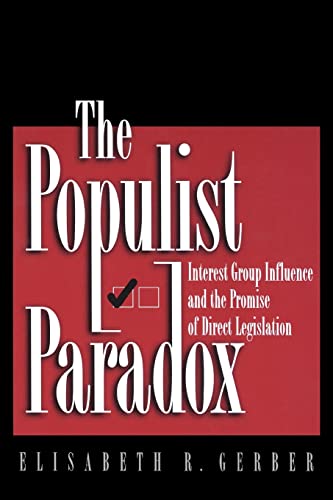
Do small but wealthy interest groups influence referendums, ballot initiatives, and other forms of direct legislation at the expense of the broader public interest? Many observers argue that they do, often lamenting that direct legislation has, paradoxically, been captured by the very same wealthy interests whose power it was designed to curb. Elisabeth Gerber, however, challenges that argument. In this first systematic study of how money and interest group power actually affect direct legislation, she reveals that big spending does not necessarily mean big influence. Gerber bases her findings on extensive surveys of the activities and motivations of interest groups and on close examination of campaign finance records from 168 direct legislation campaigns in eight states. Her research confirms what such wealthy interests as the insurance industry, trial lawyer associations, and tobacco companies have learned by defeats at the ballot box: if citizens do not like a proposed new law, even an expensive, high-profile campaign will not make them change their mind. She demonstrates, however, that these economic interest groups have considerable success in using direct legislation to block initiatives that others are proposing and to exert pressure on politicians. By contrast, citizen interest groups with broad-based support and significant organizational resources have proven to be extremely effective in using direct legislation to pass new laws. Clearly written and argued, this is a major theoretical and empirical contribution to our understanding of the role of citizens and organized interests in the American legislative process.
Les informations fournies dans la section « Synopsis » peuvent faire référence à une autre édition de ce titre.
À propos de l'auteur
Elisabeth R. Gerber, Associate Professor of Political Science at the University of California, San Diego, studies the consequences of U.S. election laws on interest representation. She is currently working on a major study of primary election laws in the American states.
Les informations fournies dans la section « A propos du livre » peuvent faire référence à une autre édition de ce titre.
Résultats de recherche pour The Populist Paradox

Image d'archives
The Populist Paradox
Edité par
Princeton University Press, 1999
ISBN 10 : 0691002673
ISBN 13 : 9780691002675
Ancien ou d'occasion
paperback
Vendeur : HPB-Red, Dallas, TX, Etats-Unis
Évaluation du vendeur 5 sur 5 étoiles

paperback. Etat : Good. Connecting readers with great books since 1972! Used textbooks may not include companion materials such as access codes, etc. May have some wear or writing/highlighting. We ship orders daily and Customer Service is our top priority! N° de réf. du vendeur S_376265152
Acheter D'occasion
EUR 4,59
Expédition à EUR 3,34
Expédition nationale : Etats-Unis
Expédition nationale : Etats-Unis
Quantité disponible : 1 disponible(s)
Image d'archives
The Populist Paradox: Interest Group Influence and the Promise of Direct Legislation
Edité par
Princeton University Press, 1999
ISBN 10 : 0691002673
ISBN 13 : 9780691002675
Ancien ou d'occasion
Paperback
Vendeur : World of Books (was SecondSale), Montgomery, IL, Etats-Unis
Évaluation du vendeur 5 sur 5 étoiles
Paperback. Etat : Very Good. A study of how money and interest group power actually affect direct legislation, this book reveals that big spending does not necessarily mean big influence. This book is a theoretical and empirical contribution to our understanding of the role of citizens and organized interests in the American legislative process. N° de réf. du vendeur 00098995963
Acheter D'occasion
EUR 8,02
Livraison gratuite
Expédition nationale : Etats-Unis
Expédition nationale : Etats-Unis
Quantité disponible : 1 disponible(s)
Image d'archives
The Populist Paradox: Interest Group Influence and the Promise of Direct Legislation
Edité par
Princeton University Press, 1999
ISBN 10 : 0691002673
ISBN 13 : 9780691002675
Ancien ou d'occasion
Paperback
Vendeur : World of Books (was SecondSale), Montgomery, IL, Etats-Unis
Évaluation du vendeur 5 sur 5 étoiles
Paperback. Etat : Good. A study of how money and interest group power actually affect direct legislation, this book reveals that big spending does not necessarily mean big influence. This book is a theoretical and empirical contribution to our understanding of the role of citizens and organized interests in the American legislative process. N° de réf. du vendeur 00108693186
Acheter D'occasion
EUR 8,02
Livraison gratuite
Expédition nationale : Etats-Unis
Expédition nationale : Etats-Unis
Quantité disponible : 1 disponible(s)
Image d'archives
The Populist Paradox: Interest Group Influence and the Promise of Direct Legislation
Edité par
Princeton University Press, 1999
ISBN 10 : 0691002673
ISBN 13 : 9780691002675
Ancien ou d'occasion
Paperback
Vendeur : World of Books Inc, Montgomery, IL, Etats-Unis
Évaluation du vendeur 4 sur 5 étoiles

Paperback. Etat : Very Good. A study of how money and interest group power actually affect direct legislation, this book reveals that big spending does not necessarily mean big influence. This book is a theoretical and empirical contribution to our understanding of the role of citizens and organized interests in the American legislative process. N° de réf. du vendeur CIN0691002673VG
Acheter D'occasion
EUR 9,86
Livraison gratuite
Expédition nationale : Etats-Unis
Expédition nationale : Etats-Unis
Quantité disponible : 1 disponible(s)
Image d'archives
The Populist Paradox: Interest Group Influence and the Promise of Direct Legislation
Edité par
Princeton University Press, 1999
ISBN 10 : 0691002673
ISBN 13 : 9780691002675
Ancien ou d'occasion
Paperback
Vendeur : World of Books Inc, Montgomery, IL, Etats-Unis
Évaluation du vendeur 4 sur 5 étoiles
Paperback. Etat : Good. A study of how money and interest group power actually affect direct legislation, this book reveals that big spending does not necessarily mean big influence. This book is a theoretical and empirical contribution to our understanding of the role of citizens and organized interests in the American legislative process. N° de réf. du vendeur CIN0691002673G
Acheter D'occasion
EUR 9,86
Livraison gratuite
Expédition nationale : Etats-Unis
Expédition nationale : Etats-Unis
Quantité disponible : 1 disponible(s)
Image d'archives
The Populist Paradox
Edité par
Princeton University Press, 1999
ISBN 10 : 0691002673
ISBN 13 : 9780691002675
Ancien ou d'occasion
Paperback
Vendeur : Sequitur Books, Boonsboro, MD, Etats-Unis
Évaluation du vendeur 5 sur 5 étoiles
Paperback. Etat : Very Good. [Interest Group Influence and the Promise of Direct Legislation] Softcover. Good binding and cover. Shelf wear. Clean, unmarked pages. N° de réf. du vendeur 2302200011
Acheter D'occasion
EUR 12,40
Expédition à EUR 5,32
Expédition nationale : Etats-Unis
Expédition nationale : Etats-Unis
Quantité disponible : 2 disponible(s)
Image fournie par le vendeur
Populist Paradox : Interest Group Influence and the Promise of Direct Legislation
Edité par
Princeton University Press, 1999
ISBN 10 : 0691002673
ISBN 13 : 9780691002675
Ancien ou d'occasion
Couverture souple
Vendeur : GreatBookPrices, Columbia, MD, Etats-Unis
Évaluation du vendeur 5 sur 5 étoiles
Etat : As New. Unread book in perfect condition. N° de réf. du vendeur 402993
Acheter D'occasion
EUR 31,17
Expédition à EUR 2,35
Expédition nationale : Etats-Unis
Expédition nationale : Etats-Unis
Quantité disponible : 4 disponible(s)
Image d'archives
The Populist Paradox
Vendeur : PBShop.store UK, Fairford, GLOS, Royaume-Uni
Évaluation du vendeur 5 sur 5 étoiles
PAP. Etat : New. New Book. Shipped from UK. Established seller since 2000. N° de réf. du vendeur WP-9780691002675
Acheter neuf
EUR 48,75
Expédition à EUR 4,97
Expédition depuis Royaume-Uni vers Etats-Unis
Expédition depuis Royaume-Uni vers Etats-Unis
Quantité disponible : 1 disponible(s)
Image d'archives
The Populist Paradox
Edité par
Princeton University Press, 1999
ISBN 10 : 0691002673
ISBN 13 : 9780691002675
Neuf
Couverture souple
Vendeur : Kennys Bookshop and Art Galleries Ltd., Galway, GY, Irlande
Évaluation du vendeur 5 sur 5 étoiles
Etat : New. 1999. Paperback. . . . . . N° de réf. du vendeur V9780691002675
Acheter neuf
EUR 44,28
Expédition à EUR 9,50
Expédition depuis Irlande vers Etats-Unis
Expédition depuis Irlande vers Etats-Unis
Quantité disponible : 1 disponible(s)
Image fournie par le vendeur
Populist Paradox : Interest Group Influence and the Promise of Direct Legislation
Edité par
Princeton University Press, 1999
ISBN 10 : 0691002673
ISBN 13 : 9780691002675
Neuf
Couverture souple
Vendeur : GreatBookPrices, Columbia, MD, Etats-Unis
Évaluation du vendeur 5 sur 5 étoiles
Etat : New. N° de réf. du vendeur 402993-n
Acheter neuf
EUR 52,86
Expédition à EUR 2,35
Expédition nationale : Etats-Unis
Expédition nationale : Etats-Unis
Quantité disponible : 4 disponible(s)