
Articles liés à The Brahmo Samaj and the Shaping of the Modern Indian...
Synopsis
As the forerunners of Indian modernization, the community of Bengali intellectuals known as the Brahmo Samaj played a crucial role in the genesis and development of every major religious, social, and political movement in India from 1820 to 1930. David Kopf launches a comprehensive generation- to-generation study of this group in order to understand the ideological foundations of the modern Indian mind. His book constitutes not only a biographical and a sociological study of the Brahmo Samaj, but also an intellectual history of modern India that ranges from the Unitarian social gospel of Rammohun Roy to Rabindranath Tagore's universal humanism and Jessie Bose's scientism.
From a variety of biographical sources, many of them in Bengali and never before used in research, the author makes available much valuable information. In his analysis of the interplay between the ideas, the consciousness, and the lives of these early rebels against the Hindu tradition, Professor Kopf reveals the subtle and intricate problems and issues that gradually shaped contemporary Indian consciousness. What emerges from this group portrait is a legacy of innovation and reform that introduced a rationalist tradition of thought, liberal political consciousness, and Indian nationalism, in addition to changing theology and ritual, marriage laws and customs, and the status of women.
Originally published in 1979.
The Princeton Legacy Library uses the latest print-on-demand technology to again make available previously out-of-print books from the distinguished backlist of Princeton University Press. These editions preserve the original texts of these important books while presenting them in durable paperback and hardcover editions. The goal of the Princeton Legacy Library is to vastly increase access to the rich scholarly heritage found in the thousands of books published by Princeton University Press since its founding in 1905.
Les informations fournies dans la section « Synopsis » peuvent faire référence à une autre édition de ce titre.
Présentation de l'éditeur
As the forerunners of Indian modernization, the community of Bengali intellectuals known as the Brahmo Samaj played a crucial role in the genesis and development of every major religious, social, and political movement in India from 1820 to 1930. David Kopf launches a comprehensive generation- to-generation study of this group in order to understand the ideological foundations of the modern Indian mind. His book constitutes not only a biographical and a sociological study of the Brahmo Samaj, but also an intellectual history of modern India that ranges from the Unitarian social gospel of Rammohun Roy to Rabindranath Tagore's universal humanism and Jessie Bose's scientism. From a variety of biographical sources, many of them in Bengali and never before used in research, the author makes available much valuable information. In his analysis of the interplay between the ideas, the consciousness, and the lives of these early rebels against the Hindu tradition, Professor Kopf reveals the subtle and intricate problems and issues that gradually shaped contemporary Indian consciousness. What emerges from this group portrait is a legacy of innovation and reform that introduced a rationalist tradition of thought, liberal political consciousness, and Indian nationalism, in addition to changing theology and ritual, marriage laws and customs, and the status of women. Originally published in 1979. The Princeton Legacy Library uses the latest print-on-demand technology to again make available previously out-of-print books from the distinguished backlist of Princeton University Press. These paperback editions preserve the original texts of these important books while presenting them in durable paperback editions. The goal of the Princeton Legacy Library is to vastly increase access to the rich scholarly heritage found in the thousands of books published by Princeton University Press since its founding in 1905.
Les informations fournies dans la section « A propos du livre » peuvent faire référence à une autre édition de ce titre.
Résultats de recherche pour The Brahmo Samaj and the Shaping of the Modern Indian...

Image fournie par le vendeur
The Brahmo Samaj and the Shaping of the Modern Indian Mind
Edité par
Princeton University Press, 1979
ISBN 10 : 0691031258
ISBN 13 : 9780691031255
Ancien ou d'occasion
Couverture rigide
Edition originale
Vendeur : Book House in Dinkytown, IOBA, Minneapolis, MN, Etats-Unis
Évaluation du vendeur 5 sur 5 étoiles

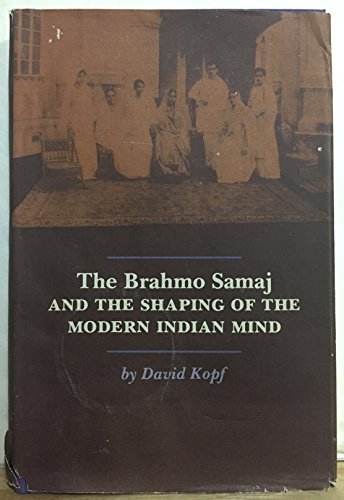
hardcover. Etat : Very Good. First Edition. Princeton University Press, 1979; no additional printings indicated; xxiii, 399pp. Binding is tight, sturdy, and square; purple cloth boards on VG condition, red/gilt titling remains bright and bold; text very good throughout. A couple small closed tears to rear panel else only very minor shelfwear to edges of unclipped dust jacket; jacket arrives wrapped in protective mylar. Ships same or next business day from Dinkytown in Minneapolis, Minnesota. N° de réf. du vendeur 334383
Acheter D'occasion
EUR 35,99
Expédition à EUR 5,68
Expédition nationale : Etats-Unis
Expédition nationale : Etats-Unis
Quantité disponible : 1 disponible(s)
Image d'archives
The Brahmo Samaj and the Shaping of the Modern Indian Mind
Edité par
Princeton University Press, 1979
ISBN 10 : 0691031258
ISBN 13 : 9780691031255
Ancien ou d'occasion
Couverture rigide
Vendeur : Better World Books Ltd, Dunfermline, Royaume-Uni
Évaluation du vendeur 5 sur 5 étoiles
Etat : Good. Former library copy. Pages intact with minimal writing/highlighting. The binding may be loose and creased. Dust jackets/supplements are not included. Includes library markings. Stock photo provided. Product includes identifying sticker. Better World Books: Buy Books. Do Good. N° de réf. du vendeur GRP33952674
Acheter D'occasion
EUR 51,40
Expédition à EUR 5,83
Expédition depuis Royaume-Uni vers Etats-Unis
Expédition depuis Royaume-Uni vers Etats-Unis
Quantité disponible : 1 disponible(s)
Image fournie par le vendeur
THE BRAHMO SAMAJ AND THE SHAPING OF THE MODERN INDIAN MIND
Edité par
Princeton University Press, Princeton, New Jersey, 1979
ISBN 10 : 0691031258
ISBN 13 : 9780691031255
Ancien ou d'occasion
Couverture rigide
Edition originale
Vendeur : Frey Fine Books, Rougemont, NC, Etats-Unis
Évaluation du vendeur 5 sur 5 étoiles
Hardcover. Etat : Very Good. Etat de la jaquette : Very Good. 1st edition. 1st edition, 1979. A Very Good book in a Very Good dust jacket. 8vo., 399 pp., bound in publishers purple cloth with brown illustrated dust jacket. Minor signs of shelf wear to jacket edges. Previous owners blind stamp on title page. Dust jacket now protected in mylar sleeve. N° de réf. du vendeur 34038
Acheter D'occasion
EUR 53,98
Expédition à EUR 6,07
Expédition nationale : Etats-Unis
Expédition nationale : Etats-Unis
Quantité disponible : 1 disponible(s)