
Articles liés à Theory of Games and Economic Behavior
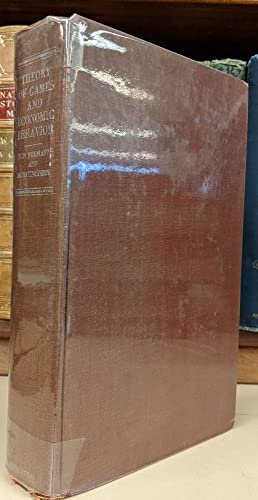
Synopsis
This is the classic work upon which modern-day game theory is based. What began more than sixty years ago as a modest proposal that a mathematician and an economist write a short paper together blossomed, in 1944, when Princeton University Press published Theory of Games and Economic Behavior. In it, John von Neumann and Oskar Morgenstern conceived a groundbreaking mathematical theory of economic and social organization, based on a theory of games of strategy. Not only would this revolutionize economics, but the entirely new field of scientific inquiry it yielded--game theory--has since been widely used to analyze a host of real-world phenomena from arms races to optimal policy choices of presidential candidates, from vaccination policy to major league baseball salary negotiations. And it is today established throughout both the social sciences and a wide range of other sciences.
Les informations fournies dans la section « Synopsis » peuvent faire référence à une autre édition de ce titre.
À propos de l'auteur
John von Neumann (1903-1957) was one of the greatest mathematicians of the twentieth century and a pioneering figure in computer science. A native of Hungary who held professorships in Germany, he was appointed Professor of Mathematics at the Institute for Advanced Study (IAS) in 1933. Later he worked on the Manhattan Project, helped develop the IAS computer, and was a consultant to IBM. An important influence on many fields of mathematics, he is the author of Continuous Geometry, Functional Operators (two volumes), and Mathematical Foundations of Quantum Mechanics (all Princeton). Oskar Morgenstern (1902-1977) taught at the University of Vienna and directed the Austrian Institute of Business Cycle Research before settling in the United States in 1938. There he joined the faculty of Princeton University, eventually becoming a professor and from 1948 directing its econometric research program. He advised the United States government on a wide variety of subjects. Though most famous for the book he co-authored with von Neumann, Morgenstern was also widely known for his skepticism about economic measurement, as reflected in one of his many other books, On the Accuracy of Economic Observations (Princeton).
Les informations fournies dans la section « A propos du livre » peuvent faire référence à une autre édition de ce titre.
Résultats de recherche pour Theory of Games and Economic Behavior

Image d'archives
Theory of Games and Economic Behavior
Edité par
Princeton University Press, 1953
ISBN 10 : 0691041830
ISBN 13 : 9780691041834
Ancien ou d'occasion
Couverture rigide
Vendeur : Better World Books, Mishawaka, IN, Etats-Unis
Évaluation du vendeur 5 sur 5 étoiles

Etat : Good. Former library copy. Pages intact with minimal writing/highlighting. The binding may be loose and creased. Dust jackets/supplements are not included. Includes library markings. Stock photo provided. Product includes identifying sticker. Better World Books: Buy Books. Do Good. N° de réf. du vendeur 751955-6
Acheter D'occasion
EUR 65,52
Livraison gratuite
Expédition nationale : Etats-Unis
Expédition nationale : Etats-Unis
Quantité disponible : 1 disponible(s)
Image fournie par le vendeur
Theory of Games and Economic Behavior
Edité par
Princeton University Press, 1953
ISBN 10 : 0691041830
ISBN 13 : 9780691041834
Ancien ou d'occasion
Couverture rigide
Vendeur : -OnTimeBooks-, Phoenix, AZ, Etats-Unis
Évaluation du vendeur 5 sur 5 étoiles
Etat : good. A copy that has been read, remains in good condition. All pages are intact, and the cover is intact. The spine and cover show signs of wear. Pages can include notes and highlighting and show signs of wear, and the copy can include "From the library of" labels or previous owner inscriptions. 100% GUARANTEE! Shipped with delivery confirmation, if you're not satisfied with purchase please return item! Ships via media mail. N° de réf. du vendeur OTV.0691041830.G
Acheter D'occasion
EUR 78,49
Livraison gratuite
Expédition nationale : Etats-Unis
Expédition nationale : Etats-Unis
Quantité disponible : 1 disponible(s)
Image d'archives
Theory of Games and Economic Behavior
Edité par
Princeton University Press (edition Third), 1953
ISBN 10 : 0691041830
ISBN 13 : 9780691041834
Ancien ou d'occasion
Couverture rigide
Vendeur : BooksRun, Philadelphia, PA, Etats-Unis
Évaluation du vendeur 5 sur 5 étoiles
Hardcover. Etat : Very Good. Third. It's a well-cared-for item that has seen limited use. The item may show minor signs of wear. All the text is legible, with all pages included. It may have slight markings and/or highlighting. N° de réf. du vendeur 0691041830-11-1
Acheter D'occasion
EUR 79,22
Livraison gratuite
Expédition nationale : Etats-Unis
Expédition nationale : Etats-Unis
Quantité disponible : 1 disponible(s)
Image d'archives
Theory of Games and Economic Behavior
Edité par
Princeton University Press, 1953
ISBN 10 : 0691041830
ISBN 13 : 9780691041834
Ancien ou d'occasion
Couverture rigide
Vendeur : Swan Trading Company, GEORGETOWN, TX, Etats-Unis
Évaluation du vendeur 5 sur 5 étoiles
hardcover. Etat : Fair. Third Edition. Hardcover rebound ex-library with typical marks shows moderate cover wear. Text is unmarked. Ships FAST! N° de réf. du vendeur 2609210032
Acheter D'occasion
EUR 79,26
Livraison gratuite
Expédition nationale : Etats-Unis
Expédition nationale : Etats-Unis
Quantité disponible : 1 disponible(s)
Image d'archives
Theory of Games and Economic Behavior
Edité par
Princeton University Press, 1953
ISBN 10 : 0691041830
ISBN 13 : 9780691041834
Ancien ou d'occasion
Couverture rigide
Vendeur : HPB-Red, Dallas, TX, Etats-Unis
Évaluation du vendeur 5 sur 5 étoiles
Hardcover. Etat : Good. Connecting readers with great books since 1972! Used textbooks may not include companion materials such as access codes, etc. May have some wear or writing/highlighting. We ship orders daily and Customer Service is our top priority! N° de réf. du vendeur S_479180408
Acheter D'occasion
EUR 78,60
Expédition à EUR 3,35
Expédition nationale : Etats-Unis
Expédition nationale : Etats-Unis
Quantité disponible : 1 disponible(s)
Image d'archives
Theory of Games and Economic Behavior
Edité par
Princeton University Press, 1953
ISBN 10 : 0691041830
ISBN 13 : 9780691041834
Ancien ou d'occasion
Couverture rigide
Vendeur : HPB-Red, Dallas, TX, Etats-Unis
Évaluation du vendeur 5 sur 5 étoiles
Hardcover. Etat : Acceptable. Connecting readers with great books since 1972. Used textbooks may not include companion materials such as access codes, etc. May have condition issues including wear and notes/highlighting. We ship orders daily and Customer Service is our top priority! N° de réf. du vendeur S_481364829
Acheter D'occasion
EUR 79,35
Expédition à EUR 3,35
Expédition nationale : Etats-Unis
Expédition nationale : Etats-Unis
Quantité disponible : 1 disponible(s)
Image d'archives
Theory of Games and Economic Behavior.
Edité par
Princeton University Press., Princeton, N.J., 1972
ISBN 10 : 0691041830
ISBN 13 : 9780691041834
Ancien ou d'occasion
Couverture rigide
Vendeur : Richard Peterson-Bookseller, Kingston, ON, Canada
Évaluation du vendeur 5 sur 5 étoiles
Hardcover. Etat : Very Good. No Jacket. 3rd Edition. This book is bound in bright red boards with bright silver letters on the spine. There is very light wear on the spine tips & cover corners. The contents are clean & unmarked, the binding is tight. States: "Third edition 1953". N° de réf. du vendeur 8305 (Box 60)
Acheter D'occasion
EUR 91,95
Expédition à EUR 21,93
Expédition depuis Canada vers Etats-Unis
Expédition depuis Canada vers Etats-Unis
Quantité disponible : 1 disponible(s)
Image d'archives
Theory of Games and Economic Behavior
Edité par
Princeton University Press, 1953
ISBN 10 : 0691041830
ISBN 13 : 9780691041834
Ancien ou d'occasion
Couverture rigide
Vendeur : Jay W. Nelson, Bookseller, IOBA, Austin, MN, Etats-Unis
Évaluation du vendeur 5 sur 5 étoiles
Hardcover. Etat : Very Good-. No Jacket. 3rd printing. Browning to page edges. No jacket. N° de réf. du vendeur 125776
Acheter D'occasion
EUR 128,74
Expédition à EUR 2,46
Expédition nationale : Etats-Unis
Expédition nationale : Etats-Unis
Quantité disponible : 1 disponible(s)
Image d'archives
Theory of Games and Economic Behavior
Edité par
Princeton University Press, Princeton, NJ, U.S.A., 1972
ISBN 10 : 0691041830
ISBN 13 : 9780691041834
Ancien ou d'occasion
Couverture rigide
Vendeur : "Pursuit of Happiness" Books, Oakland, CA, Etats-Unis
Évaluation du vendeur 4 sur 5 étoiles

Hardcover. Etat : Good. Publisher: Princeton University Press, 1972, Good, Hard Cover, ISBN: 0-691-04183-0. Book. N° de réf. du vendeur 005305
Acheter D'occasion
EUR 143,43
Expédition à EUR 3,57
Expédition nationale : Etats-Unis
Expédition nationale : Etats-Unis
Quantité disponible : 1 disponible(s)