
Articles liés à Three Critics of the Enlightenment: Vico, Hamann, Herder
Synopsis
Book by Berlin Isaiah
Les informations fournies dans la section « Synopsis » peuvent faire référence à une autre édition de ce titre.
Présentation de l'éditeur
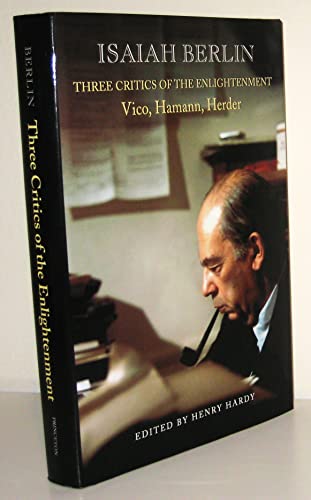
This book brings together three major studies from Isaiah Berlin's central intellectual project - to explain the opposition to the excessively scientistic French Enlightenment by getting under the skin of its critics and giving a sympathetic account of their views.
The contributions of these particular critics could hardly be more important. Giambattista Vico estabished that the humanties are and must remain crucially different from the sciences: J G Herder - sometimes called the father of European nationalism - originated populism, expressionism and pluralism (an idea which Berlin enriched and made powerfully his own); and the anti-rationalist J.G. Hamann lit the fuse of romanticism, the major movement to arise out of the various currents of hostility to Enlightenment thought.
The intellectual tension that existed between Enlightenment advocates and these critics is as crucial today as it was at its inception. With his customary humane understanding, Berlin analyses the ideas of three deeply original but often neglected thinkers, and demonstrates their disturbing relevance to the central issues of today's world.
This new edition includes three previously uncollected pieces on Vico, an interesting passage excluded from the first edition of the essay on Hamann, and Berlin's thoughtful letters responding to two reviewers of that same edition.
Biographie de l'auteur
Isaiah Berlin was born in Riga, now capital of Latvia, in 1909. When he was six, his family moved to Russia, and in Petrograd in 1917 Berlin witnessed both Revolutions - Social Democratic and Bolshevik. In 1921 he and his parents emigrated to England, where he was educated at St Paul's School, London, and Corpus Christi College, Oxford. Apart from his war service in New York, Washington, Moscow and Leningrad, he remained at Oxford thereafter - as a Fellow of All Souls, then of New College, as Chichele Professor of Social and Political Theory, and as founding President of Wolfson College. He also held the Presidency of the British Academy.
His published work includes Karl Marx, Russian Thinkers, Concepts and Categories, Against the Current, Personal Impressions, The Sense of Reality, The Proper Study of Mankind, The Roots of Romanticism, The Power of Ideas, Three Critics of the Enlightenment, Freedom and Its Betrayal, Liberty, The Soviet Mind and Political Ideas in the Romantic Age. As an exponent of the history of ideas he was awarded the Erasmus, Lippincott and Agnelli Prizes; he also received the Jerusalem Prize for his lifelong defence of civil liberties. He died in 1997.
Les informations fournies dans la section « A propos du livre » peuvent faire référence à une autre édition de ce titre.
Résultats de recherche pour Three Critics of the Enlightenment: Vico, Hamann, Herder

Image d'archives
Three Critics of the Enlightenment
Edité par
Princeton University Press, 2000
ISBN 10 : 0691057265
ISBN 13 : 9780691057262
Ancien ou d'occasion
Couverture rigide
Vendeur : HPB-Red, Dallas, TX, Etats-Unis
Évaluation du vendeur 5 sur 5 étoiles

Hardcover. Etat : Good. Connecting readers with great books since 1972! Used textbooks may not include companion materials such as access codes, etc. May have some wear or writing/highlighting. We ship orders daily and Customer Service is our top priority! N° de réf. du vendeur S_448074713
Acheter D'occasion
EUR 12,87
Expédition à EUR 3,36
Expédition nationale : Etats-Unis
Expédition nationale : Etats-Unis
Quantité disponible : 1 disponible(s)
Image d'archives
Three Critics of the Enlightenment
Edité par
Princeton University Press, 2000
ISBN 10 : 0691057265
ISBN 13 : 9780691057262
Ancien ou d'occasion
Couverture rigide
Vendeur : ThriftBooks-Atlanta, AUSTELL, GA, Etats-Unis
Évaluation du vendeur 5 sur 5 étoiles
Hardcover. Etat : Good. No Jacket. Pages can have notes/highlighting. Spine may show signs of wear. ~ ThriftBooks: Read More, Spend Less. N° de réf. du vendeur G0691057265I3N00
Acheter D'occasion
EUR 16,55
Livraison gratuite
Expédition nationale : Etats-Unis
Expédition nationale : Etats-Unis
Quantité disponible : 1 disponible(s)
Image d'archives
Three Critics of the Enlightenment: Vico, Hamann, Herder
Edité par
Princeton University Press, 2000
ISBN 10 : 0691057265
ISBN 13 : 9780691057262
Ancien ou d'occasion
Couverture rigide
Vendeur : World of Books (was SecondSale), Montgomery, IL, Etats-Unis
Évaluation du vendeur 5 sur 5 étoiles
Hardback. Etat : Fair. Isaiah Berlin was deeply admired during his life, but his full contribution was perhaps underestimated because of his preference for the long essay form. The efforts of Henry Hardy to edit Berlin's work and reintroduce it to a broad, eager readership have gone far to remedy this. Now, Princeton is pleased to return to print, under one cover, Berlin's essays on Vico, Hamann, and Herder. These essays on three relatively uncelebrated thinkers are not marginal ruminations, but rather among Berlin's most important studies in the history of ideas. They are integral to his central project: the critical recovery of the ideas of the Counter-Enlightenment and the explanation of its appeal and consequences--both positive and (often) tragic. Giambattista Vico was the anachronistic and impoverished Neapolitan philosopher sometimes credited with founding the human sciences. He opposed Enlightenment methods as cold and fallacious. J. G. Hamann was a pious, cranky dilettante in a peripheral German city. But he was brilliant enough to gain the audience of Kant, Goethe, and Moses Mendelssohn. In Hamann's chaotic and long-ignored writings, Berlin finds the first strong attack on Enlightenment rationalism and a wholly original source of the coming swell of romanticism. Johann Gottfried Herder, the progenitor of populism and European nationalism, rejected universalism and rationalism but championed cultural pluralism. Individually, these fascinating intellectual biographies reveal Berlin's own great intelligence, learning, and generosity, as well as the passionate genius of his subjects. Together, they constitute an arresting interpretation of romanticism's precursors. In Hamann's railings and the more considered writings of Vico and Herder, Berlin finds critics of the Enlightenment worthy of our careful attention. But he identifies much that is misguided in their rejection of universal values, rationalism, and science. With his customary emphasis on the frightening power of ideas, Berlin traces much of the next centuries' irrationalism and suffering to the historicism and particularism they advocated. What Berlin has to say about these long-dead thinkers--in appreciation and dissent--is remarkably timely in a day when Enlightenment beliefs are being challenged not just by academics but by politicians and by powerful nationalist and fundamentalist movements. The study of J. G. Hamann was originally published under the title The Magus of the North: J. G. Hamann and the Origins of Modern Irrationalism. The essays on Vico and Herder were originally published as Vico and Herder: Two Studies in the History of Ideas. Both are out of print. N° de réf. du vendeur 00100539582
Acheter D'occasion
EUR 16,59
Livraison gratuite
Expédition nationale : Etats-Unis
Expédition nationale : Etats-Unis
Quantité disponible : 1 disponible(s)
Image d'archives
Three Critics of the Enlightenment: Vico, Hamann, Herder
Edité par
Princeton University Press, 2000
ISBN 10 : 0691057265
ISBN 13 : 9780691057262
Ancien ou d'occasion
Couverture rigide
Vendeur : World of Books Inc, Montgomery, IL, Etats-Unis
Évaluation du vendeur 4 sur 5 étoiles

Hardback. Etat : Fair. Isaiah Berlin was deeply admired during his life, but his full contribution was perhaps underestimated because of his preference for the long essay form. The efforts of Henry Hardy to edit Berlin's work and reintroduce it to a broad, eager readership have gone far to remedy this. Now, Princeton is pleased to return to print, under one cover, Berlin's essays on Vico, Hamann, and Herder. These essays on three relatively uncelebrated thinkers are not marginal ruminations, but rather among Berlin's most important studies in the history of ideas. They are integral to his central project: the critical recovery of the ideas of the Counter-Enlightenment and the explanation of its appeal and consequences--both positive and (often) tragic. Giambattista Vico was the anachronistic and impoverished Neapolitan philosopher sometimes credited with founding the human sciences. He opposed Enlightenment methods as cold and fallacious. J. G. Hamann was a pious, cranky dilettante in a peripheral German city. But he was brilliant enough to gain the audience of Kant, Goethe, and Moses Mendelssohn. In Hamann's chaotic and long-ignored writings, Berlin finds the first strong attack on Enlightenment rationalism and a wholly original source of the coming swell of romanticism. Johann Gottfried Herder, the progenitor of populism and European nationalism, rejected universalism and rationalism but championed cultural pluralism. Individually, these fascinating intellectual biographies reveal Berlin's own great intelligence, learning, and generosity, as well as the passionate genius of his subjects. Together, they constitute an arresting interpretation of romanticism's precursors. In Hamann's railings and the more considered writings of Vico and Herder, Berlin finds critics of the Enlightenment worthy of our careful attention. But he identifies much that is misguided in their rejection of universal values, rationalism, and science. With his customary emphasis on the frightening power of ideas, Berlin traces much of the next centuries' irrationalism and suffering to the historicism and particularism they advocated. What Berlin has to say about these long-dead thinkers--in appreciation and dissent--is remarkably timely in a day when Enlightenment beliefs are being challenged not just by academics but by politicians and by powerful nationalist and fundamentalist movements. The study of J. G. Hamann was originally published under the title The Magus of the North: J. G. Hamann and the Origins of Modern Irrationalism. The essays on Vico and Herder were originally published as Vico and Herder: Two Studies in the History of Ideas. Both are out of print. N° de réf. du vendeur CIN0691057265A
Acheter D'occasion
EUR 18,44
Livraison gratuite
Expédition nationale : Etats-Unis
Expédition nationale : Etats-Unis
Quantité disponible : 1 disponible(s)
Image d'archives
Three Critics of the Enlightenment : Vico, Hamann, Herder
Edité par
Princeton University Press, 2000
ISBN 10 : 0691057265
ISBN 13 : 9780691057262
Ancien ou d'occasion
Couverture rigide
Vendeur : Better World Books, Mishawaka, IN, Etats-Unis
Évaluation du vendeur 5 sur 5 étoiles
Etat : Good. Former library copy. Pages intact with minimal writing/highlighting. The binding may be loose and creased. Dust jackets/supplements are not included. Includes library markings. Stock photo provided. Product includes identifying sticker. Better World Books: Buy Books. Do Good. N° de réf. du vendeur 14802691-75
Acheter D'occasion
EUR 19,76
Livraison gratuite
Expédition nationale : Etats-Unis
Expédition nationale : Etats-Unis
Quantité disponible : 1 disponible(s)
Image d'archives
Three Critics of the Enlightenment Vico, Hamann, Herder
Edité par
Princeton University Press, c.2000,, 2000
ISBN 10 : 0691057265
ISBN 13 : 9780691057262
Ancien ou d'occasion
Couverture rigide
Vendeur : Harry Alter, Sylva, NC, Etats-Unis
Évaluation du vendeur 5 sur 5 étoiles
hardcover, Etat : Good, Princeton University Press, c.2000, 1st., 8vo., cloth, 240pp., pencilling & a little inking throughout in a pretty light hand, ow VG/VG $. N° de réf. du vendeur 88904
Acheter D'occasion
EUR 18,44
Expédition à EUR 3,54
Expédition nationale : Etats-Unis
Expédition nationale : Etats-Unis
Quantité disponible : 1 disponible(s)
Image d'archives
Three Critics of the Enlightenment.
Edité par
Princeton University Press, Princeton, 2000
ISBN 10 : 0691057265
ISBN 13 : 9780691057262
Ancien ou d'occasion
Couverture rigide
Edition originale
Vendeur : Ted Kottler, Bookseller, Redondo Beach, CA, Etats-Unis
Évaluation du vendeur 4 sur 5 étoiles
Hardcover. Etat : Near Fine. Etat de la jaquette : Near Fine. 1st Edition. Original cloth. Near Fine, in dust jacket. N° de réf. du vendeur 25697
Acheter D'occasion
EUR 69,14
Expédition à EUR 11,37
Expédition nationale : Etats-Unis
Expédition nationale : Etats-Unis
Quantité disponible : 1 disponible(s)