
Articles liés à Kant and the Capacity to Judge: Sensibility and Discursivity...
Kant and the Capacity to Judge: Sensibility and Discursivity in the Transcendental Analytic of the "Critique of Pure Reason" - Couverture souple
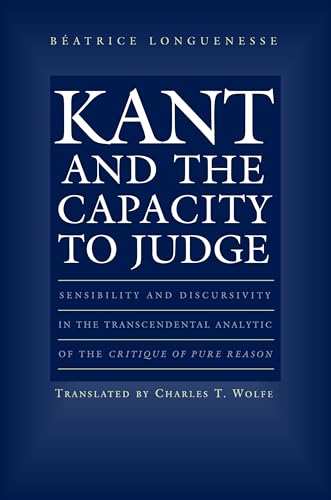
Synopsis
Kant claims to have established his table of categories or "pure concepts of the understanding" according to the "guiding thread" provided by logical forms of judgment. By drawing extensively on Kant's logical writings, Béatrice Longuenesse analyzes this controversial claim, and then follows the thread through its continuation in the transcendental deduction of the categories, the transcendental schemata, and the principles of pure understanding. The result is a systematic, persuasive new interpretation of the Critique of Pure Reason. Longuenesse shows that although Kant adopts his inventory of the forms of judgment from logic textbooks of his time, he is nevertheless original in selecting just those forms he holds to be indispensable to our ability to relate representations to objects. Kant gives formal representation to this relation between conceptual thought and its objects by introducing the term "x" into his analysis of logical forms to stand for the object that is "thought under" the concepts that are combined in judgment. This "x" plays no role in Kant's forms of logical inference, but instead plays a role in clarifying the relation between logical forms (forms of concept subordination) and combinations ("syntheses") of perceptual data, necessary for empirical cognition. Considering Kant's logical forms of judgment thus helps illuminate crucial aspects of the Transcendental Analytic as a whole, while revealing the systematic unity between Kant's theory of judgment in the first Critique and his analysis of "merely reflective" (aesthetic and teleological) judgments in the third Critique.
Les informations fournies dans la section « Synopsis » peuvent faire référence à une autre édition de ce titre.
À propos de l'auteur
Béatrice Longuenesse is Professor of Philosophy at Princeton University. Her other books include Hegel et la critique de la métaphysique.
À propos de la quatrième de couverture
Shows that although Kant adopts his inventory of the forms of judgment from logic textbooks of his time, he is nevertheless original in selecting just those forms he holds to be indispensable to our ability to relate representations to objects.
Les informations fournies dans la section « A propos du livre » peuvent faire référence à une autre édition de ce titre.
Résultats de recherche pour Kant and the Capacity to Judge: Sensibility and Discursivity...

Image d'archives
Kant and the Capacity to Judge: Sensibility and Discursivity in the Transcendental Analytic of the Critique of Pure Reason
Edité par
Princeton University Press, 2001
ISBN 10 : 0691074518
ISBN 13 : 9780691074511
Ancien ou d'occasion
paperback
Vendeur : HPB-Red, Dallas, TX, Etats-Unis
Évaluation du vendeur 5 sur 5 étoiles

paperback. Etat : Good. Connecting readers with great books since 1972! Used textbooks may not include companion materials such as access codes, etc. May have some wear or writing/highlighting. We ship orders daily and Customer Service is our top priority! N° de réf. du vendeur S_479722299
Acheter D'occasion
EUR 33,93
Expédition à EUR 3,34
Expédition nationale : Etats-Unis
Expédition nationale : Etats-Unis
Quantité disponible : 1 disponible(s)
Image fournie par le vendeur
Kant and the Capacity to Judge: Sensibility and Discursivity in the Transcendental Analytic of the Critique of Pure Reason
Edité par
Princeton University Press, 2001
ISBN 10 : 0691074518
ISBN 13 : 9780691074511
Ancien ou d'occasion
paperback
Vendeur : Book House in Dinkytown, IOBA, Minneapolis, MN, Etats-Unis
Évaluation du vendeur 5 sur 5 étoiles
paperback. Etat : Very Good. Very good paperback, from a personal collection (NOT ex-library). Spine is uncreased, binding tight and sturdy. Light shelfwear to wraps. Previous owner name to first page, else, interior is free of markings. Ships same or next day from Dinkytown, Minneapolis, Minnesota. N° de réf. du vendeur 337841
Acheter D'occasion
EUR 45,82
Expédition à EUR 5,78
Expédition nationale : Etats-Unis
Expédition nationale : Etats-Unis
Quantité disponible : 1 disponible(s)
Image fournie par le vendeur
Kant and the Capacity to Judge : Sensibility and Discursivity in the Transcendental Analytic of Critique of Pure Reason
Edité par
Princeton University Press, 2001
ISBN 10 : 0691074518
ISBN 13 : 9780691074511
Ancien ou d'occasion
Couverture souple
Vendeur : GreatBookPrices, Columbia, MD, Etats-Unis
Évaluation du vendeur 5 sur 5 étoiles
Etat : As New. Unread book in perfect condition. N° de réf. du vendeur 400608
Acheter D'occasion
EUR 65,45
Expédition à EUR 2,35
Expédition nationale : Etats-Unis
Expédition nationale : Etats-Unis
Quantité disponible : 2 disponible(s)
Image d'archives
Kant and the Capacity to Judge: Sensibility and Discursivity in the Transcendental Analytic of the Critique of Pure Reason
Edité par
Princeton University Press, 2001
ISBN 10 : 0691074518
ISBN 13 : 9780691074511
Neuf
Couverture souple
Vendeur : Kennys Bookshop and Art Galleries Ltd., Galway, GY, Irlande
Évaluation du vendeur 5 sur 5 étoiles
Etat : New. 2001. Paperback. Shows that although Kant adopts his inventory of the forms of judgment from logic textbooks of his time, he is nevertheless original in selecting just those forms he holds to be indispensable to our ability to relate representations to objects. Num Pages: 440 pages, 2 line illus. BIC Classification: HPK; HPL. Category: (P) Professional & Vocational; (U) Tertiary Education (US: College). Dimension: 237 x 165 x 26. Weight in Grams: 652. . . . . . N° de réf. du vendeur V9780691074511
Acheter neuf
EUR 59,40
Expédition à EUR 9,50
Expédition depuis Irlande vers Etats-Unis
Expédition depuis Irlande vers Etats-Unis
Quantité disponible : 1 disponible(s)
Image d'archives
Kant & the Capacity to Judge
Edité par
Princeton University Press, 2001
ISBN 10 : 0691074518
ISBN 13 : 9780691074511
Neuf
Couverture souple
Vendeur : Majestic Books, Hounslow, Royaume-Uni
Évaluation du vendeur 4 sur 5 étoiles

Etat : New. pp. 440. N° de réf. du vendeur 8063574
Acheter neuf
EUR 63,57
Expédition à EUR 7,71
Expédition depuis Royaume-Uni vers Etats-Unis
Expédition depuis Royaume-Uni vers Etats-Unis
Quantité disponible : 4 disponible(s)
Image fournie par le vendeur
Kant and the Capacity to Judge : Sensibility and Discursivity in the Transcendental Analytic of Critique of Pure Reason
Edité par
Princeton University Press, 2001
ISBN 10 : 0691074518
ISBN 13 : 9780691074511
Neuf
Couverture souple
Vendeur : GreatBookPrices, Columbia, MD, Etats-Unis
Évaluation du vendeur 5 sur 5 étoiles
Etat : New. N° de réf. du vendeur 400608-n
Acheter neuf
EUR 69,07
Expédition à EUR 2,35
Expédition nationale : Etats-Unis
Expédition nationale : Etats-Unis
Quantité disponible : 2 disponible(s)
Image d'archives
Kant and the Capacity to Judge
Vendeur : PBShop.store US, Wood Dale, IL, Etats-Unis
Évaluation du vendeur 5 sur 5 étoiles
PAP. Etat : New. New Book. Shipped from UK. Established seller since 2000. N° de réf. du vendeur WP-9780691074511
Acheter neuf
EUR 71,57
Livraison gratuite
Expédition nationale : Etats-Unis
Expédition nationale : Etats-Unis
Quantité disponible : 1 disponible(s)
Image d'archives
Kant and the Capacity to Judge
Vendeur : PBShop.store UK, Fairford, GLOS, Royaume-Uni
Évaluation du vendeur 5 sur 5 étoiles
PAP. Etat : New. New Book. Shipped from UK. Established seller since 2000. N° de réf. du vendeur WP-9780691074511
Acheter neuf
EUR 66,07
Expédition à EUR 5,95
Expédition depuis Royaume-Uni vers Etats-Unis
Expédition depuis Royaume-Uni vers Etats-Unis
Quantité disponible : 1 disponible(s)
Image d'archives
Kant and the Capacity to Judge: Sensibility and Discursivity in the Transcendental Analytic of the "Critique of Pure Reason"
Edité par
Princeton University Press 2001-01-03, 2001
ISBN 10 : 0691074518
ISBN 13 : 9780691074511
Neuf
Paperback
Vendeur : Chiron Media, Wallingford, Royaume-Uni
Évaluation du vendeur 5 sur 5 étoiles
Paperback. Etat : New. Brand new book, sourced directly from publisher. Dispatch time is 3-4 days from our warehouse. Book will be sent in robust, secure packaging to ensure it reaches you securely. N° de réf. du vendeur 6666-WLY-9780691074511
Acheter neuf
EUR 68,22
Expédition à EUR 7,70
Expédition depuis Royaume-Uni vers Etats-Unis
Expédition depuis Royaume-Uni vers Etats-Unis
Quantité disponible : 1 disponible(s)
Image fournie par le vendeur
Kant and the Capacity to Judge
Edité par
Princeton University Press, US, 2001
ISBN 10 : 0691074518
ISBN 13 : 9780691074511
Neuf
Paperback
Vendeur : Rarewaves USA, HEBRON, KY, Etats-Unis
Évaluation du vendeur 5 sur 5 étoiles
Paperback. Etat : New. Kant claims to have established his table of categories or "pure concepts of the understanding" according to the "guiding thread" provided by logical forms of judgment. By drawing extensively on Kant's logical writings, Beatrice Longuenesse analyzes this controversial claim, and then follows the thread through its continuation in the transcendental deduction of the categories, the transcendental schemata, and the principles of pure understanding. The result is a systematic, persuasive new interpretation of the Critique of Pure Reason. Longuenesse shows that although Kant adopts his inventory of the forms of judgment from logic textbooks of his time, he is nevertheless original in selecting just those forms he holds to be indispensable to our ability to relate representations to objects. Kant gives formal representation to this relation between conceptual thought and its objects by introducing the term "x" into his analysis of logical forms to stand for the object that is "thought under" the concepts that are combined in judgment.This "x" plays no role in Kant's forms of logical inference, but instead plays a role in clarifying the relation between logical forms (forms of concept subordination) and combinations ("syntheses") of perceptual data, necessary for empirical cognition. Considering Kant's logical forms of judgment thus helps illuminate crucial aspects of the Transcendental Analytic as a whole, while revealing the systematic unity between Kant's theory of judgment in the first Critique and his analysis of "merely reflective" (aesthetic and teleological) judgments in the third Critique. N° de réf. du vendeur LU-9780691074511
Acheter neuf
EUR 76,26
Livraison gratuite
Expédition nationale : Etats-Unis
Expédition nationale : Etats-Unis
Quantité disponible : Plus de 20 disponibles