
Articles liés à Cultural Transmission and Evolution: A Quantitative...
Cultural Transmission and Evolution: A Quantitative Approach. (Mpb-16) (Monographs In Population Biology) - Couverture souple
Livre 52 sur 64: Monographs in Population Biology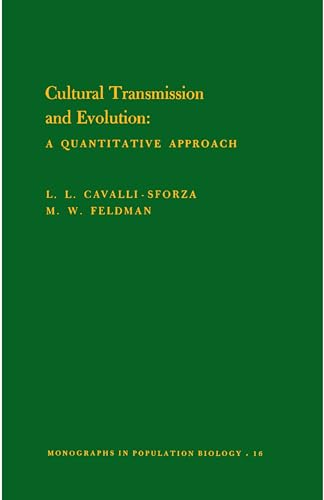
Synopsis
A number of scholars have found that concepts such as mutation, selection, and random drift, which emerged from the theory of biological evolution, may also explain evolutionary phenomena in other disciplines as well. Drawing on these concepts, Professors Cavalli-Sforza and Feldman classify and systematize the various modes of transmitting "culture" and explore their consequences for cultural evolution. In the process, they develop a mathematical theory of the non-genetic transmission of cultural traits that provides a framework for future investigations in quantitative social and anthropological science.
The authors use quantitative models that incorporate the various modes of transmission (for example, parent-child, peer-peer, and teacher-student), and evaluate data from sociology, archaeology, and epidemiology in terms of the models. They show that the various modes of transmission in conjunction with cultural and natural selection produce various rates of cultural evolution and various degrees of diversity within and between groups. The same framework can be used for explaining phenomena as apparently unrelated as linguistics, epidemics, social values and customs, and diffusion of innovations. The authors conclude that cultural transmission is an essential factor in the study of cultural change.
Les informations fournies dans la section « Synopsis » peuvent faire référence à une autre édition de ce titre.
Résultats de recherche pour Cultural Transmission and Evolution: A Quantitative...

Image d'archives
Cultural Transmission and Evolution
Edité par
Princeton University Press (edition First Edition), 1981
ISBN 10 : 0691082839
ISBN 13 : 9780691082837
Ancien ou d'occasion
Paperback
Edition originale
Vendeur : BooksRun, Philadelphia, PA, Etats-Unis
Évaluation du vendeur 5 sur 5 étoiles

Paperback. Etat : Very Good. First Edition. It's a well-cared-for item that has seen limited use. The item may show minor signs of wear. All the text is legible, with all pages included. It may have slight markings and/or highlighting. N° de réf. du vendeur 0691082839-11-1
Acheter D'occasion
EUR 42,42
Livraison gratuite
Expédition nationale : Etats-Unis
Expédition nationale : Etats-Unis
Quantité disponible : 1 disponible(s)
Image fournie par le vendeur
Cultural Transmission and Evolution
Edité par
Princeton University Press, 1981
ISBN 10 : 0691082839
ISBN 13 : 9780691082837
Ancien ou d'occasion
Couverture souple
Vendeur : Bay State Book Company, North Smithfield, RI, Etats-Unis
Évaluation du vendeur 5 sur 5 étoiles
Etat : very_good. N° de réf. du vendeur BSM.1B3P9
Acheter D'occasion
EUR 43,21
Livraison gratuite
Expédition nationale : Etats-Unis
Expédition nationale : Etats-Unis
Quantité disponible : 1 disponible(s)
Image fournie par le vendeur
Cultural Transmission and Evolution
Edité par
Princeton University Press, 1981
ISBN 10 : 0691082839
ISBN 13 : 9780691082837
Ancien ou d'occasion
Soft cover
Edition originale
Vendeur : Blue Fog Books, Arlington Heights, IL, Etats-Unis
Évaluation du vendeur 5 sur 5 étoiles
Soft cover. Etat : Very Good. 1st Edition. Signature/date on inner cover. Spotting to page edges. No underlining, notes or highlighting. h5. N° de réf. du vendeur ABE-1784845534136
Acheter D'occasion
EUR 44,27
Expédition à EUR 5,34
Expédition nationale : Etats-Unis
Expédition nationale : Etats-Unis
Quantité disponible : 1 disponible(s)
Image d'archives
Cultural Transmission and Evolution : A Quantitative Approach
Edité par
Princeton University Press, 1981
ISBN 10 : 0691082839
ISBN 13 : 9780691082837
Ancien ou d'occasion
Couverture souple
Vendeur : Better World Books, Mishawaka, IN, Etats-Unis
Évaluation du vendeur 5 sur 5 étoiles
Etat : Good. Former library copy. Pages intact with minimal writing/highlighting. The binding may be loose and creased. Dust jackets/supplements are not included. Includes library markings. Stock photo provided. Product includes identifying sticker. Better World Books: Buy Books. Do Good. N° de réf. du vendeur 6138924-6
Acheter D'occasion
EUR 53,68
Livraison gratuite
Expédition nationale : Etats-Unis
Expédition nationale : Etats-Unis
Quantité disponible : 1 disponible(s)
Image d'archives
Cultural Transmission and Evolution: A Quantitative Approach
Edité par
Princeton University Press, 1981
ISBN 10 : 0691082839
ISBN 13 : 9780691082837
Ancien ou d'occasion
Soft cover
Vendeur : N. Fagin Books, Chicago, IL, Etats-Unis
Évaluation du vendeur 5 sur 5 étoiles
Soft cover. Etat : Near Fine. 1981. Natural History, Zoology, evolutionary studies. Monographs in Population Biology #16. Princeton University Press. Very good - near fine paperback 388p. 6/26. N° de réf. du vendeur 24070
Acheter D'occasion
EUR 50,52
Expédition à EUR 5,35
Expédition nationale : Etats-Unis
Expédition nationale : Etats-Unis
Quantité disponible : 1 disponible(s)
Image d'archives
Cultural Transmission and Evolution (MPB-16), Volume 16: A Quantitative Approach. (MPB-16)
Edité par
Princeton University Press, 1992
ISBN 10 : 0691082839
ISBN 13 : 9780691082837
Neuf
Couverture souple
Vendeur : Kennys Bookshop and Art Galleries Ltd., Galway, GY, Irlande
Évaluation du vendeur 5 sur 5 étoiles
Etat : New. Series: Monographs in Population Biology. Num Pages: 388 pages, black & white illustrations. BIC Classification: JFC; JH. Category: (P) Professional & Vocational; (U) Tertiary Education (US: College). Dimension: 216 x 140 x 25. Weight in Grams: 457. . 1981. Paperback. . . . . N° de réf. du vendeur V9780691082837
Acheter neuf
EUR 72,28
Expédition à EUR 9,50
Expédition depuis Irlande vers Etats-Unis
Expédition depuis Irlande vers Etats-Unis
Quantité disponible : 1 disponible(s)
Image fournie par le vendeur
Cultural Transmission and Evolution : A Quantitative Approach
Edité par
Princeton University Press, 1981
ISBN 10 : 0691082839
ISBN 13 : 9780691082837
Ancien ou d'occasion
Couverture souple
Vendeur : GreatBookPrices, Columbia, MD, Etats-Unis
Évaluation du vendeur 5 sur 5 étoiles
Etat : As New. Unread book in perfect condition. N° de réf. du vendeur 400395
Acheter D'occasion
EUR 81,98
Expédition à EUR 2,35
Expédition nationale : Etats-Unis
Expédition nationale : Etats-Unis
Quantité disponible : 1 disponible(s)
Image d'archives
Cultural Transmission and Evolution
Vendeur : PBShop.store UK, Fairford, GLOS, Royaume-Uni
Évaluation du vendeur 5 sur 5 étoiles
PAP. Etat : New. New Book. Shipped from UK. Established seller since 2000. N° de réf. du vendeur WP-9780691082837
Acheter neuf
EUR 79,65
Expédition à EUR 5,92
Expédition depuis Royaume-Uni vers Etats-Unis
Expédition depuis Royaume-Uni vers Etats-Unis
Quantité disponible : 2 disponible(s)
Image fournie par le vendeur
Cultural Transmission and Evolution : A Quantitative Approach
Edité par
Princeton University Press, 1981
ISBN 10 : 0691082839
ISBN 13 : 9780691082837
Neuf
Couverture souple
Vendeur : GreatBookPrices, Columbia, MD, Etats-Unis
Évaluation du vendeur 5 sur 5 étoiles
Etat : New. N° de réf. du vendeur 400395-n
Acheter neuf
EUR 83,94
Expédition à EUR 2,35
Expédition nationale : Etats-Unis
Expédition nationale : Etats-Unis
Quantité disponible : 1 disponible(s)
Image fournie par le vendeur
Cultural Transmission and Evolution
Edité par
Princeton University Press, US, 1981
ISBN 10 : 0691082839
ISBN 13 : 9780691082837
Neuf
Paperback
Vendeur : Rarewaves.com USA, London, LONDO, Royaume-Uni
Évaluation du vendeur 5 sur 5 étoiles
Paperback. Etat : New. A number of scholars have found that concepts such as mutation, selection, and random drift, which emerged from the theory of biological evolution, may also explain evolutionary phenomena in other disciplines as well. Drawing on these concepts, Professors Cavalli-Sforza and Feldman classify and systematize the various modes of transmitting "culture" and explore their consequences for cultural evolution. In the process, they develop a mathematical theory of the non-genetic transmission of cultural traits that provides a framework for future investigations in quantitative social and anthropological science. The authors use quantitative models that incorporate the various modes of transmission (for example, parent-child, peer-peer, and teacher-student), and evaluate data from sociology, archaeology, and epidemiology in terms of the models. They show that the various modes of transmission in conjunction with cultural and natural selection produce various rates of cultural evolution and various degrees of diversity within and between groups.The same framework can be used for explaining phenomena as apparently unrelated as linguistics, epidemics, social values and customs, and diffusion of innovations. The authors conclude that cultural transmission is an essential factor in the study of cultural change. N° de réf. du vendeur LU-9780691082837
Acheter neuf
EUR 89,80
Livraison gratuite
Expédition depuis Royaume-Uni vers Etats-Unis
Expédition depuis Royaume-Uni vers Etats-Unis
Quantité disponible : 1 disponible(s)