
Articles liés à Mousterian Lithic Technology: An Ecological Perspective...
Mousterian Lithic Technology: An Ecological Perspective (Princeton Legacy Library) - Couverture souple
Livre 40 sur 89: Princeton Legacy Library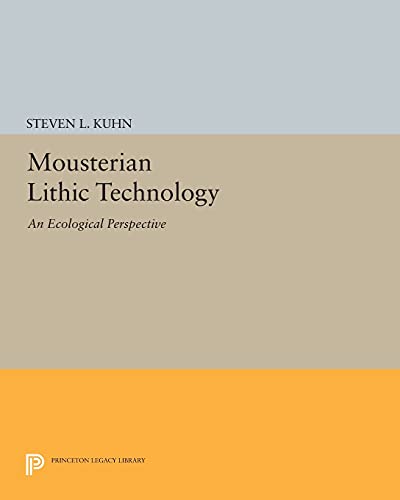
Synopsis
Human beings depend more on technology than any other animal--the use of tools and weapons is vital to the survival of our species. What processes of biocultural evolution led to this unique dependence? Steven Kuhn turns to the Middle Paleolithic (Mousterian) and to artifacts associated with Neanderthals, the most recent human predecessors. His study examines the ecological, economic, and strategic factors that shaped the behavior of Mousterian tool makers, revealing how these hominids brought technological knowledge to bear on the basic problems of survival. Kuhn's main database consists of assemblages of stone artifacts from four caves and a series of open-air localities situated on the western coast of the Italian peninsula. Variations in the ways stone tools were produced, maintained, and discarded demonstrate how Mousterian hominids coped with the problems of keeping mobile groups supplied with the artifacts and raw materials they used on a daily basis. Changes through time in lithic technology were closely tied to shifting strategies for hunting and collecting food. Some of the most provocative findings of this study stem from observations about the behavioral flexibility of Mousterian populations and the role of planning in foraging and technology. Originally published in 1995. The Princeton Legacy Library uses the latest print-on-demand technology to again make available previously out-of-print books from the distinguished backlist of Princeton University Press. These paperback editions preserve the original texts of these important books while presenting them in durable paperback editions. The goal of the Princeton Legacy Library is to vastly increase access to the rich scholarly heritage found in the thousands of books published by Princeton University Press since its founding in 1905.
Les informations fournies dans la section « Synopsis » peuvent faire référence à une autre édition de ce titre.
Résultats de recherche pour Mousterian Lithic Technology: An Ecological Perspective...

Image fournie par le vendeur
Mousterian Lithic Technology : An Ecological Perspective
Edité par
Princeton University Press, 2014
ISBN 10 : 0691605203
ISBN 13 : 9780691605203
Ancien ou d'occasion
Couverture souple
Vendeur : GreatBookPrices, Columbia, MD, Etats-Unis
Évaluation du vendeur 5 sur 5 étoiles

Etat : As New. Unread book in perfect condition. N° de réf. du vendeur 21573451
Acheter D'occasion
EUR 37,64
Expédition à EUR 2,32
Expédition nationale : Etats-Unis
Expédition nationale : Etats-Unis
Quantité disponible : 4 disponible(s)
Image fournie par le vendeur
Mousterian Lithic Technology : An Ecological Perspective
Edité par
Princeton University Press, 2014
ISBN 10 : 0691605203
ISBN 13 : 9780691605203
Neuf
Couverture souple
Vendeur : GreatBookPrices, Columbia, MD, Etats-Unis
Évaluation du vendeur 5 sur 5 étoiles
Etat : New. N° de réf. du vendeur 21573451-n
Acheter neuf
EUR 42,64
Expédition à EUR 2,32
Expédition nationale : Etats-Unis
Expédition nationale : Etats-Unis
Quantité disponible : 4 disponible(s)
Image fournie par le vendeur
Mousterian Lithic Technology
Edité par
Princeton University Press, US, 2014
ISBN 10 : 0691605203
ISBN 13 : 9780691605203
Neuf
Paperback
Vendeur : Rarewaves.com USA, London, LONDO, Royaume-Uni
Évaluation du vendeur 5 sur 5 étoiles
Paperback. Etat : New. Human beings depend more on technology than any other animal--the use of tools and weapons is vital to the survival of our species. What processes of biocultural evolution led to this unique dependence? Steven Kuhn turns to the Middle Paleolithic (Mousterian) and to artifacts associated with Neanderthals, the most recent human predecessors. His study examines the ecological, economic, and strategic factors that shaped the behavior of Mousterian tool makers, revealing how these hominids brought technological knowledge to bear on the basic problems of survival. Kuhn's main database consists of assemblages of stone artifacts from four caves and a series of open-air localities situated on the western coast of the Italian peninsula. Variations in the ways stone tools were produced, maintained, and discarded demonstrate how Mousterian hominids coped with the problems of keeping mobile groups supplied with the artifacts and raw materials they used on a daily basis. Changes through time in lithic technology were closely tied to shifting strategies for hunting and collecting food.Some of the most provocative findings of this study stem from observations about the behavioral flexibility of Mousterian populations and the role of planning in foraging and technology. Originally published in 1995. The Princeton Legacy Library uses the latest print-on-demand technology to again make available previously out-of-print books from the distinguished backlist of Princeton University Press. These editions preserve the original texts of these important books while presenting them in durable paperback and hardcover editions. The goal of the Princeton Legacy Library is to vastly increase access to the rich scholarly heritage found in the thousands of books published by Princeton University Press since its founding in 1905. N° de réf. du vendeur LU-9780691605203
Acheter neuf
EUR 45,04
Livraison gratuite
Expédition depuis Royaume-Uni vers Etats-Unis
Expédition depuis Royaume-Uni vers Etats-Unis
Quantité disponible : 1 disponible(s)
Image d'archives
Mousterian Lithic Technology: An Ecological Perspective
Edité par
Princeton University Press, 2014
ISBN 10 : 0691605203
ISBN 13 : 9780691605203
Neuf
Couverture souple
Vendeur : Kennys Bookshop and Art Galleries Ltd., Galway, GY, Irlande
Évaluation du vendeur 5 sur 5 étoiles
Etat : New. Series: Princeton Legacy Library. Num Pages: 208 pages, 4 halftones 58 line drawings 50 tables. BIC Classification: HDD. Category: (P) Professional & Vocational; (U) Tertiary Education (US: College). Dimension: 256 x 203 x 12. Weight in Grams: 466. . 2014. Paperback. . . . . N° de réf. du vendeur V9780691605203
Acheter neuf
EUR 37,83
Expédition à EUR 9,50
Expédition depuis Irlande vers Etats-Unis
Expédition depuis Irlande vers Etats-Unis
Quantité disponible : 1 disponible(s)
Image d'archives
Mousterian Lithic Technology
Vendeur : PBShop.store UK, Fairford, GLOS, Royaume-Uni
Évaluation du vendeur 5 sur 5 étoiles
PAP. Etat : New. New Book. Shipped from UK. Established seller since 2000. N° de réf. du vendeur WP-9780691605203
Acheter neuf
EUR 41,63
Expédition à EUR 5,84
Expédition depuis Royaume-Uni vers Etats-Unis
Expédition depuis Royaume-Uni vers Etats-Unis
Quantité disponible : 2 disponible(s)
Image fournie par le vendeur
Mousterian Lithic Technology
Edité par
Princeton University Press, US, 2014
ISBN 10 : 0691605203
ISBN 13 : 9780691605203
Neuf
Paperback
Vendeur : Rarewaves USA, HEBRON, KY, Etats-Unis
Évaluation du vendeur 5 sur 5 étoiles
Paperback. Etat : New. Human beings depend more on technology than any other animal--the use of tools and weapons is vital to the survival of our species. What processes of biocultural evolution led to this unique dependence? Steven Kuhn turns to the Middle Paleolithic (Mousterian) and to artifacts associated with Neanderthals, the most recent human predecessors. His study examines the ecological, economic, and strategic factors that shaped the behavior of Mousterian tool makers, revealing how these hominids brought technological knowledge to bear on the basic problems of survival. Kuhn's main database consists of assemblages of stone artifacts from four caves and a series of open-air localities situated on the western coast of the Italian peninsula. Variations in the ways stone tools were produced, maintained, and discarded demonstrate how Mousterian hominids coped with the problems of keeping mobile groups supplied with the artifacts and raw materials they used on a daily basis. Changes through time in lithic technology were closely tied to shifting strategies for hunting and collecting food.Some of the most provocative findings of this study stem from observations about the behavioral flexibility of Mousterian populations and the role of planning in foraging and technology. Originally published in 1995. The Princeton Legacy Library uses the latest print-on-demand technology to again make available previously out-of-print books from the distinguished backlist of Princeton University Press. These editions preserve the original texts of these important books while presenting them in durable paperback and hardcover editions. The goal of the Princeton Legacy Library is to vastly increase access to the rich scholarly heritage found in the thousands of books published by Princeton University Press since its founding in 1905. N° de réf. du vendeur LU-9780691605203
Acheter neuf
EUR 47,87
Livraison gratuite
Expédition nationale : Etats-Unis
Expédition nationale : Etats-Unis
Quantité disponible : Plus de 20 disponibles
Image d'archives
Mousterian Lithic Technology: An Ecological Perspective
Edité par
Princeton University Press, 2014
ISBN 10 : 0691605203
ISBN 13 : 9780691605203
Neuf
Couverture souple
Vendeur : Kennys Bookstore, Olney, MD, Etats-Unis
Évaluation du vendeur 5 sur 5 étoiles
Etat : New. Series: Princeton Legacy Library. Num Pages: 208 pages, 4 halftones 58 line drawings 50 tables. BIC Classification: HDD. Category: (P) Professional & Vocational; (U) Tertiary Education (US: College). Dimension: 256 x 203 x 12. Weight in Grams: 466. . 2014. Paperback. . . . . Books ship from the US and Ireland. N° de réf. du vendeur V9780691605203
Acheter neuf
EUR 47,39
Expédition à EUR 9,22
Expédition nationale : Etats-Unis
Expédition nationale : Etats-Unis
Quantité disponible : 1 disponible(s)
Image d'archives
Mousterian Lithic Technology an Ecological Perspective
Edité par
Princeton University Press, 2014
ISBN 10 : 0691605203
ISBN 13 : 9780691605203
Neuf
Paperback
Vendeur : Revaluation Books, Exeter, Royaume-Uni
Évaluation du vendeur 5 sur 5 étoiles
Paperback. Etat : Brand New. 224 pages. 10.00x8.00x0.70 inches. In Stock. This item is printed on demand. N° de réf. du vendeur __0691605203
Acheter neuf
EUR 45,37
Expédition à EUR 11,63
Expédition depuis Royaume-Uni vers Etats-Unis
Expédition depuis Royaume-Uni vers Etats-Unis
Quantité disponible : 2 disponible(s)
Image fournie par le vendeur
Mousterian Lithic Technology : An Ecological Perspective
Edité par
Princeton University Press, 2014
ISBN 10 : 0691605203
ISBN 13 : 9780691605203
Ancien ou d'occasion
Couverture souple
Vendeur : GreatBookPricesUK, Woodford Green, Royaume-Uni
Évaluation du vendeur 5 sur 5 étoiles
Etat : As New. Unread book in perfect condition. N° de réf. du vendeur 21573451
Acheter D'occasion
EUR 39,67
Expédition à EUR 17,44
Expédition depuis Royaume-Uni vers Etats-Unis
Expédition depuis Royaume-Uni vers Etats-Unis
Quantité disponible : 1 disponible(s)
Image fournie par le vendeur
Mousterian Lithic Technology : An Ecological Perspective
Edité par
Princeton University Press, 2014
ISBN 10 : 0691605203
ISBN 13 : 9780691605203
Neuf
Couverture souple
Vendeur : GreatBookPricesUK, Woodford Green, Royaume-Uni
Évaluation du vendeur 5 sur 5 étoiles
Etat : New. N° de réf. du vendeur 21573451-n
Acheter neuf
EUR 41,62
Expédition à EUR 17,44
Expédition depuis Royaume-Uni vers Etats-Unis
Expédition depuis Royaume-Uni vers Etats-Unis
Quantité disponible : 1 disponible(s)