
Articles liés à Hard Marching Every Day: The Civil War Letters of Private...
Hard Marching Every Day: The Civil War Letters of Private Wilbur Fisk, 1861-1865 - Couverture souple
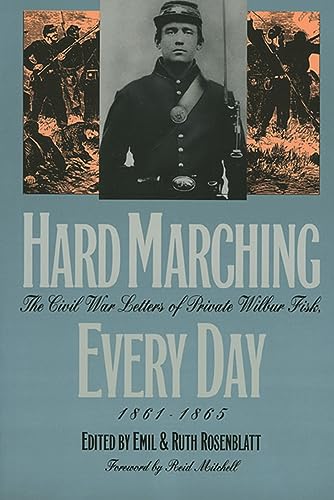
Synopsis
As a war correspondent, Wilbur Fisk was an amateur, yet his letters to the Montpelier Green Mountain Freeman comprise one of the finest collections of Civil War letters in existence. "Literary gems," historian Herman Hattaway calls them. "It would be believable that some expert novelist had created them."
But Fisk was no novelist. He was a rural school teacher from Vermont, primarily self-educated, who enlisted in the Union Army simply because he believed he would regret it later if he didn't. Unlike professional war correspondents, Private Fisk had no access to rank or headquarters. Instead, he wrote of life as a private--as one of the foot soldiers who slept in the mud and obeyed orders no matter how incomprehensible. "As for the plans our superiors are laying out for us to execute," he wrote, "we know as little as a horse knows of his driver." Between December 11, 1861 and July 26, 1865, Fisk wrote nearly 100 letters from the battlefield to the Green Mountain Freeman, all of them signed "Anti-Rebel." At the beginning of the war he was exuberant and eager for contact with the enemy. In his first letter he boasted, "This regiment would relish a fight now extremely well." Two years later, after the battle of Gettysburg, Fisk was disillusioned and war weary. "The rebel dead and ours lay thickly together, their thirst for blood forever quenched. Their bodies were swollen, black, and hideously unnatural. Their eyes glared from their sockets, their tongues protruded from their mouths, and in almost every case, clots of blood and mangled flesh showed how they had died, and rendered a sight ghastly beyond description. I thought I had become hardened to almost anything, but I cannot say I ever wish to see another sight like that I saw on the battlefield of Gettysburg." Fisk wrote as eloquently on the moral and political issues behind the war as he did on the everyday hardships of life in the Army of the Potomac. He saw the war as a question of right and wrong--of freedom against slavery and democracy against aristocracy--and he continued to believe that the war had to be fought, even after he was well acquainted with its horror and pointlessness. "When they have done their killing, there remains the question to be settled the same as before. They might as well have settled it before the shooting as afterwards." In this volume editors Ruth and Emil Rosenblatt have included all of Fisk's existing letters to the Freeman, along with three speeches from the 1890s in which Fisk looks back on his wartime experiences from the vantage point of an older man.Les informations fournies dans la section « Synopsis » peuvent faire référence à une autre édition de ce titre.
Résultats de recherche pour Hard Marching Every Day: The Civil War Letters of Private...

Image d'archives
Hard Marching Every Day: Civil War Letters of Private Wilbur Fisk, 1861-65
Edité par
University Press of Kansas, 1992
ISBN 10 : 0700606815
ISBN 13 : 9780700606818
Ancien ou d'occasion
Paperback
Vendeur : World of Books (was SecondSale), Montgomery, IL, Etats-Unis
Évaluation du vendeur 5 sur 5 étoiles

Paperback. Etat : Very Good. As a war correspondent, Wilbur Fisk was an amateur, yet his letters to the Montpelier Green Mountain Freeman comprise one of the finest collections of Civil War letters in existence. Literary gems, historian Herman Hattaway calls them. It would be believable that some expert novelist had created them. But Fisk was no novelist. He was a rural school teacher from Vermont, primarily self-educated, who enlisted in the Union Army simply because he believed he would regret it later if he didn't. Unlike professional war correspondents, Private Fisk had no access to rank or headquarters. Instead, he wrote of life as a private-as one of the foot soldiers who slept in the mud and obeyed orders no matter how incomprehensible. As for the plans our superiors are laying out for us to execute, he wrote, we know as little as a horse knows of his driver. Between December 11, 1861 and July 26, 1865, Fisk wrote nearly 100 letters from the battlefield to the Green Mountain Freeman, all of them signed Anti-Rebel. At the beginning of the war he was exuberant and eager for contact with the enemy. In his first letter he boasted, This regiment would relish a fight now extremely well. Two years later, after the battle of Gettysburg, Fisk was disillusioned and war weary. The rebel dead and ours lay thickly together, their thirst for blood forever quenched. Their bodies were swollen, black, and hideously unnatural. Their eyes glared from their sockets, their tongues protruded from their mouths, and in almost every case, clots of blood and mangled flesh showed how they had died, and rendered a sight ghastly beyond description. I thought I had become hardened to almost anything, but I cannot say I ever wish to see another sight like that I saw on the battle-field of Gettysburg. Fisk wrote as eloquently on the moral and political issues behind the war as he did on the everyday hardships of life in the Army of the Potomac. He saw the war as a question of right and wrong-of freedom against slavery and democracy against aristocracy-and he continued to believe that the war had to be fought, even after he was well acquainted with its horror and pointlessness. When they have done their killing, there remains the question to be settled the same as before. They might as well have settled it before the shooting as afterwards. In this volume editors Ruth and Emil Rosenblatt have included all of Fisk's existing letters to the Freeman, along with three speeches from the 1890s in which Fisk looks back on his wartime experiences from the vantage point of an older man. This is one of the richest collections of Civil War letters I have seen. I doubt if I have seen any collection that surpasses it. Fisk is intelligent and thoughtful. He writes well and the prose is still accessible to a late twentieth-century reader. He successfully presents the minutiae of soldier life-marching, food, picketing, pay, battles-while also explicating the issues behind the war.-Reid Mitchell, author of Civil War Soldiers: Their Expectations and Experiences. Fisk's letters are marvelous. It is almost unbelievable, they are such literary gems. In fact, they are so good that the thought occurred to me that perhaps they are not authentic. It would be believable that some expert novelist had created them -Herman Hattaway, coauthor of How the North Won the Civil War and Why the South Lost the Civil War. An important combat chronology of the war from the infantry private's viewpoint.-James McPherson, author of Battle Cry of Freedom. The letters contain descriptions of conditions in camp, on the march, and in hospitals; comments on battles, officers, and army morale; reactions to places seen and executions of deserters, as well as Fisk's political views and military frustrations.-Choice. The Fisk letters are superb. They are extremely well written and they convey a magnificent picture of the life of a Federal soldier in the Army of the Potomac.-Civil War Book Exchange. N° de réf. du vendeur CIN0700606815VG
Acheter D'occasion
EUR 5,53
Livraison gratuite
Expédition nationale : Etats-Unis
Expédition nationale : Etats-Unis
Quantité disponible : 1 disponible(s)
Image d'archives
Hard Marching Every Day: The Civil War Letters of Private Wilbur Fisk, 1861-1865
Edité par
University Press of Kansas, 1992
ISBN 10 : 0700606815
ISBN 13 : 9780700606818
Ancien ou d'occasion
Paperback
Vendeur : ThriftBooks-Dallas, Dallas, TX, Etats-Unis
Évaluation du vendeur 5 sur 5 étoiles
Paperback. Etat : Good. No Jacket. Pages can have notes/highlighting. Spine may show signs of wear. ~ ThriftBooks: Read More, Spend Less. N° de réf. du vendeur G0700606815I3N00
Acheter D'occasion
EUR 6,20
Livraison gratuite
Expédition nationale : Etats-Unis
Expédition nationale : Etats-Unis
Quantité disponible : 1 disponible(s)
Image d'archives
Hard Marching Every Day: The Civil War Letters of Private Wilbur Fisk, 1861-1865
Edité par
University Press of Kansas, 1992
ISBN 10 : 0700606815
ISBN 13 : 9780700606818
Ancien ou d'occasion
Paperback
Vendeur : ThriftBooks-Atlanta, AUSTELL, GA, Etats-Unis
Évaluation du vendeur 5 sur 5 étoiles
Paperback. Etat : Very Good. No Jacket. May have limited writing in cover pages. Pages are unmarked. ~ ThriftBooks: Read More, Spend Less. N° de réf. du vendeur G0700606815I4N00
Acheter D'occasion
EUR 6,20
Livraison gratuite
Expédition nationale : Etats-Unis
Expédition nationale : Etats-Unis
Quantité disponible : 1 disponible(s)
Image d'archives
Hard Marching Every Day: The Civil War Letters of Private Wilbur Fisk, 1861-1865
Edité par
University Press of Kansas, 1992
ISBN 10 : 0700606815
ISBN 13 : 9780700606818
Ancien ou d'occasion
Paperback
Vendeur : ThriftBooks-Reno, Reno, NV, Etats-Unis
Évaluation du vendeur 5 sur 5 étoiles
Paperback. Etat : Good. No Jacket. Pages can have notes/highlighting. Spine may show signs of wear. ~ ThriftBooks: Read More, Spend Less. N° de réf. du vendeur G0700606815I3N00
Acheter D'occasion
EUR 6,20
Livraison gratuite
Expédition nationale : Etats-Unis
Expédition nationale : Etats-Unis
Quantité disponible : 1 disponible(s)
Image d'archives
Hard Marching Every Day: The Civil War Letters of Private Wilbur Fisk, 1861-1865
Edité par
University Press of Kansas, 1992
ISBN 10 : 0700606815
ISBN 13 : 9780700606818
Ancien ou d'occasion
Paperback
Vendeur : ThriftBooks-Atlanta, AUSTELL, GA, Etats-Unis
Évaluation du vendeur 5 sur 5 étoiles
Paperback. Etat : Good. No Jacket. Pages can have notes/highlighting. Spine may show signs of wear. ~ ThriftBooks: Read More, Spend Less. N° de réf. du vendeur G0700606815I3N00
Acheter D'occasion
EUR 6,20
Livraison gratuite
Expédition nationale : Etats-Unis
Expédition nationale : Etats-Unis
Quantité disponible : 1 disponible(s)
Image d'archives
Hard Marching Every Day : The Civil War Letters of Private Wilbur Fisk, 1861-1865
Edité par
University Press of Kansas, 1992
ISBN 10 : 0700606815
ISBN 13 : 9780700606818
Ancien ou d'occasion
Couverture souple
Vendeur : Better World Books, Mishawaka, IN, Etats-Unis
Évaluation du vendeur 5 sur 5 étoiles
Etat : Good. rev. Former library copy. Pages intact with minimal writing/highlighting. The binding may be loose and creased. Dust jackets/supplements are not included. Includes library markings. Stock photo provided. Product includes identifying sticker. Better World Books: Buy Books. Do Good. N° de réf. du vendeur 41144456-6
Acheter D'occasion
EUR 7,24
Livraison gratuite
Expédition nationale : Etats-Unis
Expédition nationale : Etats-Unis
Quantité disponible : 1 disponible(s)
Image d'archives
Hard Marching Every Day : The Civil War Letters of Private Wilbur Fisk, 1861-1865
Edité par
University Press of Kansas, 1992
ISBN 10 : 0700606815
ISBN 13 : 9780700606818
Ancien ou d'occasion
Couverture souple
Vendeur : Better World Books, Mishawaka, IN, Etats-Unis
Évaluation du vendeur 5 sur 5 étoiles
Etat : Very Good. rev. Pages intact with possible writing/highlighting. Binding strong with minor wear. Dust jackets/supplements may not be included. Stock photo provided. Product includes identifying sticker. Better World Books: Buy Books. Do Good. N° de réf. du vendeur 17978570-6
Acheter D'occasion
EUR 7,24
Livraison gratuite
Expédition nationale : Etats-Unis
Expédition nationale : Etats-Unis
Quantité disponible : 1 disponible(s)
Image d'archives
Hard Marching Every Day: Civil War Letters of Private Wilbur Fisk, 1861-65
Edité par
University Press of Kansas, 1992
ISBN 10 : 0700606815
ISBN 13 : 9780700606818
Ancien ou d'occasion
Paperback
Vendeur : World of Books Inc, Montgomery, IL, Etats-Unis
Évaluation du vendeur 4 sur 5 étoiles

Paperback. Etat : Very Good. As a war correspondent, Wilbur Fisk was an amateur, yet his letters to the Montpelier Green Mountain Freeman comprise one of the finest collections of Civil War letters in existence. Literary gems, historian Herman Hattaway calls them. It would be believable that some expert novelist had created them. But Fisk was no novelist. He was a rural school teacher from Vermont, primarily self-educated, who enlisted in the Union Army simply because he believed he would regret it later if he didn't. Unlike professional war correspondents, Private Fisk had no access to rank or headquarters. Instead, he wrote of life as a private-as one of the foot soldiers who slept in the mud and obeyed orders no matter how incomprehensible. As for the plans our superiors are laying out for us to execute, he wrote, we know as little as a horse knows of his driver. Between December 11, 1861 and July 26, 1865, Fisk wrote nearly 100 letters from the battlefield to the Green Mountain Freeman, all of them signed Anti-Rebel. At the beginning of the war he was exuberant and eager for contact with the enemy. In his first letter he boasted, This regiment would relish a fight now extremely well. Two years later, after the battle of Gettysburg, Fisk was disillusioned and war weary. The rebel dead and ours lay thickly together, their thirst for blood forever quenched. Their bodies were swollen, black, and hideously unnatural. Their eyes glared from their sockets, their tongues protruded from their mouths, and in almost every case, clots of blood and mangled flesh showed how they had died, and rendered a sight ghastly beyond description. I thought I had become hardened to almost anything, but I cannot say I ever wish to see another sight like that I saw on the battle-field of Gettysburg. Fisk wrote as eloquently on the moral and political issues behind the war as he did on the everyday hardships of life in the Army of the Potomac. He saw the war as a question of right and wrong-of freedom against slavery and democracy against aristocracy-and he continued to believe that the war had to be fought, even after he was well acquainted with its horror and pointlessness. When they have done their killing, there remains the question to be settled the same as before. They might as well have settled it before the shooting as afterwards. In this volume editors Ruth and Emil Rosenblatt have included all of Fisk's existing letters to the Freeman, along with three speeches from the 1890s in which Fisk looks back on his wartime experiences from the vantage point of an older man. This is one of the richest collections of Civil War letters I have seen. I doubt if I have seen any collection that surpasses it. Fisk is intelligent and thoughtful. He writes well and the prose is still accessible to a late twentieth-century reader. He successfully presents the minutiae of soldier life-marching, food, picketing, pay, battles-while also explicating the issues behind the war.-Reid Mitchell, author of Civil War Soldiers: Their Expectations and Experiences. Fisk's letters are marvelous. It is almost unbelievable, they are such literary gems. In fact, they are so good that the thought occurred to me that perhaps they are not authentic. It would be believable that some expert novelist had created them -Herman Hattaway, coauthor of How the North Won the Civil War and Why the South Lost the Civil War. An important combat chronology of the war from the infantry private's viewpoint.-James McPherson, author of Battle Cry of Freedom. The letters contain descriptions of conditions in camp, on the march, and in hospitals; comments on battles, officers, and army morale; reactions to places seen and executions of deserters, as well as Fisk's political views and military frustrations.-Choice. The Fisk letters are superb. They are extremely well written and they convey a magnificent picture of the life of a Federal soldier in the Army of the Potomac.-Civil War Book Exchange. N° de réf. du vendeur CIN0700606815VG
Acheter D'occasion
EUR 7,38
Livraison gratuite
Expédition nationale : Etats-Unis
Expédition nationale : Etats-Unis
Quantité disponible : 1 disponible(s)
Image d'archives
Hard Marching Every Day: The Civil War Letters of Private Wilbur Fisk, 1861-1865
Edité par
Univ Pr of Kansas, Lawrence, Kansas, U.S.A., 1992
ISBN 10 : 0700606815
ISBN 13 : 9780700606818
Ancien ou d'occasion
Soft cover
Vendeur : Martin Nevers- used & rare books, Oxford, FL, Etats-Unis
Évaluation du vendeur 5 sur 5 étoiles
Soft cover. Etat : G-vg. Second Printing. 383 pages. Top corner tips of front and back cover lightly creased. Light edgewear. About a third of the pages lightly creased at top corner tips. Photos of book on request. N° de réf. du vendeur 004511
Acheter D'occasion
EUR 6,46
Expédition à EUR 5,15
Expédition nationale : Etats-Unis
Expédition nationale : Etats-Unis
Quantité disponible : 1 disponible(s)
Image d'archives
Hard Marching Every Day: The Civil War Letters of Private Wilbur Fisk, 1861-1865 (Modern War Studies)
Edité par
University Press of Kansas, 1992
ISBN 10 : 0700606815
ISBN 13 : 9780700606818
Ancien ou d'occasion
paperback
Vendeur : SatelliteBooks, Burlington, VT, Etats-Unis
Évaluation du vendeur 5 sur 5 étoiles
paperback. Etat : Softcover. Softcover. Minor shelf-wear. Free of any markings and no writings inside. N° de réf. du vendeur 241106007
Acheter D'occasion
EUR 13,83
Expédition à EUR 5,16
Expédition nationale : Etats-Unis
Expédition nationale : Etats-Unis
Quantité disponible : 1 disponible(s)