
Articles liés à My Dear Hugh: Letters from Richard Cobb to Hugh Trevor-Roper...
Synopsis
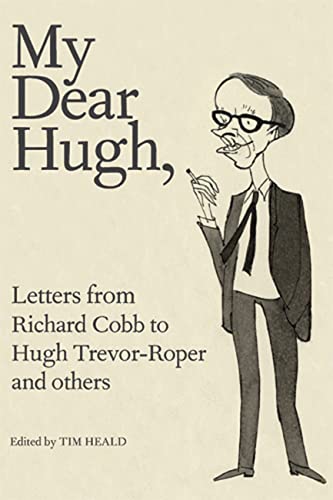
Richard Cobb was one of the most distinguished British historians of the twentieth century. A professor at Oxford, a multiple prize-winner, author of numerous books and innumerable essays and reviews, he was proudest of all to be described as a Parisian. He was unconventional, anarchic and almost impossibly erudite.
Somehow he managed in the course of a life of apparently unremitting grandeur to write letters. They were scratchy, iconoclastic, funny, indiscreet, vivid, fluent, and occasionally brilliant set-pieces of descriptive or historical reporting. The sight of one of his ill-typed missives in a blue Basildon Bond envelope was always a promise of pleasure, and usually of instruction, frequently an invitation to a feast of scurrilous gossip, and an excuse to put off day-to-day concerns for a while. He wrote about politicians, the royal family, fellow academics and journalists, and, of course, mutual friends.
The complete letters would fill many volumes, but here is a selection of the best, made by Tim Heald, who was taught by Cobb at university, and corresponded with him intermittently for the next thirty years.
Somehow he managed in the course of a life of apparently unremitting grandeur to write letters. They were scratchy, iconoclastic, funny, indiscreet, vivid, fluent, and occasionally brilliant set-pieces of descriptive or historical reporting. The sight of one of his ill-typed missives in a blue Basildon Bond envelope was always a promise of pleasure, and usually of instruction, frequently an invitation to a feast of scurrilous gossip, and an excuse to put off day-to-day concerns for a while. He wrote about politicians, the royal family, fellow academics and journalists, and, of course, mutual friends.
The complete letters would fill many volumes, but here is a selection of the best, made by Tim Heald, who was taught by Cobb at university, and corresponded with him intermittently for the next thirty years.
Les informations fournies dans la section « Synopsis » peuvent faire référence à une autre édition de ce titre.
À propos de l'auteur
Tim Heald has worked as a journalist on many newspapers, and has written over thirty books, fiction and non-fiction, including crime novels, and biographies. He lives in Fowey, Cornwall.
Extrait. © Reproduit sur autorisation. Tous droits réservés.
Introduction
Richard Cobb was unusual.
His public reputation makes him seem almost conventional. He was Professor of Modern History at Oxford from 1973 to 1984 before which he was a Fellow of Balliol for 10 years. He was amazingly knowledgeable about France and all things French but most of all about the French Revolution. He wrote several books about this, the first of which was in French and appeared in two volumes as "Les Armees Revolutionnaires". He was also a memoirist of brilliance who wrote several slim autobiographical volumes full of vivid and evocative scenes described in a style which was lucid, entertaining and unique.
The entry in Who's Who records his marriage to Margaret who was a pupil of his at Leeds University and of their five children. It mentions his education at Shrewsbury and Merton where he was a Postmaster. His ten years of research in France are listed together with his early academic career teaching at universities in Aberystwyth, Manchester and Leeds. There are honorary degrees, the Legion d'honneur - he was a chevalier - and a CBE. The publications are impressive and include one book which won the Wolfson History Prize and another which secured him the J.R. Ackerley. His address is given as Worcester College, Oxford where he held a Fellowship from 1973. He died in 1996. It sounds like a worthy, well-lived but essentially rather dull life.
None of this semi-official stuff provides much of a glimpse of the real self - "l'etonnant Cobb" as his many French admirers called him. He was an extraordinary man in many ways and although his qualities as a historian underpinned and bolstered his reputation and his achievements they didn't begin to tell the whole story.
His Frenchness was vital. One of the compliments he most treasured was when a Frenchman described him as "un titi Parisien" which meant, essentially,that he was "one of them". He spent many years in Paris, lodged as a young man in the rackety dixieme district of Paris, later had a flat in the Rue de Tournon and eventually, with Margaret, graduated to a house in Normandy which turned out to be one of several essentially disastrous forays into the property market. His ostensibly English writing was conducted in a curious upmarket franglais in which his mother tongue was liberally aided by French words and phrases. It was a style that was unique to him and perfectly encapsulated a personality which was as nearly bicultural as it is possible for an Englishman to be. And, in many ways, he was by education and background - his book on childhood Tunbridge Wells is an uncomfortable classic - the quintessential Englishman...
8 April 1981
The trip to the States seems to have been a success and at the beginning of April Cobb wrote to thank Wasserstein for his part in it.
'I got into Heathrow after a perfectly comfortable flight, part of it spent watching a film of quite unusual inaneness. England was looking very green, but now it is quite Arctic. I find myself thinking with affection of Brandeis, even of Steinbergers, of Waltham, of the Silver Bullet, and the young man in the cowboy hat who drives the 1.35 from Roberts to Boston…Here everything is boring & predictable.'
On 9 April Cobb wrote to Trevor-Roper
'I greatly enjoyed Brandeis, but Barraclough remained invisible. I really wonder whether he actually exists, as few people there claim to have seen him or even heard him on the phone; on the other hand, he is listed as having an address in Boston. Harvard I did not greatly like, at least the place, Cambridge; every square was crowded with earnest students SITTING DOWN in the dust and protesting about this or that, mostly somewhere called El Salv
Les informations fournies dans la section « A propos du livre » peuvent faire référence à une autre édition de ce titre.
Résultats de recherche pour My Dear Hugh: Letters from Richard Cobb to Hugh Trevor-Roper...

Image d'archives
My Dear Hugh : Letters from Richard Cobb to Hugh Trevor-Roper and Others
Edité par
Quarto Publishing Group UK, 2011
ISBN 10 : 0711232407
ISBN 13 : 9780711232402
Ancien ou d'occasion
Couverture rigide
Vendeur : Better World Books: West, Reno, NV, Etats-Unis
Évaluation du vendeur 5 sur 5 étoiles

Etat : Good. Pages intact with minimal writing/highlighting. The binding may be loose and creased. Dust jackets/supplements are not included. Stock photo provided. Product includes identifying sticker. Better World Books: Buy Books. Do Good. N° de réf. du vendeur 51527328-75
Acheter D'occasion
EUR 6,64
Livraison gratuite
Expédition nationale : Etats-Unis
Expédition nationale : Etats-Unis
Quantité disponible : 1 disponible(s)
Image d'archives
My Dear Hugh: Letters from Richard Cobb to Hugh Trevor-Roper and others
Edité par
Frances Lincoln, 2011
ISBN 10 : 0711232407
ISBN 13 : 9780711232402
Ancien ou d'occasion
Paperback
Vendeur : WorldofBooks, Goring-By-Sea, WS, Royaume-Uni
Évaluation du vendeur 5 sur 5 étoiles
Paperback. Etat : Very Good. The book has been read, but is in excellent condition. Pages are intact and not marred by notes or highlighting. The spine remains undamaged. N° de réf. du vendeur GOR004131271
Acheter D'occasion
EUR 8,63
Expédition à EUR 6,51
Expédition depuis Royaume-Uni vers Etats-Unis
Expédition depuis Royaume-Uni vers Etats-Unis
Quantité disponible : 7 disponible(s)
Image d'archives
My Dear Hugh: Letters from Richard Cobb to Hugh Trevor-Roper and Others
Edité par
Frances Lincoln, 2011
ISBN 10 : 0711232407
ISBN 13 : 9780711232402
Ancien ou d'occasion
Couverture rigide
Vendeur : Anybook.com, Lincoln, Royaume-Uni
Évaluation du vendeur 5 sur 5 étoiles
Etat : Good. This is an ex-library book and may have the usual library/used-book markings inside.This book has hardback covers. In good all round condition. Dust jacket in good condition. Please note the Image in this listing is a stock photo and may not match the covers of the actual item,700grams, ISBN:9780711232402. N° de réf. du vendeur 5576443
Acheter D'occasion
EUR 3,90
Expédition à EUR 15,81
Expédition depuis Royaume-Uni vers Etats-Unis
Expédition depuis Royaume-Uni vers Etats-Unis
Quantité disponible : 1 disponible(s)
Image d'archives
My Dear Hugh: Letters from Richard Cobb to Hugh Trevor-Roper and Others
Edité par
Frances Lincoln, 2011
ISBN 10 : 0711232407
ISBN 13 : 9780711232402
Ancien ou d'occasion
Couverture rigide
Vendeur : Anybook.com, Lincoln, Royaume-Uni
Évaluation du vendeur 5 sur 5 étoiles
Etat : Good. This is an ex-library book and may have the usual library/used-book markings inside.This book has hardback covers. In good all round condition. Dust jacket in good condition. Please note the Image in this listing is a stock photo and may not match the covers of the actual item,550grams, ISBN:9780711232402. N° de réf. du vendeur 5796285
Acheter D'occasion
EUR 3,90
Expédition à EUR 15,81
Expédition depuis Royaume-Uni vers Etats-Unis
Expédition depuis Royaume-Uni vers Etats-Unis
Quantité disponible : 1 disponible(s)
Image d'archives
My Dear Hugh: Letters from Richard Cobb to Hugh Trevor-Roper and others
Edité par
Frances Lincoln, 2011
ISBN 10 : 0711232407
ISBN 13 : 9780711232402
Ancien ou d'occasion
Couverture rigide
Vendeur : Jackson Street Booksellers, Omaha, NE, Etats-Unis
Évaluation du vendeur 5 sur 5 étoiles
Hardcover. Etat : Fine. Etat de la jaquette : Fine. Fine copy in hardcover with fine jacket. N° de réf. du vendeur 167602
Acheter D'occasion
EUR 22,61
Expédition à EUR 5,71
Expédition nationale : Etats-Unis
Expédition nationale : Etats-Unis
Quantité disponible : 1 disponible(s)
Image d'archives
My Dear Hugh: Letters from Richard Cobb to Hugh Trevor-Roper and others
Edité par
Frances Lincoln, 2011
ISBN 10 : 0711232407
ISBN 13 : 9780711232402
Ancien ou d'occasion
Couverture rigide
Vendeur : HALCYON BOOKS, LONDON, Royaume-Uni
Évaluation du vendeur 5 sur 5 étoiles
Hardcover. Etat : Very Good. NEW EU 3 EURO CHARGE FOR IMPORTS IS INCLUDED IN OUR SHIPPING PRICE. ALL ITEMS ARE DISPATCHED FROM THE UK, ALL OVERSEAS ORDERS SENT BY TRACKABLE AIR MAIL. IF YOU ARE LOCATED OUTSIDE THE UK PLEASE ASK US FOR A POSTAGE QUOTE FOR MULTI VOLUME SETS BEFORE ORDERING. N° de réf. du vendeur mon0000895314
Acheter D'occasion
EUR 7,79
Expédition à EUR 20,93
Expédition depuis Royaume-Uni vers Etats-Unis
Expédition depuis Royaume-Uni vers Etats-Unis
Quantité disponible : 1 disponible(s)
Image d'archives
My Dear Hugh,: Letters from Richard Cobb to Hugh
Edité par
Pgw, 2011
ISBN 10 : 0711232407
ISBN 13 : 9780711232402
Ancien ou d'occasion
Couverture rigide
Vendeur : Russell Books, Victoria, BC, Canada
Évaluation du vendeur 5 sur 5 étoiles
Etat : Acceptable. N° de réf. du vendeur FORT883895
Acheter D'occasion
EUR 13,55
Expédition à EUR 17,55
Expédition depuis Canada vers Etats-Unis
Expédition depuis Canada vers Etats-Unis
Quantité disponible : 1 disponible(s)
Image d'archives
My Dear Hugh: Letters from Richard Cobb to Hugh Trevor-Roper and others
Edité par
Frances Lincoln, 2011
ISBN 10 : 0711232407
ISBN 13 : 9780711232402
Ancien ou d'occasion
Couverture rigide
Vendeur : Greener Books, London, Royaume-Uni
Évaluation du vendeur 4 sur 5 étoiles

Hardcover. Etat : Used; Very Good. **SHIPPED FROM UK** We believe you will be completely satisfied with our quick and reliable service. All orders are dispatched as swiftly as possible! Buy with confidence! Greener Books. N° de réf. du vendeur 2966974
Acheter D'occasion
EUR 9,96
Expédition à EUR 23,26
Expédition depuis Royaume-Uni vers Etats-Unis
Expédition depuis Royaume-Uni vers Etats-Unis
Quantité disponible : 1 disponible(s)
Image fournie par le vendeur
My dear Hugh : letters from Richard Cobb to Hugh Trevor-Roper and others
Edité par
London : Frances Lincoln Ltd., 2011
ISBN 10 : 0711232407
ISBN 13 : 9780711232402
Ancien ou d'occasion
Couverture rigide
Edition originale
Vendeur : MW Books, New York, NY, Etats-Unis
Évaluation du vendeur 5 sur 5 étoiles
First Edition. Fine cloth copy in a near-fine, very slightly edge-dulled dust wrapper, now mylar-sleeved. Remains particularly well-preserved overall; tight, bright, clean and strong. Physical description: 239 pages ; 24cm. Subjects: Cobb, Richard (1917-1996) -- Correspondence. Historians -- Great Britain -- Correspondence. 1 Kg. N° de réf. du vendeur 304463
Acheter D'occasion
EUR 46,12
Livraison gratuite
Expédition nationale : Etats-Unis
Expédition nationale : Etats-Unis
Quantité disponible : 1 disponible(s)
Image fournie par le vendeur
My dear Hugh : letters from Richard Cobb to Hugh Trevor-Roper and others
Edité par
London : Frances Lincoln Ltd., 2011
ISBN 10 : 0711232407
ISBN 13 : 9780711232402
Ancien ou d'occasion
Couverture rigide
Edition originale
Vendeur : MW Books Ltd., Galway, Irlande
Évaluation du vendeur 5 sur 5 étoiles
First Edition. Fine cloth copy in a near-fine, very slightly edge-dulled dust wrapper, now mylar-sleeved. Remains particularly well-preserved overall; tight, bright, clean and strong. Physical description: 239 pages ; 24cm. Subjects: Cobb, Richard (1917-1996) -- Correspondence. Historians -- Great Britain -- Correspondence. 1 Kg. N° de réf. du vendeur 304463
Acheter D'occasion
EUR 35
Expédition à EUR 13,95
Expédition depuis Irlande vers Etats-Unis
Expédition depuis Irlande vers Etats-Unis
Quantité disponible : 1 disponible(s)