
Articles liés à At Duty's Call: A Study in Obsolete Patriotism
At Duty's Call: A Study in Obsolete Patriotism - Couverture souple
Livre 6 sur 180: Studies in Imperialism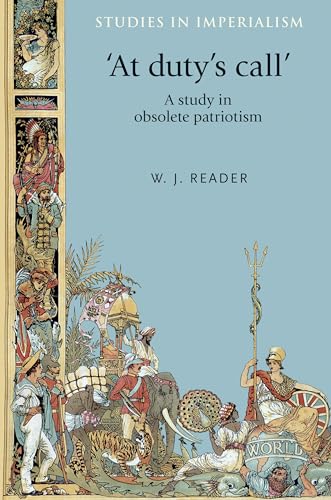
Synopsis
The Victorian private solider was a despised figure. A working man had to be desperate indeed to take the Queen's shilling. Yet in the first sixteen months of the Great War two and a half million men from the UK and many more from the empire, flocked to the colours - without any form of legal compulsion. There had never been a volunteer army like it.
What was in the air of England in the generation or so before 1914 to bring about such collective exultation? How did it come about that, in a society which - in oft-proclaimed contrast to Germany - rejected conscription and prided itself on having no taint of militarism, men could be induced to volunteer in such numbers? The nation's general state of mind, system of values and set of attitudes derived largely from the upper middle class, which had emerged and become dominant during the nineteenth century. The book examines the phenomenon of 1914 and the views held by people of that class, since it was under their leadership that the country went to war.Les informations fournies dans la section « Synopsis » peuvent faire référence à une autre édition de ce titre.
À propos de l'auteur
W. J. Reader was a freelance historian associated with the Business History Unit at the London School of Economics
Les informations fournies dans la section « A propos du livre » peuvent faire référence à une autre édition de ce titre.
Résultats de recherche pour At Duty's Call: A Study in Obsolete Patriotism

Image fournie par le vendeur
'At Duty's Call'
Edité par
Manchester University Press, GB, 1988
ISBN 10 : 0719097533
ISBN 13 : 9780719097539
Neuf
Paperback
Vendeur : Rarewaves.com USA, London, LONDO, Royaume-Uni
Évaluation du vendeur 5 sur 5 étoiles

Paperback. Etat : New. The Victorian private solider was a despised figure. A working man had to be desperate indeed to take the Queen's shilling. Yet in the first sixteen months of the Great War two and a half million men from the UK and many more from the empire, flocked to the colours - without any form of legal compulsion. There had never been a volunteer army like it.What was in the air of England in the generation or so before 1914 to bring about such collective exultation? How did it come about that, in a society which - in oft-proclaimed contrast to Germany - rejected conscription and prided itself on having no taint of militarism, men could be induced to volunteer in such numbers? The nation's general state of mind, system of values and set of attitudes derived largely from the upper middle class, which had emerged and become dominant during the nineteenth century. The book examines the phenomenon of 1914 and the views held by people of that class, since it was under their leadership that the country went to war. N° de réf. du vendeur LU-9780719097539
Acheter neuf
EUR 31,86
Livraison gratuite
Expédition depuis Royaume-Uni vers Etats-Unis
Expédition depuis Royaume-Uni vers Etats-Unis
Quantité disponible : 1 disponible(s)
Image d'archives
'At Duty's Call'
Vendeur : PBShop.store US, Wood Dale, IL, Etats-Unis
Évaluation du vendeur 5 sur 5 étoiles
PAP. Etat : New. New Book. Shipped from UK. Established seller since 2000. N° de réf. du vendeur CX-9780719097539
Acheter neuf
EUR 31,87
Livraison gratuite
Expédition nationale : Etats-Unis
Expédition nationale : Etats-Unis
Quantité disponible : 15 disponible(s)
Image d'archives
'At Duty's Call'
Vendeur : PBShop.store UK, Fairford, GLOS, Royaume-Uni
Évaluation du vendeur 5 sur 5 étoiles
PAP. Etat : New. New Book. Shipped from UK. Established seller since 2000. N° de réf. du vendeur CX-9780719097539
Acheter neuf
EUR 30,71
Expédition à EUR 4,84
Expédition depuis Royaume-Uni vers Etats-Unis
Expédition depuis Royaume-Uni vers Etats-Unis
Quantité disponible : 15 disponible(s)
Image d'archives
'At Duty's Call'
Edité par
Manchester University Press, 1988
ISBN 10 : 0719097533
ISBN 13 : 9780719097539
Ancien ou d'occasion
Couverture souple
Vendeur : Books Puddle, New York, NY, Etats-Unis
Évaluation du vendeur 4 sur 5 étoiles

Etat : Used. pp. 164. N° de réf. du vendeur 26142329789
Acheter D'occasion
EUR 33,14
Expédition à EUR 3,43
Expédition nationale : Etats-Unis
Expédition nationale : Etats-Unis
Quantité disponible : 1 disponible(s)
Image d'archives
'At Duty's Call'
Edité par
Manchester University Press, 1988
ISBN 10 : 0719097533
ISBN 13 : 9780719097539
Ancien ou d'occasion
Couverture souple
Vendeur : Majestic Books, Hounslow, Royaume-Uni
Évaluation du vendeur 4 sur 5 étoiles
Etat : Used. pp. 164. N° de réf. du vendeur 135034978
Acheter D'occasion
EUR 29,02
Expédition à EUR 7,57
Expédition depuis Royaume-Uni vers Etats-Unis
Expédition depuis Royaume-Uni vers Etats-Unis
Quantité disponible : 1 disponible(s)
Image d'archives
'At Duty's Call'
Edité par
Manchester University Press, 1988
ISBN 10 : 0719097533
ISBN 13 : 9780719097539
Ancien ou d'occasion
Couverture souple
Vendeur : Biblios, Frankfurt am main, HESSE, Allemagne
Évaluation du vendeur 4 sur 5 étoiles
Etat : Used. pp. 164. N° de réf. du vendeur 18142329783
Acheter D'occasion
EUR 30,11
Expédition à EUR 9,95
Expédition depuis Allemagne vers Etats-Unis
Expédition depuis Allemagne vers Etats-Unis
Quantité disponible : 1 disponible(s)
Image d'archives
At Duty's Call: A Study in Obsolete Patriotism
impression à la demandeVendeur : Revaluation Books, Exeter, Royaume-Uni
Évaluation du vendeur 5 sur 5 étoiles
Paperback. Etat : Brand New. reprint edition. 152 pages. 9.25x6.25x0.25 inches. In Stock. This item is printed on demand. N° de réf. du vendeur __0719097533
Acheter neuf
EUR 30,22
Expédition à EUR 11,65
Expédition depuis Royaume-Uni vers Etats-Unis
Expédition depuis Royaume-Uni vers Etats-Unis
Quantité disponible : 2 disponible(s)
Image fournie par le vendeur
'At Duty's Call'
Edité par
Manchester University Press, GB, 1988
ISBN 10 : 0719097533
ISBN 13 : 9780719097539
Neuf
Paperback
Vendeur : Rarewaves USA, HEBRON, KY, Etats-Unis
Évaluation du vendeur 5 sur 5 étoiles
Paperback. Etat : New. The Victorian private solider was a despised figure. A working man had to be desperate indeed to take the Queen's shilling. Yet in the first sixteen months of the Great War two and a half million men from the UK and many more from the empire, flocked to the colours - without any form of legal compulsion. There had never been a volunteer army like it.What was in the air of England in the generation or so before 1914 to bring about such collective exultation? How did it come about that, in a society which - in oft-proclaimed contrast to Germany - rejected conscription and prided itself on having no taint of militarism, men could be induced to volunteer in such numbers? The nation's general state of mind, system of values and set of attitudes derived largely from the upper middle class, which had emerged and become dominant during the nineteenth century. The book examines the phenomenon of 1914 and the views held by people of that class, since it was under their leadership that the country went to war. N° de réf. du vendeur LU-9780719097539
Acheter neuf
EUR 42,20
Livraison gratuite
Expédition nationale : Etats-Unis
Expédition nationale : Etats-Unis
Quantité disponible : Plus de 20 disponibles
Image d'archives
'At Duty's Call': A Study in Obsolete Patriotism
Edité par
Manchester University Press, 1988
ISBN 10 : 0719097533
ISBN 13 : 9780719097539
Neuf
Paperback / softback
Vendeur : THE SAINT BOOKSTORE, Southport, Royaume-Uni
Évaluation du vendeur 5 sur 5 étoiles
Paperback / softback. Etat : New. New copy - Usually dispatched within 4 working days. N° de réf. du vendeur B9780719097539
Acheter neuf
EUR 28,65
Expédition à EUR 15,72
Expédition depuis Royaume-Uni vers Etats-Unis
Expédition depuis Royaume-Uni vers Etats-Unis
Quantité disponible : 2 disponible(s)
Image d'archives
'At Duty's Call': A study in obsolete patriotism (Studies in Imperialism, 5)
Edité par
Manchester University Press, 1988
ISBN 10 : 0719097533
ISBN 13 : 9780719097539
Neuf
Couverture souple
Vendeur : Ria Christie Collections, Uxbridge, Royaume-Uni
Évaluation du vendeur 5 sur 5 étoiles
Etat : New. In. N° de réf. du vendeur ria9780719097539_new
Acheter neuf
EUR 32,54
Expédition à EUR 13,15
Expédition depuis Royaume-Uni vers Etats-Unis
Expédition depuis Royaume-Uni vers Etats-Unis
Quantité disponible : 2 disponible(s)