
Articles liés à Centrist Rhetoric: The Production of Political Transcendence...
Centrist Rhetoric: The Production of Political Transcendence in the Clinton Presidency - Couverture souple
Livre 17 sur 71: Lexington Studies in Political Communication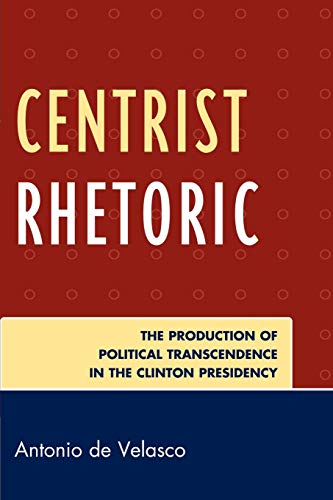
Synopsis
What exactly is happening when politicians evoke a center space beyond partisan politics to advance what are unmistakably political arguments? Drawing from an analysis of pivotal speeches surrounding Bill Clinton's 1992 presidential campaign and first term in office, Centrist Rhetoric: The Production of Political Transcendence in the Clinton Presidency takes an extended look at this question by showing how the possibility of political transcendence takes form in the rhetoric of the political center.
Faced with a divided and shrinking party, and later with a pitched battle against a resurgent conservative movement, Clinton used the image of a political center, a "third way" beyond liberal and conservative orthodoxies, to advance his strategic goals, define his adversaries, and overcome key political challenges. As appeals to the center helped Clinton to achieve these advantages in specific cases, however, they also served to define the means, ends, and very essence of democracy in ambiguous and contradictory ways. Touching on controversies from the early 1990s over the future of the Democratic Party, racial identity in American politics, the threat of rightwing extremism, and the role of government, Antonio de Velasco show how centrist rhetoric's call to transcendence weaved together forms of identification and division, insight and blindness, so as to defy the conventional assessments of both Clinton's supporters and his detractors.
Centrist Rhetoric thus offers general insight into the workings of political rhetoric, and a specific appreciation of Clinton's attempts to define and adjust to the political exigencies of a critical period in history of the Democratic Party and politics in the United States.
Les informations fournies dans la section « Synopsis » peuvent faire référence à une autre édition de ce titre.
À propos de l'auteur
Antonio de Velasco is assistant professor of rhetoric in the department of communication at the University of Memphis.
Les informations fournies dans la section « A propos du livre » peuvent faire référence à une autre édition de ce titre.
Résultats de recherche pour Centrist Rhetoric: The Production of Political Transcendence...

Image fournie par le vendeur
Centrist Rhetoric: The Production of Political Transcendence in the Clinton Presidency (Lexington Studies in Political Communication) (Bloomsbury Studies in Political Communication)
Edité par
Lexington Books (UK), 2012
ISBN 10 : 0739139819
ISBN 13 : 9780739139813
Ancien ou d'occasion
paperback
Vendeur : WeBuyBooks, Rossendale, LANCS, Royaume-Uni
Évaluation du vendeur 5 sur 5 étoiles

paperback. Etat : Like New. Most items will be dispatched the same or the next working day. An apparently unread copy in perfect condition. Dust cover is intact with no nicks or tears. Spine has no signs of creasing. Pages are clean and not marred by notes or folds of any kind. N° de réf. du vendeur rev3763469281
Acheter D'occasion
EUR 34,88
Expédition à EUR 6,78
Expédition depuis Royaume-Uni vers Etats-Unis
Expédition depuis Royaume-Uni vers Etats-Unis
Quantité disponible : 1 disponible(s)
Image d'archives
Centrist Rhetoric (Paperback)
Edité par
Bloomsbury Publishing Plc, Lanham, MD, 2012
ISBN 10 : 0739139819
ISBN 13 : 9780739139813
Neuf
Paperback
Vendeur : Grand Eagle Retail, Bensenville, IL, Etats-Unis
Évaluation du vendeur 5 sur 5 étoiles
Paperback. Etat : new. Paperback. What exactly is happening when politicians evoke a center space beyond partisan politics to advance what are unmistakably political arguments? Drawing from an analysis of pivotal speeches surrounding Bill Clinton's 1992 presidential campaign and first term in office, Centrist Rhetoric: The Production of Political Transcendence in the Clinton Presidency takes an extended look at this question by showing how the possibility of political transcendence takes form in the rhetoric of the political center. Faced with a divided and shrinking party, and later with a pitched battle against a resurgent conservative movement, Clinton used the image of a political center, a "third way" beyond liberal and conservative orthodoxies, to advance his strategic goals, define his adversaries, and overcome key political challenges. As appeals to the center helped Clinton to achieve these advantages in specific cases, however, they also served to define the means, ends, and very essence of democracy in ambiguous and contradictory ways. Touching on controversies from the early 1990s over the future of the Democratic Party, racial identity in American politics, the threat of rightwing extremism, and the role of government, Antonio de Velasco show how centrist rhetoric's call to transcendence weaved together forms of identification and division, insight and blindness, so as to defy the conventional assessments of both Clinton's supporters and his detractors. Centrist Rhetoric thus offers general insight into the workings of political rhetoric, and a specific appreciation of Clinton's attempts to define and adjust to the political exigencies of a critical period in history of the Democratic Party and politics in the United States. Focused on the centrist rhetoric of President Bill Clinton, Centrist Rhetoric explores questions about the basic nature and function of pleas to transcend partisan division. Using close textual analysis in the context of a broader theoretical argument about rhetoric, democrac. This item is printed on demand. Shipping may be from multiple locations in the US or from the UK, depending on stock availability. N° de réf. du vendeur 9780739139813
Acheter neuf
EUR 65,77
Livraison gratuite
Expédition nationale : Etats-Unis
Expédition nationale : Etats-Unis
Quantité disponible : 1 disponible(s)
Image d'archives
Centrist Rhetoric
impression à la demandeVendeur : PBShop.store US, Wood Dale, IL, Etats-Unis
Évaluation du vendeur 5 sur 5 étoiles
PAP. Etat : New. New Book. Shipped from UK. THIS BOOK IS PRINTED ON DEMAND. Established seller since 2000. N° de réf. du vendeur L0-9780739139813
Acheter neuf
EUR 65,78
Livraison gratuite
Expédition nationale : Etats-Unis
Expédition nationale : Etats-Unis
Quantité disponible : Plus de 20 disponibles
Image fournie par le vendeur
Centrist Rhetoric
Edité par
Bloomsbury Publishing Plc, US, 2012
ISBN 10 : 0739139819
ISBN 13 : 9780739139813
Neuf
Paperback
Vendeur : Rarewaves.com USA, London, LONDO, Royaume-Uni
Évaluation du vendeur 5 sur 5 étoiles
Paperback. Etat : New. What exactly is happening when politicians evoke a center space beyond partisan politics to advance what are unmistakably political arguments? Drawing from an analysis of pivotal speeches surrounding Bill Clinton's 1992 presidential campaign and first term in office, Centrist Rhetoric: The Production of Political Transcendence in the Clinton Presidency takes an extended look at this question by showing how the possibility of political transcendence takes form in the rhetoric of the political center. Faced with a divided and shrinking party, and later with a pitched battle against a resurgent conservative movement, Clinton used the image of a political center, a "third way" beyond liberal and conservative orthodoxies, to advance his strategic goals, define his adversaries, and overcome key political challenges. As appeals to the center helped Clinton to achieve these advantages in specific cases, however, they also served to define the means, ends, and very essence of democracy in ambiguous and contradictory ways. Touching on controversies from the early 1990s over the future of the Democratic Party, racial identity in American politics, the threat of rightwing extremism, and the role of government, Antonio de Velasco show how centrist rhetoric's call to transcendence weaved together forms of identification and division, insight and blindness, so as to defy the conventional assessments of both Clinton's supporters and his detractors. Centrist Rhetoric thus offers general insight into the workings of political rhetoric, and a specific appreciation of Clinton's attempts to define and adjust to the political exigencies of a critical period in history of the Democratic Party and politics in the United States. N° de réf. du vendeur LU-9780739139813
Acheter neuf
EUR 67,25
Livraison gratuite
Expédition depuis Royaume-Uni vers Etats-Unis
Expédition depuis Royaume-Uni vers Etats-Unis
Quantité disponible : Plus de 20 disponibles
Image d'archives
Centrist Rhetoric
impression à la demandeVendeur : PBShop.store UK, Fairford, GLOS, Royaume-Uni
Évaluation du vendeur 5 sur 5 étoiles
PAP. Etat : New. New Book. Delivered from our UK warehouse in 4 to 14 business days. THIS BOOK IS PRINTED ON DEMAND. Established seller since 2000. N° de réf. du vendeur L0-9780739139813
Acheter neuf
EUR 63,42
Expédition à EUR 4,99
Expédition depuis Royaume-Uni vers Etats-Unis
Expédition depuis Royaume-Uni vers Etats-Unis
Quantité disponible : Plus de 20 disponibles
Image d'archives
Centrist Rhetoric: The Production of Political Transcendence in the Clinton Presidency (Bloomsbury Studies in Political Communication)
Vendeur : California Books, Miami, FL, Etats-Unis
Évaluation du vendeur 5 sur 5 étoiles
Etat : New. N° de réf. du vendeur I-9780739139813
Acheter neuf
EUR 66,53
Expédition à EUR 2,69
Expédition nationale : Etats-Unis
Expédition nationale : Etats-Unis
Quantité disponible : Plus de 20 disponibles
Image d'archives
Centrist Rhetoric: The Production of Political Transcendence in the Clinton Presidency
Vendeur : Revaluation Books, Exeter, Royaume-Uni
Évaluation du vendeur 5 sur 5 étoiles
Paperback. Etat : Brand New. reprint edition. 191 pages. 9.00x6.50x0.50 inches. In Stock. N° de réf. du vendeur x-0739139819
Acheter neuf
EUR 80,25
Expédition à EUR 11,99
Expédition depuis Royaume-Uni vers Etats-Unis
Expédition depuis Royaume-Uni vers Etats-Unis
Quantité disponible : 2 disponible(s)
Image d'archives
Centrist Rhetoric
Edité par
Rowman & Littlefield Publishers, Incorporated, 2012
ISBN 10 : 0739139819
ISBN 13 : 9780739139813
Neuf
Couverture souple
Vendeur : Books Puddle, Woodside, NY, Etats-Unis
Évaluation du vendeur 4 sur 5 étoiles

Etat : New. pp. 202. N° de réf. du vendeur 2642987992
Acheter neuf
EUR 103,39
Expédition à EUR 3,58
Expédition nationale : Etats-Unis
Expédition nationale : Etats-Unis
Quantité disponible : 1 disponible(s)
Image d'archives
Centrist Rhetoric (Paperback)
Edité par
Bloomsbury Publishing Plc, Lanham, MD, 2012
ISBN 10 : 0739139819
ISBN 13 : 9780739139813
Neuf
Paperback
Vendeur : CitiRetail, Stevenage, Royaume-Uni
Évaluation du vendeur 5 sur 5 étoiles
Paperback. Etat : new. Paperback. What exactly is happening when politicians evoke a center space beyond partisan politics to advance what are unmistakably political arguments? Drawing from an analysis of pivotal speeches surrounding Bill Clinton's 1992 presidential campaign and first term in office, Centrist Rhetoric: The Production of Political Transcendence in the Clinton Presidency takes an extended look at this question by showing how the possibility of political transcendence takes form in the rhetoric of the political center. Faced with a divided and shrinking party, and later with a pitched battle against a resurgent conservative movement, Clinton used the image of a political center, a "third way" beyond liberal and conservative orthodoxies, to advance his strategic goals, define his adversaries, and overcome key political challenges. As appeals to the center helped Clinton to achieve these advantages in specific cases, however, they also served to define the means, ends, and very essence of democracy in ambiguous and contradictory ways. Touching on controversies from the early 1990s over the future of the Democratic Party, racial identity in American politics, the threat of rightwing extremism, and the role of government, Antonio de Velasco show how centrist rhetoric's call to transcendence weaved together forms of identification and division, insight and blindness, so as to defy the conventional assessments of both Clinton's supporters and his detractors. Centrist Rhetoric thus offers general insight into the workings of political rhetoric, and a specific appreciation of Clinton's attempts to define and adjust to the political exigencies of a critical period in history of the Democratic Party and politics in the United States. Focused on the centrist rhetoric of President Bill Clinton, Centrist Rhetoric explores questions about the basic nature and function of pleas to transcend partisan division. Using close textual analysis in the context of a broader theoretical argument about rhetoric, democrac. This item is printed on demand. Shipping may be from our UK warehouse or from our Australian or US warehouses, depending on stock availability. N° de réf. du vendeur 9780739139813
Acheter neuf
EUR 68,49
Expédition à EUR 44,34
Expédition depuis Royaume-Uni vers Etats-Unis
Expédition depuis Royaume-Uni vers Etats-Unis
Quantité disponible : 1 disponible(s)
Image d'archives
Centrist Rhetoric
Edité par
Rowman & Littlefield Publishers, Incorporated, 2012
ISBN 10 : 0739139819
ISBN 13 : 9780739139813
Neuf
Couverture souple
Vendeur : Majestic Books, Hounslow, Royaume-Uni
Évaluation du vendeur 4 sur 5 étoiles
Etat : New. pp. 202. N° de réf. du vendeur 49827335
Acheter neuf
EUR 106,05
Expédition à EUR 7,79
Expédition depuis Royaume-Uni vers Etats-Unis
Expédition depuis Royaume-Uni vers Etats-Unis
Quantité disponible : 1 disponible(s)