Synopsis
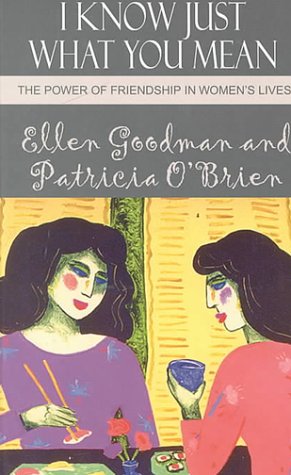
Book by Goodman Ellen OBrien Patricia
Les informations fournies dans la section « Synopsis » peuvent faire référence à une autre édition de ce titre.
Extrait
Chapter One: Beginnings
Ellen
The sun was setting when I pulled my battered red Chevy Vega station wagon out of the driveway of the brown shingle house that I had just bought with every last nickel to my name, and headed off for Cambridge. The hands on the steering wheel were still speckled with the red paint that I had been rolling onto the living room walls that day, paint financed by the sale of an engagement ring from a former marriage and life.
I was thirty-two years old, a single mother, with a five-year-old daughter and a brand new puppy, living less than a mile from the house in which I had grown up, and I was going back to Harvard ten years after graduation. An adult now, a journalist, a reporter for The Boston Globe, I had hustled and won a prize -- a mid-career Nieman Fellowship in journalism -- and I was off to meet the other members of my "class" for the first time.
In those days, I was breathless. Coping with work and family and love -- what Zorba the Greek would call the whole catastrophe. I was not at all sure how the pieces of my life fit together. At work, I had learned to say what I thought and to write about ideas. I was by no means as confident when it came to the messy business of feelings.
But this September of 1973, I knew, in some inchoate way, that I was on the edge of something more than a year "off." Perhaps a year "on."
Pat
While Ellen was driving from Brookline, I was on the bus coming from my rented house in Belmont, marveling at the fact that I had landed in this place, at this time, in this way. Harvard was only a few miles south of the working-class town of Somerville (known locally, I learned later, as "Slumerville"), where I had been born -- geographically close, but in the days when my Irish immigrant mother and father lived there, Harvard might as well have been on the moon.
That was the past, this was now. I was thirty-seven, a newly divorced mother of four children working as a reporter for the Chicago Sun-Times with a year ahead of me as a Nieman Fellow. For a woman who had not graduated from college until she was thirty, this new venture felt like a huge leap across a class divide. Getting here had taken a certain amount of audacity, and even though I had an officially punched ticket of admission, I half expected someone to snatch it away at the last moment.
I also had two teenage daughters living for the year with their father back home in Evanston, Illinois, and two younger girls nervously tiptoeing through a strange house, wondering what the year ahead would hold for them. This was by no means a carefree venture. But as I walked down those narrow streets toward the home of Jim Thomson, the head of the Nieman program -- the brick sidewalks scraping the backs of my high-heeled shoes -- I also knew there was nowhere else I wanted to be. I was literally walking into a major life-changing experience, not knowing what would come next. I knew that from here on, everything would be different. I just didn't know how different.
Ellen
I remember when I first spotted Pat. She was wearing some kind of full skirt, heels, and bright lipstick; her long, wavy brown hair was parted in the middle. This was Harvard Square in the black-turtleneck, ripped-jeans, straight hair, early-'70s era. She was ironed and starched.
0
I added it all together and, in the way women will sum up the totality of someone's personality through their shoes and suit jacket, I came up with this: perky California cheerleader. Suburban mom. Smiling, pretty, very Little League, station wagon driving. Verrrrry straight.
Yet I knew she had to be a good reporter in the competitive atmosphere of Chicago to have made it through this process. And from the bios we'd been sent, I also knew that Pat was the only other woman in the class with children. We were both divorced. Cheerleader or not, we had these things in common.
I wasn't looking for or expecting a friend, just a classmate, but I was curious. Maybe there was something below that conventional surface. She had four children to my one and, as if my life were not overloaded enough, had just published her first book. There was a long year ahead of us, so who knew what I'd find out.
Pat
I first saw Ellen as I stood in the front hallway of the house, exchanging stiff little pleasantries with a few people whose names I hadn't absorbed. She was tall, with long straight hair and blue aviator glasses, dressed in some kind of loose pants, clearly not wearing a girdle. (I was only weeks away from shedding mine.) I knew there were three other women in my class, but she certainly didn't look as nervous or uptight as I felt. Craftsy orange earrings; no makeup. An in-charge, what's-it-to-you type. I fingered the piece of paper in my pocket that listed all the class members, and glanced around for a bathroom so I could duck in and check them out. But the minute Ellen opened her mouth, there was no question -- she stood out from the crowd.
"Well," she said in an easy, cheery voice, "I wonder what bullshit everybody threw to get here?"
How blunt were you allowed to be at Harvard? Not that I wasn't wondering myself how the others had parlayed their credentials into this prize. But here was somebody who actually said it out loud. The thought crossed my mind: How can she be so irreverent in this rarefied environment? But still she had an engaging air that relaxed me, that made me listen for what she would say next. When I learned she was the Nieman who had gone to Radcliffe, I thought, well, no wonder she's so casual. This is her turf. It must all be easy for her.
* * *
This is how we met, but it's not how or certainly why we became friends. Pat saw a confident, breezy insider, but she couldn't see the missteps or wrenching changes. Ellen saw Pat's conventional surface, but not the rebellious soul, and certainly not the pulls of tradition and independence that had defined so much of her adult life and that would be a running dialogue of our twenty-six-year conversation.
Would we ever have sought each other out after a chance meeting at some ordinary cocktail party? We doubt it. But we had the gift of time to discover and to get to know -- that oddly flat statement -- each other. We had a chance to become friends.
Friends? What's a friend? If the Eskimos have twenty-six different words for snow, Americans have only one word commonly used to describe everyone from acquaintances to intimates. It is a word we have to qualify with adjectives: school friends, work friends, old friends, casual friends, good friends.
But this catch-all word doesn't catch everything, especially how we describe a truly intimate friend. A chosen relative? Bonded, but not by blood? When we asked women how they define what a close friend is, they leaped past such qualifiers to describe the impact: being known and accepted, understood to the core; feeling you can count on trust and loyalty, having someone on your side; having someone to share worries and secrets as well as the good stuff of life, someone who needs you in return.
This special person is not always easy to find. "Every so often you run into someone from your tribe, a magic person," said actress Carrie Fisher. "People who give without keeping lists and receive with gratitude." These "magic people," these close friends, she said, become like family.
The longing for close friendship begins early and goes deep. In the much-loved children's classic Anne of Green Gables, the young heroine is newly transplanted to Avonlea and pining for a "bosom friend." With a yearning that has resonated through several generations of young readers, Anne confides her hope of finding "a kindred spirit to whom I can confide my inmost soul. I've dreamed of meeting her all my life."
The most famous young diarist of the twentieth century, Anne Frank, herself yearned for a close girlfriend with whom to share her feelings when she and her family went into hiding to escape the Nazis. Deprived of that intimacy, she turned to her diary, making up imaginary friends and writing them letters chronicling life in the claustrophobic, secret annex. "With them, she could laugh, cry, forget her isolation," writes biographer Melissa Muller.
The desire for love, trust, and intimacy is at the center of all close relationships, and friendship is no exception. But because friendship has no biological purpose, no economic status, no evolutionary meaning to examine or explore, sometimes we see a curious vanishing act.
A friend who might have been privy to every nuance in a courting relationship is not in the receiving line at the wedding; the friend who delivers a heartfelt eulogy may have been banned from the hospital room because she wasn't "family." We have many ways of celebrating family milestones, but not the milestones of friendship. "It's your silver anniversary? Let's make the toasts and get out the presents!" Nobody does that for friends.
We wanted to. We found ourselves walking away from interview after interview, feeling we'd just had some of the best conversations of our lives with women telling us the stories of how they met, joking and laughing with each other, thoroughly enjoying the pleasure of sharing their histories together.
- Boston publicist Sally Jackson first laid eyes on Melanie L'Ecuyer when, as a scared five-year-old, she came into her mother's hospital room and saw two-year-old Melanie, dressed in a camel-hair coat and leggings, throwing a tantrum under her mother's bed. The howling child, she was told, was the daughter of her mother's nurse.
- Nadia Shamsuddin and Maddie Hammond met as two women glaring at each other on an elevator, wondering who would be able to write a check faster to snare the choice apartment they were about to see.
- Mary Landrieu was boarding a bus with a group of strangers heading for a high school leadership conference when, drawn by a friendly face, she sat down next to Norma Jane Sabiston, the girl who would become her lifelong friend and, eventually -- when Mary became a U.S. senator from Louisiana -- her chief of staff.
- Author Mary Gordon took one look at Maureen Strafford when she met her in grammar school and made a firm, instant decision to ignore her totally. Why? Because Mary was wearing a mohair sweater and Maureen was wearing plaid.
- Eileen Fennelly and Jenn MacDonough, now college students, were five-year-olds wearing party hats when Jenn mistakenly called Eileen "Elaine." Eileen decided right there that she hated her. By the time they graduated from high school, the longest period of time that went by without their talking to each other was exactly, by their actual count, seventy-two hours.
Some of these women felt an initial spark of connection, and for some it was just a spark, but it's with great relish that they remember these stories of meeting each other. They were not so different in their exuberance from a young child recounting the thrilling fact of what she has in common with a friend -- "Do you know we were born on the same day?" "I can't believe she uses ketchup on her hot dog, too!"
Certainly the two of us were very different; in an earlier era we might never have met. We grew up a continent away, Ellen on the older, colder side, Pat in the sunny California world of shallow roots that had drawn her parents west when she was a child. If we had followed the prepared scripts, we each would have stayed in our place. We might have remained in our circumscribed ethnic groups, our neighborhoods and family circles, holding little in common. Pat was, after all, expected to stay in Catholic schools, and when Ellen went to college, she was assigned a roommate with whom she had only one thing in common: they were both Jewish.
Looking back at the trajectory we were on, it was Pat who made the moves. She was the one who moved in great upheavals from one place to the next. Ellen stayed put, spending all but four years of her life in her hometown. Pat's life was charted by its uprootings, willful and imposed. Ellen had traveled intellectually, but her feet remained on the same, familiar ground.
It wasn't just ethnicity or geography that made for some of the degrees of separation between us. In our early twenties, we had nothing in common. When Ellen was starting college at Radcliffe in September of 1959, Pat was changing diapers for two small babies. Pat cannot imagine what she would have had to say to the young college freshman from Brookline as she stood at a changing table in Eugene, Oregon, with a wiggling baby in front of her and diaper pins in her mouth.
At twenty-seven, Pat was a full-time mom with four kids, learning the wonders of Hamburger Helper and Simplicity sewing patterns. Ellen had started working in the early '60s, and had one child at twenty-seven. She stayed home after Katie's birth for a total of six weeks; Pat was at home for nine years. Pat had the Feminine Mystique, while Ellen had a ticket on the first anxious flight of Superwoman before the myth came crashing to earth.
By the time Pat ventured back to school, juggling those four children and final exams, Ellen was married to a medical resident, living in Ann Arbor, and commuting to her job as a reporter for the Detroit Free Press -- never quite accepted as one of the doctors' wives raising babies at one end of I-94, and never quite accepted as one of the boys covering fires at the other.
By 1968, we would at least have understood each other's language. We were both working mothers, trying to do what we wanted to do: work and keep our families intact in an atmosphere still hostile to the effort. Pat had broken from the Catholic Church with a prescription for birth control pills -- and deep ambivalence. For Ellen, Judaism had become more a celebration of family and food than formal ritual.
By 1971, the women's movement was changing both of our lives, and -- even before we met -- we already had more in common than liking ketchup. Each of us in our own city was covering the first "happenings." Pat wrote an article on being ejected from a Chicago church because she was wearing a "Women's Strike Day" button, and Ellen also visited a church, to write a piece for the Globe about radical feminists teaching sexual politics and karate.
You could say we had the classic first day of school meeting. We were starting something entirely new, with hors d'oeuvres rather than shiny lunchboxes in our hands. It's the familiar story of friendships that emerge as natural by-products of a new venture, antidotes to the fear of being alone in an uncertain if not totally unfamiliar environment. We've seen this happen with small children, even our own. Recently Pat's granddaughter Charlotte, at the end of her first day of school, tugged her mother, Marianna, by the hand and pulled her into the classroom. "Come meet my new best friend," she implored. "What's her name?" Marianna asked. "I don't know, let's go ask her," Charlotte replied. The connection was made; details to come later.
As grown-ups we were not afraid of starting school alo...
Revue de presse
Kay Redfield Jamison The New York Times A terrific book that vividly captures the essence, delight, and occasional perils of women's friendships.
Cokie Roberts ABC News, National Public Radio, author of We Are Our Mothers' Daughters Patricia O'Brien and Ellen Goodman here celebrate with warmth and humor their own decades-long friendship.
Doris Kearns Goodwin author of Wait Till Next Year Never before has the centrality of friendship in women's lives been captured as fully as in this fabulous book. With a perfect blend of biography and anecdote, O'Brien and Goodman have written a rousing good story, complete with humor, insight, and wisdom.
Judy Blume author of Summer Sisters A fresh, warm, and honest look at best friends and how important a role they play in the lives of women of all ages.
Caryl Rivers Boston Sunday Globe When historians ask what it was like for women and their friends in a time when it often seemed that everything was changing, this will be a book that provides the texture of life, as real people lived it.
Les informations fournies dans la section « A propos du livre » peuvent faire référence à une autre édition de ce titre.
Autres éditions populaires du même titre

Résultats de recherche pour I Know Just What You Mean: The Power of Friendship...

Image d'archives
I Know Just What You Mean : The Power of Friendship in Women's Lives
Edité par
Thorndike Press, 2000
ISBN 10 : 0783891385
ISBN 13 : 9780783891385
Ancien ou d'occasion
Couverture rigide
Vendeur : Better World Books, Mishawaka, IN, Etats-Unis
Évaluation du vendeur 5 sur 5 étoiles

Etat : Very Good. Largeprint. Used book that is in excellent condition. May show signs of wear or have minor defects. N° de réf. du vendeur 38605662-6
Acheter D'occasion
EUR 6,01
Frais de port :
Gratuit
Vers Etats-Unis
Quantité disponible : 1 disponible(s)
Image d'archives
I Know Just What You Mean : The Power of Friendship in Women's Lives
Edité par
Thorndike Press, 2000
ISBN 10 : 0783891385
ISBN 13 : 9780783891385
Ancien ou d'occasion
Couverture rigide
Vendeur : Better World Books, Mishawaka, IN, Etats-Unis
Évaluation du vendeur 5 sur 5 étoiles
Etat : Very Good. Largeprint. Former library book; may include library markings. Used book that is in excellent condition. May show signs of wear or have minor defects. N° de réf. du vendeur 42488172-6
Acheter D'occasion
EUR 6,01
Frais de port :
Gratuit
Vers Etats-Unis
Quantité disponible : 1 disponible(s)
Image d'archives
I Know Just What You Mean: The Power of Friendship in Women's Lives
Edité par
G K Hall & Co., Thorndike, Maine, U.S.A., 2000
ISBN 10 : 0783891385
ISBN 13 : 9780783891385
Ancien ou d'occasion
Couverture rigide
Vendeur : The Yard Sale Store, Narrowsburg, NY, Etats-Unis
Évaluation du vendeur 5 sur 5 étoiles
Hard Cover. Etat : Good. Large print hardcover withdrawn from the library in very clean and presentable condition. Minimal library markings. Stamped at the page edge with a card pocket the front. Clean text. N° de réf. du vendeur LIBSC9150800425
Acheter D'occasion
EUR 4,42
Frais de port :
EUR 5,06
Vers Etats-Unis
Quantité disponible : 1 disponible(s)