
Synopsis
He who boasts of what he will do, succeeds in nothing, Tao Te Ching
No understanding of Chinese civilization is possible without a grasp of Taoism, the philosophy that has shaped not just Chinese spirituality but also art, science and politics since 6th century BC. And it was in the Tao Te Ching, written around 300BC, that the fundamental beliefs of Taoism were first gathered. This short, wise but very humble book went on to influence on philosophy, religion and politics.
In a simple rhetorical style Tao Te Ching addresses how to live a simple, peaceful and harmonious life, how to rid oneself of desires and free society of institutions promoting greed.
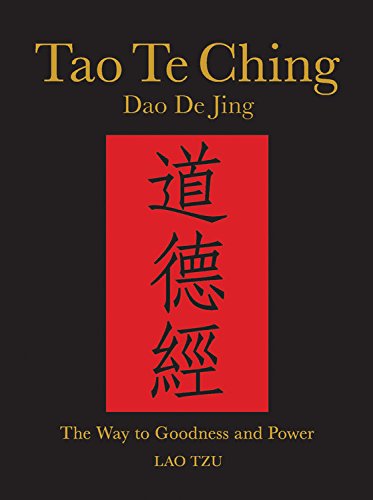
This dual-language edition of Tao Te Ching presents the original Chinese characters with a new translation on the facing page. With a new introduction that discusses the questioned authorship of the text and editorial notes, all 81 brief chapters are included, ranging from advice for politicians to wise words for the everyday person. An important Chinese philosophy that has been popular for hundreds of years is given a new life in this new edition with editorial notes and guides to understanding the depth of the Tao.
Les informations fournies dans la section « Synopsis » peuvent faire référence à une autre édition de ce titre.
Biographie de l'auteur
Chinese philosopher Lao Tzu is considered to be the founder of Taoism. According to legend, he was an imperial archivist for the ruling Chou Dynasty for many years. When he retired, he set out for the northwestern border of China, disillusioned that men were unwilling to follow the path of goodness. When he reached the border, a guard recognized him and refused to let Lao Tzu leave until he wrote down his teachings. These teachings became the Tao Te Ching, which is considered one of the most influential books in Chinese literature and remains one of the most-frequently translated and widely-read books in the world.
Présentation de l'éditeur
Most philosophies and religions borrow traits from earlier schools, and indeed some of China’s most famous – including Confucianism and Buddhism – derive from Taoism, whose most important text is the Tao Te Ching, which hails from around 500 BCE and is attributed to Lao Tzu. Lao Tzu is thought to have been a record-keeper during the Zhou dynasty, and his work is translated by James Legge, a Victorian-era Scotsman who worked closely with Christian missionaries to China. The content of Tao Te Ching imparts advice for people from all walks of life, from royal emperors to the everyman.
Les informations fournies dans la section « A propos du livre » peuvent faire référence à une autre édition de ce titre.
Autres éditions populaires du même titre

Résultats de recherche pour Tao Te Ching: The Way to Goodness and Power

Image d'archives
Tao Te Ching: The Way to Goodness and Power (Chinese Binding)
Edité par
Chartwell Books, 2015
ISBN 10 : 0785833196
ISBN 13 : 9780785833192
Ancien ou d'occasion
Couverture rigide
Vendeur : HPB Inc., Dallas, TX, Etats-Unis
Évaluation du vendeur 5 sur 5 étoiles

hardcover. Etat : Very Good. Connecting readers with great books since 1972! Used books may not include companion materials, and may have some shelf wear or limited writing. We ship orders daily and Customer Service is our top priority! N° de réf. du vendeur S_477184126
Acheter D'occasion
EUR 31,49
Expédition à EUR 3,30
Expédition nationale : Etats-Unis
Expédition nationale : Etats-Unis
Quantité disponible : 1 disponible(s)
Image d'archives
Tao Te Ching: The Way to Goodness and Power (Chinese Binding)
Edité par
Chartwell Books, 2015
ISBN 10 : 0785833196
ISBN 13 : 9780785833192
Ancien ou d'occasion
Couverture rigide
Vendeur : World of Books (was SecondSale), Montgomery, IL, Etats-Unis
Évaluation du vendeur 5 sur 5 étoiles
Etat : Acceptable. Item in acceptable condition! Textbooks may not include supplemental items i.e. CDs, access codes etc. N° de réf. du vendeur 00103373269
Acheter D'occasion
EUR 35,02
Livraison gratuite
Expédition nationale : Etats-Unis
Expédition nationale : Etats-Unis
Quantité disponible : 1 disponible(s)
Image d'archives
Tao Te Ching
Edité par
Chartwell Books/Amber Books Ltd, 2015
ISBN 10 : 0785833196
ISBN 13 : 9780785833192
Ancien ou d'occasion
Couverture rigide
Vendeur : Recycle Bookstore, San Jose, CA, Etats-Unis
Évaluation du vendeur 4 sur 5 étoiles

Leather bound. Etat : Fine. Etat de la jaquette : Near Fine. Specially bound issue in black leather in black slipcase. Book is as new, very clean and very sharp. Slipcase has a few minor smudges but is otherwise looking as new. N° de réf. du vendeur 965948
Acheter D'occasion
EUR 208,21
Expédition à EUR 5,05
Expédition nationale : Etats-Unis
Expédition nationale : Etats-Unis
Quantité disponible : 1 disponible(s)