
Articles liés à Psychopathy: Theory, Research And Implications For...
Psychopathy: Theory, Research And Implications For Society (Nato Science Series D: (Closed)) - Couverture souple
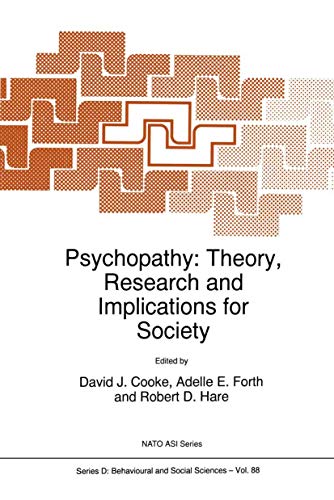
Synopsis
Psychopathy is a very important concept for those working in the field of criminal justice - investigators, prosecutors, and those who have to evaluate, manage and treat offenders. In Psychopathy: Theory, Research and Implications for Society, detailed, empirically based contributions by the world's leading researchers describe the relevance of the construct to practical and policy issues, examining its relevance to such topics as treatment, risk management and recidivism. The use of the concept in a range of populations is discussed, including juveniles, children, and the mentally disordered, as well as across cultures. The major strength of the volume is that the validity of the psychopathy construct is enhanced by the extensive empirical support: contributors explore topics including the genetic, biological, affective, interpersonal and information processing models that underpin the disorder.
Audience: All those dealing with offenders - psychologists, psychiatrists, lawyers, judges, prison administrators and those who formulate policy in the criminal justice system.
Les informations fournies dans la section « Synopsis » peuvent faire référence à une autre édition de ce titre.
Présentation de l'éditeur
Psychopathy is a very important concept for those working in the field of criminal justice - investigators, prosecutors, and those who have to evaluate, manage and treat offenders. In Psychopathy: Theory, Research and Implications for Society, detailed, empirically based contributions by the world's leading researchers describe the relevance of the construct to practical and policy issues, examining its relevance to such topics as treatment, risk management and recidivism. The use of the concept in a range of populations is discussed, including juveniles, children, and the mentally disordered, as well as across cultures. The major strength of the volume is that the validity of the psychopathy construct is enhanced by the extensive empirical support: contributors explore topics including the genetic, biological, affective, interpersonal and information processing models that underpin the disorder.
Audience: All those dealing with offenders - psychologists, psychiatrists, lawyers, judges, prison administrators and those who formulate policy in the criminal justice system.
Les informations fournies dans la section « A propos du livre » peuvent faire référence à une autre édition de ce titre.
Résultats de recherche pour Psychopathy: Theory, Research And Implications For...

Image fournie par le vendeur
Psychopathy: Theory, Research and Implications for Society (NATO Science Series D:, 88)
Edité par
Springer, 1997
ISBN 10 : 0792349202
ISBN 13 : 9780792349204
Ancien ou d'occasion
Couverture souple
Vendeur : -OnTimeBooks-, Phoenix, AZ, Etats-Unis
Évaluation du vendeur 5 sur 5 étoiles

Etat : good. A copy that has been read, remains in good condition. All pages are intact, and the cover is intact. The spine and cover show signs of wear. Pages can include notes and highlighting and show signs of wear, and the copy can include "From the library of" labels or previous owner inscriptions. 100% GUARANTEE! Shipped with delivery confirmation, if you're not satisfied with purchase please return item! Ships via media mail. N° de réf. du vendeur OTV.0792349202.G
Acheter D'occasion
EUR 54,72
Livraison gratuite
Expédition nationale : Etats-Unis
Expédition nationale : Etats-Unis
Quantité disponible : 1 disponible(s)
Image d'archives
Psychopathy : Theory, Research and Implications for Society
Edité par
Springer Netherlands, 1997
ISBN 10 : 0792349202
ISBN 13 : 9780792349204
Ancien ou d'occasion
Couverture souple
Vendeur : Better World Books Ltd, Dunfermline, Royaume-Uni
Évaluation du vendeur 5 sur 5 étoiles
Etat : Very Good. Former library copy. Pages intact with possible writing/highlighting. Binding strong with minor wear. Dust jackets/supplements may not be included. Includes library markings. Stock photo provided. Product includes identifying sticker. Better World Books: Buy Books. Do Good. N° de réf. du vendeur 68063257-20
Acheter D'occasion
EUR 55,68
Expédition à EUR 5,92
Expédition depuis Royaume-Uni vers Etats-Unis
Expédition depuis Royaume-Uni vers Etats-Unis
Quantité disponible : 1 disponible(s)
Image d'archives
Psychopathy: Theory, Research and Implications for Society (NATO Science Series D:, 88)
Edité par
Springer, 1997
ISBN 10 : 0792349202
ISBN 13 : 9780792349204
Ancien ou d'occasion
Couverture souple
Vendeur : Phatpocket Limited, Waltham Abbey, HERTS, Royaume-Uni
Évaluation du vendeur 5 sur 5 étoiles
Etat : Good. Your purchase helps support Sri Lankan Children's Charity 'The Rainbow Centre'. Ex-library, so some stamps and wear, but in good overall condition. Our donations to The Rainbow Centre have helped provide an education and a safe haven to hundreds of children who live in appalling conditions. N° de réf. du vendeur Z1-L-015-02071
Acheter D'occasion
EUR 177,94
Expédition à EUR 12,59
Expédition depuis Royaume-Uni vers Etats-Unis
Expédition depuis Royaume-Uni vers Etats-Unis
Quantité disponible : 5 disponible(s)
Image fournie par le vendeur
Psychopathy
Edité par
Springer Netherlands, 1997
ISBN 10 : 0792349202
ISBN 13 : 9780792349204
Neuf
Kartoniert / Broschiert
Vendeur : moluna, Greven, Allemagne
Évaluation du vendeur 5 sur 5 étoiles
Kartoniert / Broschiert. Etat : New. Dieser Artikel ist ein Print on Demand Artikel und wird nach Ihrer Bestellung fuer Sie gedruckt. Proceedings of the NATO Advanced Study Institute, Alvor, Portugal, 27 November-7 December 1995 Psychopathy is a very important concept for those working in the field of criminal justice - investigators, prosecutors, and those who have to evaluate, ma. N° de réf. du vendeur 5968359
Acheter neuf
EUR 531,25
Expédition à EUR 48,99
Expédition depuis Allemagne vers Etats-Unis
Expédition depuis Allemagne vers Etats-Unis
Quantité disponible : Plus de 20 disponibles
Image fournie par le vendeur
Psychopathy
Edité par
Springer Netherlands Dez 1997, 1997
ISBN 10 : 0792349202
ISBN 13 : 9780792349204
Neuf
Taschenbuch
Vendeur : BuchWeltWeit Ludwig Meier e.K., Bergisch Gladbach, Allemagne
Évaluation du vendeur 5 sur 5 étoiles
Taschenbuch. Etat : Neu. This item is printed on demand - it takes 3-4 days longer - Neuware -Psychopathy is a very important concept for those working in the field of criminal justice - investigators, prosecutors, and those who have to evaluate, manage and treat offenders. In Psychopathy: Theory, Research and Implications for Society, detailed, empirically based contributions by the world's leading researchers describe the relevance of the construct to practical and policy issues, examining its relevance to such topics as treatment, risk management and recidivism. The use of the concept in a range of populations is discussed, including juveniles, children, and the mentally disordered, as well as across cultures. The major strength of the volume is that the validity of the psychopathy construct is enhanced by the extensive empirical support: contributors explore topics including the genetic, biological, affective, interpersonal and information processing models that underpin the disorder. Audience: All those dealing with offenders - psychologists, psychiatrists, lawyers, judges, prison administrators and those who formulate policy in the criminal justice system. 440 pp. Englisch. N° de réf. du vendeur 9780792349204
Acheter neuf
EUR 641,99
Expédition à EUR 23
Expédition depuis Allemagne vers Etats-Unis
Expédition depuis Allemagne vers Etats-Unis
Quantité disponible : 2 disponible(s)
Image fournie par le vendeur
Psychopathy
Edité par
Springer, Springer Dez 1997, 1997
ISBN 10 : 0792349202
ISBN 13 : 9780792349204
Neuf
Taschenbuch
Vendeur : buchversandmimpf2000, Emtmannsberg, BAYE, Allemagne
Évaluation du vendeur 5 sur 5 étoiles
Taschenbuch. Etat : Neu. This item is printed on demand - Print on Demand Titel. Neuware -Psychopathy is a very important concept for those working in the field of criminal justice - investigators, prosecutors, and those who have to evaluate, manage and treat offenders. In Psychopathy: Theory, Research and Implications for Society, detailed, empirically based contributions by the world's leading researchers describe the relevance of the construct to practical and policy issues, examining its relevance to such topics as treatment, risk management and recidivism. The use of the concept in a range of populations is discussed, including juveniles, children, and the mentally disordered, as well as across cultures. The major strength of the volume is that the validity of the psychopathy construct is enhanced by the extensive empirical support: contributors explore topics including the genetic, biological, affective, interpersonal and information processing models that underpin the disorder.Audience: All those dealing with offenders - psychologists, psychiatrists, lawyers, judges, prison administrators and those who formulate policy in the criminal justice system.Springer-Verlag KG, Sachsenplatz 4-6, 1201 Wien 440 pp. Englisch. N° de réf. du vendeur 9780792349204
Acheter neuf
EUR 641,99
Expédition à EUR 60
Expédition depuis Allemagne vers Etats-Unis
Expédition depuis Allemagne vers Etats-Unis
Quantité disponible : 1 disponible(s)
Image d'archives
Psychopathy: Theory, Research and Implications for Society (NATO Science Series D:, 88)
Vendeur : California Books, Miami, FL, Etats-Unis
Évaluation du vendeur 5 sur 5 étoiles
Etat : New. N° de réf. du vendeur I-9780792349204
Acheter neuf
EUR 702,37
Livraison gratuite
Expédition nationale : Etats-Unis
Expédition nationale : Etats-Unis
Quantité disponible : Plus de 20 disponibles
Image d'archives
Psychopathy: Theory, Research and Implications for Society (NATO Science Series D:, 88)
Vendeur : Ria Christie Collections, Uxbridge, Royaume-Uni
Évaluation du vendeur 5 sur 5 étoiles
Etat : New. In English. N° de réf. du vendeur ria9780792349204_new
Acheter neuf
EUR 693,96
Expédition à EUR 13,36
Expédition depuis Royaume-Uni vers Etats-Unis
Expédition depuis Royaume-Uni vers Etats-Unis
Quantité disponible : Plus de 20 disponibles
Image d'archives
Psychopathy
Edité par
Kluwer Academic Publishers, 1997
ISBN 10 : 0792349202
ISBN 13 : 9780792349204
Neuf
Couverture souple
Vendeur : Kennys Bookshop and Art Galleries Ltd., Galway, GY, Irlande
Évaluation du vendeur 5 sur 5 étoiles
Etat : New. Proceedings of the NATO Advanced Study Institute, Alvor, Portugal, 27 November-7 December 1995 Editor(s): Cooke, David J.; etc. Series: NATO Science Series D:. Num Pages: 438 pages, biography. BIC Classification: JM; MMH. Category: (P) Professional & Vocational; (UP) Postgraduate, Research & Scholarly; (UU) Undergraduate. Dimension: 240 x 160 x 23. Weight in Grams: 692. . 1997. Softcover reprint of the original 1st ed. 1998. Paperback. . . . . N° de réf. du vendeur V9780792349204
Acheter neuf
EUR 728,53
Expédition à EUR 9,50
Expédition depuis Irlande vers Etats-Unis
Expédition depuis Irlande vers Etats-Unis
Quantité disponible : 15 disponible(s)
Image fournie par le vendeur
Psychopathy : Theory, Research and Implications for Society
Vendeur : AHA-BUCH GmbH, Einbeck, Allemagne
Évaluation du vendeur 5 sur 5 étoiles
Taschenbuch. Etat : Neu. Druck auf Anfrage Neuware - Printed after ordering - Psychopathy is a very important concept for those working in the field of criminal justice - investigators, prosecutors, and those who have to evaluate, manage and treat offenders. In Psychopathy: Theory, Research and Implications for Society, detailed, empirically based contributions by the world's leading researchers describe the relevance of the construct to practical and policy issues, examining its relevance to such topics as treatment, risk management and recidivism. The use of the concept in a range of populations is discussed, including juveniles, children, and the mentally disordered, as well as across cultures. The major strength of the volume is that the validity of the psychopathy construct is enhanced by the extensive empirical support: contributors explore topics including the genetic, biological, affective, interpersonal and information processing models that underpin the disorder. Audience: All those dealing with offenders - psychologists, psychiatrists, lawyers, judges, prison administrators and those who formulate policy in the criminal justice system. N° de réf. du vendeur 9780792349204
Acheter neuf
EUR 709,40
Expédition à EUR 35
Expédition depuis Allemagne vers Etats-Unis
Expédition depuis Allemagne vers Etats-Unis
Quantité disponible : 1 disponible(s)