
Articles liés à Cross-Talk Noise Immune Vlsi Design Using Regular Layout...
Synopsis
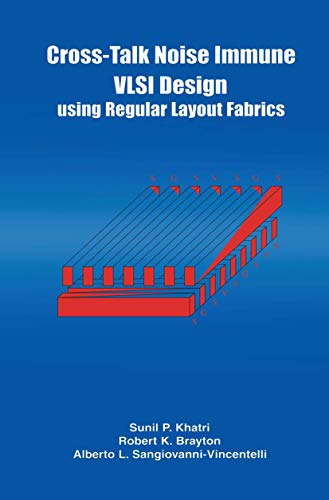
This book was motivated by the problems being faced with shrinking IC process feature sizes. It is well known that as process feature sizes shrink, a host of electrical problems like cross-talk, electromigration, self-heat, etc. are becoming important. Cross-talk is one of the major problems since it results in unpredictable design behavior. In particular, it can result in significant delay variation or signal integrity problems in a wire, depending on the state of its neighboring wires. Typical approaches to tackle the cross-talk problem attempt to fix the problem once it is created. In our approach, we ensure that cross-talk is eliminated by design. The work described in this book attempts to take an "outside-the-box" view and propose a radically different design style. This design style first imposes a fixed layout pattern (or fabric) on the integrated circuit, and then embeds the circuit being implemented into this fabric. The fabric is chosen carefully in order to eliminate the cross-talk problem being faced in modem IC processes. With our choice of fabric, cross-talk between adjacent wires on an IC is reduced by between one and two orders of magnitude. In this way, the fabric concept eliminates cross-talk up-front, and by design. We propose two separate design flows, each of which uses the fabric concept to implement logic. The first flow uses fabric-compliant standard cells as an im- plementation vehicle. We call these cells fabric cells, and they have the same logic functionality as existing standard cells with which they are compared.
Les informations fournies dans la section « Synopsis » peuvent faire référence à une autre édition de ce titre.
Résultats de recherche pour Cross-Talk Noise Immune Vlsi Design Using Regular Layout...

Image d'archives
Cross-Talk Noise Immune VLSI Design Using Regular Layout Fabrics
Edité par
Kluwer Academic Publishers, Boston, 2001
ISBN 10 : 079237407X
ISBN 13 : 9780792374077
Ancien ou d'occasion
Couverture rigide
Vendeur : PsychoBabel & Skoob Books, Didcot, Royaume-Uni
Évaluation du vendeur 5 sur 5 étoiles

hardcover. Etat : Very Good. Etat de la jaquette : No Dust Jacket. Name from previous owner on FEP. No dust jacket. Staining on front cover as though from light spattered paint. Binding otherwise very well preserved, pages are clean and crisp, and printing is tight, clean and bright throughout. MB. Used. N° de réf. du vendeur 248048
Acheter D'occasion
EUR 36,72
Expédition à EUR 14,58
Expédition depuis Royaume-Uni vers Etats-Unis
Expédition depuis Royaume-Uni vers Etats-Unis
Quantité disponible : 1 disponible(s)
Image d'archives
Cross-Talk Noise Immune VLSI Design Using Regular Layout Fabrics
Vendeur : BennettBooksLtd, Los Angeles, CA, Etats-Unis
Évaluation du vendeur 5 sur 5 étoiles
hardcover. Etat : New. In shrink wrap. Looks like an interesting title! N° de réf. du vendeur Q-079237407X
Acheter neuf
EUR 114,68
Expédition à EUR 5,99
Expédition nationale : Etats-Unis
Expédition nationale : Etats-Unis
Quantité disponible : 1 disponible(s)
Image d'archives
Cross-Talk Noise Immune VLSI Design Using Regular Layout Fabrics
Vendeur : Ria Christie Collections, Uxbridge, Royaume-Uni
Évaluation du vendeur 5 sur 5 étoiles
Etat : New. In. N° de réf. du vendeur ria9780792374077_new
Acheter neuf
EUR 116,37
Expédition à EUR 13,17
Expédition depuis Royaume-Uni vers Etats-Unis
Expédition depuis Royaume-Uni vers Etats-Unis
Quantité disponible : Plus de 20 disponibles
Image fournie par le vendeur
Cross-Talk Noise Immune VLSI Design Using Regular Layout Fabrics
Edité par
Springer US Jun 2001, 2001
ISBN 10 : 079237407X
ISBN 13 : 9780792374077
Neuf
Couverture rigide
Vendeur : BuchWeltWeit Ludwig Meier e.K., Bergisch Gladbach, Allemagne
Évaluation du vendeur 5 sur 5 étoiles
Buch. Etat : Neu. This item is printed on demand - it takes 3-4 days longer - Neuware -This book was motivated by the problems being faced with shrinking IC process feature sizes. It is well known that as process feature sizes shrink, a host of electrical problems like cross-talk, electromigration, self-heat, etc. are becoming important. Cross-talk is one of the major problems since it results in unpredictable design behavior. In particular, it can result in significant delay variation or signal integrity problems in a wire, depending on the state of its neighboring wires. Typical approaches to tackle the cross-talk problem attempt to fix the problem once it is created. In our approach, we ensure that cross-talk is eliminated by design. The work described in this book attempts to take an 'outside-the-box' view and propose a radically different design style. This design style first imposes a fixed layout pattern (or fabric) on the integrated circuit, and then embeds the circuit being implemented into this fabric. The fabric is chosen carefully in order to eliminate the cross-talk problem being faced in modem IC processes. With our choice of fabric, cross-talk between adjacent wires on an IC is reduced by between one and two orders of magnitude. In this way, the fabric concept eliminates cross-talk up-front, and by design. We propose two separate design flows, each of which uses the fabric concept to implement logic. The first flow uses fabric-compliant standard cells as an im plementation vehicle. We call these cells fabric cells, and they have the same logic functionality as existing standard cells with which they are compared. 140 pp. Englisch. N° de réf. du vendeur 9780792374077
Acheter neuf
EUR 106,99
Expédition à EUR 23
Expédition depuis Allemagne vers Etats-Unis
Expédition depuis Allemagne vers Etats-Unis
Quantité disponible : 2 disponible(s)
Image fournie par le vendeur
Cross-Talk Noise Immune VLSI Design Using Regular Layout Fabrics
impression à la demandeVendeur : moluna, Greven, Allemagne
Évaluation du vendeur 5 sur 5 étoiles
Gebunden. Etat : New. Dieser Artikel ist ein Print on Demand Artikel und wird nach Ihrer Bestellung fuer Sie gedruckt. This book was motivated by the problems being faced with shrinking IC process feature sizes. It is well known that as process feature sizes shrink, a host of electrical problems like cross-talk, electromigration, self-heat, etc. are becoming important. Cros. N° de réf. du vendeur 5970138
Acheter neuf
EUR 92,27
Expédition à EUR 48,99
Expédition depuis Allemagne vers Etats-Unis
Expédition depuis Allemagne vers Etats-Unis
Quantité disponible : Plus de 20 disponibles
Image d'archives
Cross-talk Noise Immune VLSI Design Using Regular Layout Fabrics
Edité par
Kluwer Academic Publishers, 2001
ISBN 10 : 079237407X
ISBN 13 : 9780792374077
Neuf
Couverture rigide
Vendeur : Kennys Bookshop and Art Galleries Ltd., Galway, GY, Irlande
Évaluation du vendeur 5 sur 5 étoiles
Etat : New. Cross-talk is one of the major problems since it results in unpredictable design behavior. It can result in delay variation or signal integrity problems in a wire, depending on the state of its neighboring wire. This book introduces a framework for cross-talk-free IC design. It uses a predetermined layout pattern on the IC. Num Pages: 112 pages, biography. BIC Classification: TJF; UY. Category: (UP) Postgraduate, Research & Scholarly. Dimension: 234 x 156 x 9. Weight in Grams: 830. . 2001. Hardback. . . . . N° de réf. du vendeur V9780792374077
Acheter neuf
EUR 131,97
Expédition à EUR 9,50
Expédition depuis Irlande vers Etats-Unis
Expédition depuis Irlande vers Etats-Unis
Quantité disponible : 15 disponible(s)
Image fournie par le vendeur
Cross-Talk Noise Immune VLSI Design Using Regular Layout Fabrics
Edité par
Springer US, 2001
ISBN 10 : 079237407X
ISBN 13 : 9780792374077
Ancien ou d'occasion
Couverture rigide
Vendeur : Buchpark, Trebbin, Allemagne
Évaluation du vendeur 5 sur 5 étoiles
Etat : Gut. Zustand: Gut | Sprache: Englisch | Produktart: Bücher | This book was motivated by the problems being faced with shrinking IC process feature sizes. It is well known that as process feature sizes shrink, a host of electrical problems like cross-talk, electromigration, self-heat, etc. are becoming important. Cross-talk is one of the major problems since it results in unpredictable design behavior. In particular, it can result in significant delay variation or signal integrity problems in a wire, depending on the state of its neighboring wires. Typical approaches to tackle the cross-talk problem attempt to fix the problem once it is created. In our approach, we ensure that cross-talk is eliminated by design. The work described in this book attempts to take an "outside-the-box" view and propose a radically different design style. This design style first imposes a fixed layout pattern (or fabric) on the integrated circuit, and then embeds the circuit being implemented into this fabric. The fabric is chosen carefully in order to eliminate the cross-talk problem being faced in modem IC processes. With our choice of fabric, cross-talk between adjacent wires on an IC is reduced by between one and two orders of magnitude. In this way, the fabric concept eliminates cross-talk up-front, and by design. We propose two separate design flows, each of which uses the fabric concept to implement logic. The first flow uses fabric-compliant standard cells as an im plementation vehicle. We call these cells fabric cells, and they have the same logic functionality as existing standard cells with which they are compared. N° de réf. du vendeur 1432219/3
Acheter D'occasion
EUR 39,88
Expédition à EUR 105
Expédition depuis Allemagne vers Etats-Unis
Expédition depuis Allemagne vers Etats-Unis
Quantité disponible : 2 disponible(s)
Image d'archives
Cross-Talk Noise Immune VLSI Design Using Regular Layout Fabrics
Vendeur : Books Puddle, New York, NY, Etats-Unis
Évaluation du vendeur 4 sur 5 étoiles

Etat : New. pp. 140. N° de réf. du vendeur 263065432
Acheter neuf
EUR 144,21
Expédition à EUR 3,44
Expédition nationale : Etats-Unis
Expédition nationale : Etats-Unis
Quantité disponible : 4 disponible(s)
Image d'archives
Cross-Talk Noise Immune VLSI Design Using Regular Layout Fabrics
impression à la demandeVendeur : Majestic Books, Hounslow, Royaume-Uni
Évaluation du vendeur 4 sur 5 étoiles
Etat : New. Print on Demand pp. 140 Illus. N° de réf. du vendeur 5863815
Acheter neuf
EUR 147,64
Expédition à EUR 7,58
Expédition depuis Royaume-Uni vers Etats-Unis
Expédition depuis Royaume-Uni vers Etats-Unis
Quantité disponible : 4 disponible(s)
Image d'archives
Cross-Talk Noise Immune VLSI Design Using Regular Layout Fabrics
impression à la demandeVendeur : Biblios, Frankfurt am main, HESSE, Allemagne
Évaluation du vendeur 4 sur 5 étoiles
Etat : New. PRINT ON DEMAND pp. 140. N° de réf. du vendeur 183065426
Acheter neuf
EUR 150,70
Expédition à EUR 9,95
Expédition depuis Allemagne vers Etats-Unis
Expédition depuis Allemagne vers Etats-Unis
Quantité disponible : 4 disponible(s)