
Articles liés à Psychoanalysis and the Postmodern Impulse: Knowing...
Psychoanalysis and the Postmodern Impulse: Knowing and Being Since Freud's Psychology - Couverture rigide
Livre 1 sur 8: Routledge Library Editions: Psychoanalysis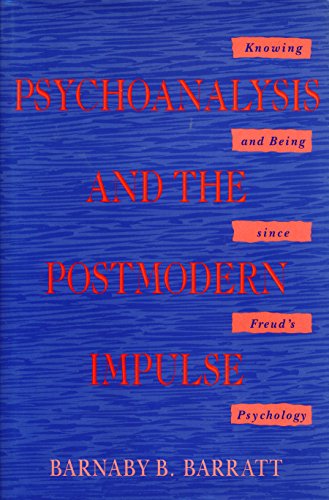
Synopsis
According to Barratt, psychoanalytic theory and practice - which discloses "the interminable falsity of the human subject's belief in the mastery of its own mental life" - is in part responsible for the coming of the postmodern era. In this book, Barratt examines the role of psychoanalysis in what he sees as the crisis of modernism, shows why the modernist position - what he calls the "modern episteme" - is failing, and proposes that psychoanalysis should redefine itself as a postmodern method. In Barratt's account of psychoanalysis, which focuses on the significance of the free-associative process, Freud's discovery of the repressed unconscious leads to a claim that is basic to postmodern ideas: "that all thinking and speaking, the production and reproduction of psychic reality, is inherantly dynamic, polysemous and contradictorious". He argues that subsequent attempts to "normalize and systemize" psychanalysis are reactionary and antipsychoanalytic efforts to salvage the modern epistome that psychoanalysis itself calls into question.
Les informations fournies dans la section « Synopsis » peuvent faire référence à une autre édition de ce titre.
Résultats de recherche pour Psychoanalysis and the Postmodern Impulse: Knowing...

Image d'archives
Psychoanalysis and the Postmodern Impulse : Knowing and Being since Freud's Psychology
Edité par
Johns Hopkins University Press, 1993
ISBN 10 : 0801845475
ISBN 13 : 9780801845475
Ancien ou d'occasion
Couverture rigide
Vendeur : Better World Books: West, Reno, NV, Etats-Unis
Évaluation du vendeur 5 sur 5 étoiles

Etat : Good. y First printing. Pages intact with minimal writing/highlighting. The binding may be loose and creased. Dust jackets/supplements are not included. Stock photo provided. Product includes identifying sticker. Better World Books: Buy Books. Do Good. N° de réf. du vendeur 57908941-75
Acheter D'occasion
EUR 34,33
Livraison gratuite
Expédition nationale : Etats-Unis
Expédition nationale : Etats-Unis
Quantité disponible : 1 disponible(s)
Image fournie par le vendeur
Psychoanalysis and the Postmodern Impulse: Knowing and Being since Freud's Psychology
Edité par
The Johns Hopkins University Press, 1993
ISBN 10 : 0801845475
ISBN 13 : 9780801845475
Ancien ou d'occasion
Couverture rigide
Vendeur : -OnTimeBooks-, Phoenix, AZ, Etats-Unis
Évaluation du vendeur 5 sur 5 étoiles
Etat : good. A copy that has been read, remains in good condition. All pages are intact, and the cover is intact. The spine and cover show signs of wear. Pages can include notes and highlighting and show signs of wear, and the copy can include "From the library of" labels or previous owner inscriptions. 100% GUARANTEE! Shipped with delivery confirmation, if you're not satisfied with purchase please return item! Ships via media mail. N° de réf. du vendeur OTV.0801845475.G
Acheter D'occasion
EUR 37,95
Livraison gratuite
Expédition nationale : Etats-Unis
Expédition nationale : Etats-Unis
Quantité disponible : 1 disponible(s)
Image fournie par le vendeur
Psychoanalysis and the Postmodern Impulse: Knowing and Being Since Freud's Psychology
Edité par
Johns Hopkins University Press, 1993
ISBN 10 : 0801845475
ISBN 13 : 9780801845475
Ancien ou d'occasion
Couverture rigide
Vendeur : crealivres, La fontennelle, France
Évaluation du vendeur 5 sur 5 étoiles
Etat : Very Good. Envoi rapide Très Bon Etat de conservation intérieur propre bonne tenue. 16 256x2 54x23 114cm. 1993. Cartonné jaquette. 272 pages. Very Good. N° de réf. du vendeur 100137963
Acheter D'occasion
EUR 103
Expédition à EUR 14
Expédition depuis France vers Etats-Unis
Expédition depuis France vers Etats-Unis
Quantité disponible : 1 disponible(s)
Image d'archives
Psychoanalysis and the Postmodern Impulse: Knowing and Being since Freud's Psychology
Edité par
The Johns Hopkins University Press, 1993
ISBN 10 : 0801845475
ISBN 13 : 9780801845475
Ancien ou d'occasion
Couverture rigide
Vendeur : The Book Spot, Sioux Falls, MN, Etats-Unis
Évaluation du vendeur 4 sur 5 étoiles

Hardcover. N° de réf. du vendeur Abebooks196490
Acheter D'occasion
EUR 274,95
Livraison gratuite
Expédition nationale : Etats-Unis
Expédition nationale : Etats-Unis
Quantité disponible : 1 disponible(s)