
Articles liés à Salt: A World History
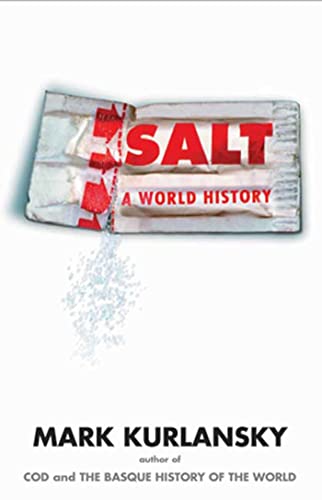
Synopsis
Book by Kurlansky Mark
Les informations fournies dans la section « Synopsis » peuvent faire référence à une autre édition de ce titre.
Extrait
Once I stood on the bank of a rice paddy in rural Sichuan Province, and a lean and aging Chinese peasant, wearing a faded forty-year-old blue jacket issued by the Mao government in the early years of the Revolution, stood knee deep in water and apropos of absolutely nothing shouted defiantly at me, "We Chinese invented many things!"
The Chinese are proud of their inventions. All Chinese leaders, including Mao Zedong, sooner or later give a speech listing the many Chinese firsts. Though rural China these days seems in need of a new round of inventions, it is irrefutably true that the Chinese originated many of the pivotal creations of history, including papermaking, printing, gunpowder, and the compass.
China is the oldest literate society still in existence, and its 4,000 years of written history begin as a history of inventions. It is no longer clear when legends were made into men and when living historic figures were turned into legends. Chinese history starts in the same manner as Old Testament history. In the Book of Genesis, first come the legends, the story of the Creation, mythical figures such as Adam and Eve and Noah, generations of people who may or may not have lived, and gradually the generations are followed to Abraham, the beginning of documented Hebrew history.
In Chinese history, first was Pangu, the creator, who made humans from parasites on his body. He died but was followed by wise rulers, who invented the things that made China the first civilization.Fuxi was first to domesticate animals. Apparently an enthusiast for domesticity, he is also credited with inventing marriage. Next came Shennong, who invented medicine, agriculture, and trade. He is credited with the plow and the hoe. Then came Huangdi, the Yellow Emperor, who invented writing, the bow and arrow, the cart, and ceramics. Several centuries after Huangdi came Emperor Yao, a wise ruler who passed over his unqualified son and named a modest sage, Shun, his successor. Shun chose his minister, Yu, to succeed him. In 2205 B.C., according to tradition, Yu founded the Xia dynasty, and this dynasty, which lasted until 1766 B.C., enters into documented history.
Chinese salt history begins with the mythical Huangdi, who invented writing, weaponry, and transportation. According to the legends, he also had the distinction of presiding over the first war ever fought over salt.
One of the earliest verifiable saltworks in prehistoric China was in the northern province of Shanxi. In this arid region of dry yellow earth and desert mountains is a lake of salty water, Lake Yuncheng. This area was known for constant warfare, and all of the wars were over control of the lake. Chinese historians are certain that by 6000 B.C., each year, when the lake's waters evaporated in the summer sun, people harvested the square crystals on the surface of the water, a system the Chinese referred to as "dragging and gathering." Human bones found around the lake have been dated much earlier, and some historians speculate that these inhabitants may also have gathered salt from the lake.
The earliest written record of salt production in China dates to around 800 B.C. and tells of production and trade of sea salt a millennium before, during the Xia dynasty. It is not known if the techniques described in this account were actually used during the Xia dynasty, but they were considered old ways by the time of this account, which describes putting ocean water in clay vessels and boiling it until reduced to pots of salt crystals. This was the technique that was spread through southern Europe by the Roman Empire, 1,000 years after the Chinese account was written.
About 1000 B.C., iron first came into use in China, though the first evidence of it being used in salt making is not until 450 B.C. by a man named Yi Dun. According to a passage written in 129 B.C., "Yi Dun rose to prominence by producing salt in pans." Yi Dun is believed to have made salt by boiling brine in iron pans, an innovation which would become one of the leading techniques for salt making for the next 2,000 years. The legend says that he worked with an ironmaster named Guo Zong and was also friendly with an enterprising wealthy bureaucrat named Fan Li. Fan Li is credited with inventing fish farming, which for centuries after was associated with salt-producing areas. The Chinese, like later Europeans, saw that salt and fish were partners. Many Chinese, including Mencius, the famous Confucian thinker who lived from 372 to 289 B.C., were said to have worked selling both fish and salt.
Throughout the long history of China, sprinkling salt directly on food has been a rarity. Usually it has been added during cooking by means of various condiments—salt-based sauces and pastes. The usual explanation is that salt was expensive and it was stretched by these condiments. A recurring idea throughout the ancient world from the Mediterranean to Southeast Asia, fish fermented in salt was one of the most popular salt condiments in ancient China. It was called jiang. But in China soybeans were added to ferment with the fish, and in time the fish was dropped altogether from the recipe and jiang became jiangyou, or, as it is called in the West, soy sauce.
Soy is a legume that produces beans, two or three in a two-inch-long furry pod. The beans can be yellow, green, brown, purple, black, or spotted, and Chinese cooking makes a great distinction among these varieties. Jiangyou is made from yellow beans, but other types are also fermented with salt to produce different pastes and condiments. In China, the earliest written mention of soy is in the sixth century B.C., describing the plant as a 700-year-old crop from the north. Soy was brought to Japan from China in the sixth century A.D. by Chinese Buddhist missionaries. Both the religion and the bean were successfully implanted. But the Japanese did not make soy sauce until the tenth century. Once they did learn, they called it shoyu and industrialized it and sold it around the world.
Though jiangyou and shoyu are pronounced very differently and appear to be very different words in Western writing, the two words are written with the same character in Japanese and Chinese. Mao's 1950s literacy campaign simplified the language to some 40,000 characters, but a pre-Mao character for the soy plant, su, depicts little roots at the bottom which revive the soil. Soy puts nutrients back into the soil and can restore fields that have been exhausted by other crops. The bean is so nutritious that a person could be sustained for a considerable period on nothing but water, soy, and salt.
The process by which the Chinese, and later the Japanese, fermented beans in earthen pots is today known as lactic acid fermentation, or, in more common jargon, pickling. Optimum lactic fermentation takes place between sixty-four and seventy-one degrees Fahrenheit, which in most of the world is an easily achieved environment.
As vegetables begin to rot, the sugars break down and produce lactic acid, which serves as a preservative. Theoretically, pickling can be accomplished without salt, but the carbohydrates and proteins in the vegetables tend to putrefy too quickly to be saved by the emerging lactic acid. Without salt, yeast forms, and the fermentation process leads to alcohol rather than pickles.
Between .8 and 1.5 percent of the vegetable's weight in salt holds off the rotting process until the lactic acid can take over. Excluding oxygen, either by sealing the jar or, more usually, by weighting the vegetables so that they remain immersed in liquid, is necessary for successful lactic fermentation.
The ancient Chinese pickled in earthen jars, which caused a white film called kahm yeast, harmless but unpleasant tasting, to form on the top. Every two weeks the cloth, board, and stone weighting the vegetables had to be washed or even boiled to remove the film. This added work is why pickling in earthen jars has not remained popular.
In Sichuan, pickled vegetables are still a staple. They are served with rice, which is never salted. The salty vegetables contrast pleasantly with the blandness of the warm but unseasoned rice gruel that is a common breakfast food. In effect, the pickles are salting the rice.
South of the Sichuan capital of Chengdu, lies Zigong, a hilly provincial salt town that grew into a city because of its preponderance of brine wells. The crowded, narrow, downhill open-air market in the center of town continues to sell salt and special pickling jars for the two local specialties, paocai and zhacai. A woman at the market who sold the glass pickling jars offered this recipe for paocai:
The spices added are usually hot red Sichuan peppers or ginger, a perennial herb of Indian origin, known to the Chinese since ancient times. The red pepper, today a central ingredient of Sichuan cooking, did not arrive until the sixteenth century, carried to Europe by Columbus, to India by the Portuguese, and to China by either the Indians, Portuguese, Andalusians, or Basques.
Paocai that is eaten in two days is obviously more about flavor than preserving. After two days the vegetables are still very crisp, and the salt maintains, even brightens, the color. Zhacai is made with salt instead of brine, alternating layers of vegetables with layers of salt crystals. In time a brine is formed from the juices the salt pulls out of the vegetables. When a peasant has a baby girl, the family puts up a vegetable every year and gives the jars to her when she's married. This shows how long zhacai is kept before eating. The original medieval idea was to marry her after twelve or fifteen jars. Today it usually takes a few more vegetables.
The Chinese also solved the delicate problem of transporting eggs by preserving them in salt. They soaked the eggs, and still do, in brine for more than a month, or they soak them for a shorter time and encase them in salted mud and straw. The resulting egg, of a hard-boiled consistency with a bright orange yolk, will neither break nor spoil if properly handled. A more complicated technique, involving salt, ash, lye, and tea, produces the "1,000-year-old egg." Typical of the Chinese love of poetic hyperbole, 1,000-year-old eggs take about 100 days to make, and will keep for another 100 days, though the yolk is then a bit green and the smell is strong.
In 250 B.C., the time of the Punic Wars in the Mediterranean, the governor of Shu, today the province of Sichuan, was a man named Li Bing. The governor was one of the greatest hydraulic engineering geniuses of all time.
The coincidence of hydraulic engineering skills and political leadership does not seem strange when it is remembered that water management was one of the critical issues in developing China, a land of droughts and floods.
The Yellow River, named for the yellowish silt it rushes through northern China, was known as "the father of floods." It and the Yangtze are the two great rivers of Chinese history, both originating in the Tibetan plateau and winding toward the sea on the east coast of China. The Yellow runs through arid northern regions and tends to silt up, raising the riverbed, which causes flooding unless dikes are built up around its banks. The Yangtze is a wider river with many navigable tributaries. It flows through the green and rainy center of China, bisecting the world's third largest country, from the Tibetan mountains to Shanghai on the East China Sea.
The rule of the wise Emperor Yao is said to have been a golden age of ancient China, and one reason for this was that Emperor Yao had tamed nature by introducing the concept of flood control. Li Bing has taken on some of the mythic dimensions of Yao, a god who conquered floods and tamed nature. But unlike the mythical Emperor Yao, Li Bing's existence is well documented. His most extraordinary accomplishment was the building of the first dam, which still functions in modernized form. At a place called Dujiangyan, he divided the Minjiang River, a tributary of the Yangtze. The diverted water goes into a series of spillways and channels that can be opened to irrigate in times of droughts and closed in times of flooding. He had three stone figures of men placed in the water as gauges. If their feet were visible, this signaled drought conditions and the dam's gates were opened to let in water. If their shoulders were submerged, floodwaters had risen too high and the dam's gates were closed.
Because of the Dujiangyan dam system, the plains of eastern Sichuan became an affluent agricultural center of China. Ancient records called the area "Land of Abundance." With the dam still operating, the Sichuan plains remain an agricultural center today.
In 1974, two water gauges, carved in A.D. 168, were found in the riverbed by the site of Li Bing's dam. They seem to have been replacements for the original water gauge statues. One of them is the oldest Chinese stone figure ever found of an identifiable individual. It is a statue of Li Bing. The original gauges he had used depicted gods of flood control. Four centuries after his death, he was considered to be one of these gods.
Li Bing made a very simple but pivotal discovery. By his time, Sichuan had long been a salt-producing area. Salt is known to have been made in Sichuan as early as 3000 B.C. But it was Li Bing who found that the natural brine, from which the salt was made, did not originate in the pools where it was found but seeped up from underground. In 252 B.C., he ordered the drilling of the world's first brine wells.
These first wells had wide mouths, more like an open pit, though some went deeper than 300 feet. As the Chinese learned how to drill, the shafts got narrower and the wells deeper.
But sometimes the people who dug the wells would inexplicably become weak, get sick, lie down, and die. Occasionally, a tremendous explosion would kill an entire crew or flames spit out from the bore holes. Gradually, the salt workers and their communities realized that an evil spirit from some underworld was rising up through the holes they were digging. By 68 B.C., two wells, one in Sichuan and one in neighboring Shaanxi, became infamous as sites where the evil spirit emerged. Once a year the governors of the respective provinces would visit these wells and make offerings.
By A.D. 100, the well workers, understanding that the disturbances were caused by an invisible substance, found the holes where it came out of the ground, lit them, and started placing pots close by. They could cook with it. Soon they learned to insulate bamboo tubes with mud and brine and pipe the invisible force to boiling houses. These boiling houses were open sheds where pots of brine cooked until the water evaporated and left salt crystals. By A.D. 200, the boiling houses had iron pots heated by gas flames. This is the first known use of natural gas in the world.
Salt makers learned to drill and shore up a narrow shaft, which allowed them to go deeper. They extracted the brine by means of a long bamboo tube which fit down ...
Présentation de l'éditeur
From the award-winning and bestselling author of Cod comes the dramatic, human story of a simple substance, an element almost as vital as water, that has created fortunes, provoked revolutions, directed economies and enlivened our recipes.
Salt is common, easy to obtain and inexpensive. It is the stuff of kitchens and cooking. Yet trade routes were established, alliances built and empires secured – all for something that filled the oceans, bubbled up from springs, formed crusts in lake beds, and thickly veined a large part of the Earth’s rock fairly close to the surface. From pre-history until just a century ago – when the mysteries of salt were revealed by modern chemistry and geology – no one knew that salt was virtually everywhere. Accordingly, it was one of the most sought-after commodities in human history. Even today, salt is a major industry. Canada, Kurlansky tells us, is the world’s sixth largest salt producer, with salt works in Ontario playing a major role in satisfying the Americans’ insatiable demand.
As he did in his highly acclaimed Cod, Mark Kurlansky once again illuminates the big picture by focusing on one seemingly modest detail. In the process, the world is revealed as never before.
From the Hardcover edition.
Les informations fournies dans la section « A propos du livre » peuvent faire référence à une autre édition de ce titre.
Résultats de recherche pour Salt: A World History

Image d'archives
Salt: A World History
Edité par
Walker Books, 2002
ISBN 10 : 0802713734
ISBN 13 : 9780802713735
Ancien ou d'occasion
Couverture rigide
Vendeur : ThriftBooks-Dallas, Dallas, TX, Etats-Unis
Évaluation du vendeur 5 sur 5 étoiles

Hardcover. Etat : Fair. No Jacket. Former library book; Readable copy. Pages may have considerable notes/highlighting. ~ ThriftBooks: Read More, Spend Less. N° de réf. du vendeur G0802713734I5N10
Acheter D'occasion
EUR 8,96
Livraison gratuite
Expédition nationale : Etats-Unis
Expédition nationale : Etats-Unis
Quantité disponible : 1 disponible(s)
Image d'archives
Salt: A World History
Edité par
Walker Books, 2002
ISBN 10 : 0802713734
ISBN 13 : 9780802713735
Ancien ou d'occasion
Couverture rigide
Vendeur : ThriftBooks-Atlanta, AUSTELL, GA, Etats-Unis
Évaluation du vendeur 5 sur 5 étoiles
Hardcover. Etat : Very Good. No Jacket. May have limited writing in cover pages. Pages are unmarked. ~ ThriftBooks: Read More, Spend Less. N° de réf. du vendeur G0802713734I4N00
Acheter D'occasion
EUR 8,96
Livraison gratuite
Expédition nationale : Etats-Unis
Expédition nationale : Etats-Unis
Quantité disponible : 1 disponible(s)
Image d'archives
Salt: A World History
Edité par
Walker Books, 2002
ISBN 10 : 0802713734
ISBN 13 : 9780802713735
Ancien ou d'occasion
Couverture rigide
Vendeur : HPB-Ruby, Dallas, TX, Etats-Unis
Évaluation du vendeur 5 sur 5 étoiles
Hardcover. Etat : Very Good. Connecting readers with great books since 1972! Used books may not include companion materials, and may have some shelf wear or limited writing. We ship orders daily and Customer Service is our top priority! N° de réf. du vendeur S_484595545
Acheter D'occasion
EUR 8,98
Expédition à EUR 3,27
Expédition nationale : Etats-Unis
Expédition nationale : Etats-Unis
Quantité disponible : 1 disponible(s)
Image d'archives
Salt: A World History
Edité par
Walker Books, 2002
ISBN 10 : 0802713734
ISBN 13 : 9780802713735
Ancien ou d'occasion
Couverture rigide
Vendeur : HPB-Emerald, Dallas, TX, Etats-Unis
Évaluation du vendeur 5 sur 5 étoiles
Hardcover. Etat : Very Good. Connecting readers with great books since 1972! Used books may not include companion materials, and may have some shelf wear or limited writing. We ship orders daily and Customer Service is our top priority! N° de réf. du vendeur S_481626190
Acheter D'occasion
EUR 8,98
Expédition à EUR 3,27
Expédition nationale : Etats-Unis
Expédition nationale : Etats-Unis
Quantité disponible : 1 disponible(s)
Image d'archives
Salt : A World History
Edité par
Walker Books, 2002
ISBN 10 : 0802713734
ISBN 13 : 9780802713735
Ancien ou d'occasion
Couverture rigide
Vendeur : Better World Books, Mishawaka, IN, Etats-Unis
Évaluation du vendeur 5 sur 5 étoiles
Etat : Good. Pages intact with minimal writing/highlighting. The binding may be loose and creased. Dust jackets/supplements are not included. Stock photo provided. Product includes identifying sticker. Better World Books: Buy Books. Do Good. N° de réf. du vendeur 4227932-6
Acheter D'occasion
EUR 12,98
Livraison gratuite
Expédition nationale : Etats-Unis
Expédition nationale : Etats-Unis
Quantité disponible : 1 disponible(s)
Image d'archives
Salt: A World History
Edité par
Walker Books, 2002
ISBN 10 : 0802713734
ISBN 13 : 9780802713735
Ancien ou d'occasion
Couverture rigide
Vendeur : My Dead Aunt's Books, Hyattsville, MD, Etats-Unis
Évaluation du vendeur 5 sur 5 étoiles
hardcover. Etat : Good. First printing. Unmarked hardcover in unclipped jacket. Walker and Company 2002. Full number line. Small discoloration at top rear of jacket. N° de réf. du vendeur 70832H
Acheter D'occasion
EUR 8,97
Expédition à EUR 4,79
Expédition nationale : Etats-Unis
Expédition nationale : Etats-Unis
Quantité disponible : 1 disponible(s)
Image d'archives
Salt: A World History
Edité par
Walker & Co, 2001
ISBN 10 : 0802713734
ISBN 13 : 9780802713735
Ancien ou d'occasion
Couverture rigide
Vendeur : Indianabookbuyer, Bloomington, IN, Etats-Unis
Évaluation du vendeur 5 sur 5 étoiles
Hardcover. Etat : Very Good. Etat de la jaquette : Near Fine. hardcover, fine DJ, , clean, unmarked pages, good binding, N° de réf. du vendeur A1341 03152025
Acheter D'occasion
EUR 16,74
Expédition à EUR 5,01
Expédition nationale : Etats-Unis
Expédition nationale : Etats-Unis
Quantité disponible : 1 disponible(s)
Image d'archives
Salt; A World History
Edité par
Walker Books, E-033, 2002
ISBN 10 : 0802713734
ISBN 13 : 9780802713735
Ancien ou d'occasion
Couverture rigide
Vendeur : Last Exit Books, Charlottesville, VA, Etats-Unis
Évaluation du vendeur 4 sur 5 étoiles

Hardcover. 8vo. Published by Walker & Co, New York, 2001. 484 pgs. Signed by Mark Kurlansky on the title page. First Edition/First Printing. DJ has light shelf-wear present to the DJ extremities. Bound in cloth boards with titles present to the spine. Boards have light shelf-wear present to the extremities (UPC code tipped to the rear board). No ownership marks present. Text is clean and free of marks. Binding tight and solid. Best-selling author Mark Kurlansky turns his attention to a common household item with a long and intriguing history: salt. The only rock we eat, salt has shaped civilization from the very beginning, and its story is a glittering, often surprising part of the history of humankind. A substance so valuable it served as currency, salt has influenced the establishment of trade routes and cities, provoked and financed wars, secured empires, and inspired revolutions. Populated by colorful characters and filled with an unending series of fascinating details, Salt is a supremely entertaining, multi-layered masterpiece.; 8vo 8" - 9" tall. N° de réf. du vendeur 74442
Acheter D'occasion
EUR 44,82
Expédition à EUR 6,09
Expédition nationale : Etats-Unis
Expédition nationale : Etats-Unis
Quantité disponible : 1 disponible(s)
Image d'archives
Salt: A World History
Edité par
Walker & Co, New York, 2001
ISBN 10 : 0802713734
ISBN 13 : 9780802713735
Ancien ou d'occasion
Soft cover
Vendeur : Bookplate, Chestertown, MD, Etats-Unis
Évaluation du vendeur 4 sur 5 étoiles
Soft cover. Etat : As New. Advanced Reading Copy from the uncorrected manuscript. Sixty pages total, not the entire ARC/Book. Signed to the title page by the author. Rare. TM/ARC/Galleys. N° de réf. du vendeur ABE-1770948424651
Acheter D'occasion
EUR 44,87
Expédition à EUR 7,41
Expédition nationale : Etats-Unis
Expédition nationale : Etats-Unis
Quantité disponible : 1 disponible(s)
Image fournie par le vendeur
Salt: A World History
Edité par
Walker and Company, 2002
ISBN 10 : 0802713734
ISBN 13 : 9780802713735
Ancien ou d'occasion
Couverture rigide
Vendeur : The Anthropologists Closet, West Des Moines, IA, Etats-Unis
Évaluation du vendeur 5 sur 5 étoiles
Hardcover. Etat : Like New. Etat de la jaquette : Like New. Like new hardcover in a like new dust jacket. Previous owners same on the front cover paste down hidden behind the book flap. 8vo. (6.12 x 1.5 x 9.25 inches) Clean text free of marks or underlining. Includes bibliography and an index. 484 pp. Fast shipping in a secure book box mailer with tracking. Homer called salt a divine substance. Plato described it as especially dear to the gods. Today we take it for granted; however, as Mark Kurlansky so brilliantly relates in this world-encompassing book, salt-the only rock we eat-has shaped civilization from the very beginning. Its story is a glittering, often surprising part of the history of humankind. Until about 100 years ago, when modern geology revealed how prevalent it is, salt was one of the most sought-after commodities, for without it humans and animals could not live. Salt has often been considered so valuable that it served as currency, and it is still exchanged as such in places today. Demand for salt established the earliest trade routes, across unknown oceans and the remotest of deserts: the city of Jericho was founded almost 10,000 years ago as a salt trading center. Because of its worth, salt has provoked and financed wars; it was, as well, a strategic element in the American Revolution and the Civil War, among other conflicts. Salt taxes secured empires across Europe and Asia and have also inspired revolution (Gandhi's salt march in 1930 began the overthrow of British rule in India); indeed, salt has been central to the age-old debate about the rights of government to tax and control economies. The story of salt encompasses fields as disparate as engineer-ing, religion, and food, all of which Kurlansky richly explores. Few endeavors have inspired more ingenuity than salt making, from the natural gas furnaces of ancient China to the drilling techniques that led to the age of petroleum, and salt revenues have funded some of the greatest public works in history, including the Erie Canal and the Great Wall of China. Salt's ability to preserve and to sustain life has made it a metaphorical symbol in all religions. Just as significantly, salt has shaped the history of foods like cheese, sauerkraut, olives mal more, and Kurlansky conveys, in his saga and through forty historic recipes how they have in turn molded civilization and eating habits the world over. Salt: A World History is veined with colorful characters, from Li Bing, the Chinese bureaucrat who built the world's first dam in 250 B.C., to Pattillo Higgins and Anthony Lucas who, ignoring the advice of geologists, drilled an east Texas salt dome in 1901 and discovered an oil reserve so large it gave birth to the age of petroleum. From the sinking salt towns of Cheshire in England to the ancient saltwork in southern San Francisco Bay; from the remotest islands in the Caribbean where roads are made of salt to rural Sichuan province where the last homemade soy sauce is produced, Mark Kurlansky has produced a kaleidoscope of history, a multilayered masterpiece that blends economic, scientific, political, religious, and culinary records into a rich and memorable tale. N° de réf. du vendeur 203630
Acheter D'occasion
EUR 49,31
Expédition à EUR 4,79
Expédition nationale : Etats-Unis
Expédition nationale : Etats-Unis
Quantité disponible : 1 disponible(s)