
Articles liés à An Edible History of Humanity
Synopsis
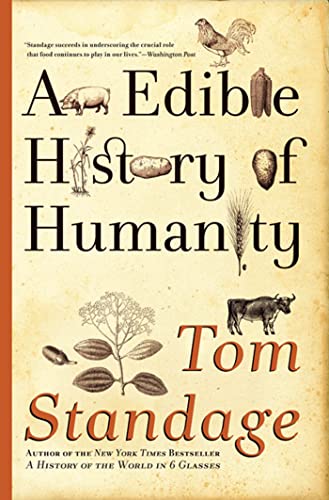
The bestselling author of A History of the World in 6 Glasses charts the enlightening history of humanity through the foods we eat.
More than simply sustenance, food historically has been a kind of technology, changing the course of human progress by helping to build empires, promote industrialization, and decide the outcomes of wars. Tom Standage draws on archaeology, anthropology, and economics to reveal how food has helped shape and transform societies around the world, from the emergence of farming in China by 7500 b.c. to the use of sugar cane and corn to make ethanol today. An Edible History of Humanity is a fully satisfying account of human history.Les informations fournies dans la section « Synopsis » peuvent faire référence à une autre édition de ce titre.
À propos de l'auteur
Tom Standage is deputy editor of the Economist and the author of six previous history books, including Writing on the Wall, the New York Times bestsellers A History of the World in 6 Glasses and An Edible History of Humanity, and The Victorian Internet, a history of the telegraph. His writing has also appeared in the New York Times, the Guardian, Wired, and other publications. Standage holds a degree in engineering and computer science from Oxford University. He lives in London. @TomStandage
Les informations fournies dans la section « A propos du livre » peuvent faire référence à une autre édition de ce titre.
Résultats de recherche pour An Edible History of Humanity

Image d'archives
An Edible History of Humanity
Edité par
Bloomsbury USA, 2010
ISBN 10 : 0802719910
ISBN 13 : 9780802719911
Ancien ou d'occasion
Paperback
Vendeur : Your Online Bookstore, Houston, TX, Etats-Unis
Évaluation du vendeur 5 sur 5 étoiles

Paperback. Etat : Fair. N° de réf. du vendeur 0802719910-4-19668743
Acheter D'occasion
EUR 3,79
Livraison gratuite
Expédition nationale : Etats-Unis
Expédition nationale : Etats-Unis
Quantité disponible : 1 disponible(s)
Image fournie par le vendeur
An Edible History of Humanity
Edité par
Bloomsbury USA, 2010
ISBN 10 : 0802719910
ISBN 13 : 9780802719911
Ancien ou d'occasion
Couverture souple
Vendeur : Dream Books Co., Denver, CO, Etats-Unis
Évaluation du vendeur 5 sur 5 étoiles
Etat : acceptable. This copy has clearly been enjoyedâ"expect noticeable shelf wear and some minor creases to the cover. Binding is strong, and all pages are legible. May contain previous library markings or stamps. N° de réf. du vendeur DBV.0802719910.A
Acheter D'occasion
EUR 3,80
Livraison gratuite
Expédition nationale : Etats-Unis
Expédition nationale : Etats-Unis
Quantité disponible : 2 disponible(s)
Image d'archives
An Edible History of Humanity
Edité par
Bloomsbury Publishing USA, 2010
ISBN 10 : 0802719910
ISBN 13 : 9780802719911
Ancien ou d'occasion
Paperback
Vendeur : World of Books (was SecondSale), Montgomery, IL, Etats-Unis
Évaluation du vendeur 5 sur 5 étoiles
Paperback. Etat : Fair. Throughout history, food has acted as a catalyst of social change, political organization, geopolitical competition, industrial development, military conflict, and economic expansion. An Edible History of Humanity is a pithy, entertaining account of how a series of changes--caused, enabled, or influenced by food--has helped to shape and transform societies around the world. The first civilizations were built on barley and wheat in the Near East, millet and rice in Asia, and corn and potatoes in the Americas. Why farming created a strictly ordered social hierarchy in contrast to the loose egalitarianism of hunter-gatherers is, as Tom Standage reveals, as interesting as the details of the complex cultures that emerged, eventually interconnected by commerce. Trade in exotic spices in particular spawned the age of exploration and the colonization of the New World. Food's influence over the course of history has been just as prevalent in modern times. In the late eighteenth century, Britain's solution to food shortages was to industrialize and import food rather than grow it. Food helped to determine the outcome of wars: Napoleon's rise and fall was intimately connected with his ability to feed his vast armies. In the twentieth century, Communist leaders employed food as an ideological weapon, resulting in the death by starvation of millions in the Soviet Union and China. And today the foods we choose in the supermarket connect us to global debates about trade, development, the environment, and the adoption of new technologies. Encompassing many fields, from genetics and archaeology to anthropology and economics--and invoking food as a special form of technology--An Edible History of Humanity is a fully satisfying discourse on the sweep of human history. N° de réf. du vendeur CIN0802719910A
Acheter D'occasion
EUR 3,86
Livraison gratuite
Expédition nationale : Etats-Unis
Expédition nationale : Etats-Unis
Quantité disponible : 3 disponible(s)
Image d'archives
An Edible History of Humanity
Edité par
Bloomsbury Publishing USA, 2010
ISBN 10 : 0802719910
ISBN 13 : 9780802719911
Ancien ou d'occasion
Paperback
Vendeur : World of Books (was SecondSale), Montgomery, IL, Etats-Unis
Évaluation du vendeur 5 sur 5 étoiles
Paperback. Etat : Good. Throughout history, food has acted as a catalyst of social change, political organization, geopolitical competition, industrial development, military conflict, and economic expansion. An Edible History of Humanity is a pithy, entertaining account of how a series of changes--caused, enabled, or influenced by food--has helped to shape and transform societies around the world. The first civilizations were built on barley and wheat in the Near East, millet and rice in Asia, and corn and potatoes in the Americas. Why farming created a strictly ordered social hierarchy in contrast to the loose egalitarianism of hunter-gatherers is, as Tom Standage reveals, as interesting as the details of the complex cultures that emerged, eventually interconnected by commerce. Trade in exotic spices in particular spawned the age of exploration and the colonization of the New World. Food's influence over the course of history has been just as prevalent in modern times. In the late eighteenth century, Britain's solution to food shortages was to industrialize and import food rather than grow it. Food helped to determine the outcome of wars: Napoleon's rise and fall was intimately connected with his ability to feed his vast armies. In the twentieth century, Communist leaders employed food as an ideological weapon, resulting in the death by starvation of millions in the Soviet Union and China. And today the foods we choose in the supermarket connect us to global debates about trade, development, the environment, and the adoption of new technologies. Encompassing many fields, from genetics and archaeology to anthropology and economics--and invoking food as a special form of technology--An Edible History of Humanity is a fully satisfying discourse on the sweep of human history. N° de réf. du vendeur 00105713922
Acheter D'occasion
EUR 3,86
Livraison gratuite
Expédition nationale : Etats-Unis
Expédition nationale : Etats-Unis
Quantité disponible : Plus de 20 disponibles
Image fournie par le vendeur
An Edible History of Humanity
Edité par
Bloomsbury USA, 2010
ISBN 10 : 0802719910
ISBN 13 : 9780802719911
Ancien ou d'occasion
Couverture souple
Vendeur : Bay State Book Company, North Smithfield, RI, Etats-Unis
Évaluation du vendeur 5 sur 5 étoiles
Etat : good. The book is in good condition with all pages and cover intact, including the dust jacket if originally issued. The spine may show light wear. Pages may contain some notes or highlighting, and there might be a "From the library of" label. Boxed set packaging, shrink wrap, or included media like CDs may be missing. N° de réf. du vendeur BSM.1CM65
Acheter D'occasion
EUR 4,82
Livraison gratuite
Expédition nationale : Etats-Unis
Expédition nationale : Etats-Unis
Quantité disponible : 1 disponible(s)
Image fournie par le vendeur
An Edible History of Humanity
Edité par
Bloomsbury USA, 2010
ISBN 10 : 0802719910
ISBN 13 : 9780802719911
Ancien ou d'occasion
Couverture souple
Vendeur : Zoom Books East, Glendale Heights, IL, Etats-Unis
Évaluation du vendeur 5 sur 5 étoiles
Etat : good. Book is in good condition and may include underlining highlighting and minimal wear. The book can also include "From the library of" labels. May not contain miscellaneous items toys, dvds, etc. . We offer 100% money back guarantee and 24 7 customer service. N° de réf. du vendeur ZEV.0802719910.G
Acheter D'occasion
EUR 4,92
Livraison gratuite
Expédition nationale : Etats-Unis
Expédition nationale : Etats-Unis
Quantité disponible : 1 disponible(s)
Image fournie par le vendeur
An Edible History of Humanity
Edité par
Bloomsbury USA, 2010
ISBN 10 : 0802719910
ISBN 13 : 9780802719911
Ancien ou d'occasion
Couverture souple
Vendeur : Zoom Books East, Glendale Heights, IL, Etats-Unis
Évaluation du vendeur 5 sur 5 étoiles
Etat : very_good. Book is in very good condition and may include minimal underlining highlighting. The book can also include "From the library of" labels. May not contain miscellaneous items toys, dvds, etc. . We offer 100% money back guarantee and 24 7 customer service. N° de réf. du vendeur ZEV.0802719910.VG
Acheter D'occasion
EUR 4,92
Livraison gratuite
Expédition nationale : Etats-Unis
Expédition nationale : Etats-Unis
Quantité disponible : 1 disponible(s)
Image d'archives
An Edible History of Humanity
Edité par
Bloomsbury USA, 2010
ISBN 10 : 0802719910
ISBN 13 : 9780802719911
Ancien ou d'occasion
Paperback
Vendeur : HPB-Movies, Dallas, TX, Etats-Unis
Évaluation du vendeur 4 sur 5 étoiles

Paperback. Etat : Very Good. Connecting readers with great books since 1972! Used books may not include companion materials, and may have some shelf wear or limited writing. We ship orders daily and Customer Service is our top priority! N° de réf. du vendeur S_477095024
Acheter D'occasion
EUR 2,30
Expédition à EUR 3,34
Expédition nationale : Etats-Unis
Expédition nationale : Etats-Unis
Quantité disponible : 1 disponible(s)
Image d'archives
An Edible History of Humanity
Edité par
Bloomsbury Publishing USA, 2010
ISBN 10 : 0802719910
ISBN 13 : 9780802719911
Ancien ou d'occasion
Paperback
Vendeur : World of Books Inc, Montgomery, IL, Etats-Unis
Évaluation du vendeur 4 sur 5 étoiles
Paperback. Etat : Fair. Throughout history, food has acted as a catalyst of social change, political organization, geopolitical competition, industrial development, military conflict, and economic expansion. An Edible History of Humanity is a pithy, entertaining account of how a series of changes--caused, enabled, or influenced by food--has helped to shape and transform societies around the world. The first civilizations were built on barley and wheat in the Near East, millet and rice in Asia, and corn and potatoes in the Americas. Why farming created a strictly ordered social hierarchy in contrast to the loose egalitarianism of hunter-gatherers is, as Tom Standage reveals, as interesting as the details of the complex cultures that emerged, eventually interconnected by commerce. Trade in exotic spices in particular spawned the age of exploration and the colonization of the New World. Food's influence over the course of history has been just as prevalent in modern times. In the late eighteenth century, Britain's solution to food shortages was to industrialize and import food rather than grow it. Food helped to determine the outcome of wars: Napoleon's rise and fall was intimately connected with his ability to feed his vast armies. In the twentieth century, Communist leaders employed food as an ideological weapon, resulting in the death by starvation of millions in the Soviet Union and China. And today the foods we choose in the supermarket connect us to global debates about trade, development, the environment, and the adoption of new technologies. Encompassing many fields, from genetics and archaeology to anthropology and economics--and invoking food as a special form of technology--An Edible History of Humanity is a fully satisfying discourse on the sweep of human history. N° de réf. du vendeur CIN0802719910A
Acheter D'occasion
EUR 5,70
Livraison gratuite
Expédition nationale : Etats-Unis
Expédition nationale : Etats-Unis
Quantité disponible : 3 disponible(s)
Image d'archives
An Edible History of Humanity
Edité par
Bloomsbury Publishing USA, 2010
ISBN 10 : 0802719910
ISBN 13 : 9780802719911
Ancien ou d'occasion
Paperback
Vendeur : World of Books Inc, Montgomery, IL, Etats-Unis
Évaluation du vendeur 4 sur 5 étoiles
Paperback. Etat : Good. Throughout history, food has acted as a catalyst of social change, political organization, geopolitical competition, industrial development, military conflict, and economic expansion. An Edible History of Humanity is a pithy, entertaining account of how a series of changes--caused, enabled, or influenced by food--has helped to shape and transform societies around the world. The first civilizations were built on barley and wheat in the Near East, millet and rice in Asia, and corn and potatoes in the Americas. Why farming created a strictly ordered social hierarchy in contrast to the loose egalitarianism of hunter-gatherers is, as Tom Standage reveals, as interesting as the details of the complex cultures that emerged, eventually interconnected by commerce. Trade in exotic spices in particular spawned the age of exploration and the colonization of the New World. Food's influence over the course of history has been just as prevalent in modern times. In the late eighteenth century, Britain's solution to food shortages was to industrialize and import food rather than grow it. Food helped to determine the outcome of wars: Napoleon's rise and fall was intimately connected with his ability to feed his vast armies. In the twentieth century, Communist leaders employed food as an ideological weapon, resulting in the death by starvation of millions in the Soviet Union and China. And today the foods we choose in the supermarket connect us to global debates about trade, development, the environment, and the adoption of new technologies. Encompassing many fields, from genetics and archaeology to anthropology and economics--and invoking food as a special form of technology--An Edible History of Humanity is a fully satisfying discourse on the sweep of human history. N° de réf. du vendeur CIN0802719910G
Acheter D'occasion
EUR 5,70
Livraison gratuite
Expédition nationale : Etats-Unis
Expédition nationale : Etats-Unis
Quantité disponible : Plus de 20 disponibles