
Articles liés à Observations on Modernity
Synopsis
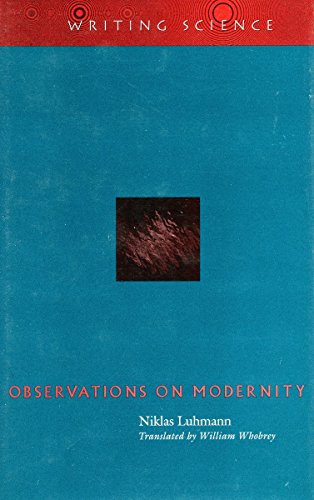
This collection of five essays by Germany's most prominent and influential social thinker both links Luhmann's social theory to the question "What is modern about modernity?" and shows the origins and context of his theory.
In the introductory essay, "Modernity in Contemporary Society," Luhmann develops the thesis that the modern epistemological situation can be seen as the consequence of a radical change in social macrostructures that he calls "social differentiation," thereby designating the juxtaposition of and interaction between a growing number of social subsystems without any hierarchical structure. "European Rationality" defines rationality as the capacity to see the difference between systems and their environment as a unity. Luhmann argues that, in a world characterized by contingency, rationality tends to become coextensive with imagination, a view that challenges their classical binary opposition and opens up the possibility of seeing modern rationality as a paradox.
In the third essay, "Contingency as Modern Society's Defining Attribute," Luhmann develops a further and probably even more important paradox: that the generalization of contingency or cognitive uncertainty is precisely what provides stability within modern societies. In the process, he argues that medieval and early modern theology can be seen as a "preadaptive advance" through which Western thinking prepared itself for the modern epistemological situation. In "Describing the Future," Luhmann claims that neither the traditional hope of learning from history nor the complementary hope of cognitively anticipating the future can be maintained, and that the classical concept of the future should be replaced by the notion of risk, defined as juxtaposing the expectation of realizing certain projects and the awareness that such projects might fail. The book concludes with "The Ecology of Ignorance," in which Luhmann outlines prospective research areas "for sponsors who have yet to be identified."
Les informations fournies dans la section « Synopsis » peuvent faire référence à une autre édition de ce titre.
À propos de l'auteur
Niklas Luhmann is Professor of Sociology Emeritus at the University of Bielefeld. Among his books translated into English is Social Systems (Stanford, 1995).
Les informations fournies dans la section « A propos du livre » peuvent faire référence à une autre édition de ce titre.
Résultats de recherche pour Observations on Modernity

Image d'archives
Observations on Modernity (Writing Science)
Edité par
Stanford University Press (edition 1), 1998
ISBN 10 : 0804732353
ISBN 13 : 9780804732352
Ancien ou d'occasion
Paperback
Vendeur : BooksRun, Philadelphia, PA, Etats-Unis
Évaluation du vendeur 5 sur 5 étoiles

Paperback. Etat : Fair. 1. The item might be beaten up but readable. May contain markings or highlighting, as well as stains, bent corners, or any other major defect, but the text is not obscured in any way. N° de réf. du vendeur 0804732353-7-1
Acheter D'occasion
EUR 11,02
Livraison gratuite
Expédition nationale : Etats-Unis
Expédition nationale : Etats-Unis
Quantité disponible : 1 disponible(s)
Image d'archives
Observations on Modernity (Writing Science)
Edité par
Stanford University Press (edition 1), 1998
ISBN 10 : 0804732353
ISBN 13 : 9780804732352
Ancien ou d'occasion
Paperback
Vendeur : BooksRun, Philadelphia, PA, Etats-Unis
Évaluation du vendeur 5 sur 5 étoiles
Paperback. Etat : Very Good. 1. It's a well-cared-for item that has seen limited use. The item may show minor signs of wear. All the text is legible, with all pages included. It may have slight markings and/or highlighting. N° de réf. du vendeur 0804732353-8-1
Acheter D'occasion
EUR 11,02
Livraison gratuite
Expédition nationale : Etats-Unis
Expédition nationale : Etats-Unis
Quantité disponible : 1 disponible(s)
Image d'archives
Observations on Modernity (Writing Science)
Edité par
Stanford University Press, 1998
ISBN 10 : 0804732353
ISBN 13 : 9780804732352
Ancien ou d'occasion
paperback
Vendeur : HPB-Red, Dallas, TX, Etats-Unis
Évaluation du vendeur 5 sur 5 étoiles
paperback. Etat : Good. Connecting readers with great books since 1972! Used textbooks may not include companion materials such as access codes, etc. May have some wear or writing/highlighting. We ship orders daily and Customer Service is our top priority! N° de réf. du vendeur S_405579745
Acheter D'occasion
EUR 9,44
Expédition à EUR 3,36
Expédition nationale : Etats-Unis
Expédition nationale : Etats-Unis
Quantité disponible : 1 disponible(s)
Image d'archives
Observations on Modernity (Writing Science)
Edité par
Stanford University Press, Stanford, CA, 1998, 1998
ISBN 10 : 0804732353
ISBN 13 : 9780804732352
Ancien ou d'occasion
Trade Paperback
Vendeur : Heartwood Books, A.B.A.A., Charlottesville, VA, Etats-Unis
Évaluation du vendeur 5 sur 5 étoiles
Trade Paperback. Etat : Very Good Plus. Very Good Plus, internally clean, solid paperback. N° de réf. du vendeur 024166
Acheter D'occasion
EUR 13,84
Expédition à EUR 4,47
Expédition nationale : Etats-Unis
Expédition nationale : Etats-Unis
Quantité disponible : 1 disponible(s)
Image d'archives
Observations on Modernity (Writing Science)
Vendeur : AwesomeBooks, Wallingford, Royaume-Uni
Évaluation du vendeur 5 sur 5 étoiles
Paperback. Etat : Very Good. Observations on Modernity (Writing Science) This book is in very good condition and will be shipped within 24 hours of ordering. The cover may have some limited signs of wear but the pages are clean, intact and the spine remains undamaged. This book has clearly been well maintained and looked after thus far. Money back guarantee if you are not satisfied. See all our books here, order more than 1 book and get discounted shipping. N° de réf. du vendeur 7719-9780804732352
Acheter D'occasion
EUR 16,44
Expédition à EUR 4,88
Expédition depuis Royaume-Uni vers Etats-Unis
Expédition depuis Royaume-Uni vers Etats-Unis
Quantité disponible : 2 disponible(s)
Image d'archives
Observations on Modernity (Writing Science)
Edité par
Stanford University Press, 1998
ISBN 10 : 0804732353
ISBN 13 : 9780804732352
Ancien ou d'occasion
paperback
Vendeur : Webster's Bookstore Cafe, Inc., State College, PA, Etats-Unis
Évaluation du vendeur 5 sur 5 étoiles
paperback. Etat : Very Good. Mild general wear to covers. Underlining and marginalia in the first third of the book in pencil, mostly neat. Sound binding. N° de réf. du vendeur mon0000136826
Acheter D'occasion
EUR 19,37
Expédition à EUR 4,92
Expédition nationale : Etats-Unis
Expédition nationale : Etats-Unis
Quantité disponible : 1 disponible(s)
Image d'archives
Observations on Modernity (Writing Science)
Edité par
Stanford University Press 99/l /01 J, 1998
ISBN 10 : 0804732353
ISBN 13 : 9780804732352
Ancien ou d'occasion
Paperback
Vendeur : Bahamut Media, Reading, Royaume-Uni
Évaluation du vendeur 4 sur 5 étoiles

Paperback. Etat : Very Good. Shipped within 24 hours from our UK warehouse. Clean, undamaged book with no damage to pages and minimal wear to the cover. Spine still tight, in very good condition. Remember if you are not happy, you are covered by our 100% money back guarantee. N° de réf. du vendeur 6545-9780804732352
Acheter D'occasion
EUR 20,30
Expédition à EUR 8,26
Expédition depuis Royaume-Uni vers Etats-Unis
Expédition depuis Royaume-Uni vers Etats-Unis
Quantité disponible : 1 disponible(s)
Image d'archives
Observations on Modernity
Edité par
Stanford University Press, 1998
ISBN 10 : 0804732353
ISBN 13 : 9780804732352
Ancien ou d'occasion
Couverture souple
Vendeur : Anybook.com, Lincoln, Royaume-Uni
Évaluation du vendeur 5 sur 5 étoiles
Etat : Poor. This is an ex-library book and may have the usual library/used-book markings inside.This book has soft covers. In poor condition, suitable as a reading copy. Library sticker on front cover. Please note the Image in this listing is a stock photo and may not match the covers of the actual item,300grams, ISBN:9780804732352. N° de réf. du vendeur 9994297
Acheter D'occasion
EUR 18,28
Expédition à EUR 15,44
Expédition depuis Royaume-Uni vers Etats-Unis
Expédition depuis Royaume-Uni vers Etats-Unis
Quantité disponible : 1 disponible(s)
Image fournie par le vendeur
Observations on Modernity
Edité par
Stanford University Press, 1998
ISBN 10 : 0804732353
ISBN 13 : 9780804732352
Ancien ou d'occasion
Couverture souple
Vendeur : GreatBookPrices, Columbia, MD, Etats-Unis
Évaluation du vendeur 5 sur 5 étoiles
Etat : As New. Unread book in perfect condition. N° de réf. du vendeur 252403
Acheter D'occasion
EUR 34,82
Expédition à EUR 2,37
Expédition nationale : Etats-Unis
Expédition nationale : Etats-Unis
Quantité disponible : Plus de 20 disponibles
Image d'archives
Observations on Modernity (Writing Science)
Edité par
Stanford University Press, 1998
ISBN 10 : 0804732353
ISBN 13 : 9780804732352
Neuf
Paperback
Vendeur : GoldBooks, Denver, CO, Etats-Unis
Évaluation du vendeur 5 sur 5 étoiles
Paperback. Etat : new. New Copy. Customer Service Guaranteed. N° de réf. du vendeur 78O89_92_0804732353
Acheter neuf
EUR 33,87
Expédition à EUR 4,93
Expédition nationale : Etats-Unis
Expédition nationale : Etats-Unis
Quantité disponible : 1 disponible(s)