
Articles liés à Dialectic of Enlightenment: Philosophical Fragments
Dialectic of Enlightenment: Philosophical Fragments - Couverture rigide
Livre 203 sur 213: Cultural Memory in the Present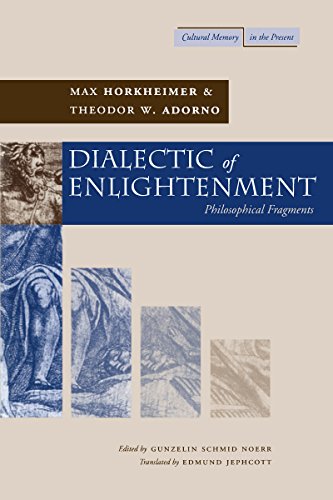
Synopsis
Dialectic of Enlightenment is undoubtedly the most influential publication of the Frankfurt School of Critical Theory. Written during the Second World War and circulated privately, it appeared in a printed edition in Amsterdam in 1947. "What we had set out to do," the authors write in the Preface, "was nothing less than to explain why humanity, instead of entering a truly human state, is sinking into a new kind of barbarism."
Yet the work goes far beyond a mere critique of contemporary events. Historically remote developments, indeed, the birth of Western history and of subjectivity itself out of the struggle against natural forces, as represented in myths, are connected in a wide arch to the most threatening experiences of the present.
The book consists in five chapters, at first glance unconnected, together with a number of shorter notes. The various analyses concern such phenomena as the detachment of science from practical life, formalized morality, the manipulative nature of entertainment culture, and a paranoid behavioral structure, expressed in aggressive anti-Semitism, that marks the limits of enlightenment. The authors perceive a common element in these phenomena, the tendency toward self-destruction of the guiding criteria inherent in enlightenment thought from the beginning. Using historical analyses to elucidate the present, they show, against the background of a prehistory of subjectivity, why the National Socialist terror was not an aberration of modern history but was rooted deeply in the fundamental characteristics of Western civilization.
Adorno and Horkheimer see the self-destruction of Western reason as grounded in a historical and fateful dialectic between the domination of external nature and society. They trace enlightenment, which split these spheres apart, back to its mythical roots. Enlightenment and myth, therefore, are not irreconcilable opposites, but dialectically mediated qualities of both real and intellectual life. "Myth is already enlightenment, and enlightenment reverts to mythology." This paradox is the fundamental thesis of the book.
This new translation, based on the text in the complete edition of the works of Max Horkheimer, contains textual variants, commentary upon them, and an editorial discussion of the position of this work in the development of Critical Theory.
Les informations fournies dans la section « Synopsis » peuvent faire référence à une autre édition de ce titre.
À propos de l'auteur
Max Horkheimer and Theodor W. Adorno were two influential members of the Frankfurt School of Critical Theory.
Les informations fournies dans la section « A propos du livre » peuvent faire référence à une autre édition de ce titre.
Résultats de recherche pour Dialectic of Enlightenment: Philosophical Fragments

Image fournie par le vendeur
Dialectic of Enlightenment: Philosophical Fragments
Edité par
Stanford University Press, Stanford, California, 2002
ISBN 10 : 0804736324
ISBN 13 : 9780804736329
Ancien ou d'occasion
Paperback
Vendeur : Aspen Book Co., Denver, CO, Etats-Unis
Évaluation du vendeur 5 sur 5 étoiles

Paperback. Etat : Good. Original Printing 2002. This paperback edition of Dialectic of Enlightenment is in good condition, with a clean cover and intact binding. There are no markings or inscriptions inside, and the pages are crisp with minimal wear. The spine shows no significant creasing, indicating careful handling. unknown (paperback edition shown). N° de réf. du vendeur A18-B3-JRM-MRG-0020
Acheter D'occasion
EUR 61,39
Livraison gratuite
Expédition nationale : Etats-Unis
Expédition nationale : Etats-Unis
Quantité disponible : 1 disponible(s)
Image d'archives
Dialectic of Enlightenment (Cultural Memory in the Present)
Edité par
Stanford University Press, 2002
ISBN 10 : 0804736324
ISBN 13 : 9780804736329
Neuf
Couverture rigide
Vendeur : BennettBooksLtd, Los Angeles, CA, Etats-Unis
Évaluation du vendeur 5 sur 5 étoiles
hardcover. Etat : New. In shrink wrap. Looks like an interesting title! N° de réf. du vendeur Q-0804736324
Acheter neuf
EUR 111,96
Expédition à EUR 6,20
Expédition nationale : Etats-Unis
Expédition nationale : Etats-Unis
Quantité disponible : 1 disponible(s)
Image fournie par le vendeur
Dialectic of Enlightenment
Edité par
Stanford University Press, US, 2002
ISBN 10 : 0804736324
ISBN 13 : 9780804736329
Neuf
Couverture rigide
Vendeur : Rarewaves USA, HEBRON, KY, Etats-Unis
Évaluation du vendeur 5 sur 5 étoiles
Hardback. Etat : New. Dialectic of Enlightenment is undoubtedly the most influential publication of the Frankfurt School of Critical Theory. Written during the Second World War and circulated privately, it appeared in a printed edition in Amsterdam in 1947. "What we had set out to do," the authors write in the Preface, "was nothing less than to explain why humanity, instead of entering a truly human state, is sinking into a new kind of barbarism." Yet the work goes far beyond a mere critique of contemporary events. Historically remote developments, indeed, the birth of Western history and of subjectivity itself out of the struggle against natural forces, as represented in myths, are connected in a wide arch to the most threatening experiences of the present. The book consists in five chapters, at first glance unconnected, together with a number of shorter notes. The various analyses concern such phenomena as the detachment of science from practical life, formalized morality, the manipulative nature of entertainment culture, and a paranoid behavioral structure, expressed in aggressive anti-Semitism, that marks the limits of enlightenment. The authors perceive a common element in these phenomena, the tendency toward self-destruction of the guiding criteria inherent in enlightenment thought from the beginning. Using historical analyses to elucidate the present, they show, against the background of a prehistory of subjectivity, why the National Socialist terror was not an aberration of modern history but was rooted deeply in the fundamental characteristics of Western civilization. Adorno and Horkheimer see the self-destruction of Western reason as grounded in a historical and fateful dialectic between the domination of external nature and society. They trace enlightenment, which split these spheres apart, back to its mythical roots. Enlightenment and myth, therefore, are not irreconcilable opposites, but dialectically mediated qualities of both real and intellectual life. "Myth is already enlightenment, and enlightenment reverts to mythology." This paradox is the fundamental thesis of the book. This new translation, based on the text in the complete edition of the works of Max Horkheimer, contains textual variants, commentary upon them, and an editorial discussion of the position of this work in the development of Critical Theory. N° de réf. du vendeur LU-9780804736329
Acheter neuf
EUR 129,33
Livraison gratuite
Expédition nationale : Etats-Unis
Expédition nationale : Etats-Unis
Quantité disponible : Plus de 20 disponibles
Image d'archives
Dialectic of Enlightenment (eng)
Edité par
Stanford University Press, 2002
ISBN 10 : 0804736324
ISBN 13 : 9780804736329
Neuf
Couverture rigide
Vendeur : Brook Bookstore On Demand, Napoli, NA, Italie
Évaluation du vendeur 5 sur 5 étoiles
Etat : new. N° de réf. du vendeur 0723e5f751dc20345d15d4888002841e
Acheter neuf
EUR 125,53
Expédition à EUR 6,80
Expédition depuis Italie vers Etats-Unis
Expédition depuis Italie vers Etats-Unis
Quantité disponible : Plus de 20 disponibles
Image d'archives
Dialectic of Enlightenment
Edité par
Stanford University Press, 2002
ISBN 10 : 0804736324
ISBN 13 : 9780804736329
Neuf
Couverture rigide
Vendeur : THE SAINT BOOKSTORE, Southport, Royaume-Uni
Évaluation du vendeur 5 sur 5 étoiles
Hardback. Etat : New. New copy - Usually dispatched within 4 working days. N° de réf. du vendeur B9780804736329
Acheter neuf
EUR 113,12
Expédition à EUR 19,43
Expédition depuis Royaume-Uni vers Etats-Unis
Expédition depuis Royaume-Uni vers Etats-Unis
Quantité disponible : Plus de 20 disponibles
Image d'archives
Dialectic of Enlightenment
Edité par
Stanford University Press, 2002
ISBN 10 : 0804736324
ISBN 13 : 9780804736329
Neuf
Couverture rigide
Vendeur : PBShop.store UK, Fairford, GLOS, Royaume-Uni
Évaluation du vendeur 5 sur 5 étoiles
HRD. Etat : New. New Book. Shipped from UK. Established seller since 2000. N° de réf. du vendeur FW-9780804736329
Acheter neuf
EUR 135,52
Expédition à EUR 5,93
Expédition depuis Royaume-Uni vers Etats-Unis
Expédition depuis Royaume-Uni vers Etats-Unis
Quantité disponible : 15 disponible(s)
Image fournie par le vendeur
Dialectic of Enlightenment
Edité par
Stanford University Press Mär 2002, 2002
ISBN 10 : 0804736324
ISBN 13 : 9780804736329
Neuf
Couverture rigide
Vendeur : BuchWeltWeit Ludwig Meier e.K., Bergisch Gladbach, Allemagne
Évaluation du vendeur 5 sur 5 étoiles
Buch. Etat : Neu. This item is printed on demand - it takes 3-4 days longer - Neuware -Dialectic of Enlightenment is undoubtedly the most influential publication of the Frankfurt School of Critical Theory. Written during the Second World War and circulated privately, it appeared in a printed edition in Amsterdam in 1947. 'What we had set out to do,' the authors write in the Preface, 'was nothing less than to explain why humanity, instead of entering a truly human state, is sinking into a new kind of barbarism.' Yet the work goes far beyond a mere critique of contemporary events. Historically remote developments, indeed, the birth of Western history and of subjectivity itself out of the struggle against natural forces, as represented in myths, are connected in a wide arch to the most threatening experiences of the present. The book consists in five chapters, at first glance unconnected, together with a number of shorter notes. The various analyses concern such phenomena as the detachment of science from practical life, formalized morality, the manipulative nature of entertainment culture, and a paranoid behavioral structure, expressed in aggressive anti-Semitism, that marks the limits of enlightenment. The authors perceive a common element in these phenomena, the tendency toward self-destruction of the guiding criteria inherent in enlightenment thought from the beginning. Using historical analyses to elucidate the present, they show, against the background of a prehistory of subjectivity, why the National Socialist terror was not an aberration of modern history but was rooted deeply in the fundamental characteristics of Western civilization. Adorno and Horkheimer see the self-destruction of Western reason as grounded in a historical and fateful dialectic between the domination of external nature and society. They trace enlightenment, which split these spheres apart, back to its mythical roots. Enlightenment and myth, therefore, are not irreconcilable opposites, but dialectically mediated qualities of both real and intellectual life. 'Myth is already enlightenment, and enlightenment reverts to mythology.' This paradox is the fundamental thesis of the book. This new translation, based on the text in the complete edition of the works of Max Horkheimer, contains textual variants, commentary upon them, and an editorial discussion of the position of this work in the development of Critical Theory. 304 pp. Englisch. N° de réf. du vendeur 9780804736329
Acheter neuf
EUR 118,77
Expédition à EUR 23
Expédition depuis Allemagne vers Etats-Unis
Expédition depuis Allemagne vers Etats-Unis
Quantité disponible : 2 disponible(s)
Image d'archives
Dialectic Of Enlightenment
Edité par
Stanford University Press, 2002
ISBN 10 : 0804736324
ISBN 13 : 9780804736329
Neuf
Couverture rigide
Edition originale
Vendeur : Kennys Bookshop and Art Galleries Ltd., Galway, GY, Irlande
Évaluation du vendeur 5 sur 5 étoiles
Etat : New. 2002. 1st Edition. hardcover. . . . . . N° de réf. du vendeur V9780804736329
Acheter neuf
EUR 135,74
Expédition à EUR 9,50
Expédition depuis Irlande vers Etats-Unis
Expédition depuis Irlande vers Etats-Unis
Quantité disponible : Plus de 20 disponibles
Image d'archives
Dialectic of Enlightenment
Edité par
Stanford University Press, 2002
ISBN 10 : 0804736324
ISBN 13 : 9780804736329
Neuf
Couverture rigide
Vendeur : Majestic Books, Hounslow, Royaume-Uni
Évaluation du vendeur 4 sur 5 étoiles

Etat : New. pp. 304 This item is printed on demand. N° de réf. du vendeur 7132603
Acheter neuf
EUR 137,86
Expédition à EUR 7,68
Expédition depuis Royaume-Uni vers Etats-Unis
Expédition depuis Royaume-Uni vers Etats-Unis
Quantité disponible : 3 disponible(s)
Image d'archives
Dialectic of Enlightenment (Cultural Memory in the Present)
Edité par
Stanford University Press, 2002
ISBN 10 : 0804736324
ISBN 13 : 9780804736329
Neuf
Couverture rigide
Vendeur : Ria Christie Collections, Uxbridge, Royaume-Uni
Évaluation du vendeur 5 sur 5 étoiles
Etat : New. In English. N° de réf. du vendeur ria9780804736329_new
Acheter neuf
EUR 138,10
Expédition à EUR 13,34
Expédition depuis Royaume-Uni vers Etats-Unis
Expédition depuis Royaume-Uni vers Etats-Unis
Quantité disponible : Plus de 20 disponibles