
Articles liés à A World Destroyed: Hiroshima and Its Legacies
A World Destroyed: Hiroshima and Its Legacies - Couverture souple
Livre 12 sur 22: Stanford Nuclear Age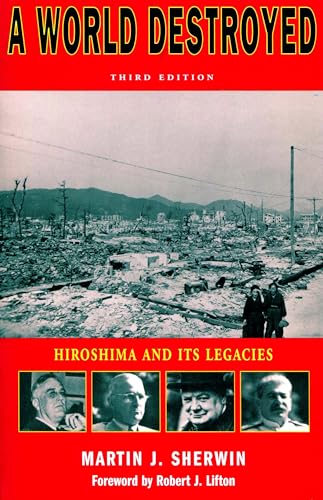
Synopsis
Continuously in demand since its first, prize-winning edition was published in 1975, this is the classic history of the development of the American atomic bomb, the decision to use it against Japan, and the origins of U.S. atomic diplomacy toward the Soviet Union.
In his Preface to this new edition, the author describes and evaluates the lengthening trail of new evidence that has come to light concerning these often emotionally debated subjects. The author also invokes his experience as a historical advisor to the controversial, aborted 1995 Enola Gay exhibit at the National Air and Space Museum of the Smithsonian Institution. This leads him to analyze the impact on American democracy of one of the most insidious of the legacies of Hiroshima: the political control of historical interpretation.
Reviews of Previous Editions
"The quality of Sherwin's research and the strength of his argument are far superior to previous accounts."
--New York Times Book Review
"Probably the definitive account for a long time to come. . . . Sherwin has tackled some of the critical questions of the Cold War's origins--and has settled them, in my opinion."
--Walter LaFeber,
Cornell University
"One of those rare achievements of conscientious scholarship, a book at once graceful and luminous, yet loyal to its documentation and restrained in its speculations."
--Boston Globe
Les informations fournies dans la section « Synopsis » peuvent faire référence à une autre édition de ce titre.
À propos de l'auteur
Pulitzer Prize-winner Martin J. Sherwin is Professor of History at Tufts University, where he founded the Nuclear Age History Center.
Les informations fournies dans la section « A propos du livre » peuvent faire référence à une autre édition de ce titre.
Résultats de recherche pour A World Destroyed: Hiroshima and Its Legacies

Image d'archives
A World Destroyed : Hiroshima and Its Legacies, Third Edition
Edité par
Stanford University Press, 2003
ISBN 10 : 0804739579
ISBN 13 : 9780804739573
Ancien ou d'occasion
Couverture souple
Vendeur : Better World Books: West, Reno, NV, Etats-Unis
Évaluation du vendeur 5 sur 5 étoiles

Etat : Very Good. 3 Edition. Pages intact with possible writing/highlighting. Binding strong with minor wear. Dust jackets/supplements may not be included. Stock photo provided. Product includes identifying sticker. Better World Books: Buy Books. Do Good. N° de réf. du vendeur 8615811-6
Acheter D'occasion
EUR 6,78
Livraison gratuite
Expédition nationale : Etats-Unis
Expédition nationale : Etats-Unis
Quantité disponible : 2 disponible(s)
Image fournie par le vendeur
A World Destroyed: Hiroshima and Its Legacies
Edité par
Stanford University Press, 2003
ISBN 10 : 0804739579
ISBN 13 : 9780804739573
Ancien ou d'occasion
Couverture souple
Vendeur : Zoom Books Company, Lynden, WA, Etats-Unis
Évaluation du vendeur 5 sur 5 étoiles
Etat : very_good. Book is in very good condition and may include minimal underlining highlighting. The book can also include "From the library of" labels. May not contain miscellaneous items toys, dvds, etc. . We offer 100% money back guarantee and 24 7 customer service. N° de réf. du vendeur ZBV.0804739579.VG
Acheter D'occasion
EUR 6,78
Livraison gratuite
Expédition nationale : Etats-Unis
Expédition nationale : Etats-Unis
Quantité disponible : 1 disponible(s)
Image d'archives
A World Destroyed : Hiroshima and Its Legacies, Third Edition
Edité par
Stanford University Press, 2003
ISBN 10 : 0804739579
ISBN 13 : 9780804739573
Ancien ou d'occasion
Couverture souple
Vendeur : Better World Books, Mishawaka, IN, Etats-Unis
Évaluation du vendeur 5 sur 5 étoiles
Etat : Good. 3 Edition. Former library copy. Pages intact with minimal writing/highlighting. The binding may be loose and creased. Dust jackets/supplements are not included. Includes library markings. Stock photo provided. Product includes identifying sticker. Better World Books: Buy Books. Do Good. N° de réf. du vendeur 936856-6
Acheter D'occasion
EUR 6,78
Livraison gratuite
Expédition nationale : Etats-Unis
Expédition nationale : Etats-Unis
Quantité disponible : 1 disponible(s)
Image fournie par le vendeur
A World Destroyed: Hiroshima and Its Legacies
Edité par
Stanford University Press, 2003
ISBN 10 : 0804739579
ISBN 13 : 9780804739573
Ancien ou d'occasion
Couverture souple
Vendeur : Greenworld Books, Arlington, TX, Etats-Unis
Évaluation du vendeur 5 sur 5 étoiles
Etat : good. Fast Free Shipping â" Good condition. It may show normal signs of use, such as light writing, highlighting, or library markings, but all pages are intact and the book is fully readable. A solid, complete copy that's ready to enjoy. N° de réf. du vendeur GWV.0804739579.G
Acheter D'occasion
EUR 7,64
Livraison gratuite
Expédition nationale : Etats-Unis
Expédition nationale : Etats-Unis
Quantité disponible : 1 disponible(s)
Image d'archives
A World Destroyed: Hiroshima and Its Legacies
Edité par
Stanford University Press, 2003
ISBN 10 : 0804739579
ISBN 13 : 9780804739573
Ancien ou d'occasion
paperback
Vendeur : HPB-Movies, Dallas, TX, Etats-Unis
Évaluation du vendeur 4 sur 5 étoiles

paperback. Etat : Very Good. Connecting readers with great books since 1972! Used books may not include companion materials, and may have some shelf wear or limited writing. We ship orders daily and Customer Service is our top priority! N° de réf. du vendeur S_468628923
Acheter D'occasion
EUR 4,63
Expédition à EUR 3,35
Expédition nationale : Etats-Unis
Expédition nationale : Etats-Unis
Quantité disponible : 1 disponible(s)
Image d'archives
A World Destroyed: Hiroshima and Its Legacies
Edité par
Stanford University Press, 2003
ISBN 10 : 0804739579
ISBN 13 : 9780804739573
Ancien ou d'occasion
Paperback
Vendeur : Midtown Scholar Bookstore, Harrisburg, PA, Etats-Unis
Évaluation du vendeur 5 sur 5 étoiles
Paperback. Etat : Good. Good - Bumped and creased book with tears to the extremities, but not affecting the text block, may have remainder mark or previous owner's name - GOOD Standard-sized. N° de réf. du vendeur M0804739579Z3
Acheter D'occasion
EUR 3,75
Expédition à EUR 5,36
Expédition nationale : Etats-Unis
Expédition nationale : Etats-Unis
Quantité disponible : 1 disponible(s)
Image d'archives
A World Destroyed: Hiroshima and Its Legacies
Edité par
Stanford University Press, 2003
ISBN 10 : 0804739579
ISBN 13 : 9780804739573
Ancien ou d'occasion
Paperback
Vendeur : Midtown Scholar Bookstore, Harrisburg, PA, Etats-Unis
Évaluation du vendeur 5 sur 5 étoiles
Paperback. Etat : Very Good. Very Good - Crisp, clean, unread book with some shelfwear/edgewear, may have a remainder mark - NICE PAPERBACK Standard-sized. N° de réf. du vendeur M0804739579Z2
Acheter D'occasion
EUR 5,08
Expédition à EUR 5,36
Expédition nationale : Etats-Unis
Expédition nationale : Etats-Unis
Quantité disponible : 6 disponible(s)
Image d'archives
A World Destroyed; Hiroshima and Its Legacies
Edité par
Stanford University Press, Stanford, California, 2006
ISBN 10 : 0804739579
ISBN 13 : 9780804739573
Ancien ou d'occasion
Trade paperback
Vendeur : Ground Zero Books, Ltd., Silver Spring, MD, Etats-Unis
Évaluation du vendeur 5 sur 5 étoiles
Trade paperback. Etat : Good. Third Edition. xl, 375, [8], Pages, Foreword by Robert J. Lifton, New preface for third edition, notes, annotated bibliography, appendices, index, This has ex-bookstore stickers, and some highlighting. Continuously in demand since its first, prize-winning edition was published in 1975, this is the classic history of the development of the atomic bomb, the decision to use it against Japan, and the origins of U.S. atomic diplomacy toward the Soviet Union. In his Preface to this new edition, the author describes and evaluates the lengthening trail of new evidence that has come to light concerning these often emotionally debates subjects. The author also invokes his experience as a historical advisor to the controversial, aborted 1995 Enola Gay exhibit at the National Air and Space Museum of the Smithsonian Institution. This leads him to analyze the impact of the most insidious of the legacies of Hiroshima: the political control of historical interpretation. Martin K. Sherwin is Walter S. Dickson Professor of History at Tufts University and Director of the Nuclear Age History and Humanities Center. He has taught at the University of Pennsylvania and Dartmouth and has received numerous academic awards and fellowships. Robert Jay Lifton (born May 16, 1926) is an American psychiatrist and author, chiefly known for his studies of the psychological causes and effects of wars and political violence, and for his theory of thought reform. He was an early proponent of the techniques of psychohistory. On 6 and 9 August 1945, the United States detonated two atomic bombs over the Japanese cities of Hiroshima and Nagasaki, respectively, during World War II. The aerial bombings killed between 150,000 and 246,000 people, most of whom were civilians, and remain the only uses of nuclear weapons in an armed conflict. Japan announced its surrender to the Allies on 15 August, six days after the bombing of Nagasaki and the Soviet Union's declaration of war against Japan and invasion of Manchuria. The Japanese government signed an instrument of surrender on 2 September, ending the war. In the final year of World War II, the Allies prepared for a costly invasion of the Japanese mainland. This undertaking was preceded by a conventional bombing and firebombing campaign that devastated 64 Japanese cities, including an operation on Tokyo. The war in Europe concluded when Germany surrendered on 8 May 1945, and the Allies turned their full attention to the Pacific War. By July 1945, the Allies' Manhattan Project had produced two types of atomic bombs: "Little Boy", an enriched uranium gun-type fission weapon, and "Fat Man", a plutonium implosion-type nuclear weapon. The 509th Composite Group of the U.S. Army Air Forces was trained and equipped with the specialized Silverplate version of the Boeing B-29 Superfortress, and deployed to Tinian in the Mariana Islands. The Allies called for the unconditional surrender of the Imperial Japanese armed forces in the Potsdam Declaration on 26 July 1945, the alternative being "prompt and utter destruction". The Japanese government ignored the ultimatum. N° de réf. du vendeur 89893
Acheter D'occasion
EUR 22,98
Expédition à EUR 4,46
Expédition nationale : Etats-Unis
Expédition nationale : Etats-Unis
Quantité disponible : 1 disponible(s)
Image d'archives
A World Destroyed: Hiroshima and Its Legacies
Edité par
Stanford University Press, 2003
ISBN 10 : 0804739579
ISBN 13 : 9780804739573
Neuf
Couverture souple
Vendeur : California Books, Miami, FL, Etats-Unis
Évaluation du vendeur 5 sur 5 étoiles
Etat : New. N° de réf. du vendeur I-9780804739573
Acheter neuf
EUR 29,42
Livraison gratuite
Expédition nationale : Etats-Unis
Expédition nationale : Etats-Unis
Quantité disponible : Plus de 20 disponibles
Image d'archives
A World Destroyed
Vendeur : PBShop.store UK, Fairford, GLOS, Royaume-Uni
Évaluation du vendeur 5 sur 5 étoiles
PAP. Etat : New. New Book. Shipped from UK. Established seller since 2000. N° de réf. du vendeur FW-9780804739573
Acheter neuf
EUR 27,65
Expédition à EUR 5,93
Expédition depuis Royaume-Uni vers Etats-Unis
Expédition depuis Royaume-Uni vers Etats-Unis
Quantité disponible : 15 disponible(s)