
Articles liés à Is It Righteous to Be?: Interviews With Emmanuel Levinas
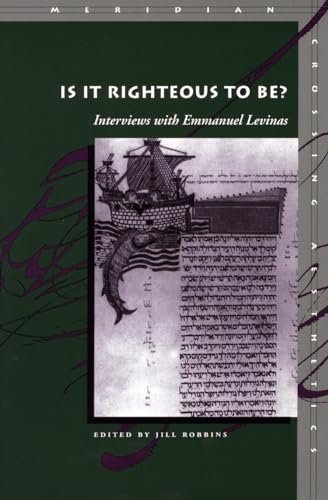
Synopsis
Recent debates within Continental philosophy have decisively renewed the question of the ethical, with the French philosopher Emmanuel Levinas (1905-1995) as its center. Coming from yet in contestation with the phenomenological traditions of Husserl and Heidegger, Levinas defines ethics as an originary response to the face of the other. For him, language is an exception to a habitual economy that represses alterity and maintains the asymmetry and distance constitutive of the nontotalizing relation to the other. Ethics occurs in the interlocutionary relation to the other, and interpellation--a kind of interruption by speaking--is the essential feature of ethical language.
Between 1982 and 1992, Levinas gave numerous interviews, closing a distinguished sixty-year career. Of the twenty interviews collected in this volume, seventeen appear in English for the first time. In the interviews Levinas sets forth the central features of his ethical philosophy, previously enunciated in Totality and Infinity (1961), in a language that bridges to the idiom of his later work. He underlines his dedication to the phenomenological search for the concrete and the nonformal signification of alterity. He also elaborates issues that do not receive extensive treatment in his formal philosophical works, including the question of prephilosophical experiences and the ethical signification of money, justice, and the State.
The informality of the interviews prompts Levinas to address matters about which he is reticent in his published works, notably the relation of his ethical philosophy to theological questions, the intrication of the Hebrew Bible in Greek philosophy, his substantial corpus of "nonphilosophical" or "confessional" writings on the Talmud, and recollections of his extraordinary talmudic teacher, Shoshani.
The centerpiece of the volume is a previously untranslated 1986 interview with François Poirié. Containing Levinas's sole extended discussion of biographical matters with an interviewer, this text helps to situate Levinas in his contemporary intellectual world and to clarify his place in French thought.
Les informations fournies dans la section « Synopsis » peuvent faire référence à une autre édition de ce titre.
À propos de l'auteur
Jill Robbins is Professor of Comparative Literature and English at the State University of New York, Buffalo
Les informations fournies dans la section « A propos du livre » peuvent faire référence à une autre édition de ce titre.
Résultats de recherche pour Is It Righteous to Be?: Interviews With Emmanuel Levinas

Image d'archives
Is It Righteous to Be? Interviews with Emmanuel Levinas
Edité par
Stanford University Press, 2002
ISBN 10 : 0804743088
ISBN 13 : 9780804743082
Ancien ou d'occasion
Couverture rigide
Vendeur : Midtown Scholar Bookstore, Harrisburg, PA, Etats-Unis
Évaluation du vendeur 5 sur 5 étoiles

Hardcover. Etat : Good. Good - Bumped and creased book with tears to the extremities, but not affecting the text block, may have remainder mark or previous owner's name - GOOD Standard-sized. N° de réf. du vendeur M0804743088Z3
Acheter D'occasion
EUR 66,65
Expédition à EUR 5,34
Expédition nationale : Etats-Unis
Expédition nationale : Etats-Unis
Quantité disponible : 2 disponible(s)
Image fournie par le vendeur
Is It Righteous to Be?: Interviews with Emmanuel Levinas
Edité par
STANFORD UNIV PR, 2002
ISBN 10 : 0804743088
ISBN 13 : 9780804743082
Neuf
Couverture rigide
Vendeur : moluna, Greven, Allemagne
Évaluation du vendeur 5 sur 5 étoiles
Gebunden. Etat : New. In the twenty interviews collected in this volume, seventeen of which appear in English for the first time, Levinas sets forth the central features of his ethical philosophy and discusses biographical matters not available elsewhere.Über den Au. N° de réf. du vendeur 595014692
Acheter neuf
EUR 155,15
Expédition à EUR 48,99
Expédition depuis Allemagne vers Etats-Unis
Expédition depuis Allemagne vers Etats-Unis
Quantité disponible : Plus de 20 disponibles
Image d'archives
Is It Righteous to Be? Interviews with Emmanuel Levinas
Edité par
Stanford Univ Pr, 2001
ISBN 10 : 0804743088
ISBN 13 : 9780804743082
Neuf
Couverture rigide
Vendeur : Revaluation Books, Exeter, Royaume-Uni
Évaluation du vendeur 5 sur 5 étoiles
Hardcover. Etat : Brand New. 1st edition. 307 pages. 9.00x6.00x1.00 inches. In Stock. N° de réf. du vendeur x-0804743088
Acheter neuf
EUR 213,36
Expédition à EUR 14,82
Expédition depuis Royaume-Uni vers Etats-Unis
Expédition depuis Royaume-Uni vers Etats-Unis
Quantité disponible : 2 disponible(s)
Image fournie par le vendeur
Is It Righteous to Be? : Interviews with Emmanuel Levinas
Edité par
Stanford University Press Nov 2002, 2002
ISBN 10 : 0804743088
ISBN 13 : 9780804743082
Neuf
Couverture rigide
Vendeur : AHA-BUCH GmbH, Einbeck, Allemagne
Évaluation du vendeur 5 sur 5 étoiles
Buch. Etat : Neu. Neuware - Recent debates within Continental philosophy have decisively renewed the question of the ethical, with the French philosopher Emmanuel Levinas (1905-1995) as its center. Coming from yet in contestation with the phenomenological traditions of Husserl and Heidegger, Levinas defines ethics as an originary response to the face of the other. For him, language is an exception to a habitual economy that represses alterity and maintains the asymmetry and distance constitutive of the nontotalizing relation to the other. Ethics occurs in the interlocutionary relation to the other, and interpellation-a kind of interruption by speaking-is the essential feature of ethical language. Between 1982 and 1992, Levinas gave numerous interviews, closing a distinguished sixty-year career. Of the twenty interviews collected in this volume, seventeen appear in English for the first time. In the interviews Levinas sets forth the central features of his ethical philosophy, previously enunciated in Totality and Infinity (1961), in a language that bridges to the idiom of his later work. He underlines his dedication to the phenomenological search for the concrete and the nonformal signification of alterity. He also elaborates issues that do not receive extensive treatment in his formal philosophical works, including the question of prephilosophical experiences and the ethical signification of money, justice, and the State. The informality of the interviews prompts Levinas to address matters about which he is reticent in his published works, notably the relation of his ethical philosophy to theological questions, the intrication of the Hebrew Bible in Greek philosophy, his substantial corpus of 'nonphilosophical' or 'confessional' writings on the Talmud, and recollections of his extraordinary talmudic teacher, Shoshani. The centerpiece of the volume is a previously untranslated 1986 interview with François Poirié. Containing Levinas's sole extended discussion of biographical matters with an interviewer, this text helps to situate Levinas in his contemporary intellectual world and to clarify his place in French thought. N° de réf. du vendeur 9780804743082
Acheter neuf
EUR 207,76
Expédition à EUR 35
Expédition depuis Allemagne vers Etats-Unis
Expédition depuis Allemagne vers Etats-Unis
Quantité disponible : 2 disponible(s)