
Articles liés à All Judges Are Political - Except When They Are Not:...
All Judges Are Political - Except When They Are Not: Acceptable Hypocrisies and the Rule of Law - Couverture souple
Livre 8 sur 19: The Cultural Lives of Law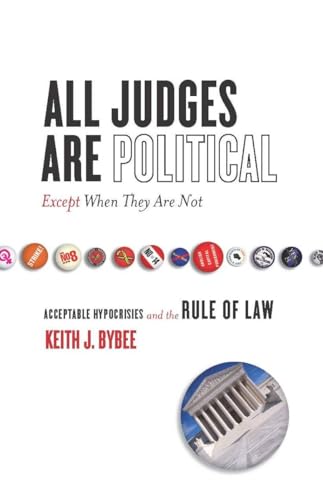
Synopsis
We live in an age where one person's judicial "activist" legislating from the bench is another's impartial arbiter fairly interpreting the law. After the Supreme Court ended the 2000 Presidential election with its decision in Bush v. Gore, many critics claimed that the justices had simply voted their political preferences. But Justice Clarence Thomas, among many others, disagreed and insisted that the Court had acted according to legal principle, stating: "I plead with you, that, whatever you do, don't try to apply the rules of the political world to this institution; they do not apply."
The legitimacy of our courts rests on their capacity to give broadly acceptable answers to controversial questions. Yet Americans are divided in their beliefs about whether our courts operate on unbiased legal principle or political interest. Comparing law to the practice of common courtesy, Keith Bybee explains how our courts not only survive under these suspicions of hypocrisy, but actually depend on them.
Law, like courtesy, furnishes a means of getting along. It frames disputes in collectively acceptable ways, and it is a habitual practice, drummed into the minds of citizens by popular culture and formal institutions. The rule of law, thus, is neither particularly fair nor free of paradoxical tensions, but it endures. Although pervasive public skepticism raises fears of judicial crisis and institutional collapse, such skepticism is also an expression of how our legal system ordinarily functions.
Les informations fournies dans la section « Synopsis » peuvent faire référence à une autre édition de ce titre.
À propos de l'auteur
Keith J. Bybee is Paul E. and the Hon. Joanne F. Alper '72 Judiciary Studies Professor at Syracuse University College of Law. He is the editor of Bench Press: The Collision of Courts, Politics, and the Media (Stanford University Press, 2007).
Les informations fournies dans la section « A propos du livre » peuvent faire référence à une autre édition de ce titre.
Résultats de recherche pour All Judges Are Political - Except When They Are Not:...

Image d'archives
All Judges Are Political - Except When They Are Not: Acceptable Hypocrisies and the Rule of Law (The Cultural Lives of Law)
Edité par
Stanford University Press, 2010
ISBN 10 : 0804753121
ISBN 13 : 9780804753128
Ancien ou d'occasion
Couverture souple
Vendeur : More Than Words, Waltham, MA, Etats-Unis
Évaluation du vendeur 5 sur 5 étoiles

Etat : Good. A sound copy with only light wear. Overall a solid copy at a great price! N° de réf. du vendeur BOS-D-06a-2170
Acheter D'occasion
EUR 1,31
Expédition à EUR 3,44
Expédition nationale : Etats-Unis
Expédition nationale : Etats-Unis
Quantité disponible : 1 disponible(s)
Image d'archives
All Judges Are Political - Except When They Are Not: Acceptable Hypocrisies and the Rule of Law (The Cultural Lives of Law)
Edité par
Stanford University Press, 2010
ISBN 10 : 0804753121
ISBN 13 : 9780804753128
Ancien ou d'occasion
paperback
Vendeur : Midtown Scholar Bookstore, Harrisburg, PA, Etats-Unis
Évaluation du vendeur 5 sur 5 étoiles
paperback. Etat : Very Good. Very Good - Crisp, clean, unread book with some shelfwear/edgewear, may have a remainder mark - NICE PAPERBACK Standard-sized. N° de réf. du vendeur M0804753121Z2
Acheter D'occasion
EUR 2,18
Expédition à EUR 5,18
Expédition nationale : Etats-Unis
Expédition nationale : Etats-Unis
Quantité disponible : 1 disponible(s)
Image d'archives
All Judges Are Political--Except When They Are Not: Acceptable Hypocrisies and the Rule of Law
Edité par
Stanford Law Books, 2010
ISBN 10 : 0804753121
ISBN 13 : 9780804753128
Ancien ou d'occasion
Paperback
Vendeur : ThriftBooks-Dallas, Dallas, TX, Etats-Unis
Évaluation du vendeur 5 sur 5 étoiles
Paperback. Etat : Very Good. No Jacket. May have limited writing in cover pages. Pages are unmarked. ~ ThriftBooks: Read More, Spend Less. N° de réf. du vendeur G0804753121I4N00
Acheter D'occasion
EUR 8,13
Livraison gratuite
Expédition nationale : Etats-Unis
Expédition nationale : Etats-Unis
Quantité disponible : 1 disponible(s)
Image d'archives
All Judges Are Political--Except When They Are Not: Acceptable Hypocrisies and the Rule of Law
Edité par
Stanford Law Books, 2010
ISBN 10 : 0804753121
ISBN 13 : 9780804753128
Ancien ou d'occasion
Paperback
Vendeur : ThriftBooks-Reno, Reno, NV, Etats-Unis
Évaluation du vendeur 5 sur 5 étoiles
Paperback. Etat : Very Good. No Jacket. May have limited writing in cover pages. Pages are unmarked. ~ ThriftBooks: Read More, Spend Less. N° de réf. du vendeur G0804753121I4N00
Acheter D'occasion
EUR 8,13
Livraison gratuite
Expédition nationale : Etats-Unis
Expédition nationale : Etats-Unis
Quantité disponible : 1 disponible(s)
Image d'archives
All Judges Are Political--Except When They Are Not: Acceptable Hypocrisies and the Rule of Law
Edité par
Stanford Law Books, 2010
ISBN 10 : 0804753121
ISBN 13 : 9780804753128
Ancien ou d'occasion
Paperback
Vendeur : ThriftBooks-Atlanta, AUSTELL, GA, Etats-Unis
Évaluation du vendeur 5 sur 5 étoiles
Paperback. Etat : Very Good. No Jacket. May have limited writing in cover pages. Pages are unmarked. ~ ThriftBooks: Read More, Spend Less. N° de réf. du vendeur G0804753121I4N00
Acheter D'occasion
EUR 8,13
Livraison gratuite
Expédition nationale : Etats-Unis
Expédition nationale : Etats-Unis
Quantité disponible : 1 disponible(s)
Image d'archives
All Judges Are Political--Except When They Are Not : Acceptable Hypocrisies and the Rule of Law
Edité par
Stanford University Press, 2010
ISBN 10 : 0804753121
ISBN 13 : 9780804753128
Ancien ou d'occasion
Couverture souple
Vendeur : Better World Books: West, Reno, NV, Etats-Unis
Évaluation du vendeur 5 sur 5 étoiles
Etat : Very Good. Pages intact with possible writing/highlighting. Binding strong with minor wear. Dust jackets/supplements may not be included. Stock photo provided. Product includes identifying sticker. Better World Books: Buy Books. Do Good. N° de réf. du vendeur 11496193-75
Acheter D'occasion
EUR 9,78
Livraison gratuite
Expédition nationale : Etats-Unis
Expédition nationale : Etats-Unis
Quantité disponible : 1 disponible(s)
Image d'archives
All Judges Are Political - Except When They Are Not: Acceptable Hypocrisies and the Rule of Law (The Cultural Lives of Law)
Edité par
Stanford University Press, 2010
ISBN 10 : 0804753121
ISBN 13 : 9780804753128
Ancien ou d'occasion
paperback
Vendeur : Midtown Scholar Bookstore, Harrisburg, PA, Etats-Unis
Évaluation du vendeur 5 sur 5 étoiles
paperback. Etat : Acceptable. Acceptable - This is a significantly damaged book. It should be considered a reading copy only. Please order this book only if you are interested in the content and not the condition. May be ex-library. PAPERBACK Standard-sized. N° de réf. du vendeur M0804753121Z4
Acheter D'occasion
EUR 7,27
Expédition à EUR 5,18
Expédition nationale : Etats-Unis
Expédition nationale : Etats-Unis
Quantité disponible : 1 disponible(s)
Image d'archives
All Judges Are Political - Except When They Are Not: Acceptable Hypocrisies and the Rule of Law (The Cultural Lives of Law)
Edité par
Stanford University Press, 2010
ISBN 10 : 0804753121
ISBN 13 : 9780804753128
Ancien ou d'occasion
paperback
Edition originale
Vendeur : Textbooks_Source, Columbia, MO, Etats-Unis
Évaluation du vendeur 5 sur 5 étoiles
paperback. Etat : Good. 1st Edition. Ships in a BOX from Central Missouri! May not include working access code. Will not include dust jacket. Has used sticker(s) and some writing or highlighting. UPS shipping for most packages, (Priority Mail for AK/HI/APO/PO Boxes). N° de réf. du vendeur 001320636U
Acheter D'occasion
EUR 10,45
Expédition à EUR 3,44
Expédition nationale : Etats-Unis
Expédition nationale : Etats-Unis
Quantité disponible : 5 disponible(s)
Image fournie par le vendeur
All Judges Are Political - Except When They Are Not : Acceptable Hypocrisies and the Rule of Law
Edité par
Stanford University Press, 2010
ISBN 10 : 0804753121
ISBN 13 : 9780804753128
Ancien ou d'occasion
Couverture souple
Vendeur : GreatBookPrices, Columbia, MD, Etats-Unis
Évaluation du vendeur 5 sur 5 étoiles
Etat : good. May show signs of wear, highlighting, writing, and previous use. This item may be a former library book with typical markings. No guarantee on products that contain supplements Your satisfaction is 100% guaranteed. Twenty-five year bookseller with shipments to over fifty million happy customers. N° de réf. du vendeur 9958086-5
Acheter D'occasion
EUR 11,64
Expédition à EUR 2,28
Expédition nationale : Etats-Unis
Expédition nationale : Etats-Unis
Quantité disponible : 5 disponible(s)
Image fournie par le vendeur
All Judges Are Political - Except When They Are Not
Edité par
Stanford University Press, 2010
ISBN 10 : 0804753121
ISBN 13 : 9780804753128
Ancien ou d'occasion
Couverture souple
Vendeur : eCampus, Lexington, KY, Etats-Unis
Évaluation du vendeur 4 sur 5 étoiles

Etat : Very Good. N° de réf. du vendeur U:9780804753128:ONHAND
Acheter D'occasion
EUR 15,48
Expédition à EUR 3,44
Expédition nationale : Etats-Unis
Expédition nationale : Etats-Unis
Quantité disponible : 1 disponible(s)