
Articles liés à Toward a Rational Society: Student Protest, Science,...
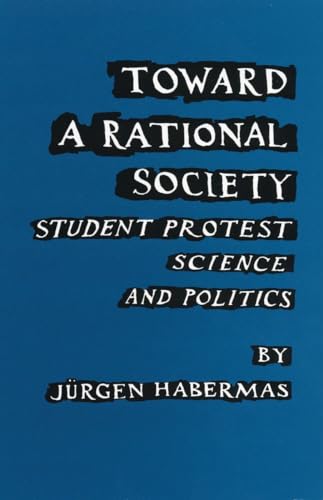
Synopsis
Knowledge, communication, action – These are the concepts central to all of Habermas's thought. As a philosopher, he is concerned with the rational connections of these concepts. As a sociologist, he is prepared to analyze with care the distortions of human interactions caused by existing social and political institutions.
In a series of connected essays, the author assesses the function of the contemporary university, and sharply analyzes contemporary students and their political efforts.
He then brilliantly analyzes as a communications model the relationships between research institutes and the political agencies which employ them. The book concludes with a complex discussion of technology and science as an "ideology," dedicated to Herbert Marcuse.
Critical parts of Marcuse's thought, Habermas dissects contemporary democratic dialogue and offers an important preliminary sketch of a general theory of social evolution.
He analyzes the difference between the technological sphere of control and the practical sphere of communication and interaction as the basic feature of human social life, and explains how and why the predominance of the technological sphere is the distinguishing and alienating characteristic of advanced industrial society. The concepts of depoliticization and the freeing of communication emerge as the crux of today's political situation.
Les informations fournies dans la section « Synopsis » peuvent faire référence à une autre édition de ce titre.
À propos de l'auteur
Jürgen Habermas (born June 18, 1929) is a German sociologist and philosopher in the tradition of critical theory and pragmatism.
Les informations fournies dans la section « A propos du livre » peuvent faire référence à une autre édition de ce titre.
Résultats de recherche pour Toward a Rational Society: Student Protest, Science,...

Image d'archives
Toward a Rational Society: Student Protest, Science, and Politics
Edité par
Beacon Press, 1971
ISBN 10 : 0807041777
ISBN 13 : 9780807041772
Ancien ou d'occasion
Paperback
Vendeur : Your Online Bookstore, Houston, TX, Etats-Unis
Évaluation du vendeur 5 sur 5 étoiles

Paperback. Etat : Fair. N° de réf. du vendeur 0807041777-4-24523586
Acheter D'occasion
EUR 4,06
Livraison gratuite
Expédition nationale : Etats-Unis
Expédition nationale : Etats-Unis
Quantité disponible : 1 disponible(s)
Image d'archives
Toward a Rational Society: Student Protest, Science, and Politics
Edité par
Beacon Press, 1971
ISBN 10 : 0807041777
ISBN 13 : 9780807041772
Ancien ou d'occasion
Paperback
Vendeur : World of Books (was SecondSale), Montgomery, IL, Etats-Unis
Évaluation du vendeur 5 sur 5 étoiles
Paperback. Etat : Good. Knowledge, communication, action - These are the concepts central to all of Habermas's thought. As a philosopher, he is concerned with the rational connections of these concepts. As a sociologist, he is prepared to analyze with care the distortions of human interactions caused by existing social and political institutions. In a series of connected essays, the author assesses the function of the contemporary university, and sharply analyzes contemporary students and their political efforts. He then brilliantly analyzes as a communications model the relationships between research institutes and the political agencies which employ them. The book concludes with a complex discussion of technology and science as an "ideology," dedicated to Herbert Marcuse. Critical parts of Marcuse's thought, Habermas dissects contemporary democratic dialogue and offers an important preliminary sketch of a general theory of social evolution. He analyzes the difference between the technological sphere of control and the practical sphere of communication and interaction as the basic feature of human social life, and explains how and why the predominance of the technological sphere is the distinguishing and alienating characteristic of advanced industrial society. The concepts of depoliticization and the freeing of communication emerge as the crux of today's political situation. N° de réf. du vendeur 00109005400
Acheter D'occasion
EUR 4,07
Livraison gratuite
Expédition nationale : Etats-Unis
Expédition nationale : Etats-Unis
Quantité disponible : 1 disponible(s)
Image d'archives
Toward a Rational Society: Student Protest, Science, and Politics
Edité par
Beacon Press, 1971
ISBN 10 : 0807041777
ISBN 13 : 9780807041772
Ancien ou d'occasion
Paperback
Vendeur : World of Books (was SecondSale), Montgomery, IL, Etats-Unis
Évaluation du vendeur 5 sur 5 étoiles
Paperback. Etat : Fair. Knowledge, communication, action - These are the concepts central to all of Habermas's thought. As a philosopher, he is concerned with the rational connections of these concepts. As a sociologist, he is prepared to analyze with care the distortions of human interactions caused by existing social and political institutions. In a series of connected essays, the author assesses the function of the contemporary university, and sharply analyzes contemporary students and their political efforts. He then brilliantly analyzes as a communications model the relationships between research institutes and the political agencies which employ them. The book concludes with a complex discussion of technology and science as an "ideology," dedicated to Herbert Marcuse. Critical parts of Marcuse's thought, Habermas dissects contemporary democratic dialogue and offers an important preliminary sketch of a general theory of social evolution. He analyzes the difference between the technological sphere of control and the practical sphere of communication and interaction as the basic feature of human social life, and explains how and why the predominance of the technological sphere is the distinguishing and alienating characteristic of advanced industrial society. The concepts of depoliticization and the freeing of communication emerge as the crux of today's political situation. N° de réf. du vendeur 00109067474
Acheter D'occasion
EUR 4,07
Livraison gratuite
Expédition nationale : Etats-Unis
Expédition nationale : Etats-Unis
Quantité disponible : 1 disponible(s)
Image fournie par le vendeur
Toward a Rational Society: Student Protest, Science, and Politics
Edité par
Beacon Press, 1971
ISBN 10 : 0807041777
ISBN 13 : 9780807041772
Ancien ou d'occasion
Couverture souple
Vendeur : Zoom Books East, Glendale Heights, IL, Etats-Unis
Évaluation du vendeur 5 sur 5 étoiles
Etat : good. Book is in good condition and may include underlining highlighting and minimal wear. The book can also include "From the library of" labels. May not contain miscellaneous items toys, dvds, etc. . We offer 100% money back guarantee and 24 7 customer service. N° de réf. du vendeur ZEV.0807041777.G
Acheter D'occasion
EUR 4,08
Livraison gratuite
Expédition nationale : Etats-Unis
Expédition nationale : Etats-Unis
Quantité disponible : 1 disponible(s)
Image d'archives
Toward a Rational Society: Student Protest, Science, and Politics
Edité par
Beacon Press, 1971
ISBN 10 : 0807041777
ISBN 13 : 9780807041772
Ancien ou d'occasion
Paperback
Vendeur : World of Books Inc, Montgomery, IL, Etats-Unis
Évaluation du vendeur 4 sur 5 étoiles

Paperback. Etat : Good. Knowledge, communication, action - These are the concepts central to all of Habermas's thought. As a philosopher, he is concerned with the rational connections of these concepts. As a sociologist, he is prepared to analyze with care the distortions of human interactions caused by existing social and political institutions. In a series of connected essays, the author assesses the function of the contemporary university, and sharply analyzes contemporary students and their political efforts. He then brilliantly analyzes as a communications model the relationships between research institutes and the political agencies which employ them. The book concludes with a complex discussion of technology and science as an "ideology," dedicated to Herbert Marcuse. Critical parts of Marcuse's thought, Habermas dissects contemporary democratic dialogue and offers an important preliminary sketch of a general theory of social evolution. He analyzes the difference between the technological sphere of control and the practical sphere of communication and interaction as the basic feature of human social life, and explains how and why the predominance of the technological sphere is the distinguishing and alienating characteristic of advanced industrial society. The concepts of depoliticization and the freeing of communication emerge as the crux of today's political situation. N° de réf. du vendeur CIN0807041777G
Acheter D'occasion
EUR 5,92
Livraison gratuite
Expédition nationale : Etats-Unis
Expédition nationale : Etats-Unis
Quantité disponible : 1 disponible(s)
Image d'archives
Toward a Rational Society: Student Protest, Science, and Politics
Edité par
Beacon Press, 1971
ISBN 10 : 0807041777
ISBN 13 : 9780807041772
Ancien ou d'occasion
Paperback
Vendeur : World of Books Inc, Montgomery, IL, Etats-Unis
Évaluation du vendeur 4 sur 5 étoiles
Paperback. Etat : Fair. Knowledge, communication, action - These are the concepts central to all of Habermas's thought. As a philosopher, he is concerned with the rational connections of these concepts. As a sociologist, he is prepared to analyze with care the distortions of human interactions caused by existing social and political institutions. In a series of connected essays, the author assesses the function of the contemporary university, and sharply analyzes contemporary students and their political efforts. He then brilliantly analyzes as a communications model the relationships between research institutes and the political agencies which employ them. The book concludes with a complex discussion of technology and science as an "ideology," dedicated to Herbert Marcuse. Critical parts of Marcuse's thought, Habermas dissects contemporary democratic dialogue and offers an important preliminary sketch of a general theory of social evolution. He analyzes the difference between the technological sphere of control and the practical sphere of communication and interaction as the basic feature of human social life, and explains how and why the predominance of the technological sphere is the distinguishing and alienating characteristic of advanced industrial society. The concepts of depoliticization and the freeing of communication emerge as the crux of today's political situation. N° de réf. du vendeur CIN0807041777A
Acheter D'occasion
EUR 5,92
Livraison gratuite
Expédition nationale : Etats-Unis
Expédition nationale : Etats-Unis
Quantité disponible : 1 disponible(s)
Image d'archives
Toward a Rational Society: Student Protest, Science, and Politics
Edité par
Beacon Press, 1971
ISBN 10 : 0807041777
ISBN 13 : 9780807041772
Ancien ou d'occasion
Paperback
Vendeur : ThriftBooks-Dallas, Dallas, TX, Etats-Unis
Évaluation du vendeur 5 sur 5 étoiles
Paperback. Etat : Good. No Jacket. Pages can have notes/highlighting. Spine may show signs of wear. ~ ThriftBooks: Read More, Spend Less. N° de réf. du vendeur G0807041777I3N00
Acheter D'occasion
EUR 6
Livraison gratuite
Expédition nationale : Etats-Unis
Expédition nationale : Etats-Unis
Quantité disponible : 1 disponible(s)
Image d'archives
Toward a Rational Society: Student Protest, Science, and Politics
Edité par
Beacon Press, 1971
ISBN 10 : 0807041777
ISBN 13 : 9780807041772
Ancien ou d'occasion
Paperback
Vendeur : ThriftBooks-Atlanta, AUSTELL, GA, Etats-Unis
Évaluation du vendeur 5 sur 5 étoiles
Paperback. Etat : Fair. No Jacket. Readable copy. Pages may have considerable notes/highlighting. ~ ThriftBooks: Read More, Spend Less. N° de réf. du vendeur G0807041777I5N00
Acheter D'occasion
EUR 6
Livraison gratuite
Expédition nationale : Etats-Unis
Expédition nationale : Etats-Unis
Quantité disponible : 1 disponible(s)
Image d'archives
Toward a Rational Society: Student Protest, Science, and Politics
Edité par
Beacon Press, 1971
ISBN 10 : 0807041777
ISBN 13 : 9780807041772
Ancien ou d'occasion
Paperback
Vendeur : ThriftBooks-Reno, Reno, NV, Etats-Unis
Évaluation du vendeur 5 sur 5 étoiles
Paperback. Etat : Good. No Jacket. Pages can have notes/highlighting. Spine may show signs of wear. ~ ThriftBooks: Read More, Spend Less. N° de réf. du vendeur G0807041777I3N00
Acheter D'occasion
EUR 6
Livraison gratuite
Expédition nationale : Etats-Unis
Expédition nationale : Etats-Unis
Quantité disponible : 1 disponible(s)