
Articles liés à The Long Walk to Freedom: Runaway Slave Narratives
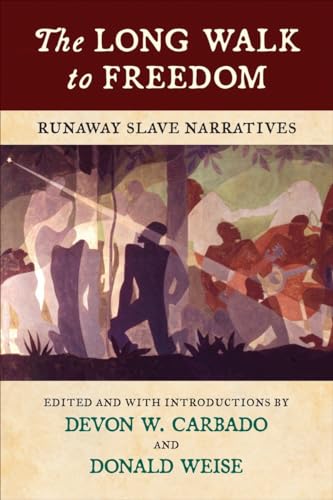
Synopsis
Book by None
Les informations fournies dans la section « Synopsis » peuvent faire référence à une autre édition de ce titre.
Extrait
From the Introduction: “I Will Run Away”
“God, deliver me! Let me be free! Is there any God? Why am I a slave?
I will run away. I will not stand it. Get caught, or get clear,
I’ll try it. I had as well die with ague as the fever. I have only one life to lose. I had as well be killed running as die standing.”
—Frederick Douglass, Narrative of the Life of Frederick Douglass
A decade ago, John Hope Franklin and Loren Schweninger published Runaway Slaves: Rebels on the Plantation. The book was part of a much broader literature that challenged the idea that slaves were generally pliant and resigned to their roles as human chattel. While W. E. B. Du Bois, in Black Reconstruction in America, had argued vociferously against the idea of slaves as docile and pliant, Franklin and Schweninger’s book, among other works, helped to solidify the idea. Far from passively acquiescing to what was euphemistically referred to as “the South’s peculiar institution,” slaves rebelled against their masters and ran away whenever they could. That they risked life and limb to do so was itself an indication of the brutality of slavery.
Runaway Slaves was successful—both in commercial terms and with respect to the critical acclaim the book received. But despite its success, since then only a few texts focusing solely on runaway slaves have been published. To be sure, dozens of books of slave narratives are already on the market; the autobiographies of Frederick Douglass and Sojourner Truth, for example, can be found readily. Indeed, slave narratives remain one of the most enduring genres of African American literature.
The Long Walk to Freedom contains the first-ever collection of fugitive slave narratives, presented as a unique genre, not simply as slave narratives more generally. The twelve narratives collectively span approximately seventy-six years. Excerpts from the best-known booklength narratives—including those by Douglass, Nat Turner, Harriet Jacobs, William and Ellen Craft—stand alongside narratives that haven’t been published in more than a hundred years.
Although most slave narratives were written or recorded after Abolition, the most widely read—even today—are antebellum fugitive accounts. Unlike the narratives of ex-slaves who had purchased their freedom prior to the Civil War or were emancipated afterward, fugitives’ stories offer dramatic exploits that overcome staid polemics. Here, one finds patrols of slave catchers and their hounds in relentless pursuit of runaways, wild animals on the attack, intrigue on the Underground Railroad, slaves dangerously masquerading as freed people—sometimes disguised as the opposite sex—in order to pass. The runaway narrative of William Craft, for example, describes how he and his wife, neither of whom was literate, employed public transportation to make their way from Georgia to Pennsylvania. To do so, Ellen Craft disguised herself as a white man traveling with her slave companion.
One finds in these narratives romantic elements as well—slaves running hundreds, if not thousands, of miles to be reunited at all costs with a loved one—that help establish emotional connections between the author and reader, much as if one were reading a novel.
But these are not works of fiction. Cumulatively, these narratives are a useful window on a specific form of black resistance to slavery. The existence of these narratives makes clear that the limited number of large-scale slave revolts does not mean that slaves acquiesced in or were content with their status as slaves. Far from being passive objects of property, slaves resisted—often in incremental and pragmatic ways.
For example, Isaac D. Williams’s story conveys the strong, rebellious, and persistent spirit that many slaves possessed in order to run away. In his flight north, Williams was initially pursued by bloodhounds, which he was able to kill. But he was eventually caught and shot, his body riddled with bullets. Nevertheless, Williams survived, managed to escape jail, and fled north again, continuing to defy the dangers of nature and the numerous police and slave owners he encountered along the way.
Slaves ran away for various reasons, among them brutal treatment; confrontations with an owner or overseer; the opportunity to escape; the fear of being sold or transferred, particularly away from one’s family; and the fundamental desire to be free. Moses Roper’s narrative documents the severe floggings he received from several different slave owners, five hundred lashes at the worst. His repeated attempts to escape, at the risk of again being flogged, no doubt were spurred by these acts of violence, which over time quite literally broke slaves down. “My natural elasticity was crushed,” wrote Frederick Douglass in his narrative on the impact of being repeatedly beaten. “[M]y intellect languished, the disposition to read departed . . . the dark night of slavery closed in upon me; and behold a man transformed into a brute!”
According to most historians, “the dark night of slavery” traces back to the first African people brought to British America in August 1619 and sold to English colonizers in Jamestown, Virginia. Some of the relatively small number of Africans in the colonies during this period likely worked as indentured servants side-by-side with white indentured servants who had fled the economic hardships of Europe. Others worked as slaves. As slaves did, white indentured servants often ran away and were punished harshly upon return. Thus, it was not uncommon to see advertisements in local newspapers for both black and white fugitives. For example, the September 26, 1751, edition of the Pennsylvania Journal sought the return of “an Irish Servant Man, Named Christopher Cooney, of Short Stature, pale Complexion, short brown Hair.” But because whiteness carried with it the presumption of freedom and blackness the presumption of slavery, indentured whites had an easier time escaping their servitude than did blacks.
In 1775, on the eve of the Revolutionary War, slavery in the thirteen Colonies was more than 150 years old and had become part of the legal and racial caste system. But the revolutionary fervor of the time made the institution of slavery more vulnerable than it had ever been. The ideals of the colonists—freedom from English oppression, and selfdetermination—were at least somewhat, if not thoroughly, inconsistent with the idea of slavery.
Other factors also helped to delegitimize the institution. One was economic: the tobacco market had crashed, and the wheat crops that replaced tobacco did not require the same kind of labor-intensive work, reducing the demand for slave workers. Compounding matters was a general recession, which found many slave owners unable to feed and support their unpaid labor force.
Religion also generated abolitionist ideas. The Great Awakening— a movement that reinvigorated Christianity by encouraging an emotional engagement with religion, a sense of personal spiritual commitment, and feelings of guilt for one’s moral transgressions— particularly motivated Baptists and Methodists to save the souls of black folks.
Moreover, Lord Dunmore, the dethroned governor of Virginia, to cite one example, “issued a proclamation of freedom to all slaves who would fight for the king.” This invitation also undermined slavery, and many slaves ran away in search of that promised freedom.
Finally, the Revolutionary War itself weakened the institution of slavery by creating runaway opportunities through general upheaval (for example, slave masters fled war-torn territories along with their slaves) and because the significant number of white men who left their plantations to join the Patriot Army created an absence that the slaves could and did exploit. More than twenty thousand slaves, many runaways, ended up under the authority of the British military during this time.
Even for the blacks who remained in slavery during the Revolutionary War period, change seemed to be on the way. Because the war had further diminished the already dwindling tobacco economy, reducing the demand for slave labor, slaves had greater freedom to pursue more skilled occupations. Indeed, slave owners permitted their more trusted slaves to lease themselves out to other owners. This transaction was risky for both the slave owner and the slave. The owner never knew whether his “property” would be returned “intact,” and the slave never knew the conditions under which he (and it was mostly men who could lease themselves out) could be forced to work in a new setting. Nevertheless, the practice of leasing enabled slaves to visit relatives and friends, and to forge relationships with whites outside of the plantation economy. Leasing also provided a means by which slaves could run away. It is unclear how many slaves exploited that limited opportunity, though, since free blacks could still be captured and re-enslaved, as Robert the Hermit’s runaway narrative attests. Robert Voorhis persuaded “a friend” to pay his master 50 pounds for his freedom. Voorhis rejoiced in the promise of his future when the payment occurred, but then quickly learned that his status as a slave would not be shed so easily. His friend, James Bevens or Bivens, sold him into the Southern market, and Voorhis was taken onto a schooner and chained there. He was subsequently sold at a public auction in South Carolina.
Still, other anti-slavery currents flowed from the federal government. The Continental Congress passed a resolution opposing slavery as well as the Northwest Ordinance, which prohibited slavery in what is today Indiana, Illinois, Michigan, Wisconsin, and parts of Minnesota. There was reason to be at l...
Présentation de l'éditeur
In this groundbreaking compilation of first-person accounts of the runaway slave phenomenon, editors Devon W. Carbado and Donald Weise have recovered twelve narratives spanning eight decades—more than half of which have been long out of print. Told in the voices of the runaway slaves themselves, these narratives reveal the extraordinary and often innovative ways that these men and women sought freedom and demanded citizenship. Also included is an essay by UCLA history professor Brenda Stevenson that contextualizes these narratives, providing a brief yet comprehensive history of slavery, as well as a look into the daily life of a slave. Divided into four categories—running away for family, running inspired by religion, running by any means necessary, and running to be free—these stories are a testament to the indelible spirit of these remarkable survivors.
The Long Walk to Freedom presents excerpts from the narratives of well-known runaway slaves, like Frederick Douglass and Harriet Jacobs, as well as from the narratives of lesser-known and virtually unknown people. Several of these excerpts have not been published for more than a hundred years. But they all portray the courageous and sometimes shocking ways that these men and women sought their freedom and asserted power, often challenging many of the common assumptions about slaves’ lack of agency.
Among the remarkable and inspiring stories is the tense but triumphant tale of Henry Box Brown, who, with a white abolitionist’s help, shipped himself in a box—over a twenty-seven-hour train ride, part of which he spent standing on his head—to freedom in Philadelphia. And there’s the story of William and Ellen Craft, who fled across thousands of miles, with Ellen, who was light-skinned, disguised as a white male slave-owner so she and her husband could achieve their dream of raising their children as free people.
Gripping, inspiring, and captivating, The Long Walk to Freedom is a remarkable collection that celebrates those who risked their lives in pursuit of basic human rights.
Les informations fournies dans la section « A propos du livre » peuvent faire référence à une autre édition de ce titre.
Résultats de recherche pour The Long Walk to Freedom: Runaway Slave Narratives

Image d'archives
The Long Walk to Freedom: Runaway Slave Narratives
Edité par
Beacon Press, 2012
ISBN 10 : 0807069124
ISBN 13 : 9780807069127
Ancien ou d'occasion
Couverture rigide
Vendeur : World of Books (was SecondSale), Montgomery, IL, Etats-Unis
Évaluation du vendeur 5 sur 5 étoiles

Etat : Good. Good condition ex-library book with usual library markings and stickers. N° de réf. du vendeur 00102769482
Acheter D'occasion
EUR 4,57
Livraison gratuite
Expédition nationale : Etats-Unis
Expédition nationale : Etats-Unis
Quantité disponible : 1 disponible(s)
Image d'archives
The Long Walk to Freedom: Runaway Slave Narratives
Edité par
Beacon Press, 2012
ISBN 10 : 0807069124
ISBN 13 : 9780807069127
Ancien ou d'occasion
Couverture rigide
Vendeur : World of Books (was SecondSale), Montgomery, IL, Etats-Unis
Évaluation du vendeur 5 sur 5 étoiles
Etat : Very Good. Item in very good condition! Textbooks may not include supplemental items i.e. CDs, access codes etc. N° de réf. du vendeur 00105763837
Acheter D'occasion
EUR 4,57
Livraison gratuite
Expédition nationale : Etats-Unis
Expédition nationale : Etats-Unis
Quantité disponible : 1 disponible(s)
Image d'archives
The Long Walk to Freedom : Runaway Slave Narratives
Edité par
Beacon Press, 2012
ISBN 10 : 0807069124
ISBN 13 : 9780807069127
Ancien ou d'occasion
Couverture rigide
Vendeur : Better World Books, Mishawaka, IN, Etats-Unis
Évaluation du vendeur 5 sur 5 étoiles
Etat : Good. Former library copy. Pages intact with minimal writing/highlighting. The binding may be loose and creased. Dust jackets/supplements are not included. Includes library markings. Stock photo provided. Product includes identifying sticker. Better World Books: Buy Books. Do Good. N° de réf. du vendeur 4954655-6
Acheter D'occasion
EUR 6,33
Livraison gratuite
Expédition nationale : Etats-Unis
Expédition nationale : Etats-Unis
Quantité disponible : 1 disponible(s)
Image d'archives
The Long Walk to Freedom : Runaway Slave Narratives
Edité par
Beacon Press, 2012
ISBN 10 : 0807069124
ISBN 13 : 9780807069127
Ancien ou d'occasion
Couverture rigide
Vendeur : Better World Books, Mishawaka, IN, Etats-Unis
Évaluation du vendeur 5 sur 5 étoiles
Etat : Good. Pages intact with minimal writing/highlighting. The binding may be loose and creased. Dust jackets/supplements are not included. Stock photo provided. Product includes identifying sticker. Better World Books: Buy Books. Do Good. N° de réf. du vendeur 949925-6
Acheter D'occasion
EUR 6,33
Livraison gratuite
Expédition nationale : Etats-Unis
Expédition nationale : Etats-Unis
Quantité disponible : 1 disponible(s)
Image d'archives
The Long Walk to Freedom: Runaway Slave Narratives
Edité par
Beacon Press, 2012
ISBN 10 : 0807069124
ISBN 13 : 9780807069127
Ancien ou d'occasion
Couverture rigide
Vendeur : World of Books Inc, Montgomery, IL, Etats-Unis
Évaluation du vendeur 4 sur 5 étoiles

Hardback. Etat : Very Good. In this groundbreaking compilation of first-person accounts of the runaway slave phenomenon, editors Devon W. Carbado and Donald Weise have recovered twelve narratives spanning eight decades--more than half of which have been long out of print. Told in the voices of the runaway slaves themselves, these narratives reveal the extraordinary and often innovative ways that these men and women sought freedom and demanded citizenship. Also included is an essay by UCLA history professor Brenda Stevenson that contextualizes these narratives, providing a brief yet comprehensive history of slavery, as well as a look into the daily life of a slave. Divided into four categories--running away for family, running inspired by religion, running by any means necessary, and running to be free--these stories are a testament to the indelible spirit of these remarkable survivors. The Long Walk to Freedom presents excerpts from the narratives of well-known runaway slaves, like Frederick Douglass and Harriet Jacobs, as well as from the narratives of lesser-known and virtually unknown people. Several of these excerpts have not been published for more than a hundred years. But they all portray the courageous and sometimes shocking ways that these men and women sought their freedom and asserted power, often challenging many of the common assumptions about slaves' lack of agency. Among the remarkable and inspiring stories is the tense but triumphant tale of Henry Box Brown, who, with a white abolitionist's help, shipped himself in a box--over a twenty-seven-hour train ride, part of which he spent standing on his head--to freedom in Philadelphia. And there's the story of William and Ellen Craft, who fled across thousands of miles, with Ellen, who was light-skinned, disguised as a white male slave-owner so she and her husband could achieve their dream of raising their children as free people. Gripping, inspiring, and captivating, The Long Walk to Freedom is a remarkable collection that celebrates those who risked their lives in pursuit of basic human rights. N° de réf. du vendeur CIN0807069124VG
Acheter D'occasion
EUR 6,40
Livraison gratuite
Expédition nationale : Etats-Unis
Expédition nationale : Etats-Unis
Quantité disponible : 1 disponible(s)
Image d'archives
The Long Walk to Freedom: Runaway Slave Narratives
Edité par
Beacon Press, 2012
ISBN 10 : 0807069124
ISBN 13 : 9780807069127
Ancien ou d'occasion
Couverture rigide
Vendeur : World of Books Inc, Montgomery, IL, Etats-Unis
Évaluation du vendeur 4 sur 5 étoiles
Hardback. Etat : Good. In this groundbreaking compilation of first-person accounts of the runaway slave phenomenon, editors Devon W. Carbado and Donald Weise have recovered twelve narratives spanning eight decades--more than half of which have been long out of print. Told in the voices of the runaway slaves themselves, these narratives reveal the extraordinary and often innovative ways that these men and women sought freedom and demanded citizenship. Also included is an essay by UCLA history professor Brenda Stevenson that contextualizes these narratives, providing a brief yet comprehensive history of slavery, as well as a look into the daily life of a slave. Divided into four categories--running away for family, running inspired by religion, running by any means necessary, and running to be free--these stories are a testament to the indelible spirit of these remarkable survivors. The Long Walk to Freedom presents excerpts from the narratives of well-known runaway slaves, like Frederick Douglass and Harriet Jacobs, as well as from the narratives of lesser-known and virtually unknown people. Several of these excerpts have not been published for more than a hundred years. But they all portray the courageous and sometimes shocking ways that these men and women sought their freedom and asserted power, often challenging many of the common assumptions about slaves' lack of agency. Among the remarkable and inspiring stories is the tense but triumphant tale of Henry Box Brown, who, with a white abolitionist's help, shipped himself in a box--over a twenty-seven-hour train ride, part of which he spent standing on his head--to freedom in Philadelphia. And there's the story of William and Ellen Craft, who fled across thousands of miles, with Ellen, who was light-skinned, disguised as a white male slave-owner so she and her husband could achieve their dream of raising their children as free people. Gripping, inspiring, and captivating, The Long Walk to Freedom is a remarkable collection that celebrates those who risked their lives in pursuit of basic human rights. N° de réf. du vendeur CIN0807069124G
Acheter D'occasion
EUR 6,40
Livraison gratuite
Expédition nationale : Etats-Unis
Expédition nationale : Etats-Unis
Quantité disponible : 1 disponible(s)
Image d'archives
The Long Walk to Freedom: Runaway Slave Narratives
Edité par
Beacon Press, 2012
ISBN 10 : 0807069124
ISBN 13 : 9780807069127
Ancien ou d'occasion
Couverture rigide
Vendeur : ThriftBooks-Atlanta, AUSTELL, GA, Etats-Unis
Évaluation du vendeur 5 sur 5 étoiles
Hardcover. Etat : Very Good. No Jacket. May have limited writing in cover pages. Pages are unmarked. ~ ThriftBooks: Read More, Spend Less. N° de réf. du vendeur G0807069124I4N00
Acheter D'occasion
EUR 6,79
Livraison gratuite
Expédition nationale : Etats-Unis
Expédition nationale : Etats-Unis
Quantité disponible : 1 disponible(s)
Image d'archives
The Long Walk to Freedom: Runaway Slave Narratives
Edité par
Beacon Press, 2012
ISBN 10 : 0807069124
ISBN 13 : 9780807069127
Ancien ou d'occasion
Couverture rigide
Vendeur : ThriftBooks-Dallas, Dallas, TX, Etats-Unis
Évaluation du vendeur 5 sur 5 étoiles
Hardcover. Etat : Very Good. No Jacket. May have limited writing in cover pages. Pages are unmarked. ~ ThriftBooks: Read More, Spend Less. N° de réf. du vendeur G0807069124I4N00
Acheter D'occasion
EUR 6,79
Livraison gratuite
Expédition nationale : Etats-Unis
Expédition nationale : Etats-Unis
Quantité disponible : 1 disponible(s)
Image d'archives
The Long Walk to Freedom: Runaway Slave Narratives
Edité par
Beacon Press, 2012
ISBN 10 : 0807069124
ISBN 13 : 9780807069127
Ancien ou d'occasion
Couverture rigide
Vendeur : ThriftBooks-Atlanta, AUSTELL, GA, Etats-Unis
Évaluation du vendeur 5 sur 5 étoiles
Hardcover. Etat : Very Good. No Jacket. Former library book; May have limited writing in cover pages. Pages are unmarked. ~ ThriftBooks: Read More, Spend Less. N° de réf. du vendeur G0807069124I4N10
Acheter D'occasion
EUR 6,79
Livraison gratuite
Expédition nationale : Etats-Unis
Expédition nationale : Etats-Unis
Quantité disponible : 1 disponible(s)
Image d'archives
The Long Walk to Freedom: Runaway Slave Narratives
Edité par
Beacon Press, 2012
ISBN 10 : 0807069124
ISBN 13 : 9780807069127
Ancien ou d'occasion
Couverture rigide
Vendeur : Books From California, Simi Valley, CA, Etats-Unis
Évaluation du vendeur 4 sur 5 étoiles
hardcover. Etat : Very Good. N° de réf. du vendeur mon0003527448
Acheter D'occasion
EUR 3,65
Expédition à EUR 4,43
Expédition nationale : Etats-Unis
Expédition nationale : Etats-Unis
Quantité disponible : 1 disponible(s)